
Richard Stevenson: Three Prior DUIs and a Fatal Fox River BUI
Richard Stevenson's three prior DUIs and multiple reckless driving convictions did not prevent the fatal Fox River boat crash. This article examines the gaps in Illinois's graduated DUI/BUI penalty framework that allowed a documented repeat offender to cause a death while boating under the influence.
- Jurisdiction
- Illinois, United States
- Court
- McHenry County Circuit Court
- Judge
- Robert S. Lamb
- AI tool named
- None
- Ruling date
- Jul 27, 2026
- Source document
- View primary court order ↗
- Last verified
- Jul 29, 2026
Lex Machina Review is an independent risk-tracking and reference resource. Nothing on this site is legal advice, and using it does not create an attorney-client relationship. Every record is reviewed against primary sources but may not reflect the most current status of a matter — always verify directly against the cited court order, rule text, or a licensed attorney before relying on it.
Companion explanation — secondary to the source document above
The Richard Stevenson Fox River boat crash DUI charges now sit in the uncomfortable space between an old warning record and a new fatality. Prosecutors allege that Stevenson, a Lisle man with reported prior DUI history and later dangerous-driving indicators, was operating a 30- or 31-foot triple-engine pontoon at extreme speed on the Fox River when it struck another vessel on July 25, 2026, killing Magdalena Jablonska. The case is pretrial as of July 29, 2026; the charges remain allegations, no public docket number has been located in the available reports, and the next reported court date is August 5, 2026.[1]
The legal question is not simply whether Illinois has serious penalties for boating under the influence. It does. The harder question is why a record that prosecutors described as a long-running danger signal did not translate into an earlier practical barrier to operating a high-powered boat.

The minimum crash account is grim enough. Jablonska died after the collision on the Fox River near McHenry. Stevenson was charged with two counts of aggravated DUI causing death and one count of reckless homicide, according to local reports. At a July 27 detention hearing, Judge Robert S. Lamb denied pretrial release after finding Stevenson posed a “real and present threat” under Illinois’s detention framework.[1][2]
That ruling matters because it is an early formal legal moment in which the old record, the alleged conduct on the water, and the immediate public-safety risk were forced into one frame. Prosecutor Brian Miller called Stevenson “a ticking time bomb that tragically went off.” The phrase is emotionally easy and legally dangerous: it can make the fatal crash sound inevitable. The useful question is narrower. Who had notice of what, and what tools actually existed before the crash?
The Record Was Serious, but Not Simple
The reported history should be separated carefully. ABC7 reported three DUI arrests between 1997 and 2005, four misdemeanor speeding offenses, three reckless-driving convictions or dispositions, a fleeing-and-eluding charge, a 2023 speeding violation for 26 to 34 mph over the limit, and a 2022 Florida careless-boating citation.[1] FOX32 likewise reported a prior history including DUI, reckless-driving, speeding, and fleeing or eluding police as prosecutors argued against release.[2]
Those facts do not all carry the same legal weight. An arrest is not a conviction. Court supervision is not the same thing as a conviction. A careless-boating citation is not a homicide predicate. And the reported DUI count itself is not fully settled in the public accounts: ABC News cited court records showing two DUI convictions, while other reports refer to three DUI arrests.[3]
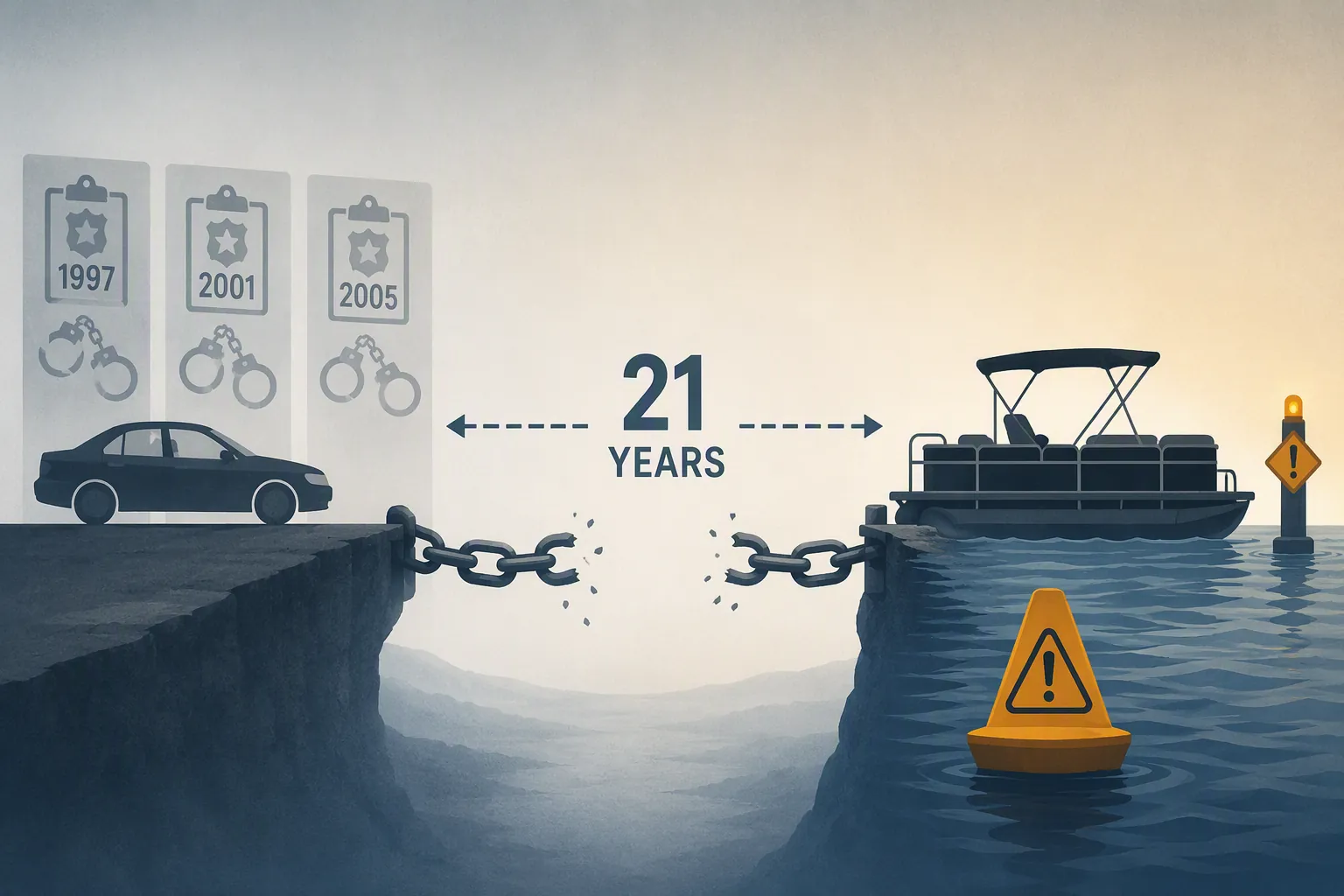
The 21-year gap since the last reported DUI arrest is not a footnote. It disrupts the easiest version of the story, the one in which Illinois simply ignored a fresh string of intoxicated-driving cases until a death occurred. The available record instead shows older DUI history combined with later reckless-driving, speeding, fleeing or eluding, and boating-carelessness signals. That mix may look like one continuous risk pattern to a prosecutor at a detention hearing. It may look more fragmented to a licensing system built around offense categories, dates, convictions, and specific operating privileges.
What Prosecutors Say Happened on the Water
The alleged conduct on July 25 is what turned a historical record into a present detention issue. Reports from the hearing say Stevenson was operating a triple-engine pontoon in a no-wake zone at a speed described as about 80 mph. Prosecutors said passengers warned him to slow down before the crash, and witnesses described him as visibly impaired on the dock.[2][4]
The alcohol evidence is severe, but the numbers should not be flattened. CBS Chicago reported hospital toxicology at 0.236, while WIFR reported that prosecutors estimated Stevenson’s blood-alcohol concentration at roughly 0.20 at the time of collision. The difference appears to reflect the distinction between a later hospital draw and an estimated collision-time calculation, not two cleanly competing facts. Both reported figures are far above the 0.08 limit that Illinois applies to operating a watercraft under the influence.[4][5][6]
Refusal evidence also matters for the enforcement story. Reports say Stevenson refused field sobriety testing, refused a breath test, and initially refused a court-ordered blood draw.[5][7] Refusal does not prove guilt. It does, however, show why implied-consent rules exist: the state cannot make boating-under-the-influence enforcement depend entirely on voluntary cooperation after a fatal crash.
Illinois Punishes BUI Deaths, but Punishment Afterward Is Not Prevention
Illinois law prohibits operating a watercraft while under the influence and uses a 0.08 blood-alcohol threshold for watercraft operation. The same statutory section also contains implied-consent consequences: a refusal can trigger a two-year suspension of watercraft operating privileges, independent of the criminal case.[6]
For a death case, the penalties become much more serious. The reported charges include aggravated DUI causing death, a Class 2 felony carrying a 3-to-14-year sentencing range in the cited reports and Illinois DUI-law references.[1][8] Illinois’s motor-vehicle DUI framework also escalates repeat DUI conduct; a third DUI can be charged as a Class 2 felony with a 3-to-7-year range under the cited DUI-law summary.[8]
That framework answers the punishment question better than the access question. If the old DUI matters were resolved decades earlier, and if later entries were speeding, reckless driving, fleeing or eluding, and a Florida careless-boating citation, the administrative system may not have had a clean current mechanism that treated Stevenson as disqualified from vessel operation before July 25. The public record provided in the reports does not establish that Illinois had an active boating suspension in place and ignored it.
| Reported fact | Why it matters legally |
|---|---|
| Three DUI arrests reported between 1997 and 2005 | Signals prior intoxicated-driving enforcement, but arrests alone are not convictions |
| ABC News reported two DUI convictions | Creates an unresolved discrepancy with the broader “three DUI” shorthand |
| Three reckless-driving convictions or dispositions reported | Shows later dangerous-driving history, but not necessarily BUI-specific escalation |
| 2023 speeding violation reported at 26 to 34 mph over the limit | Strengthens a pattern of speed-related risk close in time to the crash |
| 2022 Florida careless-boating citation | Connects the risk pattern to vessel operation, though not as a proven Illinois BUI |
| Refusal of sobriety, breath, and initially blood testing | Triggers the enforcement rationale behind implied-consent vessel sanctions |
The Detention Ruling Turned History Into Present Risk
At the July 27 hearing, Judge Lamb did not have to decide guilt. He had to decide whether Stevenson should be released before trial. FOX32 reported that the judge denied release under the “real and present threat” standard, citing the alleged no-wake-zone speed, ignored passenger warnings, observable impairment, and prior criminal history.[2]
That is a different legal exercise from sentencing enhancement. The detention question is forward-looking: what risk exists now if this person is released? The prior record becomes relevant not because every old entry predicts a new offense, but because the court can place it beside the present allegations. In this case, the reported allegations were not merely that Stevenson had been drinking. They were that he was operating a large triple-engine pontoon at extreme speed, in a restricted-speed area, after warnings from passengers, with severe BAC evidence, after a record that already included intoxicated-driving and high-risk operation markers.
The denial of release is therefore the sharpest legal event so far. It is also provisional. It rests on detention-stage evidence and allegations, not a trial verdict. That distinction is not politeness toward the accused; it is the boundary that keeps a risk analysis from becoming a conviction narrative before the case has been tried.
A Downstream Consequence, Not the Main Event
Stevenson Crane terminated Stevenson after the crash, according to Patch.[9] That fact has public significance because it shows an institutional response once the allegations became known. It does not answer the harder pre-crash question. Employers can fire after a fatal incident. Licensing and enforcement systems are supposed to decide, before the worst result, when prior conduct has become too much risk to keep granting access to cars, boats, or both.
The Narrow Lesson From the Stevenson Case
The Stevenson case does not prove that every repeat offender can be predicted, or that every old DUI should automatically bar someone from every vehicle or vessel decades later. The available reports do not support that broad conclusion. They support a narrower and more useful one: Illinois can punish a fatal BUI severely while still failing to connect old motor-vehicle DUI history, later dangerous-driving behavior, and vessel-operation privileges before a death occurs.
That is the administrative gap exposed by the Fox River crash. The law had escalation rules. The record had warning signs. The detention court had enough alleged facts to find a present threat after Jablonska was killed. What remains unresolved is whether any legal tool, before July 25, could have treated the combined record as actionable enough to keep Stevenson off the water.
References
- Richard Stevenson, who has history of DUI, speeding offenses, charged in deadly Fox River boat crash, ABC7 Chicago
- Lisle man accused in fatal Fox River boat crash denied pretrial release, FOX32 Chicago
- Man held without release after boating accident leaves victim decapitated, ABC News
- Lisle man Richard Stevenson charged in deadly Fox River boat crash, CBS Chicago
- Boater charged in deadly Fox River crash tests double legal limit, WIFR
- 625 ILCS 45/5-16, Illinois General Assembly
- Company exec charged with homicide in deadly Fox River boat crash, Lake McHenry Scanner
- Illinois DUI Laws, NCDD
- Crane Company Fires Man Charged In Fatal Fox River Crash: Statement, Patch
Related records
Tool profile
Browse tool evaluations →Governing regulation
Browse the obligations tracker →Preventive workflow
Browse verification workflows →
Report a correction or tip
Spotted an outdated figure, a misstated fact, or a ruling this case record should reflect? Public comments are disabled for this content given the professional cost of a misreported case outcome, penalty amount, or rule text — use the structured correction channel instead.
Report a correction or tip for this record →