
What to Do If You Bought Recalled Rohto Eye Drops
Bought Rohto Cooling Eye Drops covered by the July 2026 recall? This consumer legal guide walks through verifying your batch, stopping use, seeking a refund, documenting the purchase, reporting the problem, and deciding whether to consult an attorney.
Lex Machina Review is an independent risk-tracking and reference resource. Nothing on this site is legal advice, and using it does not create an attorney-client relationship. Every record is reviewed against primary sources but may not reflect the most current status of a matter — always verify directly against the cited court order, rule text, or a licensed attorney before relying on it.
Companion explanation — secondary to the source document above
Last verified: July 31, 2026, UTC. This guide is general consumer information, not legal advice. If you have symptoms, an injury, or a dispute you cannot resolve through the recall process, speak with a qualified attorney or medical professional about your own facts.
If there is a bottle of Rohto Cooling Eye Drops on your bathroom counter, in a purse, in a desk drawer, or loose in a medicine cabinet, the first job is not to decide whether you have a legal claim. The first job is to identify the product carefully enough that the rest of your choices are not guesswork.
Use this order: verify the batch against the recall notice, stop using the drops if your bottle is covered, keep the bottle and any proof of purchase, request the refund through the recall channel, report any problem through the channel listed in the recall materials, and consider an attorney only if there is documented harm or the ordinary remedy path breaks down.

Start by proving whether your bottle is actually covered
A recall only helps you if you can connect your bottle to the recalled product. “I bought Rohto eye drops recently” is a useful memory, but it is not enough for a refund request, a report, or a later legal review. You need the specific product identity and the batch, lot, or other code that the recall notice uses.
Look at the bottle first, then the outer box if you still have it. Eye drop packaging is small, and the important code may be printed in a place people normally ignore: near the bottom edge of the bottle label, on the crimp or seam, on the carton flap, near an expiration date, or beside a manufacturing or lot code. Do not rely on the front branding alone.
- Find the exact product name on the bottle or carton, not just the brand family.
- Find the batch, lot, or other identifying code used in the recall notice.
- Check the expiration date, size, and packaging format if the notice distinguishes among versions.
- Compare the code character by character. A single digit or letter can matter.
- Take clear photos before you contact anyone, especially if the print is faint or may rub off.
If you no longer have the box, that does not mean the trail is gone. The bottle may still carry the code. If the bottle is too worn to read, check whether your retailer order history identifies the exact item purchased. Online receipts, pharmacy account histories, delivery app records, credit card descriptions, shipping confirmation emails, and product photos taken at the time of purchase can all help reconstruct what you bought.
Be careful with screenshots from product pages. Retailers sometimes reuse a listing for multiple batches or packaging versions. A product page can support your memory, but it usually does not prove that your specific bottle belongs to the recalled batch. The bottle code, carton code, receipt, order record, and date of purchase carry more weight.
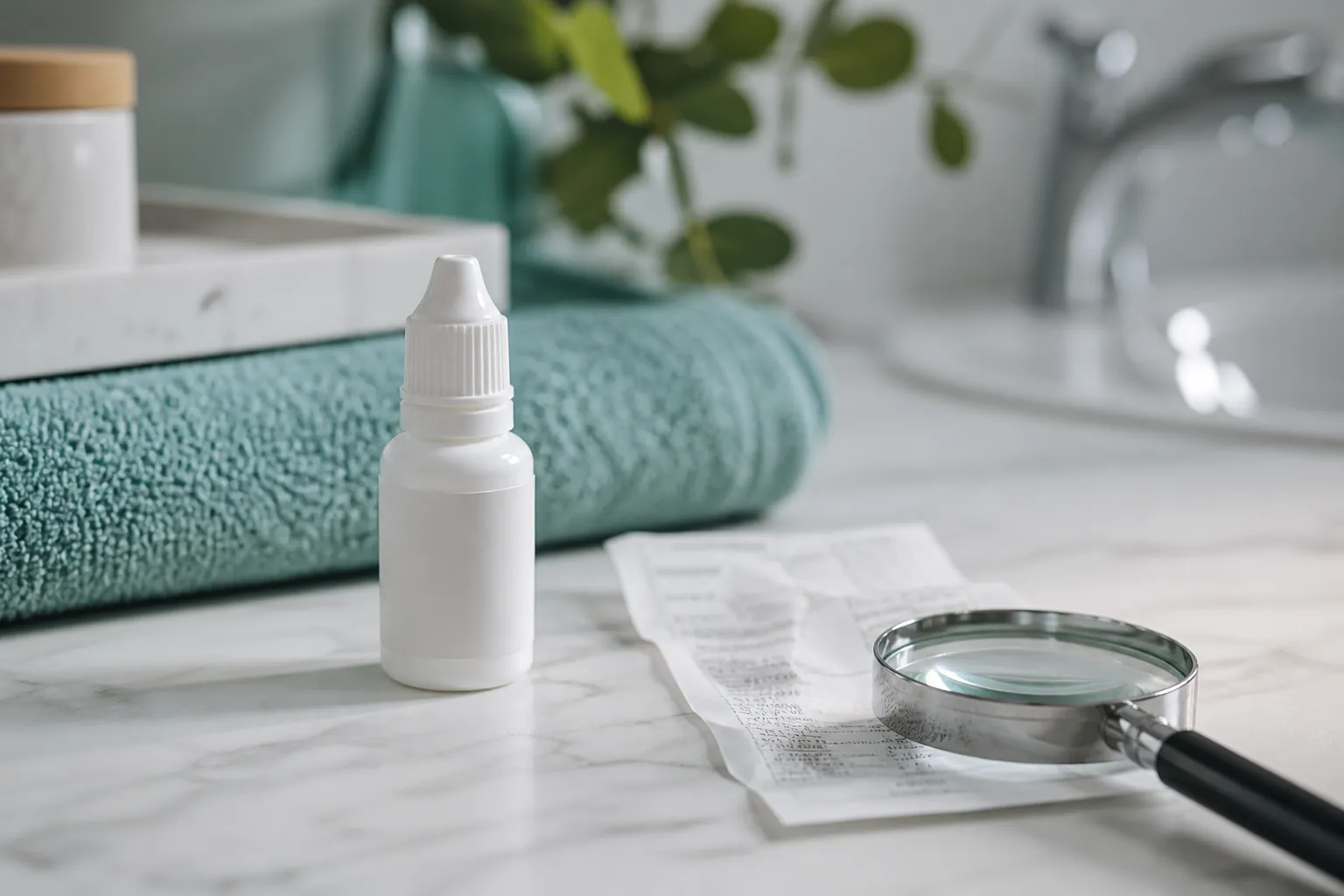
If the code is hard to read
Do not scrape, wash, peel, or flatten anything while trying to read it. Set the bottle on a plain surface, use bright indirect light, and photograph it from several angles. A phone camera often catches embossed or low-contrast printing better than the eye does. If a character is uncertain, write it down with the uncertainty marked, such as “possibly B or 8,” rather than forcing a clean version that may be wrong.
That kind of notation may feel fussy, but it protects you from a common recall problem: a consumer believes they checked the bottle, throws it away, and later cannot show what they checked. Keep the product until the refund process or reporting channel tells you what to do with it.
If your bottle matches, stop using it and set it aside
Once the product and batch match the recall notice, stop using the drops. Do not finish the bottle because it is nearly empty. Do not test it “one more time” to see whether it feels different. Eye drops are used directly in the eye, and the practical value of another dose is not worth creating a new exposure after you know the product is covered.
Put the bottle and packaging, if you still have it, in a clean bag or container. Store it somewhere children, pets, guests, or another household member will not accidentally use it. If more than one person in the home uses eye drops, label the bag plainly: “Do not use — recall check pending” or “Do not use — recalled batch.”
If you already discarded the bottle before learning about the recall, do not panic and do not invent certainty. Work from the evidence you still have: photos, order records, receipts, bank statements, shipment emails, or messages about the purchase. A weaker file is still better than no file, and honest gaps are easier to evaluate than corrected memories.
Build a small evidence file before you request the refund
The refund path is usually administrative: someone has to confirm that the product is covered and that you bought or possessed it. The cleaner your file is, the less time you spend answering follow-up questions. This is especially important for a low-cost product because the time spent chasing missing details can quickly become more frustrating than the refund itself.
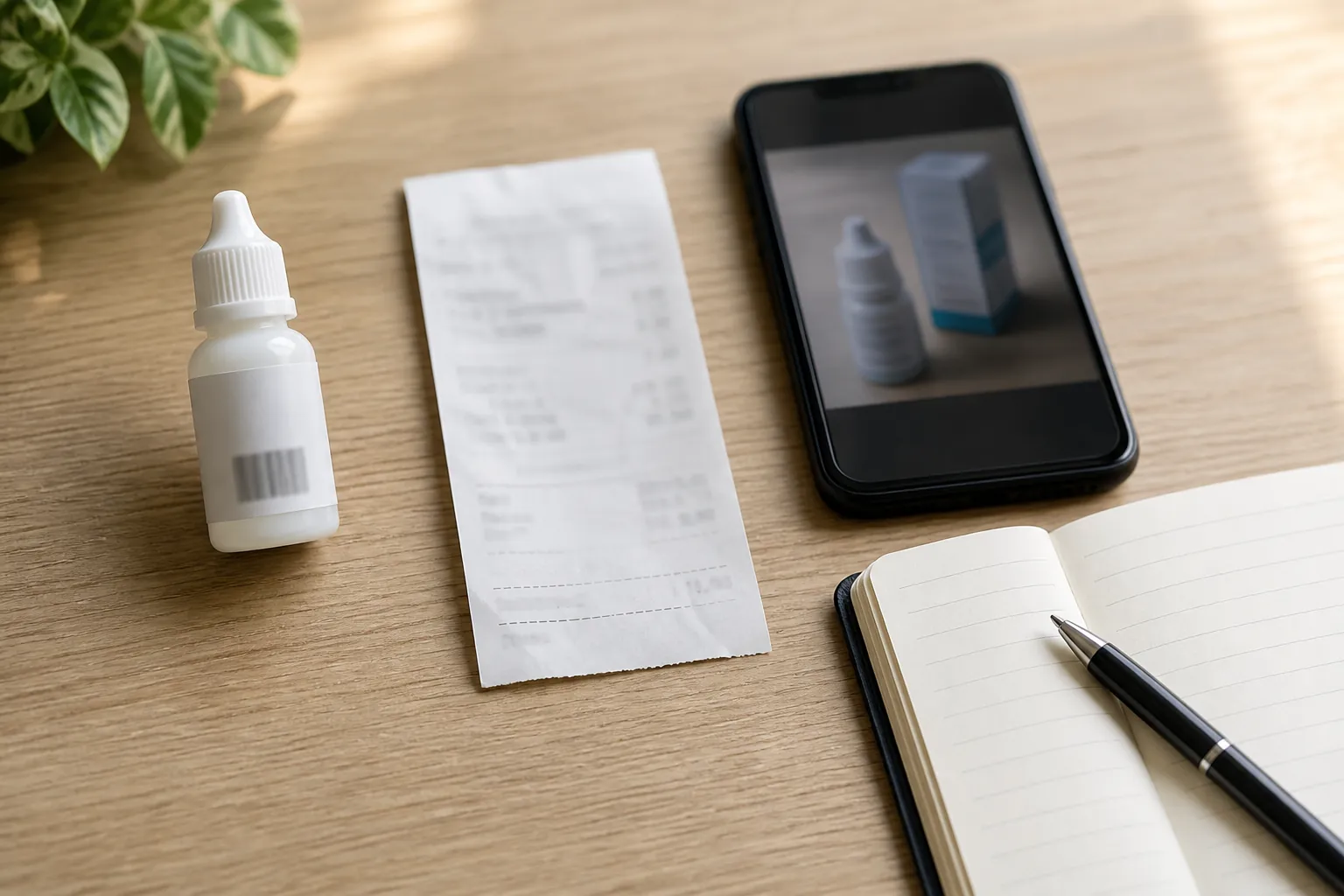
Create one folder on your phone or computer. Put everything in that folder before you submit a form or call a hotline. If you handle this in pieces—one photo in your camera roll, one receipt in email, one note on paper—it is easy to lose the thread when someone asks for a batch code or purchase date.
| What to save | Why it matters |
|---|---|
| Photos of the front label | Shows the product name and helps distinguish similar eye drop products. |
| Photos of the batch, lot, expiration, or other code | Connects your bottle to the recall notice if the code matches. |
| Photo of the bottle and box together, if available | Links the inner product to the outer packaging. |
| Receipt, email confirmation, pharmacy history, retailer order page, or delivery record | Supports where and when you bought it. |
| Payment record if no receipt remains | May help reconstruct the purchase, though it may not identify the exact product by itself. |
| Notes about use and any symptoms | Preserves timing if you later need to report a problem or speak with counsel. |
| Copies or screenshots of refund submissions and replies | Shows whether the remedy channel worked or failed. |
Name files plainly. “Rohto-bottle-front,” “Rohto-lot-code,” and “Rohto-receipt” are better than a roll of unnamed images. If you make notes, include the date you made the note. A short note made today is often more useful than a long reconstruction made weeks later.
What if the receipt is gone?
Many people throw away the box and receipt for an inexpensive health product. That is ordinary, not careless. Start with the seller. If you bought online, search your email for “Rohto,” “eye drops,” the retailer name, or the delivery service. If you bought in a store using a loyalty account, check the store account or app. If you used a pharmacy account, look for purchase history. If you used a credit card, identify the transaction and save the statement line, while recognizing that a card statement may show the retailer but not the item.
If the only thing you still have is the bottle, photograph it thoroughly and keep it. A bottle with a readable recalled code may be more useful than a vague memory plus a perfect-looking receipt for a shopping trip that included several items.
Use the refund channel before treating this as a legal dispute
For most buyers, the immediate remedy is the refund process described in the recall materials. That route is built for the ordinary purchaser: identify the covered product, provide the requested proof, and follow the instructions for reimbursement or return. It may feel unsatisfying if you are angry that the product was in your home, but a clean refund file is still the practical first step.
Before submitting anything, read the recall instructions from start to finish. Check whether the process asks you to keep the bottle, mail the product, discard it, photograph the code, provide a purchase location, or submit a claim through a specific form. If the instructions conflict with your instinct, follow the recall instructions unless a medical professional or attorney tells you otherwise for your situation.
- Submit only accurate information. If you are unsure about a code character or purchase date, say so.
- Save the confirmation page, claim number, email receipt, chat transcript, or call notes.
- Write down the date and time of any call, the number you called, and the name or ID of the representative if provided.
- Do not discard the product until the refund instructions tell you to, especially if you had a health problem after using it.
- If your claim is denied, ask for the reason in writing or save the explanation you receive.
A denial is not automatically proof that anyone acted wrongly. It may mean the code does not match, the proof is incomplete, the product is outside the covered scope, or the submission was missing a required field. But a denial with no explanation, repeated nonresponses, or changing instructions is different. That is when your documentation starts to matter beyond reimbursement.
If you had symptoms, document the timeline without overstating it
If you used the recalled drops and later had eye pain, redness, irritation, discharge, vision changes, swelling, or any other concerning symptom, treat that as a health issue first. Get appropriate medical care. A refund form is not a substitute for an exam, and a general article cannot tell you whether a symptom is connected to a product.
For your record, write a simple timeline. Include when you bought the product if known, when you first used it, when symptoms started, when you stopped using it, who you contacted, and what you were told. Use ordinary language. “Left eye became red the next morning” is better than a confident medical conclusion you are not qualified to make.
| Record | Practical note |
|---|---|
| Medical visit summaries | Save the discharge papers, visit notes, diagnosis information, and prescribed treatment if provided. |
| Photos of visible symptoms | Take them in consistent lighting and avoid editing them beyond normal cropping. |
| Medication or treatment receipts | Keep receipts for prescriptions, over-the-counter products, copays, and follow-up care. |
| Work or school impact | Save messages or records if symptoms caused missed time or schedule changes. |
| Communications with the company, retailer, or recall administrator | Keep full messages, not just screenshots of favorable lines. |
The line between “I used the product” and “the product caused my injury” is not something to fill in casually. Timing matters, but timing alone may not prove causation. Medical records, preserved product evidence, and a clear sequence give a professional something to evaluate. Guesswork gives them very little.
Report the problem through the channel identified in the recall materials
If the recall notice provides a reporting contact, use it. If the retailer, manufacturer, distributor, or recall administrator asks for a report number or a product photo, provide the information you can support. Keep copies of every submission and reply.
Separate a refund request from a health report in your own records, even if the same company receives both. A refund request says, “I bought a covered product and want the listed remedy.” A health report says, “I experienced a problem after using this product.” Those records may overlap, but they do not serve the same purpose.
When describing a problem, stick to what happened: product used, dates if known, symptoms observed, care sought, and current status. Avoid adding legal labels or dramatic conclusions. Clear, restrained reports are easier to process and harder to misunderstand.
When it makes sense to speak with an attorney
A recalled bottle in your cabinet does not automatically mean a lawsuit is the right next step. If you confirmed the batch, stopped using the drops, submitted the requested proof, received the refund, and had no health problem, the practical matter may be finished once your records are saved.
A consultation becomes more sensible when there is something concrete for counsel to evaluate: documented symptoms, medical care, out-of-pocket costs, missed work, preserved product evidence, a readable recalled code, communications showing the remedy process failed, or a refusal that appears inconsistent with the recall instructions.
- You used a bottle that appears to match the recalled batch and later received medical care for an eye-related problem.
- You still have the bottle, packaging, photos, or records showing the relevant code.
- You have medical records, bills, prescriptions, follow-up instructions, or symptom photos.
- The refund or reporting channel rejected a covered product without a clear reason.
- You cannot get a response after using the recall instructions and saving proof of your attempts.
If you do contact an attorney, send the file rather than a long emotional summary. Include the recall notice you used, product photos, proof of purchase, refund submission, denial or response, medical records if any, and your timeline. The question is not simply whether the product was recalled. The question is what happened to you, what you can prove, and whether the ordinary remedy was adequate.
The decision point
If your Rohto Cooling Eye Drops do not match the recalled product and batch, save your check if you want the record, but the recall remedy may not apply to that bottle. If they do match, stop using them, preserve the product and proof, use the refund channel, and report any problem through the recall materials.
For buyers without symptoms whose refund request works, that is usually the practical end of the matter. For buyers with documented harm, preserved batch evidence, medical records, or a blocked remedy path, the next step is not another general article. It is a direct consultation with someone who can review the file.
Related records
Tool profile
Browse tool evaluations →Governing regulation
Browse the obligations tracker →Preventive workflow
Browse verification workflows →
Report a correction or tip
Spotted an outdated figure, a misstated fact, or a ruling this case record should reflect? Public comments are disabled for this content given the professional cost of a misreported case outcome, penalty amount, or rule text — use the structured correction channel instead.
Report a correction or tip for this record →