
Was the Romanian F-16 Drone Shootdown Lawful?
Analyzes whether Romania's July 24, 2026 shootdown of a suspected Russian Shahed drone was lawful under domestic law, self-defense, and neutrality frameworks, and what legal risk the incident creates for NATO member states.
- Jurisdiction
- Romania
- Court
- Constitutional Court of Romania
- AI tool named
- Shahed drone
- Ruling date
- Jul 24, 2026
- Source document
- View primary court order ↗
- Last verified
- Jul 25, 2026
Lex Machina Review is an independent risk-tracking and reference resource. Nothing on this site is legal advice, and using it does not create an attorney-client relationship. Every record is reviewed against primary sources but may not reflect the most current status of a matter — always verify directly against the cited court order, rule text, or a licensed attorney before relying on it.
Companion explanation — secondary to the source document above
The cleanest place to begin the Romanian F-16 drone shootdown question is not with Article 51, NATO solidarity, or a map of the Black Sea. It is with the operational record: NATO Allied Air Command said a drone entered Romanian airspace on July 24, 2026, was detected at 09:39, drew an Italian Eurofighter response, and was shot down at 11:02 by Romanian F-16s near Padina after flying in Romanian airspace for more than an hour.[1]
That sequence matters because legal authority in an air-defense incident is not an after-action label. It is supposed to be available to the pilot, the ministry lawyer, and the alliance briefer before the missile leaves the rail. Here, Romania was not improvising from a blank page. In 2025, its lawmakers adopted a statute designed to authorize graduated responses to unauthorized aircraft and drones, including destruction of unmanned aerial vehicles where the threat level warrants it and destruction is treated as a last resort.[2]
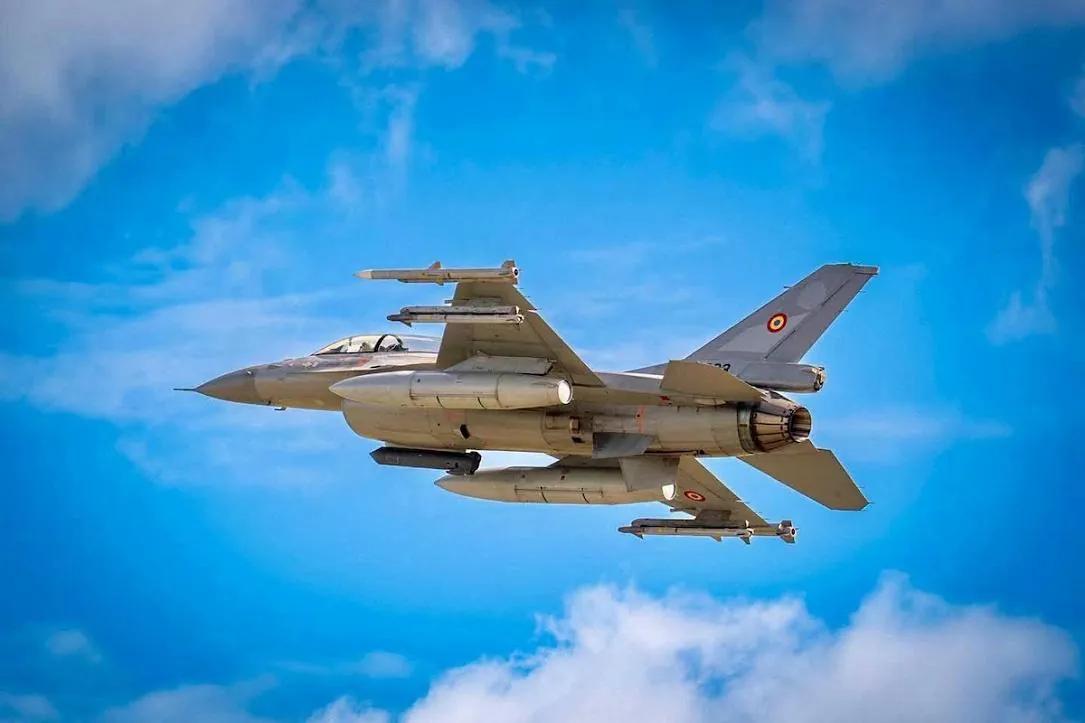
The short answer is that the shootdown was likely lawful. The more useful answer is that “lawful” does too much work unless the legal theory is separated into its component parts. Domestic airspace law, self-defense, and neutrality enforcement are not interchangeable. Each can point toward legality. Each exports a different risk to the next NATO state facing a slow, unattributed, possibly armed drone.
The domestic-law basis is the least strained
Romania’s strongest ground is also the least glamorous one: sovereign control of national airspace implemented through domestic legislation. Reuters reported in February 2025 that Law No. 73/2025 created graduated measures for aircraft breaching Romanian airspace: identification, contact, interception, warning shots, and destruction for manned aircraft; and, for UAVs, destruction, neutralization, or control based on threat level, with destruction as a last resort.[2]
The statute later survived constitutional review. Romania Insider reported that the Constitutional Court of Romania unanimously rejected challenges to the law and held that NATO shared-defense obligations did not infringe Romanian sovereignty.[3] That point does not prove every future shootdown will be lawful. It does mean the Romanian state had done the internal work that was missing in earlier incidents: it had moved from military tracking to a legislated decision chain.
One caveat should stay visible. The full English text of Law No. 73/2025 was not available for this analysis. The description here relies on Reuters and Romania Insider reporting, not on an independently reviewed official English translation of the statute.[2][3] For a legal-risk file, that is not a trivial distinction. It limits confidence in the exact statutory triggers, command approvals, and evidentiary standards. It does not erase the broader point that Romania had adopted and validated a domestic legal architecture before the July 2026 shootdown.
The earlier gap explains why this matters. The Jamestown Foundation described a September 2025 incident in which a Romanian F-16 tracked a Shahed-type drone for nearly an hour but did not fire because the legal authority to shoot down such an aircraft was not in place.[4] Whether one agrees with that restraint or not, it is exactly the sort of operational paralysis legislators try to cure after repeated airspace violations. Law No. 73/2025 appears to have been written for the problem that July 24, 2026, presented.
Three legal theories, three different risk profiles
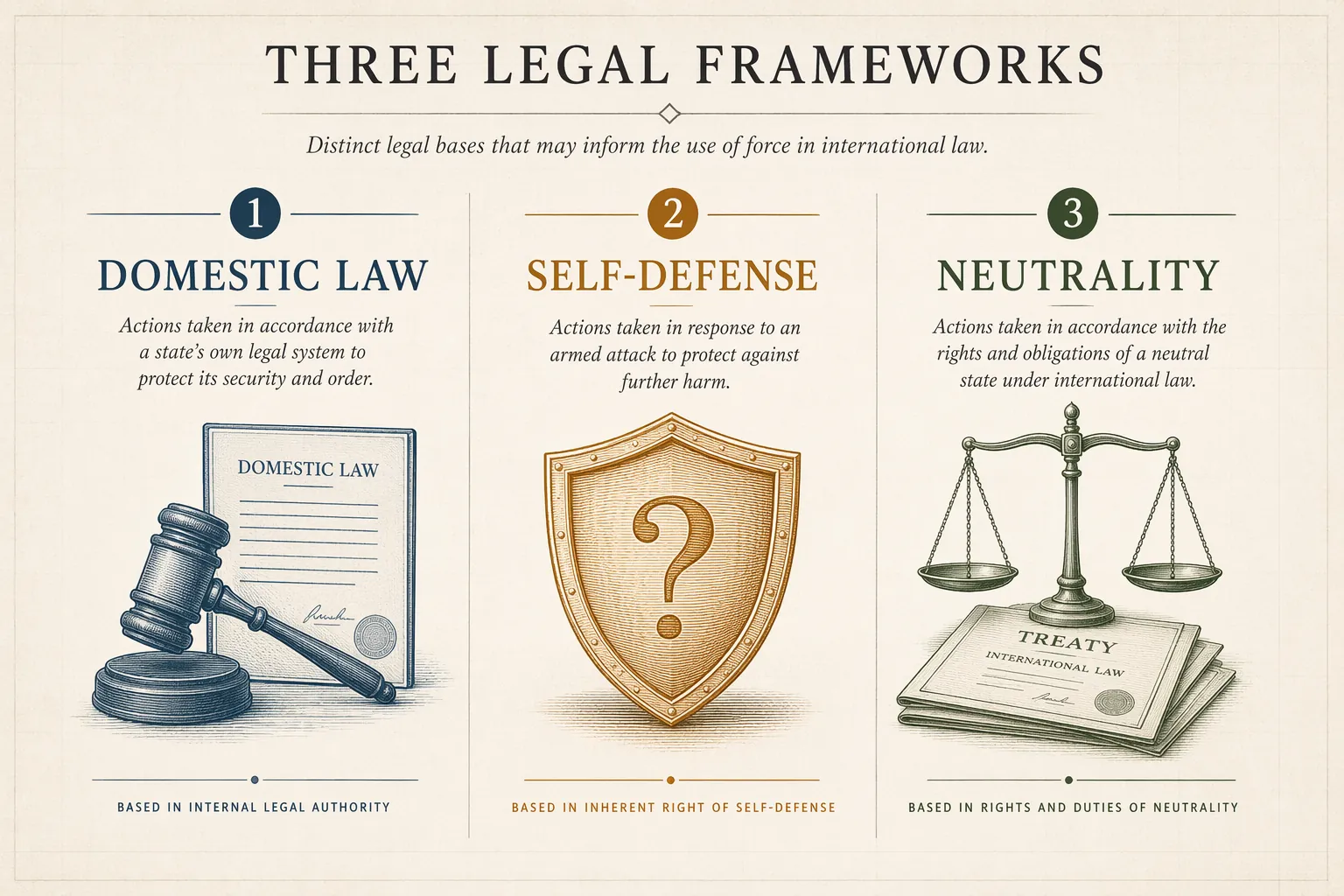
Michael Schmitt’s Just Security analysis of Russian penetrations of NATO airspace is useful because it keeps the legal theories apart. He identifies three potentially available frameworks: law enforcement, self-defense, and neutrality enforcement.[5] That separation is not academic tidiness. It determines what a NATO member is claiming, what facts it must prove, and what other states may later cite as precedent.
| Framework | What it does in this incident | Main legal risk |
|---|---|---|
| Domestic law / law enforcement | Authorizes Romania to police its own airspace under Law No. 73/2025, including last-resort action against UAVs based on threat level. | Narrow transferability; other NATO states need their own domestic authority. |
| Self-defense | Frames the drone incursion as a use of force or armed attack permitting defensive force under the UN Charter. | Contested armed-attack threshold; strongest escalation signal. |
| Neutrality enforcement | Frames Romania as a neutral state required to terminate belligerent military aircraft violations of its airspace. | Strong doctrinal fit on paper, but rarely tested in modern drone incidents. |
The domestic-law theory asks the most concrete questions: Was the drone in Romanian airspace? Was the response authorized by Romanian law? Was destruction permitted at that threat level and treated as a last resort? NATO’s timeline answers only part of that record. It establishes detection, allied aircraft response, reported shootdown timing, and location near Padina.[1] It does not, and need not, supply the classified or internal Romanian decision record.
Even so, domestic law is the least overextended basis for this incident. States are entitled to control their airspace. A drone does not become legally harmless because it is unmanned, slow, deniable, or badly aimed. If the factual record supports the reported incursion and Romanian authorities followed their own statute, domestic authority carries the smallest doctrinal burden.
Self-defense is plausible, but it is the theory to generalize most carefully
Self-defense is the tempting phrase after a suspected Russian Shahed-type drone enters NATO airspace. It is also the phrase most likely to hide the hard question. UN Charter Article 51 preserves the inherent right of self-defense if an armed attack occurs. The legal fight is whether this sort of incursion crosses that threshold.
The threshold is genuinely contested. The EPC analysis of aircraft shootdowns notes the ICJ’s Nicaragua approach, under which an armed attack involves the “most grave forms” of the use of force, while the United States has taken the broader position that all uses of force amount to armed attacks.[6] Those are not two ways of saying the same thing. Under the narrower ICJ frame, a single drone crossing sovereign airspace for approximately an hour may be a violation, a danger, and a use of force concern without necessarily becoming an armed attack. Under the broader U.S. view, the same intrusion may more readily support defensive force.
Attribution complicates the point. The drone has been described as suspected Russian or Shahed-type based on available reporting, including pilot observations and ministerial statements, but formal origin confirmation awaits investigation. Suspicion may be enough for an immediate cockpit decision under domestic rules of engagement. It is a weaker foundation for a broad public claim that Romania used force in self-defense against Russia.
That distinction is where escalation risk enters. A domestic airspace-enforcement account tells allies and adversaries that Romania terminated an unauthorized object inside Romanian airspace. An Article 51 account can imply that the state was responding to an armed attack. In a NATO context, that phrasing is not just lawyerly scenery. It affects diplomatic signaling, alliance consultations, and the way future incidents may be briefed to publics that already read armed aircraft and Russian drones as a single escalatory picture.
Neutrality law may do more work than the headlines suggest
Neutrality enforcement is the least familiar of the three frameworks in ordinary commentary, but it may be the most interesting for NATO states bordering the Russia-Ukraine war. Schmitt points to Hague Convention V and the AMW Manual’s Rule 170, under which a neutral state must use all means at its disposal to prevent or terminate violations of neutral airspace by belligerent military aircraft.[5]
That rule changes the posture. The legal claim is not “we were attacked,” and it is not merely “our statute allowed it.” It is that a state not party to the armed conflict has an obligation to prevent its territory and airspace from being used by belligerents. If a belligerent military drone enters neutral airspace, terminating the violation can be framed as compliance with neutrality duties rather than participation in the conflict.
On paper, that is a strong fit for repeated drone incursions spilling from the Russia-Ukraine war into neighboring NATO territory. It is also a framework that deserves caution precisely because it sounds cleaner than self-defense. Modern drone warfare has not produced a deep, settled record of states formally invoking neutrality law to justify NATO shootdowns. The doctrinal fit is real; the litigation and diplomatic record is thin.
For NATO members, neutrality enforcement may be more transferable than Romania’s domestic statute because it does not depend on Law No. 73/2025. But it still depends on facts: the object must be a belligerent military aircraft or at least fall close enough to that category to justify the response; the state must be acting to terminate the incursion, not to conduct hostilities; and the force used must fit the violation. A neutral-state theory cannot become a polite label for joining an air campaign.
Why this was not a one-off legal problem
The July 2026 shootdown sits inside a recurring pattern, not an isolated air-defense curiosity. ABC News reported, citing Romanian Defense Ministry data, that in the first four months of 2026 Romania recorded seven airspace violations, eleven fragment discoveries, and eighteen air-policing scrambles.[7] Those numbers do not prove every object was Russian, every incursion was deliberate, or every response would be lawful. They show why Romanian officials could not treat drone incursions as a rare nuisance.
The comparison with other NATO incidents is useful only up to a point. Poland’s September 2025 shootdown of four drones, reported incursions involving Estonia, and Turkey’s 2015 shootdown of a Russian Su-24 all show that airspace enforcement against Russian or Russia-linked aircraft can become an alliance-management problem as quickly as a legal one.[5] But they should not be flattened into one precedent pile. A manned fighter, a formation of drones, and a single suspected Shahed-type UAV do not present identical facts.
That is why the Romanian incident is better treated as a risk record than as a slogan. NATO can accurately report what it observed and how allied aircraft responded. Romania can rely most securely on its domestic law if the statutory conditions were met. Counsel advising other NATO states should resist the comfort of a universal answer. The lawful basis will turn on national implementing law, the object’s behavior, attribution, warnings or alternatives where feasible, and the theory the state chooses to put on the record.
The better legal reading
On the available record, Romania’s July 24, 2026 shootdown was likely lawful. The domestic-law basis is the cleanest: Romania had enacted and constitutionally validated a statute authorizing graduated responses to unauthorized drones, and NATO’s operational account places the drone inside Romanian airspace before the F-16 engagement.[1][2][3]
Self-defense is not unavailable, but it is the riskiest theory to generalize. It requires a position on the armed-attack threshold, and the ICJ and U.S. approaches leave meaningful room for disagreement.[6] In contrast, neutrality law may offer the more transferable framework for NATO border states facing belligerent drones, because it focuses on terminating unauthorized belligerent use of neutral airspace. Its weakness is not doctrinal irrelevance. Its weakness is that modern practice has not yet tested it enough to make it feel as administratively familiar as domestic airspace enforcement.
The incident therefore should not be filed simply as escalation or non-event. It is a worked example of why drone incursions force states to align cockpit authority, domestic legislation, alliance messaging, and international-law theory before the next object crosses the border.
References
- NATO fighter jets scramble, shot down drone after it enters Romania airspace, NATO Allied Air Command, July 24, 2026.
- Romanian lawmakers adopt law to shoot down drones breaching airspace, Reuters, February 26, 2025.
- CCR clears law to shoot down unauthorized drones, Romania Insider, March 28, 2025.
- Romania No Longer Turns Blind Eye to Russia’s Airspace Violations, Jamestown Foundation, December 2025.
- Legally Available Options in Response to Russia’s Penetrations of NATO Airspace, Just Security, September 2025.
- Shooting Down an Enemy Aircraft is Far from Simple Under International Law, European Policy Centre.
- NATO ally Romania reports increased rate of Russian drone incidents, ABC News, May 2026.
Related records
Tool profile
Browse tool evaluations →Governing regulation
Browse the obligations tracker →Preventive workflow
Browse verification workflows →
Report a correction or tip
Spotted an outdated figure, a misstated fact, or a ruling this case record should reflect? Public comments are disabled for this content given the professional cost of a misreported case outcome, penalty amount, or rule text — use the structured correction channel instead.
Report a correction or tip for this record →