
Salesforce stock and layoffs hold a due diligence lesson for legal AI
This article examines Salesforce's simultaneous stock decline, workforce reduction, and AI pivot to distill a vendor-diligence framework legal professionals can use before committing to AI procurement.
- Jurisdiction
- us-federal
- Court
- U.S. Securities and Exchange Commission
- AI tool named
- Salesforce Agentforce
- Ruling date
- Jun 10, 2026
- Source document
- View primary court order ↗
- Last verified
- Jul 30, 2026
Lex Machina Review is an independent risk-tracking and reference resource. Nothing on this site is legal advice, and using it does not create an attorney-client relationship. Every record is reviewed against primary sources but may not reflect the most current status of a matter — always verify directly against the cited court order, rule text, or a licensed attorney before relying on it.
Companion explanation — secondary to the source document above
The useful thing about Salesforce right now is not that it proves enterprise AI is failing. It does not. The useful thing is that it puts a number next to the story vendors prefer to tell without numbers.
As of June 9-10, 2026 reporting, Salesforce was showing the kind of operating results most software companies would happily put at the top of every board deck: record quarterly revenue of $11.13 billion and a record 34.8% non-GAAP operating margin. At the same time, its stock was reported around $175.35, down more than 30% year to date and close to a 52-week low of $163.52.[1] The company was also cutting staff while pursuing acquisitions and a $50 billion share-buyback authorization.[2]
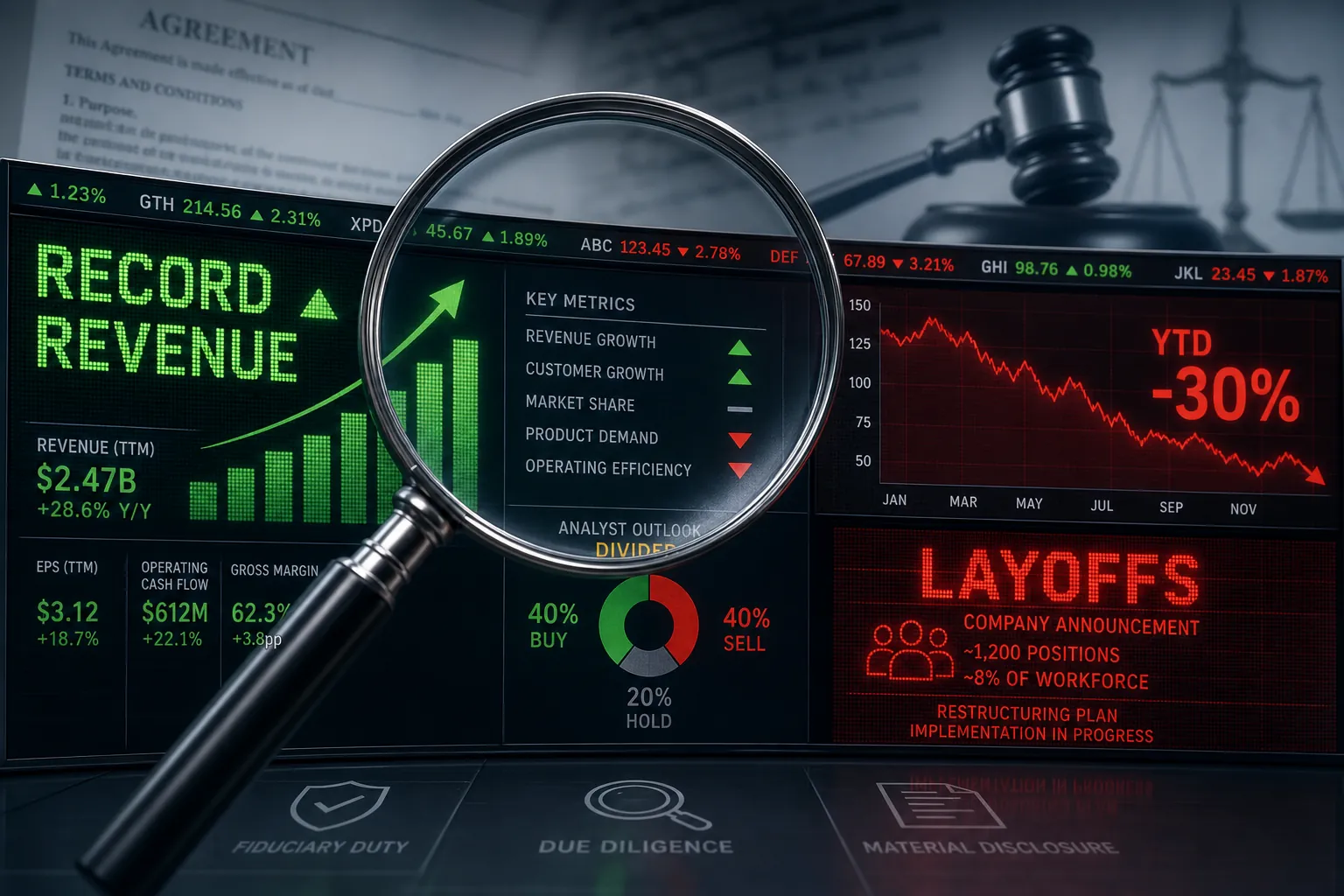
That contradiction is the whole procurement lesson. The market was not simply asking whether Salesforce had AI features. It was asking whether the AI investment strategy was large enough, durable enough, and economically visible enough to change the company’s financial trajectory. Legal AI buyers should ask the same question before they treat a demo, pilot, or product roadmap as evidence of return on investment.
This is why Salesforce’s layoffs, stock decline, and AI investment strategy matter outside Salesforce. A law firm or legal department does not need to become an equity analyst to learn from it. It only needs to notice the gap between capability claims and measurable economics. If a company with Salesforce’s distribution, customer base, and executive urgency can show AI growth and still face skepticism, a legal team buying a narrower AI tool should not accept “the model can do it” as a substitute for “the organization is saving money safely.”
The AI revenue number is real, but scale is the missing word
Agentforce is not a rounding-error product announcement. Salesforce reported $1.2 billion in annual recurring revenue for Agentforce, up 205% year over year.[3] In a procurement memo, that number would deserve attention. It says customers are buying, the product has commercial traction, and the AI line is not merely a branding exercise.
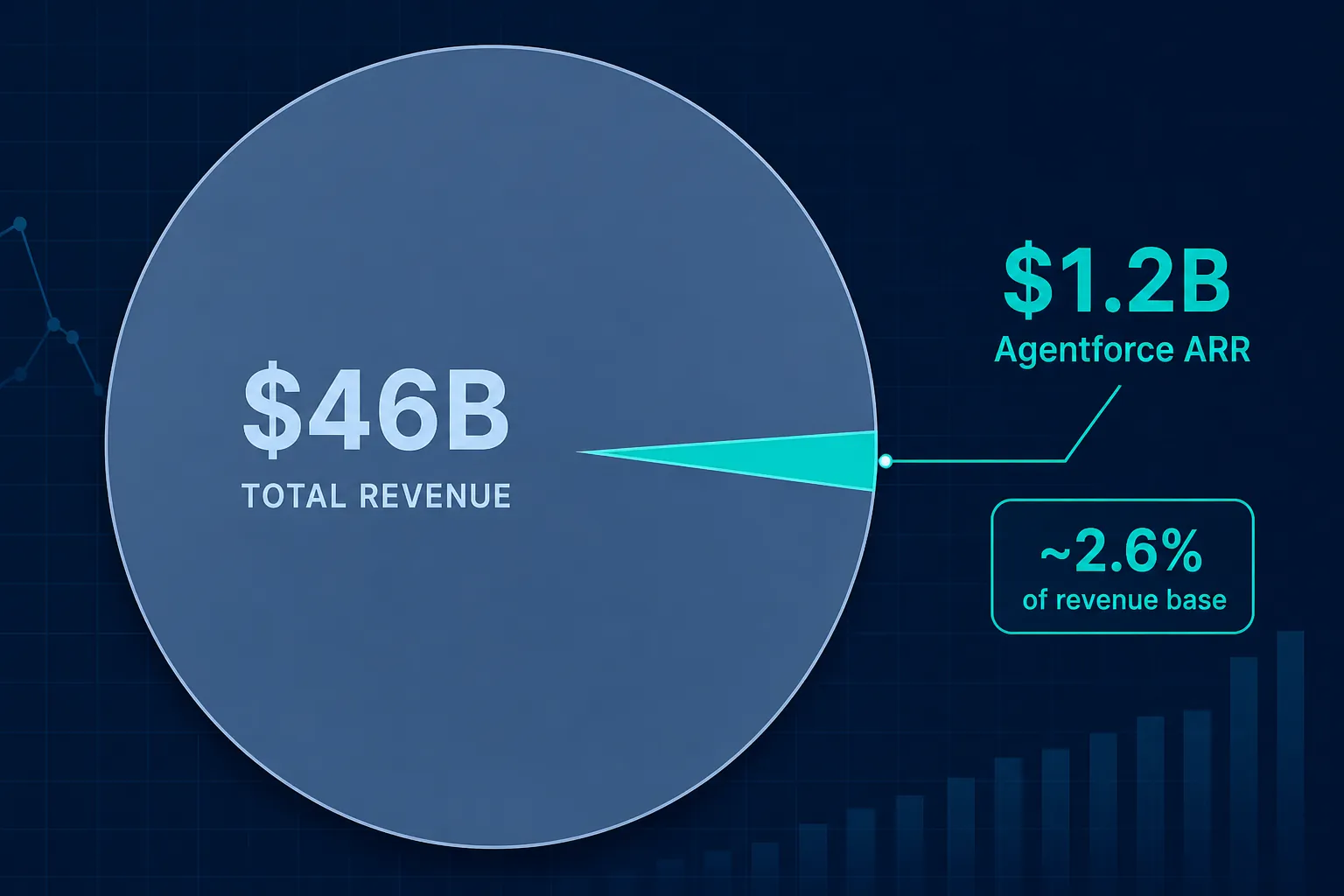
But the same Inc. report placed that $1.2 billion Agentforce ARR against Salesforce’s roughly $46 billion revenue base, or about 2.6%.[3] That is the more useful comparison. A fast-growing AI product can be commercially meaningful and still too small to carry the economics of the larger enterprise. Growth rate answers one question. Revenue mix answers another.
Legal AI vendors create the same kind of scale problem when they lead with pilot adoption. A tool may reduce time on one research task, produce acceptable first drafts for one practice group, or speed intake triage for one business unit. None of that proves the buyer has reduced total matter cost, shortened cycle time across a portfolio, or avoided hiring in a way that will survive the next quarter’s workload.
The due-diligence question is not whether the AI feature works in isolation. It is whether the workflow economics survive the handoff. Who reviews the output? Who corrects it? Who trains new users? Who handles exceptions when the system is confident and wrong? Who maintains the playbook when the law, client preference, or internal policy changes? A vendor can show product usage without showing that those costs have disappeared.
That distinction matters most in legal work because the expense is rarely located in a single visible click. A research assistant may retrieve authority faster, but a supervising attorney may still recheck the case law. A contract tool may flag deviations, but a commercial lawyer may still negotiate the business exception. An intake agent may classify a request, but legal operations may still chase the facts that make the classification useful. The AI system can reduce one step while increasing review, escalation, or governance work somewhere else.
Layoffs are a weak proxy for AI savings
The workforce side of the Salesforce story is more uncomfortable for buyers than the stock chart because it shows the risk of treating headcount reduction as proof of automation success. In September 2025, CNBC reported that Salesforce had reduced customer-support staff from 9,000 to 5,000, with CEO Marc Benioff tying the reduction to AI and saying he needed “less heads.”[4]
By February 2026, Wipfli described a reversal: Salesforce had begun rehiring after overestimating AI’s problem-solving capabilities and underestimating the value of institutional knowledge.[5] That does not prove AI support agents have no value. It proves something narrower and more relevant to procurement: removing people before the workflow is proven can create a second cost event.
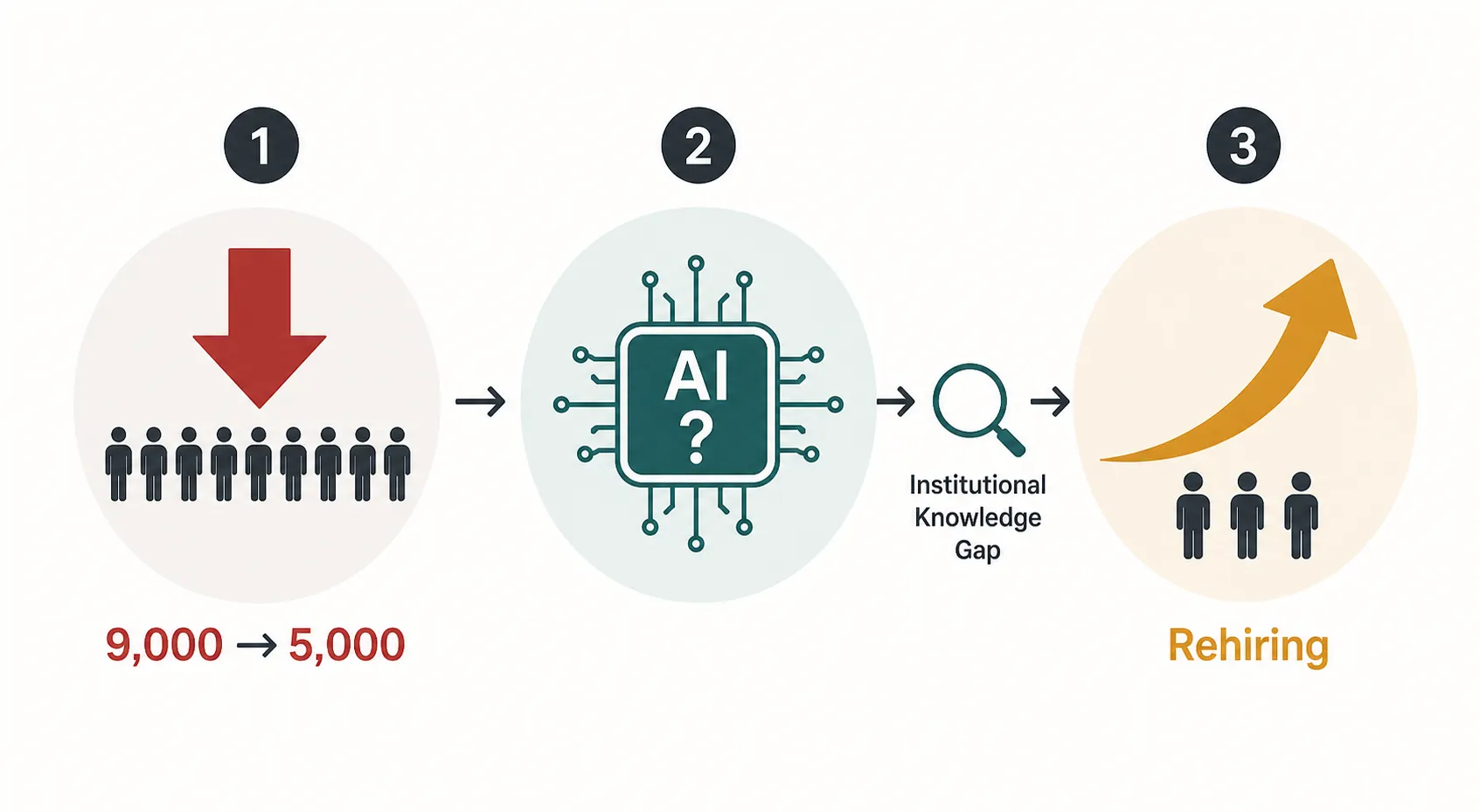
Legal departments should read that as a mechanism, not as a morality tale. AI can handle repeatable tasks and still fail at the surrounding judgment layer. It can answer common questions and still miss the unusual fact that changes the answer. It can route routine work and still need a human who understands the client, the business unit, the regulator, the judge, or the partner who will not accept a generic answer.
That is why procurement teams should be careful when a vendor’s ROI model depends on “freeing up” lawyers, paralegals, contract managers, or support staff without specifying what happens to the work they used to absorb. Hidden labor often moves to the people least likely to record it: senior associates reviewing AI research, in-house counsel correcting intake summaries, knowledge-management leads repairing templates, or supervising attorneys documenting why a generated draft was not usable.
A credible cost-savings model has to show the before-and-after workflow, not just the model’s capability. If the vendor claims a 40-minute task becomes a 10-minute task, the buyer should ask whether that measurement includes prompt setup, review, correction, privilege checks, policy mapping, audit logging, and escalation. If the vendor claims reduced headcount need, the buyer should ask what rehiring, outside-counsel remediation, or client-credit exposure would look like if the automation misses exceptions.
The market is pricing uncertainty, not just enthusiasm
Salesforce’s public numbers create a cleaner version of a problem legal buyers usually see in miniature. The company can point to record revenue, record margin, a major AI product line, acquisitions, layoffs, and capital return. Yet the reported June 2026 stock level still reflected investor doubt about whether those moves would translate into scaled returns.[1][2][3]
That is the same doubt legal operations should formalize in vendor scoring. Announced features are not returns. Usage is not savings. Automation is not risk reduction unless the buyer can identify the control that replaced the human control. A pilot is not firm-wide economics unless the same staffing, review, data-access, and governance assumptions hold when the tool moves from friendly users to reluctant ones.
This is especially important in legal AI because many promised efficiencies depend on work being reclassified rather than eliminated. Research becomes “AI-assisted research,” but someone still signs the memo. Contract review becomes “AI-first,” but someone still owns the fallback language. Compliance monitoring becomes “continuous,” but someone still investigates the alert. Client service becomes “agentic,” but someone still explains the error if the system gives the wrong answer.
The better procurement frame is cost extraction versus capability transformation. WNDYR’s 2026 strategy framework draws that distinction at the executive level: companies using AI mainly to cut cost face a different path from companies redesigning how work is performed.[6] In legal buying, the distinction is practical. A cost-extraction pitch asks the buyer to remove labor and hope the system covers the gap. A capability-transformation pitch shows which workflow is redesigned, which humans remain accountable, and which measurements prove the new workflow is better.
Secondary signals point in the same direction, with caveats
The broader AI-layoff literature should be handled carefully. It is useful as a warning light, not as a substitute for buyer-specific analysis.
SalesforceBen summarized a Gartner press release as finding that 80% of companies that cut staff to fund AI investments saw the same financial gains as companies that did not, and that Gartner predicted 50% would rehire by 2027.[7] The same SalesforceBen article cited MIT NANDA reporting that 95% of enterprise AI pilots delivered no measurable profit-and-loss impact, with organizational readiness rather than model capability described as the bottleneck.[7]
Those are serious figures, but they need source discipline. The Gartner number is being used here through a secondary summary, and the MIT NANDA figure should be checked against the original methodology before anyone treats it as a courtroom-grade exhibit. Still, the direction of the warning is consistent with what procurement teams already see: the distance between a tool working and an organization benefiting from it is often wider than the demo suggests.
The layoff backdrop is also broad enough to matter but too broad to overread. Programs.com tracked more than 120,000 tech layoffs in the first half of 2026, and Forbes separately reported on AI-linked job losses at Oracle.[8][9] Those figures do not prove that AI-driven layoffs fail. They do show that many companies are trying to fund or justify AI investment through labor reduction before the long-term operating model is settled.
For a legal buyer, the practical question is narrower: does the vendor’s economics require your organization to make the same bet? If the projected savings depend on fewer review hours, fewer support roles, fewer outside-counsel touchpoints, or fewer knowledge-management updates, the buyer should demand evidence that the reduced work has actually disappeared rather than migrated to a less visible budget line.
What legal AI buyers should ask before accepting the ROI story
The Salesforce case does not say legal teams should avoid AI agents, drafting tools, research assistants, or intake automation. It says buyers should separate product capability from realized operating return. That separation belongs in the procurement file before signature, not in the post-implementation explanation.
- What financial result is being promised: lower outside-counsel spend, shorter cycle time, reduced internal labor, higher matter throughput, fewer write-offs, or better risk detection?
- Which baseline is being used: a real pre-AI workflow, a vendor benchmark, a friendly pilot group, or a hypothetical “manual” process?
- Which human review costs remain: legal signoff, privilege screening, hallucination checks, template maintenance, audit review, client communication, or escalation handling?
- What happens when the tool is wrong: who detects the error, who remediates it, who pays for rework, and whether the vendor contract assigns any meaningful responsibility?
- What adoption metric is being shown: logins, generated outputs, accepted outputs, completed matters, reduced hours, or audited savings?
- What must be rehired, rebuilt, or reintroduced if the expected savings do not materialize?
The baseline question deserves particular attention. Vendor ROI decks often compare AI-assisted work against an artificially slow version of the old process. A better comparison uses recent matters, actual time entries where available, documented review steps, and the same quality threshold the legal team must meet in production. If the old workflow included partner review, client-specific judgment, or regulatory signoff, the AI workflow should not erase those steps from the denominator unless the buyer has actually removed them.
The hidden-labor question is just as important. In many legal environments, the official owner of an AI tool is not the person absorbing its cost. The legal-ops director signs the contract. The KM lead updates the source materials. Associates recheck citations. In-house counsel repair intake summaries. IT manages access and logs. Risk or compliance reviews the governance model. If the procurement model counts only license cost and time saved by the end user, it is not measuring the workflow.
Professional-responsibility exposure also changes the ROI calculation. A legal AI tool that saves time but increases the chance of uncaught false authority, confidential-data leakage, missed conflicts, or unauthorized-practice concerns has not produced a clean efficiency gain. The buyer has shifted cost into risk. That is why AI procurement belongs with governance review, not after it. The same logic runs through Lex Machina Review’s prior market-signal pieces on CoreWeave, IREN, and SK Hynix: financial stress in the AI stack is useful when it sharpens vendor diligence rather than becoming stock-market commentary.
The diligence standard
Salesforce is a signal, not a verdict. Its AI strategy may still become financially sound at greater scale. Agentforce may keep growing. Workforce redesign may stabilize. The stock price may move after the June 2026 reporting window used here. None of that weakens the procurement lesson.
The lesson is that even visible AI revenue growth does not automatically settle the ROI question. Public markets can look at record revenue, record margin, rapid AI growth, layoffs, acquisitions, and buybacks and still ask whether the strategy is producing returns at scale. Legal buyers should be at least that demanding with vendors whose tools will touch client work, privileged information, court filings, contract obligations, compliance decisions, and professional judgment.
Before a legal organization relies on AI savings in a budget, staffing plan, or client-pricing model, it should be able to trace the claim from feature to workflow to measured financial impact. It should know the benchmark, the review burden, the exception path, the remediation cost, the source of every headline statistic, and the professional-responsibility controls that make the workflow defensible.
If that chain is missing, the buyer is not purchasing proven ROI. It is purchasing an invoice attached to a forecast.
References
- Salesforce Stock Falls 3.9% as Fresh Layoffs and m3ter Billing Deal Signal an AI Pricing Shift, EBC.com
- Salesforce cuts staff amid acquisition spree and $50 billion share buyback, The Register
- Last Month, Salesforce Announced It Hit $1.2 Billion in AI Revenue—Now It's Laying Off Staff, Inc.
- Salesforce CEO confirms 4,000 layoffs 'because I need less heads' with AI, CNBC, September 2025
- Salesforce failed to replace thousands of workers with AI. What can your business learn?, Wipfli, February 2026
- The Fork in the Road: Two AI Strategies CEOs Will Choose in 2026, WNDYR
- 100,000 Tech Layoffs Later: Companies Admit to Not Seeing AI Returns, SalesforceBen
- List of Companies Announcing AI-Driven Layoffs, Programs.com
- Oracle Admits Artificial Intelligence Has Cost 21,000 Jobs, Forbes
Related records
Tool profile
Salesforce Agentforce Under the Legal Reliability MicroscopeGoverning regulation
Browse the obligations tracker →Preventive workflow
Browse verification workflows →
Report a correction or tip
Spotted an outdated figure, a misstated fact, or a ruling this case record should reflect? Public comments are disabled for this content given the professional cost of a misreported case outcome, penalty amount, or rule text — use the structured correction channel instead.
Report a correction or tip for this record →