
Salesforce Stock Drop Shows Agentforce Adoption Gap
Salesforce's Agentforce reported explosive growth while its stock hit a three-year low — a gap between booked revenue and active deployment that mirrors the disconnect in legal AI vendor claims. This article examines why the market is right to discount those numbers and what law-firm AI buyers should demand instead.
- Jurisdiction
- United States
- Court
- General
- AI tool named
- Agentforce
- Ruling date
- Jun 17, 2026
- Source document
- View primary court order ↗
- Last verified
- Jul 30, 2026
Lex Machina Review is an independent risk-tracking and reference resource. Nothing on this site is legal advice, and using it does not create an attorney-client relationship. Every record is reviewed against primary sources but may not reflect the most current status of a matter — always verify directly against the cited court order, rule text, or a licensed attorney before relying on it.
Companion explanation — secondary to the source document above
Salesforce has managed to put two numbers in front of the same buyer that do not comfortably sit together: Agentforce annual recurring revenue of $1.2 billion, up 205% year over year, and a CRM share price that touched a three-year low of $157.74 on June 17, 2026 after falling 55% from its December 2024 highs. [1][2]
That is why a serious look at Salesforce’s stock drop and Agentforce impact cannot just ask whether the market has become too pessimistic. For legal AI buyers, the more useful question is procurement-grade: what evidence would prove that this AI revenue is converting into governed, repeatable production use?
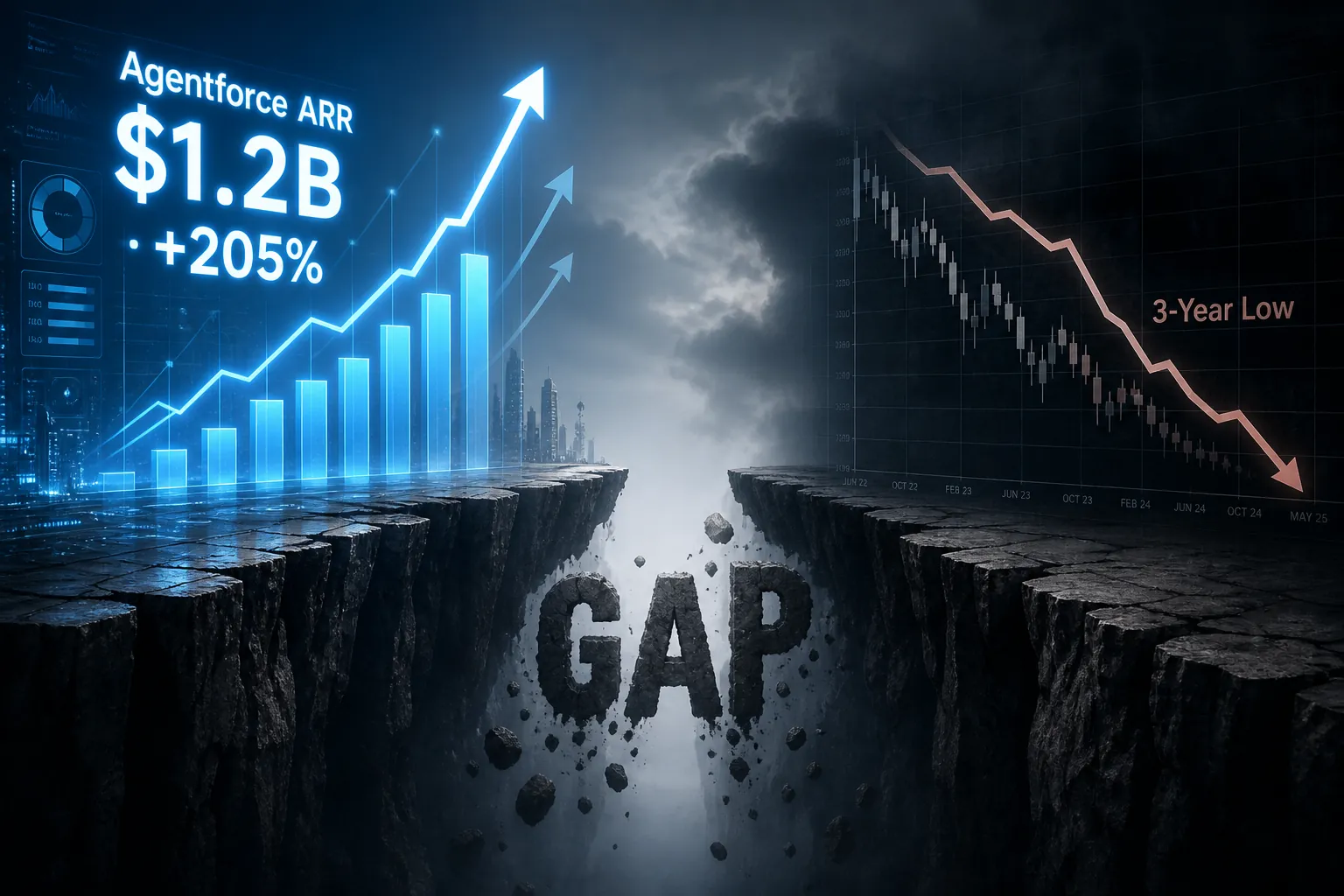
The answer is not visible in the headline ARR figure. Salesforce also reported record first-quarter fiscal 2027 revenue, and management can reasonably argue that customers are committing real budget to Agentforce. [1] But analysts have also reported weak CIO sentiment around Agentforce production readiness and customer feedback suggesting that the product is not yet ready for many use cases. [3] What Salesforce has not publicly separated is the metric a buyer should care about most: how many customers are actively running Agentforce in production, under governance, with measurable business outcomes.
That missing number matters more than the market drama. It is the same number legal teams should look for when a vendor says a generative AI product has been adopted by major firms, passed internal pilots, or reached a large contract base. Signed paper is a useful commercial signal. It is not proof that lawyers trust the output, that data permissions are clean, that privileged material is protected, or that someone has accepted the verification workload.
ARR Is Not Production Evidence
Annual recurring revenue is a sales metric. It can include committed spend that has not yet become routine work. It can reflect customers expanding enterprise agreements before their operating model is mature. It can also hide a wide spread between a handful of advanced deployments and a long tail of accounts still testing, configuring, or waiting for data cleanup.
That distinction becomes sharper because more than half of Agentforce bookings reportedly came from existing Salesforce customers expanding contracts rather than from new logos. [4] Expansion can be a strong sign; existing customers already have procurement paths, administrative owners, and stored data inside the ecosystem. But it is still not the same as net-new proof that the agent layer has crossed from budget allocation into daily governed work.
| Vendor claim | What it can prove | What it does not prove |
|---|---|---|
| Booked ARR | Customers have committed budget | Users are relying on the tool in production |
| Expanded contracts | Existing accounts are increasing commercial exposure | The new AI workflow is deployed across matters or teams |
| Pilot activity | A buyer is willing to test the product | The workflow survives security, data, supervision, and ROI review |
| Named-customer logos | The vendor has enterprise access or a referenceable relationship | The named customer has approved broad governed use |
| Benchmark scores | The system performed under a defined test condition | The system will remain reliable against a firm’s live documents and legal sources |
This is where the broader AI-agent data becomes hard to ignore. Forrester and Anaconda found that 88% of AI agent pilots never reach production, while Gartner has predicted that 40% of agentic AI projects will be scrapped by 2027 because of unclear returns. [5] The 88% figure is not an Agentforce-specific deployment rate, and the Gartner number is a forecast rather than a measured outcome. Still, together they describe the exact gap procurement teams see after the executive demo: enthusiasm is easy to generate before the workflow has to live inside real data, real controls, and real accountability.

A pilot can be impressive because it is protected from the ugliest parts of the operating environment. It uses selected examples. It runs with close vendor attention. It often avoids the full permissions map, the exception cases, the records that are duplicated or stale, and the human review process that will determine whether the output is actually usable. Production is where those avoided costs come due.
The Data Problem Is Not a Footnote
Salesforce’s own numbers show how much of the Agentforce story depends on data readiness. In the first quarter of fiscal 2027, Data 360 ingested 52 trillion records, including 35 trillion through Zero Copy. [1] Those figures are easy to read as scale. They are also a reminder that the expensive work is not only building an agent; it is connecting the agent to the right records, without copying data into unsafe places, while preserving permissions, context, freshness, and auditability.

Legal AI buyers should recognize the pattern immediately. Law-firm knowledge is rarely sitting in one clean, labeled, access-controlled repository. Precedent banks, document-management systems, billing narratives, matter profiles, email, research notes, client outside-counsel guidelines, and litigation work product often carry different owners and different permission assumptions. A tool may look capable in a vendor environment and still fail once it must retrieve the right clause version, respect ethical walls, distinguish superseded guidance from current policy, and explain where an answer came from.
This is the structural link between enterprise agents and legal AI hallucinations. The Salesforce data does not prove that any specific legal AI product will hallucinate. It does show why buyers should be skeptical when the hard data layer is treated as implementation detail rather than a gating condition. If the model cannot see the right materials, or sees them without the right context, the user inherits the burden. In legal work, that burden does not land on an abstract enterprise process. It lands on a lawyer, KM attorney, paralegal, or in-house reviewer whose name or judgment may stand behind the final work product.
The failure mode is usually not cinematic. The tool does not need to invent an entire case to become operationally expensive. It only needs to pull the wrong form, miss a carveout, flatten a jurisdictional distinction, summarize a clause without the exception, or cite a source that a lawyer then has to chase manually. At scale, verification time becomes the hidden tax that turns a promising AI pilot into another system people avoid unless a partner asks for a demonstration.
Why the Market’s Discount Is Useful to Legal Procurement
The stock market is not a procurement committee, and a falling share price is not a product review. Salesforce’s sell-off can reflect valuation compression, macro sentiment, investor impatience with software names, or disagreement over how much future AI growth deserves to be capitalized today. There is also a reasonable bull case: Salesforce authorized a $25 billion accelerated buyback that reportedly retired about 10% of outstanding shares while the company traded below 14 times forward earnings. [6]
Management conviction has weight. A large buyback can tell investors that leadership believes the business is undervalued, and record revenue is a real operating signal. The mistake is treating either point as a substitute for deployment evidence. A board may believe the platform is strategically strong and still have customers stuck between pilot and production. A vendor may have real bookings and still not have shown how many users are relying on the AI layer in governed workflows.
That is the useful discipline legal AI buyers can borrow from the market reaction. The discount is not necessarily a claim that Agentforce is fake. It is a refusal to value booked AI growth as if it had already become durable operating behavior. In procurement terms, it separates commercial momentum from adoption evidence.
Legal teams need that separation because vendor proof often arrives in the wrong order. First come capability claims, demos, customer logos, and sometimes benchmark numbers. Only later does the buyer discover the real implementation questions: which data sources are in scope, who owns matter taxonomy, how privilege and confidentiality are enforced, what human review is required, how errors are logged, and which business metric will determine whether the tool stays funded.
The Legal AI Version of the Agentforce Gap
In a law firm, the adoption gap can hide behind polite language. A product is “available” to lawyers, but only a small practice group uses it. A pilot is “successful,” but success means users liked the interface, not that the tool reduced review time after verification. A firm has “deployed” an assistant, but the approved use cases exclude the work that would have justified the spend. A benchmark looks strong, but the test set does not match the firm’s live research, contract, or litigation needs.
For legal research tools, the production question is not simply whether the model can produce a plausible answer. It is whether the system routes the user to authority that can be checked, preserves jurisdiction and procedural posture, and makes the verification path faster rather than more fragile. For contract review, the question is not whether the tool can identify a clause category in a demo. It is whether it handles a messy counterparty paper set, respects the client’s playbook, flags uncertainty, and leaves a review trail an in-house team can defend.
Benchmarks still matter, but they have to be read as bounded evidence. A score under a defined test condition is not the same as reliable performance on a firm’s own documents, sources, and supervision model. That is why legal teams should pair benchmark review with implementation evidence, as outlined in Legal AI Accuracy Benchmarks: A Guide to Interpreting the Numbers.
The same standard applies when comparing general models or legal-specific research systems. A tool that wins a controlled task may still be the wrong procurement choice if it cannot be governed, integrated, monitored, or explained inside the buyer’s environment. Evaluation work should therefore look more like the practical comparisons in Which AI Legal Research Tool Should Your Firm Adopt? and Claude, ChatGPT, or Kimi K3 — Which Wins for Legal Tasks?, not a pass-through of vendor launch materials.
What Buyers Should Ask Before Treating AI Adoption as Real
The procurement response should be specific. Do not ask only whether the tool has customers, revenue, pilots, or published accuracy claims. Ask what happens after the contract is signed.
- Production usage: how many comparable customers use the system in live governed workflows, and what percentage of licensed users return without vendor prompting?
- Workflow fit: which legal task is in scope, who initiates it, who reviews it, and which step becomes faster or safer?
- Governance controls: how are confidentiality, privilege, ethical walls, audit logs, retention, and model-output review handled?
- Data readiness: which repositories must be connected, cleaned, permissioned, labeled, or excluded before the tool can work reliably?
- Verification burden: what must a lawyer or reviewer check line by line, and is that burden lower than the current process?
- Measured outcomes: what metric proves success after deployment, and who owns that metric once the vendor implementation team leaves?
Those questions belong in the RFP, not in the post-mortem. For a broader procurement structure, How to Evaluate Legal AI Software in 2026 gives a practical evaluation framework, while How to Evaluate AI Contract Review Tools with Legal-Specific Criteria shows how to press vendors on contract-review evidence rather than capability claims.
Salesforce’s Agentforce numbers may ultimately prove commercially durable. The sell-off may also prove too harsh by ordinary valuation standards. Neither outcome changes the lesson for legal AI procurement. Announced revenue, signed contracts, demos, benchmark scores, and named-customer logos are not evidence of reliable production performance. Before approving a rollout, the buyer should demand proof of production usage, workflow fit, governance controls, data-readiness assumptions, verification burden, and measured outcomes.
References
- Salesforce Delivers Record First Quarter Fiscal 2027 Results — Salesforce, May 27, 2026
- Salesforce Stock Crashes To A Three-Year Low: The Full Story — Ayan Insights
- How Salesforce Stock Slipped -30% — Trefis, March 25, 2026
- Salesforce Stock Sank 30% Even as Its AI Business Boomed — Cynoteck
- Why Salesforce Plunged Over 40% — Yahoo Finance
- Salesforce Stock Is Down 30% in 2026. Here's What the $25 Billion Buyback Means for CRM Investors — TIKR
Related records
Tool profile
Salesforce Agentforce Under the Legal Reliability MicroscopeGoverning regulation
Browse the obligations tracker →Preventive workflow
Browse verification workflows →
Report a correction or tip
Spotted an outdated figure, a misstated fact, or a ruling this case record should reflect? Public comments are disabled for this content given the professional cost of a misreported case outcome, penalty amount, or rule text — use the structured correction channel instead.
Report a correction or tip for this record →