
Part 161 AI Verification Risk in Schoharie County Animal Cruelty Cases
New York's Part 161 AI-filing rule applies to criminal charging instruments in rural county prosecutions. The active Schoharie County animal cruelty cases illustrate the heightened hallucination risks that arise when AI-assisted drafting encounters complex statutory frameworks and resource constraints typical of rural prosecutors' offices.
- Jurisdiction
- New York (state)
- Court
- Jefferson Town Court
- AI tool named
- Thomson Reuters CoCounsel
- Ruling date
- Jun 1, 2026
- Source document
- View primary court order ↗
- Last verified
- Jul 28, 2026
Lex Machina Review is an independent risk-tracking and reference resource. Nothing on this site is legal advice, and using it does not create an attorney-client relationship. Every record is reviewed against primary sources but may not reflect the most current status of a matter — always verify directly against the cited court order, rule text, or a licensed attorney before relying on it.
Companion explanation — secondary to the source document above
Last verified: July 28, 2026, UTC. This Risk Digest record is limited to New York state criminal practice and is not legal advice. The public record reviewed here contains no confirmation that artificial intelligence was used in any Schoharie County filing, no AI-related sanction in the Schoharie matters, and no confirmed Schoharie County District Attorney AI policy. The narrower question is where Part 161 verification risk would arise if AI-assisted drafting or research touched filings connected to Schoharie County animal cruelty charges in 2026.
Part 161 reaches the criminal filing desk
New York’s Part 161 took effect on June 1, 2026, and the New York State Unified Court System adopted it as a rule governing AI use in court filings, with an Appendix A certification model for filers to use when required.[1] Its reach is not limited to commercial litigation, appellate briefs, or downstate motion practice. The relevant point for county criminal practice is that Part 161 applies to New York state-court filings, which brings criminal charging instruments, supporting depositions, and motions within the practical zone of concern.[1]

That matters most in the offices least likely to have spare process. A rural prosecutor or town-court defense lawyer may be moving from animal seizure facts to an accusatory instrument, supporting deposition, appearance-ticket return, or motion without a dedicated legal-technology reviewer standing between the draft and the clerk’s counter. If an AI tool supplied statutory language, summarized witness facts, classified animals by count, or produced a motion argument, the certification problem does not wait until trial. It appears at filing.
The useful discipline is not to ask whether AI is fashionable or suspect in the abstract. It is to ask, for each filed assertion, who verified the source fact, who checked the statute, and who confirmed that the count actually matches the charged conduct. Part 161 makes that a filing obligation rather than an after-the-fact quality preference.
The Schoharie cases are stress tests, not AI-misconduct stories
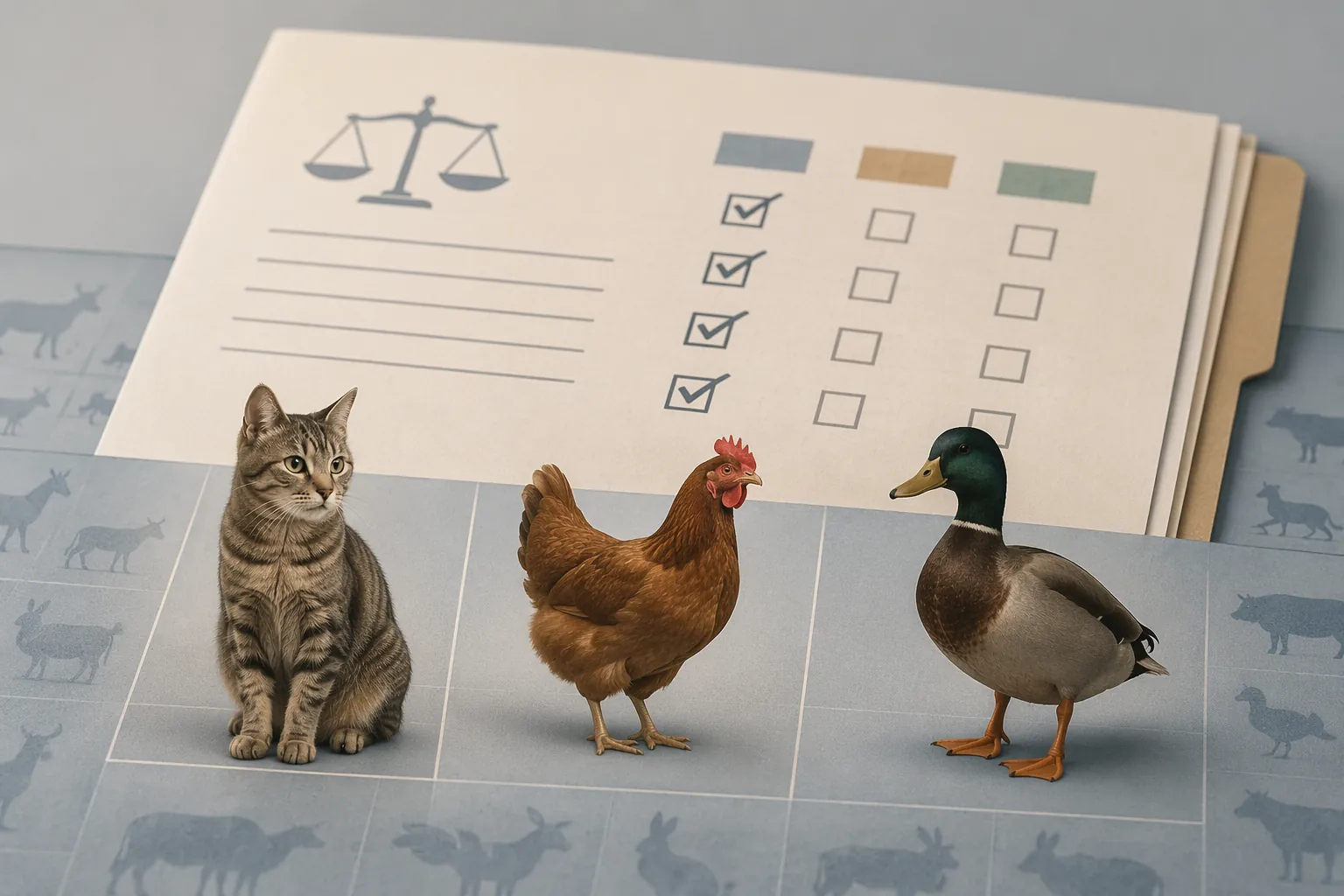
The Summers/Scott matter supplies the sharper filing-risk example because the public release identifies charges. New York State Police reported that two people were arrested in Jefferson and charged with 39 counts under Agriculture and Markets Law § 353 after an investigation involving 22 cats, 2 ducks, and 15 chickens; the release also reported weapons charges, Jefferson Town Court, and appearance tickets for February 2025.[2] No later disposition was located in the reviewed materials.
Those numbers are exactly the kind of neat pattern a drafting system can make look cleaner than the file may be. Twenty-two plus two plus fifteen equals thirty-nine. A model can infer a one-animal-one-count structure very easily. But the public release is not the accusatory instrument. It does not show the text of each count, the supporting deposition for each animal, the statutory element selected for each allegation, or whether the weapons charges were pleaded in the same instrument or separately.
The Carlisle investigation is different and should stay different in the wording. Regional reporting described 78 animals removed from a Carlisle property across six species categories during a July 24–26, 2026 time window, and reported the matter as an active investigation with no charges filed as of July 26, 2026.[3][4] That is a fact-classification pressure point, not yet a filed-charge pressure point. Treating it as a set of filed cruelty counts would be its own verification failure.
Article 26 leaves little room for casual statutory autocomplete
The New York City Bar’s animal-cruelty guide describes animal fighting and cruelty cases in New York as “unfamiliar terrain” for many judges, prosecutors, and defense counsel.[5] That description is more useful than any dramatic flourish about animal neglect. Article 26 is not a statute most town-court practitioners read every week, and the risk rises when a draft must move quickly from mixed animal facts to chargeable statutory language.
In a multi-animal case, hallucination does not need to arrive as a fake appellate citation. The more likely failures are smaller and harder to catch on a hurried read: a generic cruelty phrase substituted for the actual statutory wording; language borrowed from the wrong Article 26 provision; a fact about one animal duplicated across several counts; a species label treated as a legal element when it is only a factual descriptor; or an investigative removal reported as though it were already a filed charge.
| Filing point | AI-assisted failure mode | Human verification question |
|---|---|---|
| Accusatory instrument | Draft repeats one animal fact across multiple counts because the count pattern looks uniform. | Does each count map to a distinct supporting fact and the correct statutory element? |
| Supporting deposition | Draft attributes an observation to the wrong witness or fills a gap from context. | Which person observed the condition, seizure, ownership fact, or location fact? |
| Motion practice | Draft describes the Carlisle investigation as if charges were filed. | Is the matter still an investigation, or is there a filed instrument in a court record? |
| Statutory research | Draft paraphrases Article 26 language from memory or from a secondary summary. | Has the exact current statutory text been checked before filing? |
The Summers/Scott numbers show why count mapping deserves more attention than rhetoric. If a prosecutor files 39 counts, the office needs a defensible path from each count to an animal, a condition or act, a responsible person, and a statutory theory. If defense counsel challenges the filing, counsel has the mirror obligation not to overstate what the public release, the accusatory instrument, or the supporting depositions actually say.
Where Part 161 verification would bite in these matters
Part 161’s practical force is felt before a document is filed. A prosecutor using AI to turn police reports into an information or supporting deposition cannot treat the certification as a footer to be added after the draft looks plausible. The filer must be able to stand behind the legal and factual content that reaches the court.[1]
For a charging instrument, that means checking more than the caption, charge title, and count total. The review has to reach the element language, the factual predicate for each count, and the relationship between the named defendant and the animal or condition alleged. In a repetitive case, the most dangerous line may be the one that looks ordinary because it resembles the line above it.
For a supporting deposition, the risk shifts from legal citation to attribution. AI-generated summaries are prone to smoothing differences between witnesses, dates, observations, and animals. A deposition that says the wrong person saw the wrong condition is not improved by the fact that the overall neglect narrative may be serious. The filing must be accurate at the sentence level.
For motion practice, the risk is often procedural. A defense motion, prosecution response, or discovery letter that collapses the Summers/Scott charged matter and the Carlisle investigation into one procedural posture would create a bad record. Carlisle may later produce charges, but the reviewed public materials described no charges as of July 26, 2026.[3][4]
Sanctions show the weather, not a Schoharie fact
Recent sanction reports explain why the verification question is no longer academic, but they do not prove anything about Schoharie. A Q1 2026 roundup by ComplianceHub.Wiki reported more than $145,000 in U.S. legal-AI hallucination sanctions, including a $110,000 Oregon penalty for factual hallucination, a Nebraska license suspension, and a Fifth Circuit $2,500 sanction involving Thomson Reuters CoCounsel.[6]
The CoCounsel point is worth keeping modest and firm. Enterprise branding does not create a safe harbor for an unverified assertion in a filed paper. The sanction examples are risk weather: they show courts and disciplinary systems treating AI verification failures as real professional events. They are not evidence that any Schoharie prosecutor, defense lawyer, or staff member used AI.
For broader Q3 2026 verification-gap context, see Gemini 3.5 Pro Delay Widens the Verification Gap for Legal AI. For a practical failure-mode approach to checking AI output before it reaches a filing, see ChatGPT Not Working? Here's the Law Firm Fix for Every Failure Mode.
A verification habit that fits a rural criminal file
A workable Part 161 check in this setting does not need to become a metropolitan procurement project. It does need to be visible in the file before filing. For each AI-touched draft, the office or lawyer should be able to identify the source of the statutory language, the source of each fact, the procedural posture, and the person who performed the final human review.
- Keep the AI draft separate from the source-of-truth record. The police report, veterinary record, witness statement, statute, and filed court document remain the sources.
- Use one row per proposed count in a multi-animal case. Record the animal identifier or description, species, alleged condition or act, witness source, statutory provision, and human reviewer.
- Mark pre-charge matters plainly. An investigation involving removed animals is not a charged case until a charging instrument exists.
- Check statutory phrasing against the current law, not against an AI summary or a prior local template.
- Read repetitive counts out of sequence. Similar lines are where duplication, skipped facts, and copied elements hide.
Part 161 makes verification a filing-stage obligation in New York criminal matters. The Schoharie animal-cruelty materials show why the danger is less likely to be one spectacular fake citation than a run of small substitutions: wrong statutory phrasing, duplicated animal facts, unsupported count mapping, or premature treatment of an investigation as a charged case. Those are ordinary filing errors made faster and smoother by AI unless a human reviewer forces every count back to its statute, source fact, and procedural posture.
References
- Effective June 1, 2026, the New York State Unified Court System Has Adopted a New Rule Regarding the Use of Artificial Intelligence, NYSBA
- State Police arrest two for animal cruelty in Jefferson, New York State Police
- 78 Animals Removed from Carlisle, WPDH
- Police: More Than 70 Animals Removed From Schoharie Co. Property, WNYT
- Animal Fighting and Cruelty Cases in New York: A Guide for Judges, Prosecutors, and Defense Counsel, New York City Bar Association
- Legal AI Hallucination Reckoning 2026, ComplianceHub.Wiki
Related records
Tool profile
Is CoCounsel Safe for Law Firm Legal Research?Governing regulation
Browse the obligations tracker →Preventive workflow
Browse verification workflows →
Report a correction or tip
Spotted an outdated figure, a misstated fact, or a ruling this case record should reflect? Public comments are disabled for this content given the professional cost of a misreported case outcome, penalty amount, or rule text — use the structured correction channel instead.
Report a correction or tip for this record →