
Seagate case reveals legal implications of AI storage demand
The Seagate Technology case — from a $300M BIS penalty to a $175M shareholder settlement — demonstrates that surging AI-driven storage demand can expose companies to cascading legal risks spanning export controls, securities disclosure, and antitrust. This article examines how the Seagate precedent creates a repeatable risk model for technology firms navigating overlapping regulatory regimes.
- Jurisdiction
- US Federal
- Court
- U.S. District Court
- AI tool named
- Seagate hard disk drives
- Ruling date
- Jun 1, 2026
- Source document
- View primary court order ↗
- Last verified
- Jul 29, 2026
Lex Machina Review is an independent risk-tracking and reference resource. Nothing on this site is legal advice, and using it does not create an attorney-client relationship. Every record is reviewed against primary sources but may not reflect the most current status of a matter — always verify directly against the cited court order, rule text, or a licensed attorney before relying on it.
Companion explanation — secondary to the source document above
By the time Seagate reached a $175 million shareholder settlement over its Huawei sales in June 2026, the company was also riding the kind of AI storage demand that makes infrastructure suppliers look strategically inevitable rather than legally exposed.[1] Reuters reported on July 28, 2026, that Seagate’s fiscal fourth-quarter revenue was $3.63 billion, up 48.5% year over year, and that its stock had more than doubled in 2026 as demand for AI-driven storage strengthened.[2]
That is the useful tension in the Seagate case. The legal implications of AI storage demand do not begin with a hard drive magically becoming an AI model, or with export controls suddenly treating every data-center component as controlled technology. They begin earlier in the sales workflow, when a component supplier continues serving a restricted customer, revenue exposure becomes material enough to matter to investors, and the company’s public risk language is later judged against what regulators and plaintiffs say the business already knew.
Seagate did not admit or deny the Bureau of Industry and Security’s findings when it resolved the export-control matter. That limitation matters. The 2023 BIS order is not a litigated merits ruling that proves how every future hard-drive or data-center case will come out. But as a disclosure-risk map, the sequence is hard to ignore: export-control theory, proposed charging letter, stock-price reaction, securities complaint, and then a nine-figure shareholder settlement.
The Seagate Cascade Was Built One Operational Step at a Time
The BIS order announced in April 2023 imposed a $300 million administrative penalty on Seagate for alleged violations of U.S. export controls involving sales of foreign-made hard disk drives to Huawei after Huawei became subject to the foreign direct product rule.[3] BIS described it as the largest standalone administrative penalty in the agency’s history.[3]
The point was not that Seagate sold chips. The point was that BIS applied the Huawei foreign direct product rule theory to foreign-made HDDs. Orrick’s analysis of the penalty described the matter as significant because BIS used that theory against non-semiconductor components, a move that should have caught the attention of companies selling into AI and cloud infrastructure without thinking of themselves as semiconductor actors.[4]
According to the later securities complaint described by The D&O Diary, Seagate allegedly sold approximately 7.4 million hard disk drives to Huawei on 429 separate occasions after the Huawei foreign direct product rule took effect, and the complaint alleged that Seagate became Huawei’s sole-source HDD supplier after competitors stopped sales.[5] Those allegations are not the same thing as adjudicated facts, but they explain why the shareholder theory did not depend only on whether an export lawyer could win the BIS issue in a vacuum.
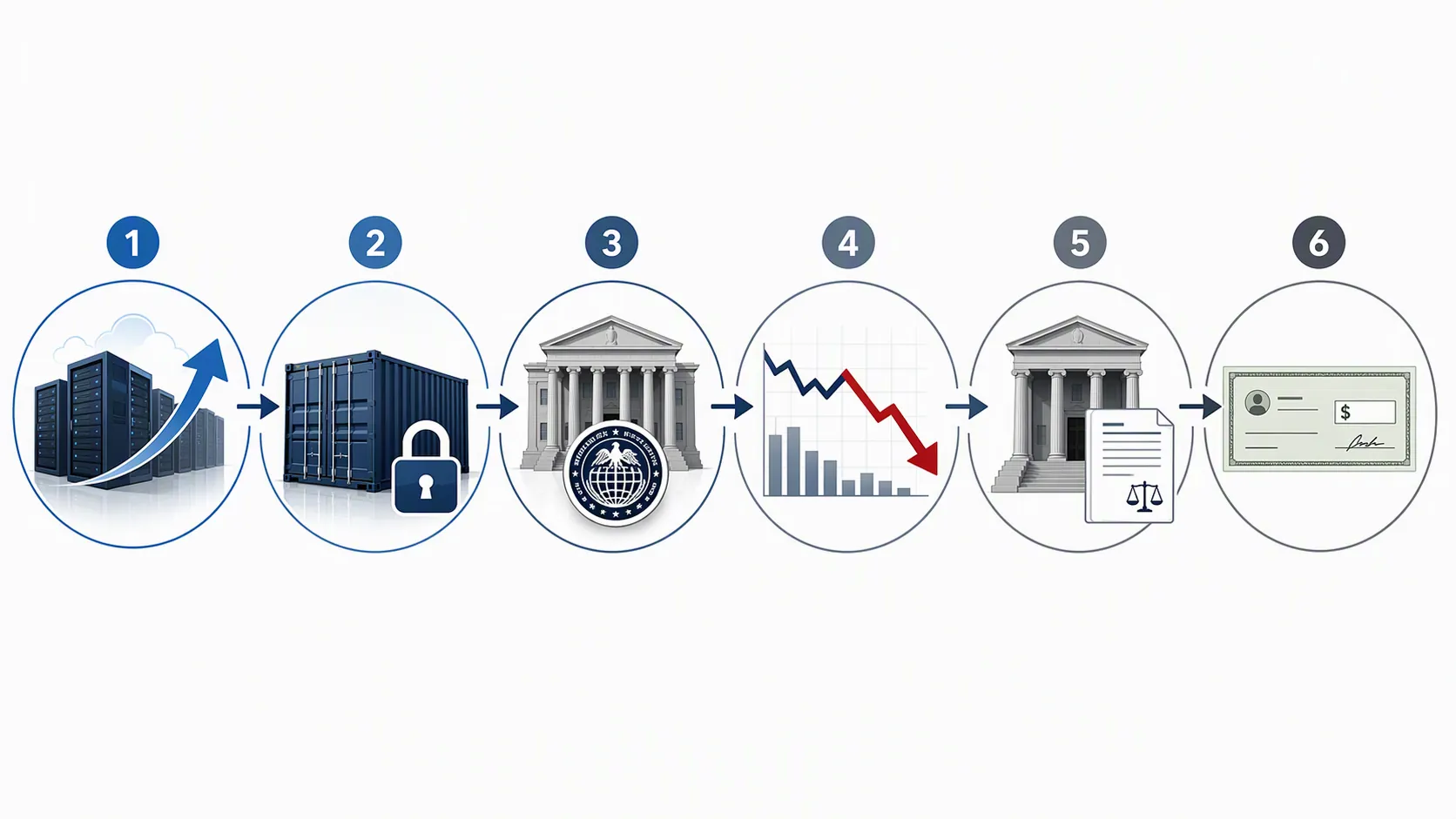
| Stage | What Changed | Why It Mattered Legally |
|---|---|---|
| AI and data-center demand | Storage became a higher-growth infrastructure market | Revenue opportunity made customer exposure more material |
| Huawei sales after rule change | Seagate allegedly continued supplying HDDs after competitors stopped | Export-control risk attached to component sales |
| BIS charging letter | The proposed charging letter became public | The market received a concrete enforcement signal |
| Stock reaction | Seagate shares allegedly fell 8% in one day | Loss causation became easier for plaintiffs to plead |
| Securities litigation | Investors alleged concealment of the nature and magnitude of Huawei sales | Export-control exposure became disclosure litigation |
| Settlement | Seagate reached a $175 million shareholder settlement | The case became a benchmark for cascade risk, not merely export-control risk |
The charging letter was the hinge. The D&O Diary reported that Seagate’s stock price fell 8% in a single day after the October 2022 proposed charging letter was disclosed.[5] For securities plaintiffs, that kind of market movement is not background color. It supplies the alleged correction event that connects regulatory exposure to investor loss.
The complaint’s theory, as summarized in the same account, was that Seagate concealed the nature and magnitude of its Huawei sales and misrepresented the associated compliance risk.[5] That framing is why intent in the underlying export-control matter, while important, does not exhaust the litigation problem. A company can dispute a regulator’s theory and still face a separate claim that its public filings did not give investors a fair description of the exposure.
Why AI Storage Demand Makes the Old Facts Current
The Seagate matter would be easier to file away as a Huawei-era export-control case if the storage market had cooled. It has not. Seagate announced in July 2025 that it had shipped more than 1 million Mozaic drives and was shipping 30TB drives to address global data-center and AI storage demand.[6] A year later, Reuters tied Seagate’s stronger results and forecast to AI-driven storage demand, reporting the $3.63 billion fiscal fourth-quarter revenue figure and the company’s more-than-doubled 2026 stock performance.[2]
That commercial backdrop matters because fast demand can make a restricted or high-risk customer look less like a legal edge case and more like a sales-allocation problem. The business question becomes how to satisfy capacity, qualification, and delivery timelines. The legal question is whether the same customer, end use, destination, or affiliate chain has been translated into a disclosure-grade risk description before a charging letter does the translation for the company.
Hard drives are not AI models. They are also not legally invisible simply because they sit in the infrastructure layer. The Seagate fact pattern is useful precisely because it involved a component that could be described, commercially, as ordinary data-center hardware. BIS’s theory and the securities complaint both treated the component’s placement in the supply chain as legally consequential.
The 2025 BIS Guidance Weakens the Comfort of Not Knowing
The forward-looking part of the Seagate model rests less on the 2023 penalty amount than on BIS’s later articulation of knowledge risk for data-center infrastructure. Morgan Lewis, discussing U.S. export-control considerations for global data-center projects, described BIS’s May 2025 guidance on General Prohibition 10 as emphasizing that the knowledge standard includes not only actual knowledge but also awareness of a high probability that a violation has occurred or is intended to occur.[7]
That does not make the guidance a new regulation, and it may be tested in future enforcement actions. But it does change the practical value of a narrow internal answer such as “we were not told the exact prohibited end use.” For data-center suppliers, cloud infrastructure vendors, resellers, and component manufacturers, the more relevant question is whether the facts in the sales channel created a high-probability destination or end-use problem that the company chose not to resolve.
A high-probability standard puts pressure on the parts of the business that often sit below executive disclosure review: customer onboarding, distributor certifications, exception approvals, contract renewals, escalation logs, shipping holds, and revenue forecasts by account. If those records show repeated unresolved flags, later securities disclosure will be judged against the internal map, not only against the most favorable legal memo.

What the Shareholder Settlement Adds
The $175 million settlement is not just a large number appended to a regulatory case. It shows how a resolved or disputed export-control matter can remain financially active after the agency order. Law.com reported that the investor case was co-led by Bernstein Litowitz Berger & Grossmann and Motley Rice, with Seagate represented by Wilson Sonsini, and that the parties reached the $175 million deal in June 2026.[1]
For a public company, the key lesson is not that every export-control settlement creates securities liability. The research record here supports a narrower proposition: where the alleged sales exposure is large, repeated, tied to a restricted counterparty, followed by a market-moving enforcement disclosure, and allegedly inconsistent with the company’s prior public risk language, the export-control event can become a securities event.
The Portable Risk Model
The Seagate pattern becomes relevant to another AI infrastructure company only when several conditions line up. The company does not need to sell the “AI system” itself. It needs a component, service, platform, or capacity commitment that is important enough to the AI supply chain, and a customer or destination profile that turns ordinary growth into controlled exposure.
- A high-growth infrastructure product whose demand is visible to investors.
- Sales to a restricted, high-risk, or politically sensitive customer, affiliate, destination, or end-use channel.
- Internal records showing repeated shipments, approvals, exceptions, or unresolved escalation signals.
- Public disclosures that describe export-control risk generally while omitting the scale or specificity of the exposure.
- A regulator action, charging letter, subpoena disclosure, or other event that makes the exposure concrete for the market.
- A stock-price movement large enough to support a securities plaintiff’s loss-causation theory.
Other regimes can overlap with this model. Antitrust scrutiny may matter where AI infrastructure capacity is concentrated among a small number of suppliers or customers. Data-sovereignty rules may matter where storage architecture crosses borders or localizes regulated data. But the Seagate materials do not support treating those regimes as the central cascade. The documented path runs from export-control exposure to market disclosure to securities litigation.
The operational test is whether legal review can trace the exposure before plaintiffs do. If a storage supplier knows which accounts are driving AI-related growth but cannot connect that account-level picture to restricted-party screening, end-use review, shipment approvals, and risk-factor drafting, the company has a translation problem. Seagate shows how expensive that translation problem can become once an enforcement agency supplies the missing narrative.
Where Seagate Should and Should Not Be Used
Seagate should not be cited as proof that all AI storage demand is legally dangerous. The better reading is more disciplined. Demand growth increases the commercial incentive to maintain or expand supply into difficult channels. Export controls define which of those channels require elevated review. Securities law then asks whether investors were told enough about the risk once the exposure became material.
Nor should the case be flattened into a morality play about intent. BIS settled with Seagate without an admission or denial of findings.[3] The securities settlement likewise resolves litigation without creating a trial-tested liability rule. Those limits do not make the sequence irrelevant; they identify exactly why the case is most useful to disclosure counsel. Litigation risk can mature before the underlying export-control theory has been tested to final judgment.
For companies selling drives, servers, accelerators, networking equipment, colocation capacity, or other AI-adjacent infrastructure, the benchmark is not whether the product feels like the center of the AI stack. The benchmark is whether high-probability end-use or destination facts are present, whether those facts are visible in the revenue stream, and whether the company’s public risk description would still read as accurate after a regulator describes the same sales pattern in a charging letter.
References
- Seagate Reaches $175M Deal to End Investor Lawsuit Over Huawei Sales, Law.com, June 1, 2026
- Seagate forecasts upbeat quarter on strong AI-driven storage demand, Reuters, July 28, 2026
- BIS Order, Bureau of Industry and Security
- Seagate Export Control Penalty Shows New Aggressive China Trade Enforcement, Orrick, April 2023
- Trade and Export Control Enforcement Leads to Securities Class Action Suit, The D&O Diary, July 2023
- Seagate Ships 30TB Drives to Meet Global Surge in Data Center AI Storage Demand, Seagate, July 2025
- Key US Export Controls Considerations for Global Data Center Projects, Morgan Lewis, February 2026
Related records
Tool profile
Browse tool evaluations →Governing regulation
Browse the obligations tracker →Preventive workflow
Browse verification workflows →
Report a correction or tip
Spotted an outdated figure, a misstated fact, or a ruling this case record should reflect? Public comments are disabled for this content given the professional cost of a misreported case outcome, penalty amount, or rule text — use the structured correction channel instead.
Report a correction or tip for this record →