
What Due Process Rights Apply to Sean Combs' Solitary Confinement?
When a federal inmate like Sean Combs is placed in solitary after a disciplinary infraction, the BOP's regulatory framework under 28 CFR Part 541 provides limited due process protections that litigators often overlook. This article maps what Wolff v. McDonnell requires, where the protections fall short, and why the enforcement gap matters for client advice.
- Jurisdiction
- US Federal
- Court
- Federal District Court
- AI tool named
- None
- Ruling date
- Jul 24, 2026
- Source document
- View primary court order ↗
- Last verified
- Jul 25, 2026
Lex Machina Review is an independent risk-tracking and reference resource. Nothing on this site is legal advice, and using it does not create an attorney-client relationship. Every record is reviewed against primary sources but may not reflect the most current status of a matter — always verify directly against the cited court order, rule text, or a licensed attorney before relying on it.
Companion explanation — secondary to the source document above
If Sean “Diddy” Combs was placed in disciplinary segregation after the reported July 24, 2026 fight, the first useful legal question is not whether solitary confinement sounds severe. It is whether the Bureau of Prisons created, served, reviewed, and preserved the disciplinary record that federal prison law requires. The legal implications of Combs’s reported solitary confinement turn less on the label “solitary” than on a sequence of papers: the incident report, the Unit Disciplinary Committee review, any Discipline Hearing Officer referral, the written decision, the sanction notice, and the administrative remedy filings that follow.
The release-date and sanction-quantification question is a separate problem. The site has already addressed that angle in Sean Combs' Prison Fight: Quantified BOP Sanction Risk. This article stays with the procedure that decides whether sanctions can be imposed and later challenged. That distinction matters because a lawyer advising a client before the hearing is not yet writing a broad conditions complaint. Counsel is trying to stop a bad record from becoming the only record.
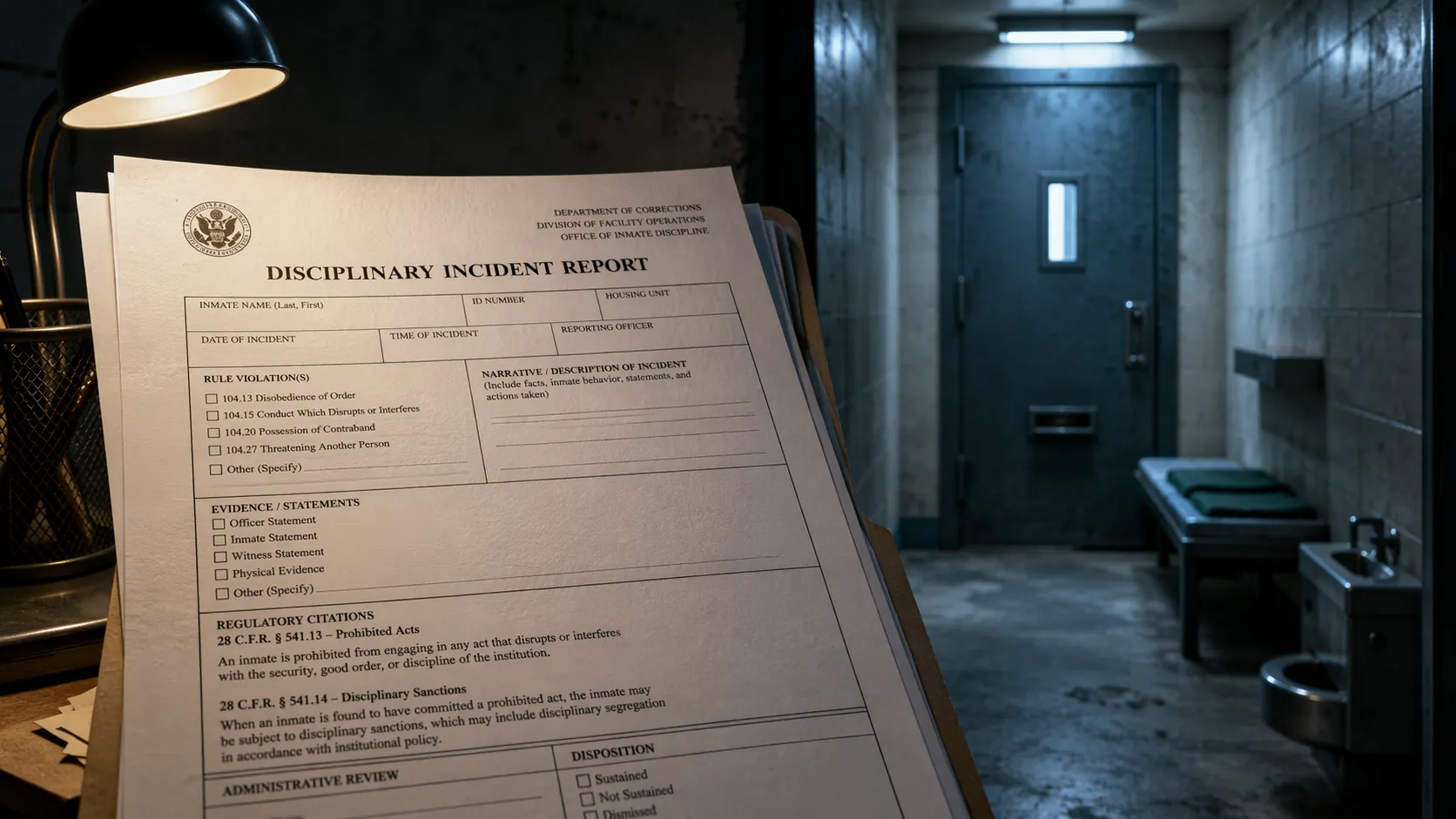
Start With the Charge, Not the Cell
A reported fight in federal custody points first to the BOP’s inmate discipline code. Fighting is listed as prohibited act Code 201, a High Severity Level offense in the BOP discipline framework discussed in the 2024 Federal Register proposed rule on inmate discipline and disciplinary segregation.[1] That does not prove Combs was charged under Code 201. Public information does not yet confirm the charge code used, whether a UDC or DHO hearing has occurred, or how long any segregation lasted. The point is narrower: if the BOP treated the incident as a High Severity disciplinary matter, the legal analysis has to track the disciplinary process before it leaps to a constitutional label.
That process is not ornamental. For a High Severity charge, the potential consequences can reach beyond discomfort and loss of routine privileges. The 2024 proposed rule described possible sanctions including disciplinary segregation, loss of privileges, forfeiture of up to 27 days of First Step Act earned time credits, and forfeiture of up to 50 percent of available good conduct time, identified there as 14 to 27 days.[1] If credits are at stake, the hearing record can affect more than housing status. It can affect the release calculus.
There is an important caution on the segregation numbers. The 2024 proposal would cap first-offense disciplinary segregation for High Severity acts at 30 days, replacing an older framework under which a first High Severity offense could allow up to 180 days.[1] The Federal Register document cited here was a proposed rule, with comments due April 1, 2024.[1] Unless final-rule status is verified for the facility and date in question, a careful analysis should present both possibilities rather than treating the 30-day cap as settled law in July 2026.
The BOP Workflow Counsel Should Audit
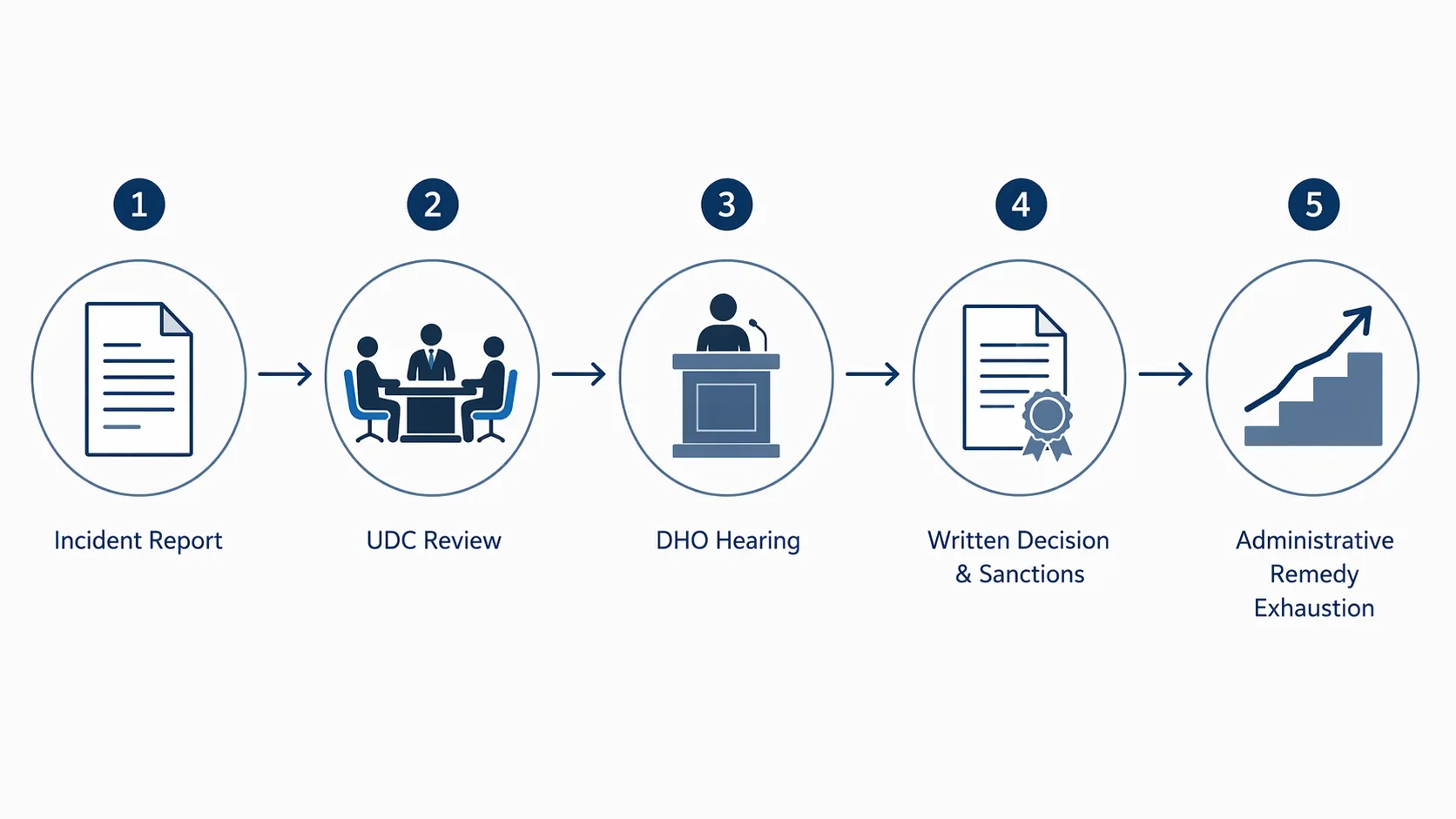
For client advice, the most useful way to read 28 CFR Part 541 is chronologically. The lawyer wants to know what should have happened, when it should have happened, who made the next decision, and what document should now exist. The 2024 proposed rule describes the familiar path: an incident report is ordinarily issued within 24 hours of staff becoming aware of the conduct; the UDC ordinarily reviews the matter within five workdays; unresolved or serious matters can be referred to a DHO for a formal hearing.[1]
| Stage | What Counsel Is Looking For |
|---|---|
| Alleged fight | Whether the conduct was classified as Code 201 or another prohibited act |
| Incident report | Whether written notice was timely and specific enough to prepare a defense |
| UDC review | Whether the review occurred within the expected workday window and whether referral was justified |
| DHO hearing | Whether witnesses, documentary evidence, staff representation, and postponements were handled on the record |
| Written decision | Whether the evidence relied on and reasons for sanctions were actually stated |
| Administrative remedy | Whether BP-8 through BP-11 exhaustion was preserved before federal litigation |
The incident report is where a future due process argument often begins or dies. It should tell the inmate what conduct is charged, not merely communicate that staff are angry or that an investigation occurred. If the report is vague, late, changed without explanation, or served too close to a hearing, counsel should preserve that issue immediately. The question is not whether the inmate already knows there was a fight. The question is whether the BOP gave usable written notice of the charge it intends to prove.
The UDC stage is easy to underestimate because it is not the final hearing. That is a mistake. The UDC can resolve lesser matters, but for a High Severity charge it may refer the case to a DHO. The five-workday review expectation described in the BOP materials gives counsel a concrete date to check.[1] If the UDC review was delayed, the next question is whether the record explains why. A delay with a documented reason is a different litigation fact from a delay that appears only when counsel reconstructs the timeline from memory.
The DHO referral is where the process becomes most consequential. At that point, counsel should be asking practical questions: Did the inmate receive advance written notice? Did he request witnesses? Were witnesses denied, and if so, was the reason tied to institutional safety or correctional goals? Was documentary evidence requested? Was staff representation offered or needed? Was the hearing postponed? Was the DHO decision delivered in writing? None of those questions requires a sweeping theory about prison isolation. They require the file.
What Wolff Gives, and What It Does Not
The constitutional baseline comes from Wolff v. McDonnell. In prison disciplinary proceedings involving good-time consequences, Wolff requires advance written notice of the charges at least 24 hours before the hearing, a written statement of the evidence relied on and reasons for the disciplinary action, and an opportunity to call witnesses and present documentary evidence when doing so would not be unduly hazardous to institutional safety or correctional goals.[2]
Those protections are real, but they are deliberately limited. Wolff does not turn a DHO hearing into a criminal trial. It does not create a general constitutional right to counsel in the disciplinary hearing. It does not create an ordinary right to confrontation or cross-examination.[2] A defense lawyer who walks into the problem expecting trial rights will miss the available pressure points. The enforceable questions are usually narrower: notice, opportunity to present evidence, witness handling, written reasons, and whether the sanction rested on an adequate disciplinary record.
That narrowness can feel unsatisfying because segregation is severe. But severity alone does not answer the due process question. Wolff was about the loss of good-time credits, not disciplinary segregation standing by itself.[2] After Sandin v. Conner, courts have treated the existence of a protected liberty interest in segregation as a more fact-bound question, often asking whether the conditions impose an atypical and significant hardship in relation to ordinary prison life. The result is not a clean national rule that every segregation placement automatically triggers the full Wolff framework.
That is why credit loss matters so much. If the DHO proceeding threatens good conduct time or earned time credits, Wolff is a more direct route into due process. If the only sanction is a short segregation placement, the due process argument may have to work harder, and Sandin becomes a larger obstacle. A conditions claim may still be possible on the right facts, but it is not a substitute for auditing the disciplinary record while deadlines are still alive.
Why the Written Decision Matters More Than the Rhetoric
The written DHO decision is not just a closing form. It is the document that tells later reviewers what evidence mattered and why the sanction was imposed. A conclusory decision creates a different problem from an unfavorable decision. “Staff report credited over inmate denial” may be thin, but it at least identifies the evidentiary choice. A decision that does not explain the evidence relied on, does not address requested witnesses, or does not connect the sanction to the finding gives counsel something concrete to challenge.
Witness requests deserve special attention. Wolff allows prison officials to refuse witnesses when testimony would be unduly hazardous to safety or correctional goals.[2] That exception is broad, and courts give prison officials substantial room. Still, “broad” is not the same as “invisible.” Counsel should look for whether the witness was requested, whether the request was recorded, whether the denial was explained, and whether the explanation is specific enough to survive review.
The same is true of documentary evidence. Video, medical notes, photographs, staff memoranda, and separation orders may matter in a fight case, but the disciplinary system will not necessarily behave like discovery in criminal court. The immediate task is to make the request, get the denial or production into the record, and avoid letting the agency later say the issue was never raised.
Administrative Exhaustion Is Part of the Merits Strategy
A disciplinary due process issue is not preserved merely because the inmate complained to staff or because counsel sent a letter. The BOP Administrative Remedy Program under 28 CFR Part 542 uses a staged path commonly described as BP-8, BP-9, BP-10, and BP-11. In practice, that means informal resolution, a formal institutional request, a regional appeal, and a central office appeal. For federal habeas or civil litigation tied to prison discipline, failure to exhaust can become the first defense argument before anyone reaches Wolff.
The exhaustion record should track the same issues counsel may later raise in court. If the claim is late notice, say so. If the claim is improper witness denial, identify the witness request and the denial. If the claim is an inadequate written decision, quote or describe the defect. General objections to unfair treatment rarely do the same work as a remedy filing that identifies the procedural violation.
This is especially important for a high-profile inmate. Public attention can create the illusion that the dispute is already preserved because everyone knows about it. The BOP record does not work that way. A missed administrative deadline can narrow the later case even if the incident received national coverage.
The Reform Backdrop Does Not Replace the Individual Record
The BOP has not been blind to restrictive-housing concerns. The 2024 proposed rule stated that disciplinary segregation populations declined 22 percent from 2012 to 2021 and tied the proposal to the Department of Justice’s 2016 restrictive-housing reform work.[1] Those facts explain why the agency was revisiting disciplinary segregation policy. They do not prove what happened in Combs’s case, and they do not establish that any specific segregation placement is lawful or unlawful.
That distinction is where much of the public commentary goes wrong. Systemic concern about isolation may be relevant to policy, sentencing advocacy, or a conditions case with developed facts. A disciplinary challenge starts smaller. It asks whether this inmate received the process required for this charge before this sanction was imposed.
What Counsel Should Preserve Before the Record Hardens
The practical checklist is short because the window is short. Counsel should obtain the incident report, identify the charge code, calculate the notice period, confirm the UDC review date, determine whether the case was referred to a DHO, request the DHO packet, and secure the written decision. If witnesses or documents were requested, counsel should preserve the request and any stated reason for denial. If credits were forfeited or segregation was imposed, counsel should match the sanction to the authority the BOP invoked.
- Ask for the exact prohibited act code, not a verbal description of the incident.
- Compare the incident-report service date with the hearing date.
- Check whether UDC timing is documented and whether any delay is explained.
- Identify every witness or document requested before the DHO.
- Read the written decision for evidence relied on, reasons given, and sanction authority.
- Calendar the BP-8 through BP-11 path before discussing federal filing.
None of this guarantees relief for Combs or for any other federal inmate. The rights are limited, prison officials receive deference, and segregation alone may not always create the protected liberty interest a litigant wants. But a missed notice requirement, an unexplained witness denial, a deficient written decision, or a failure to preserve the administrative remedy path can be more immediately important than a broad constitutional theory. The first legal task is to audit the BOP process against the regulatory baseline, then decide what kind of claim the record can actually carry.
References
- Inmate Discipline Program: Disciplinary Segregation and Prohibited Act Code Changes, Federal Register, Feb. 1, 2024.
- U.S. Supreme Court Cases, Solitary Watch.
Related records
Tool profile
Browse tool evaluations →Governing regulation
Browse the obligations tracker →Preventive workflow
Browse verification workflows →
Report a correction or tip
Spotted an outdated figure, a misstated fact, or a ruling this case record should reflect? Public comments are disabled for this content given the professional cost of a misreported case outcome, penalty amount, or rule text — use the structured correction channel instead.
Report a correction or tip for this record →