
First Federal Section 47.1 Fee Award in Lively v. Wayfarer
Judge Liman's June 12, 2026 fee-entitlement ruling in Lively v. Wayfarer Studios marks the first successful federal application of California Civil Code § 47.1, establishing a qualified privilege and mandatory fee-shifting framework for retaliatory-defamation counterclaims. This entry covers the three first-impression holdings—privilege assessment at the pleading stage, Erie applicability, and constitutional validity—and identifies the unresolved fee-reasonableness phase that follows.
- Jurisdiction
- US Federal
- Court
- U.S. District Court for the Southern District of New York
- Judge
- Lewis Liman
- AI tool named
- None
- Ruling date
- Jun 12, 2026
- Source document
- View primary court order ↗
- Last verified
- Jul 28, 2026
Lex Machina Review is an independent risk-tracking and reference resource. Nothing on this site is legal advice, and using it does not create an attorney-client relationship. Every record is reviewed against primary sources but may not reflect the most current status of a matter — always verify directly against the cited court order, rule text, or a licensed attorney before relying on it.
Companion explanation — secondary to the source document above
The ruling is fee entitlement, not an $8 million award
Judge Lewis Liman’s June 12, 2026 order in the Blake Lively–Wayfarer legal fee dispute did not award Lively a final fee total. It ruled that she is entitled to recover fees and costs under California Civil Code § 47.1 after defeating Wayfarer’s defamation counterclaims in federal court. That distinction matters: the court has crossed the entitlement threshold, but the dollar amount remains in active dispute. The ruling is therefore best read as a federal risk marker for retaliatory-defamation counterclaims tied to harassment or workplace-discrimination reports, not as a completed damages or fee judgment. [1][2]
The underlying merits posture explains why the fee motion existed. In June 2025, the court dismissed Wayfarer’s counterclaims in a 132-page ruling that treated the claims as barred by California’s litigation privilege and the fair report privilege. That dismissal did the first round of privilege work; the June 2026 order then asked whether § 47.1 added a mandatory fee-shifting consequence once Lively had prevailed. [3]

What Section 47.1 added
Section 47.1 is a California statute enacted through AB 933 and effective January 1, 2024. In broad terms, it extends qualified privilege protection to certain communications involving sexual assault, sexual harassment, and workplace-discrimination complaints, and it includes mandatory fee-shifting when a defendant prevails and the court finds the protected communication was made without malice. [4]
That design makes the statute more than a pleading defense. If it applies, a defamation plaintiff or counterclaimant faces not only dismissal risk but also downstream fee exposure. In a federal case, however, that consequence had to survive several threshold questions before it could become operational: whether the privilege could be assessed at the pleading stage, whether the state fee-shifting rule applied in federal court, and whether the statute itself could withstand constitutional objections.
The three-part framework counsel will reuse
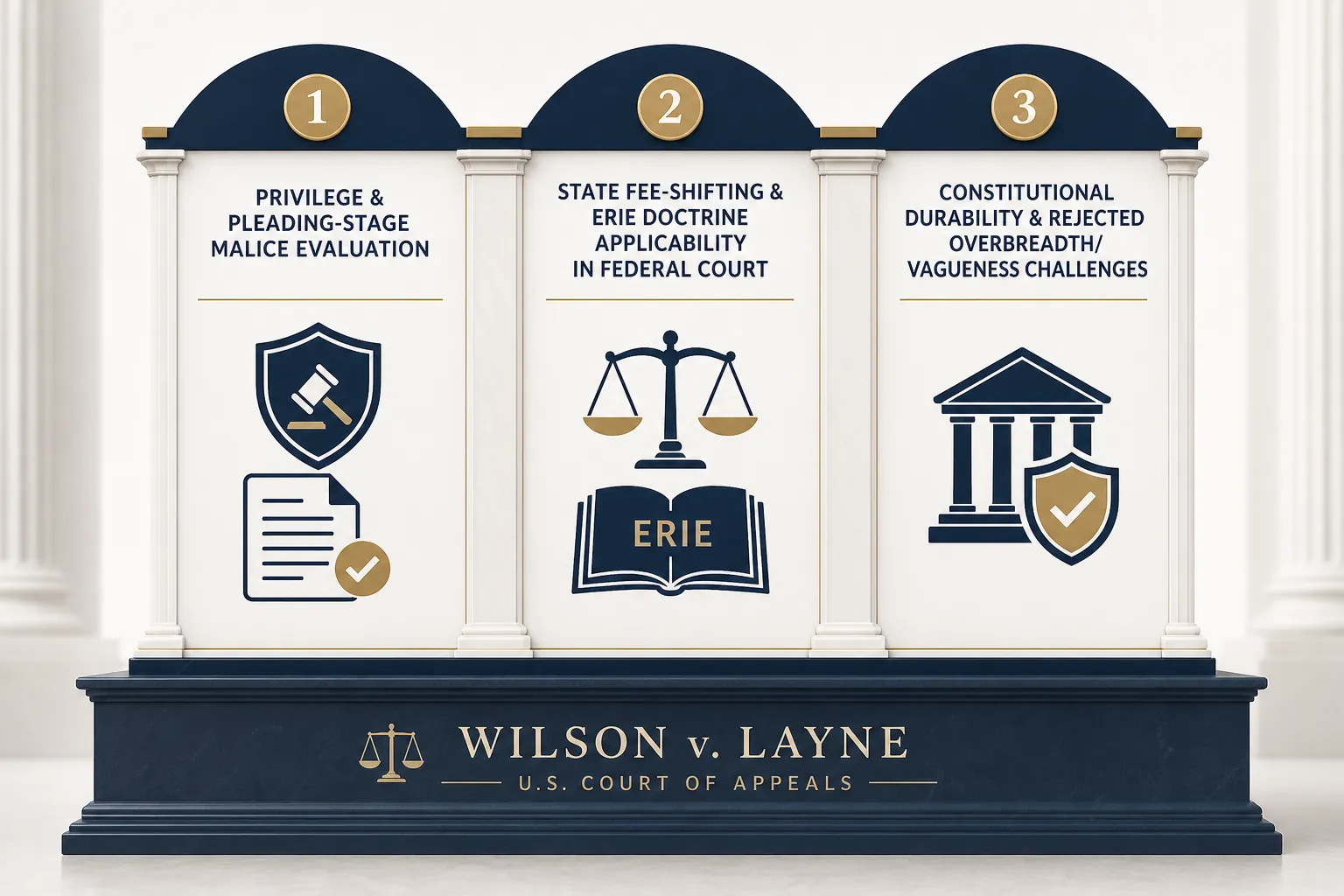
The useful part of Judge Liman’s 47-page order is not the celebrity caption. It is the sequence. A lawyer evaluating a defamation counterclaim against a harassment or discrimination complainant now has a federal SDNY roadmap: test the privilege and malice record first, then the federal applicability of the fee-shifting remedy, then the constitutional objections to the statute. [2]
Privilege and malice came first
The court treated § 47.1’s qualified privilege as usable at the pleading-stage posture rather than postponing the question until a later evidentiary phase. That matters because fee exposure becomes visible much earlier if the court can decide, on the available record, that the challenged communications fall within the statute and were made without malice. The order found Lively’s statements protected by the § 47.1 qualified privilege and concluded that the record showed they were made without malice. [1][2]
This is the point that changes counterclaim evaluation. A defamation counterclaim may still be filed as reputational defense strategy, but if it targets protected reporting activity and cannot plausibly support malice, it can become a fee-shifting event. The court’s approach does not make every harassment-related statement untouchable; it makes the malice showing the practical hinge.
The Erie ruling made the remedy usable in SDNY
Wayfarer challenged whether § 47.1’s mandatory fee-shifting mechanism could apply in federal court. Judge Liman rejected that challenge under Erie, allowing the California fee-shifting rule to operate in the Southern District of New York. That holding is the order’s most portable federal-court feature, but it is not automatically nationwide in the way a Supreme Court rule would be. Other federal circuits may frame state fee-shifting statutes differently when Erie and federal procedure collide. [1][2]
For case assessment, the immediate lesson is narrow but important: in this SDNY posture, a defendant who defeats a covered retaliatory-defamation claim can invoke the California statute’s mandatory fee consequence. Counsel outside the Second Circuit should still run the local Erie analysis before treating the ruling as a guaranteed template.
The constitutional objections did not stop the statute
The order also rejected Wayfarer’s constitutional attacks on § 47.1, including First Amendment overbreadth and due process vagueness objections. That part of the ruling prevents the statute from being treated as merely aspirational until constitutional validity is sorted out. In this case, the court treated the statute as enforceable and moved from validity to entitlement. [1][2]
The constitutional ruling should not be overstated. It does not answer every possible challenge to every future application of § 47.1. It does give defendants a litigated answer to two predictable objections when the statute is invoked after dismissal of a defamation claim tied to protected complaint activity.
The unresolved fight is reasonableness
The next phase is not ceremonial. On June 30, 2026, Lively sought $8,035,040.88, consisting of $7,495,526.87 in attorneys’ fees and $539,514.01 in costs. That is a pending request, not an awarded sum. Reports that flatten the posture into “Lively won $8 million” skip the reasonableness fight that federal courts ordinarily take seriously. [6][7]
Wayfarer’s July 13, 2026 opposition attacked the size of the request, pointing to 82 timekeepers and 7,070.20 hours. It also cited the New York Times’s separate $181,622.70 fee request as a comparator. That comparison has an obvious procedural limitation: the Times matter reportedly involved no discovery, while Lively’s fee request arises from a different litigation track. The comparator may still appear in the reasonableness briefing, but it cannot do all the work by itself. [6][7]
The entitlement order also drew a remedial boundary. Lively sought treble and punitive damages through the fee motion, but the court denied that request, holding that those remedies could not be awarded through the fee-motion vehicle and would require a separate counterclaim or independent action. Section 47.1 entitlement therefore accomplished something substantial, but not everything a prevailing defendant might want. [1][2]
How far the ruling travels
The “first” label needs careful scope. Willkie Farr described the ruling as the first time § 47.1’s qualified privilege had been applied successfully in federal court and the first time a prevailing defendant had obtained fee-and-cost entitlement under the statute. That is the useful formulation: first successful federal application, based on the available materials, rather than a universal claim about every possible § 47.1 proceeding. [2]
There is also a state-court parallel. Advocate Magazine describes Young v. Alameda Health System as a September 2025 Alameda County Superior Court judgment and presents it as the first state-court § 47.1 judgment. Because that “first” characterization comes from the prevailing attorneys’ own practitioner article and has not been independently verified against all California trial court records, it is useful as a roadmap, not as a final census of California trial-court activity. [5]
As of Q3 2026, the risk judgment is straightforward. Counsel now have a durable SDNY framework for § 47.1 entitlement: pleadings-stage privilege and malice analysis, Erie-compliant application of mandatory fee-shifting, and rejection of facial constitutional attacks in this posture. They do not yet have a final reasonable-fee number. They also should not assume that a California-specific fee-shifting statute will move through every federal circuit exactly as it did before Judge Liman.
References
- Judge awards Blake Lively legal fees in 'It Ends with Us' feud with Justin Baldoni — Courthouse News Service
- Willkie Wins Precedent-Setting Fee Award for Blake Lively After Defeating Defamation Suit — Willkie Farr & Gallagher LLP, June 2026
- Lively v. Wayfarer Studios LLC — Loeb & Loeb LLP, June 2025
- California Extends Defamation Privilege Defenses to Assault, Sexual Harassment, and Workplace Discrimination Complainants — Ogletree Deakins
- New California law protects sexual assault/harrassment survivors from retaliatory lawsuits — Advocate Magazine, June 2026
- Justin Baldoni Challenges Blake Lively’s Stunning Request For Nearly $8 Million In Attorneys’ Fees — Forbes, July 14, 2026
- Justin Baldoni Challenges Blake Lively Legal Fee Request — People
Related records
Tool profile
Browse tool evaluations →Governing regulation
Browse the obligations tracker →Preventive workflow
Browse verification workflows →
Report a correction or tip
Spotted an outdated figure, a misstated fact, or a ruling this case record should reflect? Public comments are disabled for this content given the professional cost of a misreported case outcome, penalty amount, or rule text — use the structured correction channel instead.
Report a correction or tip for this record →