
Perjury allegations against Sheriff Nanos create Brady risk in Guthrie case
Formal perjury allegations against Sheriff Chris Nanos, lead investigator in the Nancy Guthrie disappearance, create a public Giglio record that obligates prosecutors to disclose his disciplinary history and deposition denials if charges are filed. Defense counsel can demand this material at the outset of any related prosecution.
- Jurisdiction
- Arizona (Pima County)
- Court
- U.S. District Court for the District of Arizona
- Judge
- Raner C. Collins
- AI tool named
- None
- Ruling date
- May 12, 2026
- Source document
- View primary court order ↗
- Last verified
- Jul 31, 2026
Lex Machina Review is an independent risk-tracking and reference resource. Nothing on this site is legal advice, and using it does not create an attorney-client relationship. Every record is reviewed against primary sources but may not reflect the most current status of a matter — always verify directly against the cited court order, rule text, or a licensed attorney before relying on it.
Companion explanation — secondary to the source document above
The first litigation risk signal in the Nancy Guthrie case is not that Pima County supervisors removed Sheriff Chris Nanos. They did not. On May 12, 2026, the Board of Supervisors voted 4-0 against removing him, while also voting to refer perjury allegations against him to the Arizona Attorney General’s Office for investigation.[1] That combination matters: no removal, no perjury charge, no Guthrie-related criminal charge as of July 31, 2026 — but a public referral record now exists.
For any future prosecution arising from the Guthrie investigation and the sheriff-FBI evidence dispute, that record is not background noise. It is the kind of credibility file defense counsel will ask for before witness lists are finalized: prior law-enforcement discipline, the deposition answer at issue, the Attorney General referral, and any related personnel or investigative material bearing on Nanos’s credibility as the official leading the investigation.

That does not mean Nanos committed perjury. It does not mean prosecutors have already violated Brady or Giglio. Those duties attach in the posture of a prosecution, and the Guthrie investigation remains active without filed charges. The narrower point is more useful and more durable: if prosecutors later use Nanos as a witness, rely on his investigative decisions, or defend evidence-handling choices he supervised, the public record already gives defense counsel a specific impeachment path.
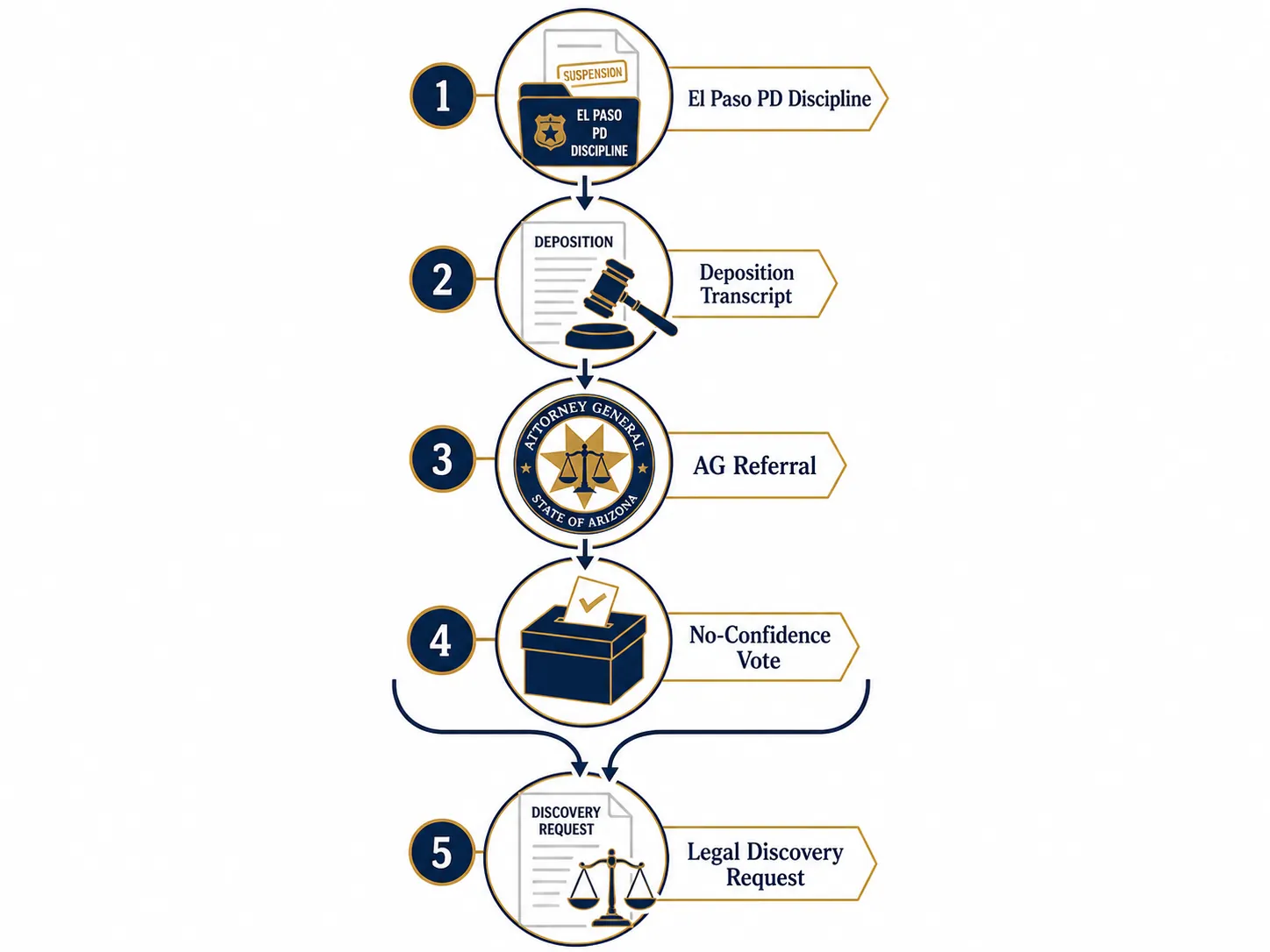
The Public Record Now Has Four Impeachment Anchors
The chain begins before the Guthrie investigation. CBS News reported that El Paso Police Department records showed Nanos had been suspended multiple times before joining the Pima County Sheriff’s Department in the 1980s, including discipline for alleged “unnecessary violence” and tardiness.[2] CBS also reported the contested deposition issue: Nanos allegedly denied under oath that he had been suspended, while his attorney responded that “Sheriff Nanos did not understand the question related to discipline with a different agency.”[2]
That response is not a footnote. It is the defense narrative to the perjury allegation, and any serious risk record has to carry it. A misunderstanding explanation may blunt an accusation of knowing false testimony. It does not erase the impeachment value of the underlying materials if Nanos later testifies about the Guthrie investigation or if prosecutors ask a court to rely on his account of investigative events.
The Board’s May 12 action then moved the dispute from public controversy into a more formal lane. The failed removal vote can be cited by Nanos’s defenders to argue that the available record did not justify removal. The Attorney General referral can be cited by defense counsel to argue that the credibility issue was serious enough for elected county officials to preserve and forward for outside review.[1]
KOLD also reported that Supervisor Rex Scott said more than 250 members of the Pima County Deputies Organization had expressed a vote of no confidence in Nanos.[1] A no-confidence vote is not proof of perjury, misconduct in the Guthrie case, or unreliability in a particular piece of evidence. But in discovery practice, it is a marker that defense counsel may use to seek personnel, internal-affairs, and credibility records rather than accept a narrow production limited to the charged facts.
| Public item | What it establishes | What it does not establish | Likely defense demand |
|---|---|---|---|
| El Paso Police Department discipline | Reported prior suspensions before Nanos joined Pima County | Misconduct in the Guthrie investigation | Complete disciplinary file, suspension records, agency correspondence |
| Deposition denial and counsel response | A contested sworn-answer issue exists | A perjury conviction or finding | Deposition transcript, exhibits, errata, related pleadings |
| Arizona Attorney General referral | County supervisors created a formal referral record | A filed criminal charge against Nanos | Referral packet, communications, status of any AG review |
| No-confidence vote | Documented internal confidence dispute involving more than 250 members | Proof that any Guthrie evidence was mishandled | Personnel credibility files, internal complaints, command-review records |
Why the FBI Evidence Dispute Makes Credibility Material
The FBI access dispute is not the legal engine of the perjury issue. It is the surrounding condition that can make investigator credibility harder to treat as collateral. Reuters reported in February 2026 that the FBI had been blocked from access to glove and DNA evidence in the Nancy Guthrie abduction investigation, citing a source.[3] If a later defense theory challenges evidence handling, investigative sequencing, or interagency decision-making, the credibility of the sheriff leading the investigation may become material rather than merely embarrassing.
That is the practical difference between a personnel controversy and a Giglio problem. A stale disciplinary issue involving an officer who never touches the case may stay outside the center of discovery. A disputed sworn statement by the lead investigator in a case already marked by contested evidence access is different. The defense does not need to prove the perjury allegation at arraignment to ask why the prosecution did not disclose it.
Newsweek later reported that an attorney said the investigation was entering a new stage, with glove DNA traced to a restaurant employee and mixed DNA still part of the status picture.[4] That update should be handled carefully. It does not prove the FBI-access dispute affected the outcome, and it does not connect Nanos to misconduct. It does show why the evidence lane remains live. When DNA, chain of custody, and investigative access are still part of the public status record, the lead investigator’s credibility is not an abstract employment issue.
What Brady and Giglio Would Require If Charges Are Filed
Giglio requires prosecutors to disclose evidence that can impeach a government witness’s credibility, including material bearing on truthfulness, bias, benefits, or credibility defects.[5] Brady requires disclosure of material evidence favorable to the accused, including exculpatory and impeachment evidence.[6] In a future Guthrie prosecution, those doctrines would not wait for defense counsel to guess the right search terms. The prosecution team would have to identify and disclose material credibility information in time for meaningful use.
The harder problem is not the abstract rule. It is scope. If Nanos is merely a public official adjacent to the investigation, prosecutors may argue the disputed material is not material. If he testifies, signs key reports, supervised evidence decisions, participated in interagency access decisions, or becomes necessary to explain investigative choices, the argument changes. At that point, the deposition denial, disciplinary history, AG referral, and no-confidence context are foreseeable impeachment demands.
A prosecutor trying to avoid a later Giglio failure would not treat the May 12 referral as optional press clippings. The safer course would be to collect the Nanos-related credibility file early, evaluate materiality before charging decisions harden, and disclose discoverable impeachment material without waiting for a motion that frames the issue as concealment.
Discovery Demands Defense Counsel Can Make at the Outset
The public record gives defense counsel enough to avoid a generic “all Brady material” request. The demand can be targeted, dated, and tied to named events. That matters because targeted requests are easier to litigate, easier for courts to enforce, and harder for the prosecution to dismiss as a fishing expedition.
- All El Paso Police Department disciplinary records concerning Nanos, including suspensions, investigative files, notices, findings, and any appeal or resolution documents.
- The full deposition transcript in which Nanos allegedly denied prior suspensions, along with exhibits, objections, errata, related pleadings, and correspondence explaining the disputed question.
- The complete Pima County Board referral packet sent to the Arizona Attorney General, including attachments, vote records, staff memoranda, and communications with the Attorney General’s Office.
- Any prosecution-team review of whether Nanos must be placed on a Giglio list, Brady list, law-enforcement credibility index, or equivalent internal disclosure tracking system.
- Pima County Sheriff’s Department personnel, internal-affairs, command-review, or complaint materials bearing on truthfulness, use of force, evidence handling, bias, retaliation, or disciplinary credibility.
- Records concerning the no-confidence vote to the extent they identify credibility, command-integrity, retaliation, evidence-handling, or truthfulness allegations rather than general workplace dissatisfaction.
The request should also separate existence from admissibility. Defense counsel does not need to concede that every item will be admissible at trial. The immediate issue is whether the prosecution must disclose enough for the defense to investigate, brief materiality, and test whether Nanos’s credibility affects probable cause, suppression issues, chain of custody, or trial testimony.
This is the same operational posture that appears in other high-risk discovery settings: identify the contested evidence path early, demand the integrity files tied to the actors who controlled that path, and preserve the record before the prosecution narrows the case narrative. The same discovery discipline discussed in the Space Needle AI evidence risk analysis applies here, although the trigger is investigator credibility rather than algorithmic evidence.
The Dismissed Lawsuit Is a Status Signal, Not a Finding
One surrounding item should not be overstated. The Hill reported that a $1.35 million inmate lawsuit against Nanos was dismissed without prejudice on July 1, 2026, after failure to pay filing fees, in the U.S. District Court for the District of Arizona before Judge Raner C. Collins.[7] A dismissal without prejudice for nonpayment is not a merits finding for Nanos and not a misconduct finding against him. It belongs in a risk file only as a docket-status item that may prompt counsel to check whether any factual allegations overlap with credibility, jail operations, retaliation, or truthfulness issues.
The distinction matters because inflated impeachment files can backfire. If defense counsel treats every public allegation as established misconduct, prosecutors can make the discovery fight look speculative. The stronger approach is to label each item accurately: reported discipline, disputed deposition answer, failed removal vote, AG referral, no-confidence vote, dismissed civil case. Precision makes the impeachment record harder to wave away.
How Prosecutors Can Lose the Issue Before Trial
The most avoidable mistake would be treating “no charges filed” as “no disclosure problem exists.” Before charges, there is no Guthrie defendant to receive Brady or Giglio material. But a prosecution team that waits until after indictment to ask whether its lead investigator has a public perjury referral is already behind. Charging decisions, plea negotiations, detention arguments, and early suppression deadlines can all be affected by credibility material.
The second mistake would be dividing the file too neatly between “Guthrie evidence” and “Nanos personnel matter.” If the state’s case depends on investigative choices Nanos made or supervised, a court may view credibility material as part of the case’s reliability architecture. That is especially true where the public record already includes an interagency evidence-access dispute and a formal Attorney General referral.
The third mistake would be disclosing only the existence of the controversy without the usable documents. A notice that “allegations were referred” does little for the defense if the prosecution withholds the deposition transcript, disciplinary records, referral materials, or internal credibility review. Giglio practice is document-driven because impeachment is document-driven. Cross-examination does not run on headlines.
The Risk Posture as of July 31, 2026
Nancy Guthrie’s disappearance remains an active missing-person investigation, and the public materials do not establish that any evidence was mishandled, that Nanos committed perjury, or that prosecutors have violated constitutional disclosure duties. The Board’s 4-0 vote against removal is a real counterweight and should appear in any honest assessment of the perjury allegation’s strength.[1]
The referral still changes the risk file. It gives future defense counsel a public basis to demand Nanos-related disciplinary records, deposition materials, Attorney General referral records, no-confidence materials tied to credibility, and any internal prosecution review of his Giglio status. For prosecutors, the prudent course is to treat those materials as proactive disclosure candidates if a Guthrie prosecution proceeds, not as optional discovery to be produced only after a defense motion frames the omission as constitutional error.
This analysis is last verified July 31, 2026, and is a litigation-risk assessment rather than legal advice.
References
- Pima County supervisors vote against removing Sheriff Chris Nanos, KOLD, May 12, 2026.
- Local officials aim to oust Arizona sheriff leading Nancy Guthrie investigation over perjury allegations, CBS News.
- Arizona sheriff blocks FBI access to evidence in Nancy Guthrie abduction, source says, Reuters, February 12, 2026.
- Nancy Guthrie Update: Attorney Says Investigation Entering New Stage, Newsweek.
- Giglio v. United States, U.S. Supreme Court, 1972.
- Brady v. Maryland, U.S. Supreme Court, 1963.
- Sheriff leading Nancy Guthrie case wins dismissal of $1.35M lawsuit, The Hill.
Related records
Tool profile
Browse tool evaluations →Governing regulation
Browse the obligations tracker →Preventive workflow
Browse verification workflows →
Report a correction or tip
Spotted an outdated figure, a misstated fact, or a ruling this case record should reflect? Public comments are disabled for this content given the professional cost of a misreported case outcome, penalty amount, or rule text — use the structured correction channel instead.
Report a correction or tip for this record →