
Small Businesses Challenged Trump Tariffs in Court
A structured docket of small-business tariff challenges filed between April 2025 and July 2026, covering the IEEPA, Section 122, and Section 301 litigation waves, the Supreme Court's February 2026 ruling, and the resulting $166 billion refund process.
- Jurisdiction
- US Federal
- Court
- Supreme Court of the United States
- AI tool named
- none
- Ruling date
- Feb 20, 2026
- Source document
- View primary court order ↗
- Last verified
- Jul 29, 2026
Lex Machina Review is an independent risk-tracking and reference resource. Nothing on this site is legal advice, and using it does not create an attorney-client relationship. Every record is reviewed against primary sources but may not reflect the most current status of a matter — always verify directly against the cited court order, rule text, or a licensed attorney before relying on it.
Companion explanation — secondary to the source document above
Category: risk-digest. Last verified: July 29, 2026. This is a litigation-status digest, not legal advice. For this tariff litigation record, the useful unit is not “small businesses sued”; it is the statute invoked, the forum selected, the procedural ruling reached, and whether money can actually move back to importers.
As of this verification date, the record supports at least 11 small-business-led tariff challenges across three statutory phases: the 2025 IEEPA cases, a Section 122 transition period, and the July 2026 Section 301 forced-labor tariff complaints. Only the IEEPA wave has produced a Supreme Court merits answer and a refund mechanism. The July 2026 Section 301 cases are filings, not rulings.
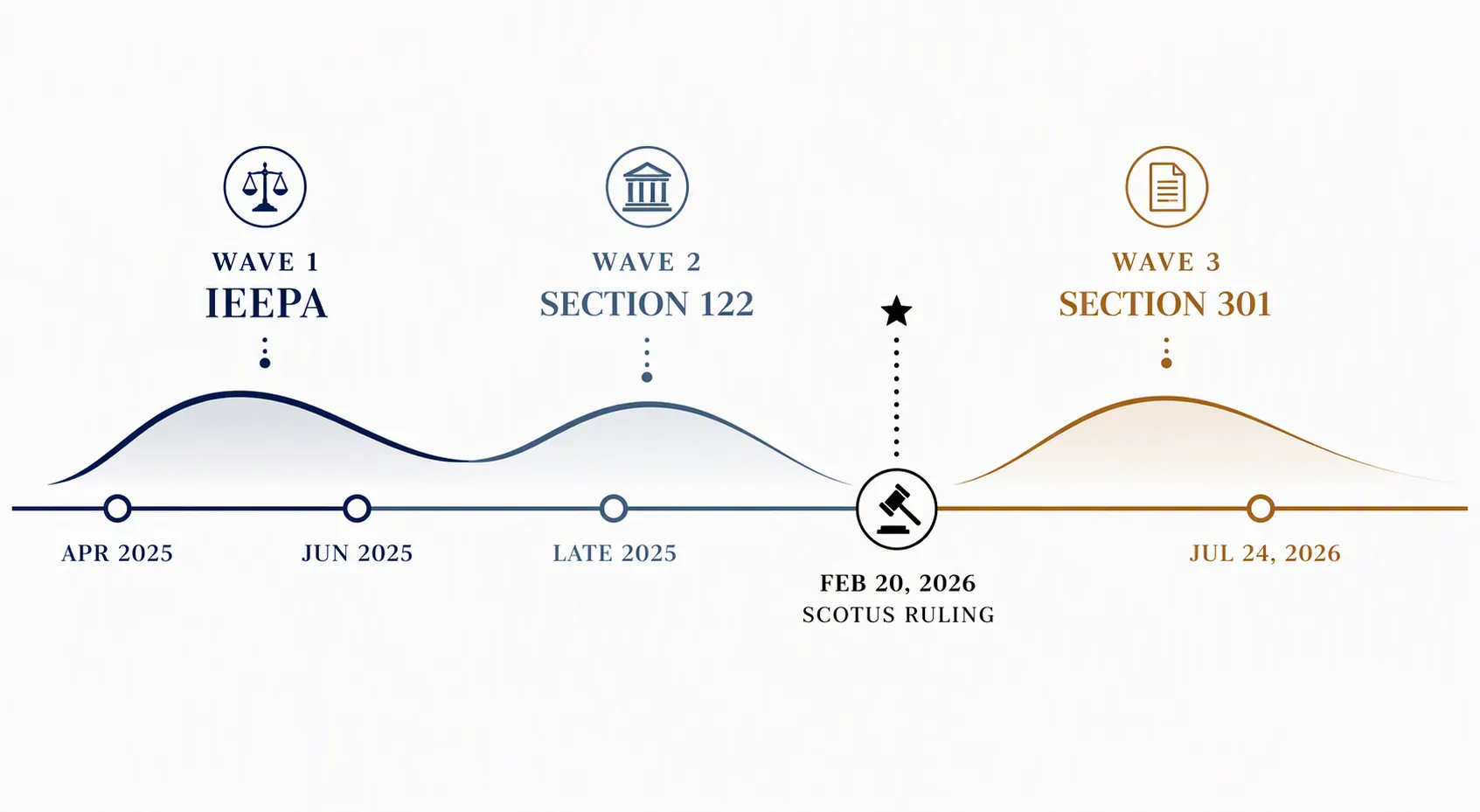
Case-status docket as of July 29, 2026
| Phase | Filing period | Statutory hook | Forum / posture | Named small-business plaintiffs or case cluster | Status as verified |
|---|---|---|---|---|---|
| IEEPA wave | Apr.–Jun. 2025 | International Emergency Economic Powers Act | Court of International Trade and related jurisdictional litigation | V.O.S. Selections v. Trump; Simplified v. Trump; Learning Resources v. Trump; at least three additional cases consolidated at the CIT | First litigation wave identified in June 2025 legal-alert coverage; jurisdiction and merits issues later moved through Federal Circuit and Supreme Court review [1] |
| IEEPA appellate sequence | Aug. 2025–Feb. 2026 | International Emergency Economic Powers Act | Federal Circuit en banc; Supreme Court | Learning Resources v. Trump and Trump v. V.O.S. Selections | Federal Circuit affirmed CIT rulings en banc; Supreme Court heard argument on Nov. 5, 2025 and ruled 6-3 on Feb. 20, 2026 that IEEPA does not authorize presidential tariffs [2][3] |
| Refund administration | Mar.–Jul. 2026 | Post-IEEPA invalidation implementation | CBP refund portal; CIT class action activity | Importers seeking refunds; Chapter1 LLC class action in the CIT | CBP opened a refund portal on Apr. 20, 2026; preliminary estimate was $166 billion owed to more than 330,000 businesses, with a stated 60- to 90-day processing window [3] |
| Section 122 transition | Late 2025–2026 | Section 122 emergency tariff authority | Tracked as part of the statutory transition rather than a settled merits category | Small-business challenges connected to the broader tariff authority dispute | Important for risk classification, but the supplied record does not support treating it as resolved by the IEEPA holding alone |
| Section 301 wave | Jul. 24, 2026 | Section 301 forced-labor tariffs | New complaints; docket numbers not publicly available in the supplied record | Burlap & Barrel / Collective Horology; Learning Resources / hand2mind | Filed within 24 hours of enactment; no court ruling as of July 29, 2026 [4][5][6] |
The first wave was not one case
The April-to-June 2025 IEEPA litigation matters because it supplied both the plaintiffs and the procedural architecture for the later risk question. V.O.S. Selections, Simplified, and Learning Resources were not merely examples of business frustration; they were vehicles for testing whether the emergency-powers statute could bear the weight the administration placed on it. Covington’s June 10, 2025 status alert identified V.O.S. Selections v. Trump, Simplified v. Trump, Learning Resources v. Trump, and at least three other cases consolidated at the Court of International Trade as the live IEEPA challenge set at that point [1].
That distinction still matters after the Supreme Court ruling. A lawyer advising an importer cannot stop at “IEEPA tariffs were struck down” without asking whether the client’s entries, liquidation status, protest posture, and refund claim fit the implementation machinery. The merits holding altered the government’s authority theory. It did not, by itself, complete the administrative unwinding for every affected importer.
Early outside analysis treated the small-business cases as serious legal challenges, but not as decided outcomes. Alan Wm. Wolff’s May 27, 2025 PIIE analysis evaluated whether small businesses could win against the tariff program; it is useful as a legal-economic assessment of the early posture, not as a substitute for later appellate rulings [7]. That is the right way to use it: as a map of arguments before the courts supplied answers.

The IEEPA question reached the Supreme Court with jurisdiction already doing work
The IEEPA sequence is the part of the docket where status labels changed the most. The Court of International Trade proceedings, related district-court litigation, Federal Circuit en banc review, and Supreme Court merits review did not all ask the same operational question at the same time. Some of the fight concerned where tariff challenges belonged. Some concerned whether the statutory grant reached tariffs at all.
By the time the Supreme Court heard argument on Nov. 5, 2025, contemporaneous coverage described the justices as skeptical of the tariff authority claim. SCOTUSblog reported that the Court appeared dubious of Trump’s tariffs during argument, a useful marker of argument posture but still not a holding [2]. Brookings’ Nov. 4, 2025 pre-ruling analysis likewise belongs in the “before decision” column: it framed legal and economic aspects of the upcoming tariff decisions, but it could not resolve the statutory question because the Court had not yet ruled [8].
The merits answer arrived on Feb. 20, 2026. In Learning Resources v. Trump and Trump v. V.O.S. Selections, the Supreme Court ruled 6-3 that IEEPA does not authorize presidential tariffs [3]. For exposure analysis, that is the pivot. Before that date, counsel was managing preservation, forum risk, and uncertainty over the government’s authority. After that date, the core IEEPA authority defense had failed, and attention shifted to implementation, refunds, and any replacement statutory theories.
What the holding did and did not decide
- It did decide that IEEPA did not authorize the presidential tariffs at issue in Learning Resources and V.O.S. Selections [3].
- It did not turn every tariff program into the same legal question; Section 122 and Section 301 have separate statutory hooks.
- It did not eliminate the need to track refund administration, because invalidation and repayment are different procedural events.
- It did not create a ruling in the July 2026 Section 301 complaints, which had only just been filed as of this digest date.
The refund phase is a separate risk event
The $166 billion figure is the easiest number in this record to misuse. It is not a court award. It is not proof that every importer will receive a specific amount. It is a preliminary CBP estimate, reported in post-Supreme Court analysis, of refunds owed to more than 330,000 businesses after the IEEPA ruling [3].
CBP launched a refund portal on April 20, 2026, with a reported 60- to 90-day processing window [3]. That administrative window is now part of the legal-risk file because it affects cash timing, documentation burdens, and escalation decisions. A client asking about recovery does not only need to know who won at the Supreme Court; it needs to know whether its claims are in the portal, whether entries are covered, whether records support the claim, and whether a delay has become ordinary processing or a dispute.
The Chapter1 LLC class action in the Court of International Trade is therefore not a footnote to the merits case. It is part of the refund-admin docket. The supplied materials identify it in connection with the post-ruling refund phase, alongside the portal and estimated refund exposure [3]. That placement matters: Chapter1 belongs with implementation and recovery mechanics, not with the earlier question whether IEEPA authorized the tariffs in the first place.
| Question counsel must separate | Record-supported answer |
|---|---|
| Were the IEEPA tariffs legally authorized? | The Supreme Court answered no in a 6-3 decision on Feb. 20, 2026 [3]. |
| How large is the refund exposure? | CBP’s preliminary estimate was $166 billion owed to more than 330,000 businesses [3]. |
| When did the administrative refund channel open? | CBP launched the refund portal on Apr. 20, 2026 [3]. |
| How fast should processing occur? | The reported processing window was 60 to 90 days [3]. |
| Does that estimate equal final refunds paid? | No. The supplied record supports only the preliminary-estimate characterization, not a final paid amount. |
Section 122 sits between invalidation and the next wave
Section 122 is best treated as a transition-risk category in this record. It appears because counsel tracking tariff exposure after the IEEPA ruling could not assume that defeat under one statute ended the administration’s ability to invoke another. But the supplied materials do not support overbuilding this phase into a completed merits line comparable to Learning Resources and V.O.S. Selections.
That produces an unsatisfying but necessary status label: track separately, do not collapse into IEEPA, and do not describe as settled unless a specific Section 122 case, forum, and ruling are being identified. For a risk digest, that is not a gap to fill with speculation. It is a boundary.
The July 2026 Section 301 complaints are important, but still only filings
The newest entries arrived on July 24, 2026. Reuters reported that small businesses filed suit within 24 hours of enactment challenging new forced-labor tariffs of 10% to 12.5% on 60 economies, covering 99% of U.S. imports [4]. Courthouse News Service separately reported small-business lawsuits against the new sweeping tariffs, identifying Burlap & Barrel, Collective Horology, Learning Resources, and hand2mind in the new litigation wave [5]. NBC News also reported that small businesses sued over Trump’s latest tariffs [6].
Those facts justify prominent placement in the docket, not predictive language. The cases are procedurally young. The supplied research does not include docket numbers for the July 2026 suits, and it does not identify a judicial ruling as of July 29, 2026. “Filed within 24 hours” is a timing fact; it is not momentum, not a merits signal, and not evidence that the IEEPA outcome will mechanically repeat under Section 301.
PIIE’s July 2026 analysis by Alan Wm. Wolff concluded that the new forced-labor tariffs were unlikely to survive court review [9]. That conclusion is relevant to risk assessment, especially because it comes from a legal-economic evaluation of the new tariff theory. It still remains analysis, not an adjudication. For litigation tracking, the correct label remains: Section 301 complaints filed; no ruling verified.
Minimum tracking fields for the Section 301 entries
- Plaintiff group: Burlap & Barrel / Collective Horology and Learning Resources / hand2mind, as reported in the July 2026 coverage [5].
- Tariff measure: 10% to 12.5% forced-labor tariffs on 60 economies covering 99% of U.S. imports, as reported by Reuters [4].
- Filing date marker: July 24, 2026, within 24 hours of enactment [4].
- Procedural status: no ruling verified as of July 29, 2026.
- Docket-number status: not publicly available in the supplied record.
What changed for legal-risk assessment
The IEEPA ruling changed the legal-risk posture for covered tariffs because the Supreme Court supplied a merits answer. The refund portal changed the operational posture because importers moved from preserving objections to pursuing repayment. The Section 301 complaints changed the monitoring posture because the next statutory wave is now live, but not decided.
Those are different changes. Treating them as one tariff-litigation story blurs the questions a client will actually ask: whether a charge was invalid, whether money is recoverable, whether a filing deadline is approaching, whether a new tariff applies to current imports, and whether a new lawsuit has produced any order worth adjusting exposure models around.
The cleanest working view is therefore statute-first and status-first. IEEPA has a Supreme Court invalidation and refund administration. Section 122 remains a separate authority category that cannot be treated as resolved on this record. Section 301 has newly filed small-business complaints against forced-labor tariffs, with no ruling verified. The record shows a major invalidation and a large refund mechanism, but it does not support a blanket answer for all Trump-era tariff exposure.
References
- The Status of Recent Legal Challenges to the Trump IEEPA Tariffs and Implications for Importers, Covington & Burling LLP, June 10, 2025.
- Court appears dubious of Trump’s tariffs, SCOTUSblog, Nov. 5, 2025.
- Supreme Court Trump Tariffs Ruling, Tax Foundation.
- US small businesses file lawsuit challenging Trump’s new forced-labor tariffs, Reuters, July 24, 2026.
- Small businesses file lawsuits against Trump’s new sweeping tariffs, Courthouse News Service.
- Small businesses sue Trump over latest tariffs, NBC News.
- Small businesses take Trump’s tariffs to court. Can they win?, Peterson Institute for International Economics, May 27, 2025.
- Legal and economic aspects of the Supreme Court’s upcoming tariff decisions, Brookings, Nov. 4, 2025.
- Trump’s new tariffs over forced labor are unlikely to survive court, Peterson Institute for International Economics.
Related records
Tool profile
Browse tool evaluations →Governing regulation
Browse the obligations tracker →Preventive workflow
Browse verification workflows →
Report a correction or tip
Spotted an outdated figure, a misstated fact, or a ruling this case record should reflect? Public comments are disabled for this content given the professional cost of a misreported case outcome, penalty amount, or rule text — use the structured correction channel instead.
Report a correction or tip for this record →