
Can Trump's Warning Signs EO Override the Smithsonian's Trust Status?
The Smithsonian's trust-instrumentality status means President Trump's July 2026 executive order targeting warning signs around the National Mall cannot legally bind the Institution — but it exposes a structural gap in separation-of-powers law that courts may need to resolve for the first time.
- Jurisdiction
- US-Federal
- Court
- Supreme Court of the United States
- AI tool named
- None
- Ruling date
- Jul 24, 2026
- Source document
- View primary court order ↗
- Last verified
- Jul 25, 2026
Lex Machina Review is an independent risk-tracking and reference resource. Nothing on this site is legal advice, and using it does not create an attorney-client relationship. Every record is reviewed against primary sources but may not reflect the most current status of a matter — always verify directly against the cited court order, rule text, or a licensed attorney before relying on it.
Companion explanation — secondary to the source document above
The most important sentence in the White House’s July 24, 2026 Smithsonian fact sheet is not the one about restoring public trust. It is the one that says the new warning-signs order applies to “National Park Service-maintained sidewalks and exterior areas surrounding Smithsonian museums” on the National Mall.[1] That is an admission-by-design. If the President could simply command the Smithsonian Institution to rewrite exhibits, replace curators, or post government-approved warnings inside its museums, there would be no need to route the order through pavement maintained by another federal entity.
That workaround is why the legal implications of Trump’s Smithsonian warning signs executive order are more complicated than a standard fight over museum labels. The order may be weak where it most loudly points — inside the Smithsonian — but stronger, or at least more immediately executable, in the federal space around it. The legal problem is not that the White House forgot the Smithsonian’s status. It appears to have noticed the limit and then built around it.
The Smithsonian Is Not a Normal Federal Agency
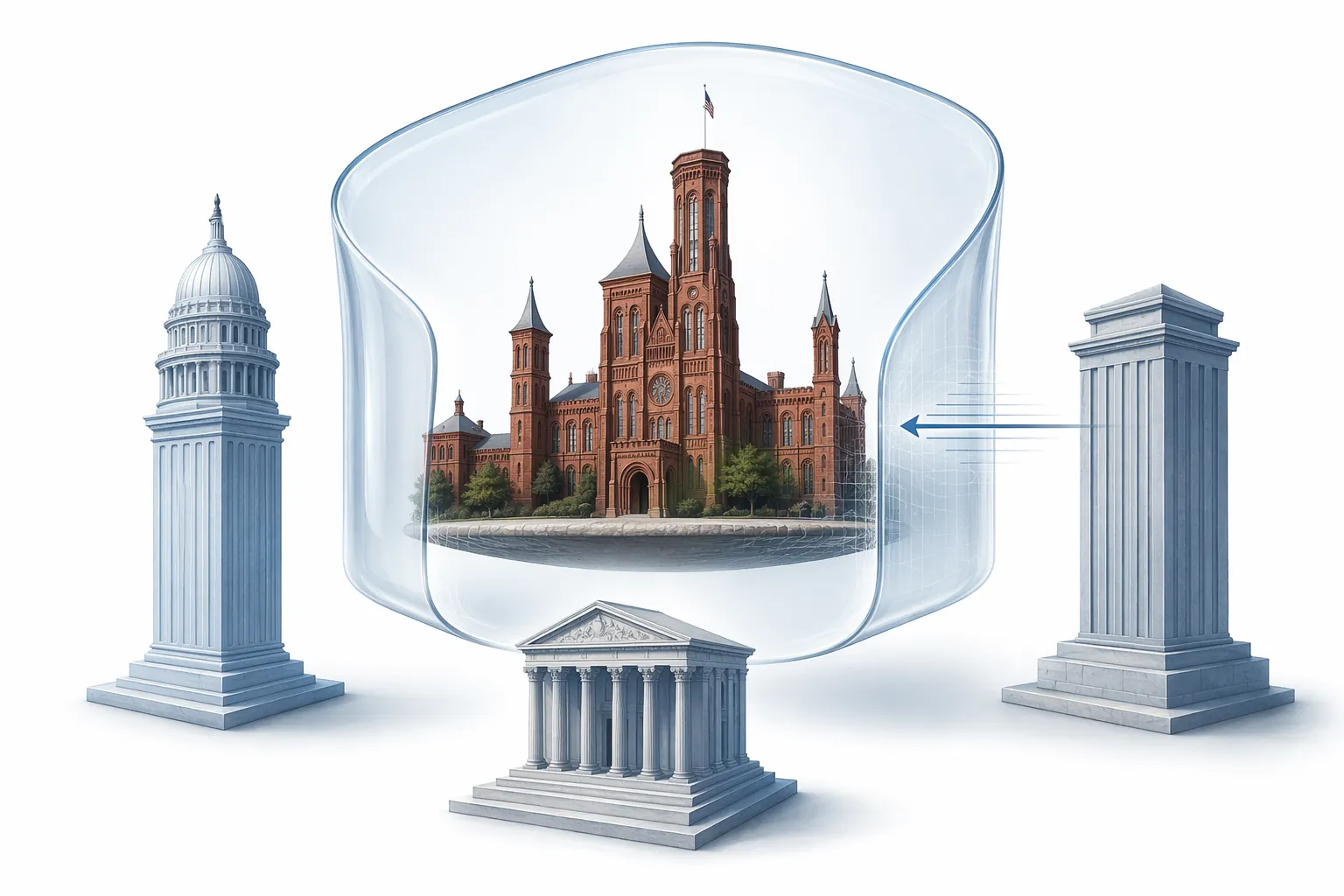
The Smithsonian’s awkward legal position begins with its origin as a congressionally created trust instrumentality. The Institution is not neatly housed inside the executive branch. Nor is it simply a legislative-branch agency, despite Congress’s central role in its charter and funding. A 2024 Congressional Research Service report, as described in Yale Law Journal scholarship, characterized the Smithsonian as “organizationally separate and distinct from the legislative, executive, or judicial branches,” and stated that curatorial control “belongs to the Board of Regents alone.”[2]
That last point matters more than the abstract label. Curatorial control is not just a cultural preference. It is the legal switch that determines who may decide what appears in a gallery, what text accompanies an object, and whether an exhibit carries the administration’s preferred warning. If that authority belongs to the Board of Regents alone, an executive order directed at the Smithsonian cannot operate in the ordinary way an executive order might operate inside an executive department.
The Board itself explains why ordinary separation-of-powers language starts to wobble. The Smithsonian Board of Regents has 17 members: the Vice President, the Chief Justice, six members of Congress, and nine private citizens. The Chief Justice serves as Chancellor.[2] That structure is not a clean executive hierarchy. It is also not a familiar independent commission model. It embeds officials from multiple constitutional locations inside a trust-governance framework, then gives that body control over an institution that receives substantial public support and occupies prominent federal space.
For the July 2026 order, the practical consequence is direct. The President can instruct executive agencies under his control. He can direct the National Park Service, through the Department of the Interior, to take action on property it maintains. But the materials available as of July 25, 2026 do not support the conclusion that he can bind the Smithsonian’s internal curatorial decisions by executive order.
Dong Answers One Question, Not All of Them
The cleanest judicial statement comes from Dong v. Smithsonian Institution, a 2000 D.C. Circuit decision holding that the Smithsonian was not an executive agency for purposes of the Privacy Act.[2] For anyone asking whether the President may treat the Smithsonian like a cabinet department, Dong is the obvious starting point. It cuts against executive-branch control.
But Dong does not settle the entire field. The older D.C. Circuit decision in Expeditions Unlimited Aquatic Enterprises, Inc. v. Smithsonian Institution treated the Smithsonian as a federal agency for Federal Tort Claims Act purposes.[2] That is not a minor footnote. It means the Smithsonian’s status has been answered differently depending on the statute in front of the court. “Not an executive agency under the Privacy Act” is a meaningful holding. It is not the same thing as “never federal,” “never subject to public-law constraints,” or “constitutionally immune from every form of executive pressure.”
That statutory-context problem is the center of the current dispute. The July 2026 order does not need to prove that the Smithsonian is an executive agency if it operates through nearby federal property. It can leave the Institution formally untouched while generating a government-authored message at museum entrances. The Board retains curatorial control inside the buildings; visitors may still encounter an executive-branch warning outside the door.
That distinction is legally important, but it is not institutionally calming. A museum’s public meaning is not formed only inside the exhibit hall. A sign placed at the threshold, on government-maintained space, can frame the visitor’s understanding before the Smithsonian says anything at all. The question becomes whether the President has merely used lawful control over executive property, or whether he has used that control to coerce or burden an institution he cannot directly command.
The July Order Turns the Gap Into a Pressure Mechanism
The White House’s stated rationale is cultural and corrective. Its July 24 fact sheet says the President is acting to restore trust in the Smithsonian and describes the warning signs as a response to exhibits the administration views as biased or misleading.[1] Those statements matter politically, but the legal architecture matters more: the order directs attention to areas maintained by the National Park Service, not to the Smithsonian’s own internal exhibit authority.[1]
That choice produces an odd combination. The executive order likely lacks binding force inside the Smithsonian, yet it may still produce federal action around the Smithsonian. A visitor approaching a museum could see a government-sponsored warning generated by an executive agency. Smithsonian officials could face public pressure to respond. Regents could be asked why the Institution is resisting presidential concerns. None of that requires the President to issue a legally valid command to the Smithsonian itself.
The arrangement therefore exploits the very status that limits the President. If the Smithsonian were simply an executive agency, the order would be judged as an internal management directive and any dispute would follow familiar administrative lines. If it were a wholly private museum, executive warning signs targeted at its entrances would look like ordinary government retaliation or speech directed at an outside institution. The Smithsonian is neither. It is close enough to the federal government to be surrounded by executive-controlled operational machinery, but separate enough that the President’s internal control is doubtful.
The Yale Law Journal’s April 2026 treatment of the earlier March 2025 Smithsonian executive order identified this as more than a one-off conflict. It concluded that the prior order constituted executive overreach and warned that the Institution’s trust-instrumentality status leaves it vulnerable unless Congress re-charters or otherwise clarifies the Smithsonian’s independence.[2] That scholarship is not a court judgment. It is, however, useful because it addresses the precise institutional oddity rather than treating the Smithsonian as just another public museum.
A Court Would Need a Plaintiff Before It Reaches the Structure
As of July 25, 2026, no lawsuit has been filed challenging the July 24 warning-signs order. That fact should restrain any prediction. The central merits question may be separation of powers, but the first litigation question would be standing: who has suffered a concrete, judicially cognizable injury from a warning sign outside a Smithsonian museum?
| Possible plaintiff | Likely theory | Standing problem |
|---|---|---|
| Smithsonian Board of Regents | Institutional injury from executive pressure on curatorial autonomy | The Board would need to show that signs outside the museums injure its legal authority, not merely its reputation or preferred presentation |
| Members of Congress | Interference with a congressionally chartered trust structure | Legislator standing is difficult unless the injury is institutional and authorized in a way courts recognize |
| Museum visitors | Viewpoint discrimination or compelled exposure to government messaging at a public cultural site | Visitors may object to the message, but objection alone may not establish the kind of injury needed for federal jurisdiction |
| Employees, curators, or affiliated scholars | Chilling effect on professional judgment or retaliation-adjacent pressure | The connection between exterior signs and a concrete employment or speech injury may be too indirect without additional facts |
The Board of Regents is the most institutionally natural plaintiff, but not automatically the easiest one. If the order does not require the Smithsonian to post anything, remove anything, or change any exhibit, the injury may be framed as indirect pressure rather than legal compulsion. Courts can hear coercion theories, but they usually require more than displeasure with government criticism. The Board would likely need to argue that the warning-sign regime impairs a chartered governance function: the exclusive authority to curate and present Smithsonian materials without executive override.
Congressional plaintiffs would face a different problem. The Smithsonian exists because Congress created and structured it, and Congress could plausibly object that the executive is invading a governance arrangement Congress designed. But individual legislators generally do not get standing merely because they believe the executive has misread a statute or disrupted a statutory design. Unless Congress, or an authorized chamber or institutional body, sued in a posture courts accept, the case could die before reaching the merits.
Visitor standing is easier to imagine factually and harder to make doctrinally satisfying. A visitor can allege direct exposure to a sign at a museum entrance. If the sign singles out particular exhibits, histories, or viewpoints, a First Amendment theory could emerge. Still, federal courts do not usually treat disagreement with government speech as enough. The visitor would need a theory that the government’s use of exterior property burdens access to Smithsonian programming, imposes a discriminatory condition, or distorts a forum in which viewpoint neutrality is required. The available materials do not yet establish those facts.
That is why the order’s most plausible legal exposure may depend on implementation. A general sign saying the administration disputes some Smithsonian presentations would present one set of problems. A sign naming specific exhibitions, curators, historical interpretations, or identity-based themes would present another. A sign coordinated with funding threats, personnel pressure, or demands for internal changes would move the case closer to institutional coercion. The executive order starts the problem; the posted text, placement, enforcement chain, and accompanying communications may determine whether a plaintiff can get into court.
The Kennedy Center Ruling Helps, But Only So Far
The closest practical analogy is the May 29, 2026 Kennedy Center ruling. In that dispute, a federal judge ordered Trump’s name removed from the Kennedy Center after finding that the administration lacked authority to rename the institution.[3] The comparison is useful because it shows a court willing to police the boundary between presidential preference and authority over a congressionally established cultural institution.
But it is not a shortcut. The Kennedy Center case involved a naming action and a different institutional charter. The Smithsonian dispute involves warning signs placed around museums, apparently through National Park Service-maintained exterior areas. A court could find the Kennedy Center reasoning persuasive on the general proposition that presidential cultural control must trace to legal authority, while still treating the Smithsonian signage order as a separate property-management or government-speech case.
That distinction matters because courts tend to decide these cases through the narrowest available door. A judge might avoid a grand holding about the Smithsonian’s constitutional status and decide instead that the National Park Service has or lacks statutory authority to post the particular signs. Another court might resolve the case on standing. Another might decide that the signs are government speech and therefore not subject to the same constraints as regulation of private expression. A more ambitious court could address whether the executive is using control over adjacent property to accomplish indirectly what it cannot accomplish directly.
The Strongest Merits Theories Are Not Identical
Several legal theories could appear in a challenge, but they would not all ask the same question.
- Ultra vires authority: the President and subordinate executive officials exceeded statutory authority by using National Park Service property to regulate, discipline, or countermand a congressionally chartered trust.
- Separation of powers: the order interferes with a governance structure Congress assigned to the Board of Regents, including officials and private citizens outside ordinary executive control.
- Viewpoint discrimination: the signs target Smithsonian presentations because of their historical, cultural, or political viewpoint, especially if implementation singles out disfavored interpretations.
- Institutional coercion: the executive is formally speaking on its own property while functionally pressuring the Smithsonian to alter protected curatorial decisions.
- Administrative-law defects: if an agency implements the order through a rule, permit, procurement, or site-management decision, plaintiffs may challenge the implementing action rather than the presidential order itself.
The ultra vires theory is the most structurally direct. It asks whether any statute gives the executive branch authority to place warning signs around Smithsonian museums for the purpose of contesting Smithsonian content. The government would likely answer that it controls and maintains the relevant exterior areas, and that the signs are government speech on government-managed property. Plaintiffs would answer that property control cannot be used as a lever to invade a separate institution’s chartered function.
The viewpoint-discrimination theory depends more heavily on facts. Government speech doctrine gives the government room to express its own views. But if signs are designed not merely to state an administration position but to burden access to disfavored Smithsonian programming, a court would have to decide whether the government is speaking for itself or distorting a public cultural forum it does not control. The line is not obvious from the fact sheet alone.
The coercion theory is the most interesting and the hardest to prove. It would not require a direct order to the Smithsonian. It would argue that the executive branch has created a pressure system around the Institution: public denunciation, exterior warnings, and possible future consequences aimed at forcing curatorial change. Courts have recognized coercion concerns in other constitutional settings, but this application would be novel because the target is neither a state government nor a private platform nor an executive subordinate. It is a federal trust instrumentality with a board that does not fit the standard diagram.
Why Congress Is the Cleaner Fix
If the legal defect is uncertainty in the Smithsonian’s chartered position, Congress is better equipped than a court to fix it prospectively. Congress could clarify the Institution’s autonomy, define the Board’s exclusive curatorial authority, specify how executive agencies may interact with Smithsonian-controlled facilities and surrounding areas, and create an express cause of action for institutional interference. That would not require romanticizing the Smithsonian or insulating it from oversight. It would require deciding who has legal authority to do what.
The alternative is judicial clarification through litigation. That route is slower, more contingent, and shaped by whichever plaintiff gets through the courthouse door first. A visitor case may produce a First Amendment holding without resolving the Board’s autonomy. A Board case may produce a standing ruling without addressing signs. An agency-implementation case may turn on National Park Service authority and leave the Smithsonian’s constitutional status largely untouched.
A Supreme Court decision could eventually define the limits of presidential power over congressionally chartered trusts, but that would likely require a clean record: an implemented sign program, a plaintiff with concrete injury, and a lower-court split or sufficiently important separation-of-powers question. As of July 25, 2026, the record is not there. The order is newly signed, the Federal Register details are not yet complete, and no complaint has tested the theory.
What the Order Can and Cannot Do Now
The safest legal conclusion is narrow. The July 2026 warning-signs executive order does not appear to bind the Smithsonian directly. The Institution’s trust-instrumentality status, the Board of Regents’ curatorial control, and Dong’s non-executive-agency holding all cut against a presidential power to command internal exhibit decisions.[2] For the direct-binding question, that is the same basic answer reached by the companion analysis, Why Trump’s Smithsonian Executive Orders Lack Binding Legal Force.
The harder conclusion is that nonbinding does not mean harmless. The same trust status that blocks direct presidential control also leaves a vacuum around indirect executive pressure. The White House can act through agencies it controls. The National Park Service can maintain sidewalks and exterior areas. Government speech can appear close enough to Smithsonian entrances to shape the public encounter with the Institution. Existing doctrine does not provide a tidy rule for when that becomes unlawful interference with a congressionally chartered trust.
That is the real legal implication of the Trump Smithsonian warning signs executive order. It is not an already-decided constitutional crisis, and it is not merely political theater. It is unresolved litigation exposure created by a hybrid institution that courts have classified differently in different statutory settings. Closing that gap will likely require Congress to clarify the Smithsonian’s charter or a court, possibly the Supreme Court, to say for the first time how far presidential power can reach around a congressionally chartered trust it cannot directly absorb.
References
- Fact Sheet: President Donald J. Trump Restores Trust in the Smithsonian Institution, The White House, July 24, 2026.
- Fight at the Museum: Executive Overreach and the Future of the Smithsonian Institution, Yale Law Journal, April 2026.
- Trump News, The New York Times, May 29, 2026.
Related records
Tool profile
Browse tool evaluations →Governing regulation
Browse the obligations tracker →Preventive workflow
Browse verification workflows →
Report a correction or tip
Spotted an outdated figure, a misstated fact, or a ruling this case record should reflect? Public comments are disabled for this content given the professional cost of a misreported case outcome, penalty amount, or rule text — use the structured correction channel instead.
Report a correction or tip for this record →