
SoftBank's $40B OpenAI Loan Signals Vendor Risk for Law Firms
This analysis translates the SoftBank-OpenAI $40B unsecured bridge loan and its surrounding financial events into concrete vendor-diligence signals for law firms using OpenAI-powered legal AI tools. Readers will learn why the 12-month term, stalled margin loan, and IPO delay create material timeline and concentration risks that should be incorporated into AI procurement and contract reviews.
- Jurisdiction
- US-Federal
- Court
- U.S. Securities and Exchange Commission
- AI tool named
- OpenAI
- Ruling date
- Mar 27, 2026
- Source document
- View primary court order ↗
- Last verified
- Jul 29, 2026
Lex Machina Review is an independent risk-tracking and reference resource. Nothing on this site is legal advice, and using it does not create an attorney-client relationship. Every record is reviewed against primary sources but may not reflect the most current status of a matter — always verify directly against the cited court order, rule text, or a licensed attorney before relying on it.
Companion explanation — secondary to the source document above
A law-firm procurement file does not need a view on whether OpenAI will command a trillion-dollar valuation. It does need a view on whether a critical drafting, research, review, or knowledge-management workflow has become dependent on a financing chain with a visible maturity date. For law firms, the SoftBank-OpenAI loan terms that matter most in 2026 are not the headline valuation drama, but the operational facts: SoftBank signed a $40 billion unsecured bridge facility in March 2026, the facility has a 12-month term, and it is due March 25, 2027, with repayment tied to an OpenAI IPO or refinancing rather than a guaranteed cash source.[1]
That does not mean OpenAI is failing as a vendor, and it does not mean every OpenAI-powered legal AI tool should be pulled from approved-use lists. It does mean a firm relying on those tools through March 2027 should update the diligence record now, while there is still room to negotiate notice rights, termination assistance, subcontractor disclosures, and fallback procedures without doing it in a renewal panic.

Bridge Terms Create The Contract Risk
The load-bearing fact is simple enough to fit inside a vendor-risk memo: SoftBank’s facility is unsecured, sized at $40 billion, and scheduled to mature on March 25, 2027.[1] By July 27, 2026, 21 new lenders had joined the financing, according to Bloomberg reporting carried by Yahoo Finance.[2] More lenders can spread exposure, but it also gives procurement teams another question to ask: if repayment depends on an IPO or refinancing, what happens to the upstream commercial relationship if those routes are delayed, repriced, or conditioned on terms OpenAI or SoftBank does not yet control?
There is an important legal distinction here. The bridge loan is SoftBank’s debt, not OpenAI’s direct debt. A law firm should not describe it in an approval memo as an OpenAI borrowing unless the contract record supports that. The risk is indirect: SoftBank’s capacity and willingness to keep supporting the OpenAI financing path may affect the stability, timing, or bargaining environment around the vendor ecosystem that legal AI customers now rely on.
That indirectness is exactly why the issue can be missed. A firm may have an enterprise agreement with an AI application vendor, not OpenAI. The application may advertise legal-specific workflows, not model infrastructure. Yet if the product depends on OpenAI APIs or OpenAI-hosted model access, the procurement file has a dependency chain. The practical question is whether the firm’s approved-use memo identifies that chain clearly enough for a risk committee to understand who must perform if pricing, terms, availability, data handling, or model roadmap commitments change.
| Financing Term Or Event | Why It Matters In A Law-Firm Vendor File |
|---|---|
| $40 billion unsecured bridge facility | Unsecured bridge financing makes repayment timing and refinancing conditions relevant to continuity review. |
| Due March 25, 2027 | Creates a specific maturity window that can be tracked against contract renewals, budget cycles, and tool approvals. |
| Repayment tied to IPO or refinancing | Requires diligence on what happens if the expected capital-market event is delayed or repriced. |
| 21 new lenders joined by July 27, 2026 | Suggests a broader lender group, but also a more complex financing environment around the dependency. |
Pressure Points Arrived Before Maturity
The bridge facility is not the only signal. On March 3, 2026, S&P revised SoftBank’s outlook to negative while affirming its BB+ rating, citing liquidity deterioration risk connected to the concentration of its OpenAI investment.[3] For a law firm, that is not a trading signal. It is a reason to stop treating “SoftBank backing” as a generic comfort phrase and start documenting the actual concentration risk.
Jefferies added another caution point on March 12, 2026, when it downgraded SoftBank to Underperform. The report, as summarized by Proactive Investors, said SoftBank had provided about 85% of the cash OpenAI raised in recent rounds and cited an OpenAI Q3 2025 loss of about $12 billion, implying annualized burn above $50 billion.[4] Those numbers should be handled carefully in a procurement record because they come through a single analyst account rather than a primary OpenAI filing. Still, even with that caveat, the direction of the concern is relevant: one backer’s balance sheet had become unusually important to the financing story around a vendor many firms now treat as infrastructure.
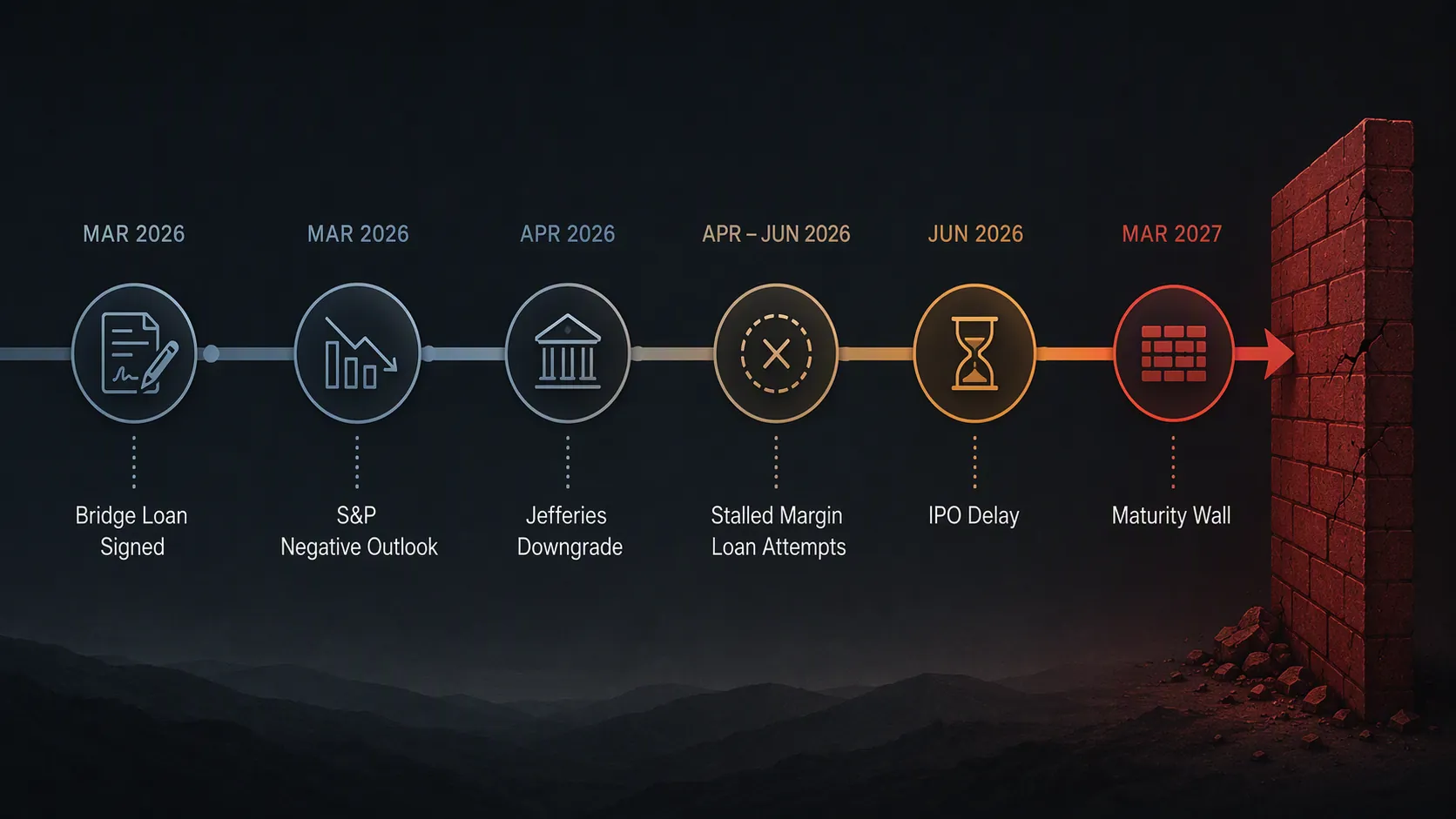
The margin-loan episode is more revealing than it may look at first. SoftBank’s attempt to raise a margin loan against OpenAI-related private-company shares stalled because lenders could not price those shares without a public market reference. The target reportedly moved from $10 billion on April 23 to $6 billion on May 8 before stalling, and the financing was later revived at $10 billion with a corporate guarantee on July 1.[5] That is not proof that the underlying shares lacked value. It is evidence that lenders had difficulty converting a private valuation story into loanable collateral on acceptable terms.
Private-company valuation friction matters to legal buyers because contract obligations are not paid in valuation narratives. Reliability engineering, support staffing, enterprise security reviews, customer-success teams, incident response, and jurisdiction-specific data commitments all consume cash and management attention. If financing becomes harder, customers may not see an immediate outage. They may see more subtle changes first: narrower support promises, tighter usage limits, revised data terms, slower roadmap commitments, or price adjustments at renewal.
The IPO Delay Creates A Calendar Problem
The financing timeline becomes tighter if OpenAI’s IPO path slips. TechTimes reported that OpenAI had filed a confidential S-1 with the SEC on May 22, 2026, publicly announced on June 9, while also reporting that OpenAI was holding out for a $1 trillion valuation and could delay to 2027.[6] The $1 trillion figure and timing expectations should not be treated as settled outcomes. The narrower point is enough: a possible 2027 IPO window sits uncomfortably close to a March 25, 2027 bridge-loan maturity.
That calendar collision is what belongs in the vendor-risk file. If a firm’s AI research platform renews in late 2026, if a litigation group plans to embed OpenAI-powered summarization into a case workflow through 2027, or if knowledge management is training lawyers on approved prompts and matter-type restrictions, the March 2027 maturity window is no longer abstract. It overlaps with the period in which the firm may be most operationally dependent on the tool.
SoftBank’s own exposure reinforces the need for that calendar discipline. CNBC reported SoftBank net debt of $122.9 billion in connection with its fiscal 2025 earnings coverage, and Forbes reported that S&P projected OpenAI would constitute more than 50% of SoftBank’s investment assets while noting a $46 billion Vision Fund gain driven by the OpenAI stake.[7][8] Those facts do not tell a law firm whether OpenAI’s product will perform well tomorrow. They do show why a single financing relationship deserves more scrutiny than an ordinary vendor-capitalization footnote.
What This Changes In AI Procurement
The first change is in the vendor questionnaire. A generic question asking whether the vendor uses third-party subprocessors is no longer enough for OpenAI-powered legal tools. The questionnaire should ask whether OpenAI models, APIs, hosting, embeddings, fine-tuning, retrieval components, or moderation services are material to the product. If the answer is yes, the file should identify whether the vendor has an alternative model path, how quickly that path can be activated, and what functionality would degrade.
The second change is in contract review. Firms should look again at amendment clauses, acceptable-use policy incorporation, data-processing terms, confidentiality commitments, service-level language, and termination assistance. A quiet update to terms can matter more than a press release. If a tool is used for privileged drafts, deposition summaries, litigation chronologies, or internal research memos, the firm should know whether the vendor can change subprocessors, model providers, retention rules, training restrictions, or support levels without affirmative notice.
- Ask for advance notice of material changes to model providers, subprocessors, data-processing terms, retention practices, and enterprise security controls.
- Require a description of OpenAI dependency in the vendor’s architecture, including which functions would fail or degrade if access changed.
- Preserve termination rights and export assistance if a restructuring, acquisition, model-provider change, or material TOS amendment affects approved legal uses.
- Document an alternative workflow for high-risk uses such as privileged summarization, litigation analytics, due-diligence review, and client-facing outputs.
- Tie renewal review to the March 2027 financing window rather than waiting for the next annual procurement cycle.
The third change is in approval memos. Many firms still approve legal AI tools with language focused on confidentiality, hallucination risk, and lawyer supervision. Those remain necessary, but they do not answer continuity questions. A stronger memo states who owns the fallback plan, who receives vendor notices, which practice groups are already dependent on the tool, and which client or matter types would be affected if the tool were paused.
Contractual Risk Comes Before Catastrophe
The most likely procurement problem is not a sudden disappearance of every OpenAI-powered product. The more realistic concern is contractual movement under pressure. A vendor may revise terms to preserve flexibility. It may narrow indemnities. It may reserve broader rights to change infrastructure. It may push customers toward higher tiers for security or administrative controls that were previously treated as standard enterprise expectations.
For legal users, small changes can carry large consequences. A data-location commitment may determine whether a regulated client permits use of the tool. A confidentiality carveout may determine whether privileged material can be processed. A subprocessor-notice clause may determine whether the firm can object before a workflow changes. A support-response commitment may determine whether litigators have help when a platform error appears during a deadline-heavy matter.
Restructuring and acquisition provisions deserve particular attention. If financial pressure leads to a refinancing, strategic investment, acquisition, or reorganization, the firm should already know whether its agreement permits assignment without consent, whether data-processing terms survive, and whether the vendor must assist with transition. The concern is not that any one of those events is certain. The concern is that a firm dependent on the tool may have little leverage if it waits until after the event is announced.
How To Treat OpenAI-Powered Tools Through March 2027
A sensible response is neither panic cancellation nor passive confidence. Firms should keep using approved tools where the legal, security, and professional-responsibility analysis supports use. But they should stop treating model-provider financing as irrelevant once the tool becomes embedded in daily work.
The practical review can be narrow. Start with the tools that touch privileged, confidential, regulated, or client-sensitive material. Identify which of them depend materially on OpenAI. Compare their renewal dates with the March 25, 2027 maturity date. Then decide whether the existing contract gives the firm enough control if pricing, data terms, support commitments, model access, or ownership changes during that window.
| Review Area | Question For The File |
|---|---|
| Dependency | Does the product materially rely on OpenAI models, APIs, hosting, or related services? |
| Notice | Must the vendor give advance notice before changing model providers, subprocessors, retention terms, or security controls? |
| Continuity | What legal workflows would stop, slow, or require manual replacement if OpenAI access changed? |
| Data Protection | Do confidentiality, data-location, privilege, retention, and training restrictions survive a restructuring or assignment? |
| Exit | Can the firm export data, preserve work product, terminate for material changes, and transition to another workflow without excessive delay? |
This is also where knowledge-management and legal-operations teams should be explicit about approved uses. If lawyers have learned to rely on an OpenAI-powered tool for first-pass research synthesis, privilege-log support, deposition preparation, or deal-document review, the fallback cannot be an unowned instruction to “use another tool.” Someone needs to maintain the alternative process, train users on when to switch, and decide whether outputs created before a provider change remain usable under the governing client and firm policies.
The financing record does not require law firms to forecast OpenAI’s IPO price, SoftBank’s refinancing options, or lender appetite in early 2027. It does require them to recognize a dated concentration-risk marker. A $40 billion unsecured bridge facility due March 25, 2027, surrounded by negative outlook pressure, an analyst downgrade, private-share collateral friction, and IPO timing uncertainty, is enough to justify updated questionnaires, tighter contract protections, refreshed approval memos, and documented fallback plans before the maturity window becomes urgent.
References
- SoftBank Group Corp. Announces Bridge Facility Agreement, SoftBank Group Corp., Mar. 27, 2026.
- SoftBank $40 Billion Loan for OpenAI, Bloomberg via Yahoo Finance, Jul. 27, 2026.
- SoftBank’s $30 Billion OpenAI Bet Spurs S&P Credit Outlook Cut, Bloomberg, Mar. 3, 2026.
- SoftBank downgraded by Jefferies on rising risks tied to OpenAI investment, Proactive Investors, Mar. 12, 2026.
- SoftBank’s OpenAI margin loan attempt stalls, The Japan Times, Jun. 10, 2026.
- OpenAI IPO Delay Sends SoftBank Down $38 Billion; Altman Refuses Any Cut From $1 Trillion Target, TechTimes, Jun. 26, 2026.
- SoftBank earnings FY 2025 Vision Fund OpenAI stake, CNBC, May 13, 2026.
- Behind SoftBank’s Multi-Billion-Dollar Bet On OpenAI, Forbes, Jun. 8, 2026.
Related records
Tool profile
Neither Codex nor Claude Code Is Safe for Legal AI AgentsGoverning regulation
Browse the obligations tracker →Preventive workflow
Browse verification workflows →
Report a correction or tip
Spotted an outdated figure, a misstated fact, or a ruling this case record should reflect? Public comments are disabled for this content given the professional cost of a misreported case outcome, penalty amount, or rule text — use the structured correction channel instead.
Report a correction or tip for this record →