
Sophie Cunningham Stalking: Felony Charges Filed in Indiana
This Risk Digest entry documents the felony stalking charges filed against Kevin Singh in the Sophie Cunningham case, analyzing how Indiana's Level 6 felony statutes apply to persistent athlete harassment and what the nine-month escalation gap reveals about protective framework gaps.
- Jurisdiction
- Indiana
- Ruling date
- Jun 23, 2026
- Source document
- View primary court order ↗
Lex Machina Review is an independent risk-tracking and reference resource. Nothing on this site is legal advice, and using it does not create an attorney-client relationship. Every record is reviewed against primary sources but may not reflect the most current status of a matter — always verify directly against the cited court order, rule text, or a licensed attorney before relying on it.
Companion explanation — secondary to the source document above
This Risk Digest entry sits outside the usual AI-reliability lane, but it belongs here for a plain reason: the Sophie Cunningham matter is now a documented criminal proceeding with statutory, probation-monitoring, and venue-security implications. Search traffic may package the episode as “sophie cunningham espn suspension legal controversy,” but the filed record points elsewhere. On June 23, 2026, Kevin Singh, 48, was charged in Indiana with Level 6 felony stalking, Level 6 felony intimidation, and Class B misdemeanor harassment in connection with alleged conduct directed at Cunningham, a guard for the Indiana Fever.[1]
Those charges remain allegations. As of July 2026, the case has not produced a conviction, plea agreement, or judicial finding establishing the alleged facts. That distinction matters because “legal controversy” is too blunt a label for a record that contains separate categories: current criminal charges, reported probable-cause facts, prior convictions, active probation status, and a civil countersuit.
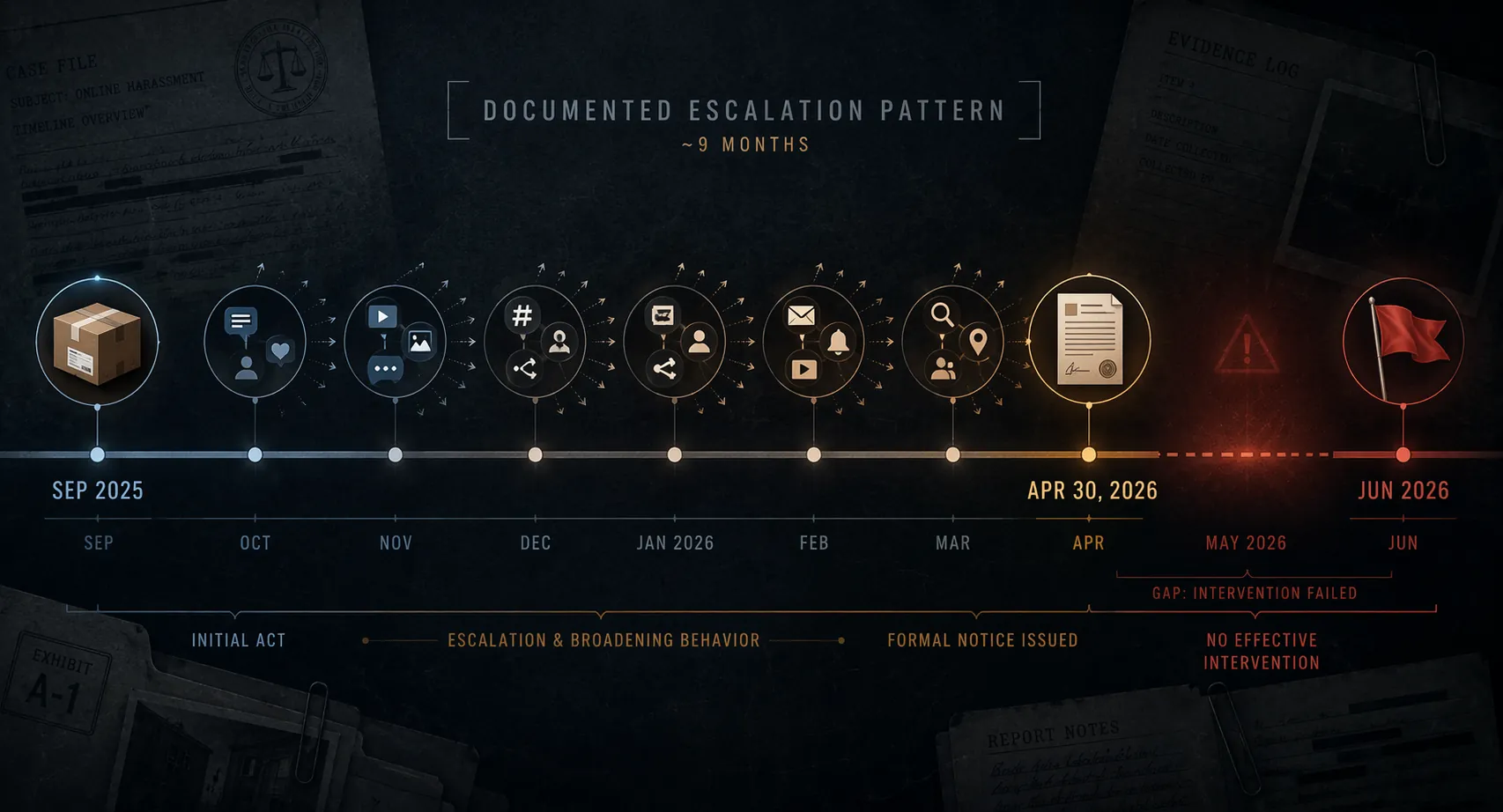
The Charges Start With a Timeline, Not a Headline
The probable-cause reporting describes a sequence that began in September 2025, when Singh allegedly delivered a package to Gainbridge Fieldhouse, the Fever’s home arena. The record then moves through continued online conduct, a cease-and-desist letter dated April 30, 2026, and Singh’s June 2026 arrest.[2]
The September package drop matters because it places the alleged conduct at a professional venue rather than only inside an online feed. For security lawyers, that shift changes the file. A message can be preserved, reviewed, and reported; a physical delivery to a workplace raises a different operational question: who received it, who logged it, who assessed it, and whether the individual can reappear at the same site.
CNN’s account of the probable-cause materials says the alleged conduct continued after that first documented contact and escalated across social media. It also reports that Cunningham experienced nightmares and stayed home, while John Ball, the team’s vice president of security, began carrying a firearm.[2]
Those details should not be inflated into facts the record does not contain. They do not prove Singh committed the charged offenses. They do, however, explain why this was no longer a low-grade nuisance file by the time prosecutors charged it. Reported sleep disruption, changed movement, and an armed security posture are impact and risk indicators. They show how repeated contact can force a public-facing workplace to convert unease into protective decisions.
| Date or Period | Reported Event | Legal or Risk Significance |
|---|---|---|
| September 2025 | Singh allegedly delivered a package to Gainbridge Fieldhouse. | The alleged conduct entered the athlete’s professional venue, creating a recordable security event. |
| After September 2025 | Probable-cause reporting describes continued online escalation. | The case theory depends on persistence, not a single uncomfortable message. |
| April 30, 2026 | A cease-and-desist letter was sent. | The notice point matters because later conduct can be assessed against documented warning. |
| June 2026 | Singh was arrested and then charged on June 23. | The matter moved from warning and security management into felony prosecution. |
The Cease-and-Desist Letter Was Notice, Not Containment
The April 30, 2026 cease-and-desist letter is an important document, but not because it solved the problem. In the reported sequence, it marks a formal warning between the first documented contact and the eventual arrest.[2] That makes it useful evidence of notice and institutional response. It also exposes the weakness of treating paper notice as a protective endpoint.
A cease-and-desist letter can clarify that contact is unwanted. It can support later escalation if conduct continues. It can give counsel and security teams a dated marker. What it cannot do by itself is keep a person away from an arena, stop online messaging, or trigger custody unless some other enforceable mechanism attaches.
That is the practical gap in this file. The alleged first contact was in September 2025; the arrest came in June 2026.[2] During that nine-month span, the available public record shows warning, impact, and security concern, but the intervention that finally changed the posture was criminal charging.

Why the Level 6 Felony Posture Is Plausible on the Filed Record
Indiana prosecutors charged stalking and intimidation as Level 6 felonies, with harassment charged as a Class B misdemeanor.[1] The charging posture is legally significant because it treats the alleged conduct as more than unwanted fandom, offensive speech, or ordinary online fixation. It frames the case as a persistent course of conduct with threat implications.
The fit is not hard to understand if the probable-cause sequence is viewed as a whole. A package allegedly delivered to the workplace creates an initial physical-world marker. Continued social media conduct supplies repetition. The cease-and-desist letter supplies notice. Cunningham’s reported nightmares and decision to stay home supply impact. Ball’s reported decision to carry a firearm supplies a security response.[2]
None of those elements alone should be treated as a conviction substitute. A public figure can receive strange messages without every sender committing felony stalking. A security officer can heighten protection before a court has found criminal liability. But the alleged pattern, as reported, is exactly the kind of assembled record that can move a case out of informal management and into felony charging.
Prior Convictions Matter for Risk Assessment, Not Proof of the New Charges
The Indiana Lawyer reported that Singh had a prior 2014 stalking conviction and that he pleaded in 2025 to two invasion-of-privacy counts, for which he was on probation at the time of his arrest in the Cunningham case.[3]
That history has to be handled carefully. Prior convictions do not prove the current allegations. They do not relieve prosecutors of the burden to prove the new charges. They also should not be erased from a risk file. For venue security, probation officers, and counsel deciding whether a pattern is escalating, a prior stalking conviction and active invasion-of-privacy probation are not background noise. They are enforceable-record facts.
The probation piece is the sharper issue. If the public reporting is accurate, Singh was already under court supervision when the alleged Cunningham conduct was occurring.[3] That does not mean probation authorities had full knowledge of every act as it happened. The available record does not establish that. It does raise the institutional question this case leaves behind: what information has to reach probation, from whom, and at what point does repeated contact with a new alleged target become a violation-response problem rather than only an employer-security problem?
The Countersuit Is a Procedural Complication, Not a Substitute Case
Singh also filed his own lawsuit against Pacers Sports & Entertainment, the Fever’s parent organization, according to USA Today.[4] That civil filing adds a procedural layer. It does not cancel the criminal case, and it should not be used to flatten the distinction between allegations made by the state and claims made by the defendant in separate litigation.
For risk managers, the countersuit still belongs in the file. Civil claims can complicate communications, discovery, insurance notice, and public statements. They may affect how an organization documents future contact or describes its own conduct. But the center of gravity remains the criminal prosecution: filed felony stalking and intimidation charges, a misdemeanor harassment charge, and an unresolved factual record.
The Fever Context Is Relevant Only Where the Courts Touch It
The Cunningham case is not the only recent Indiana prosecution involving alleged stalking of a Fever player. The Michael Lewis case involving Caitlin Clark ended in a 2.5-year sentence in 2025, and the Cunningham prosecution is the second Fever-player stalking case within a 12-month window.
That comparison should stay narrow. Two cases do not prove a leaguewide frequency rate, and the public materials do not disclose the Fever’s internal security protocols. The useful point is jurisdictional: Indiana authorities have recently treated athlete-directed stalking allegations as felony-grade criminal matters, not merely as fan-management problems.
That matters for sports organizations because the workplace is unusual but the legal questions are familiar. A player’s office is an arena. Public appearances are scheduled and advertised. Travel is visible. Online posts can be directed at a person who must keep showing up in public to do her job. Those facts do not create a separate stalking statute for athletes; they change how quickly vague contact can become operationally serious.
What This Case Exposes for Venue-Security Counsel
The public record supports a restrained lesson. Existing criminal statutes can reach repeated athlete-directed harassment when the file contains enough dated, concrete events: workplace contact, continued messages, formal notice, reported fear or behavioral change, and security escalation. Prosecutors do not need a sports-specific criminal code to charge a felony stalking case.
The same record also shows why organizations should be wary of over-relying on documents that only warn. A cease-and-desist letter may become evidence later, but it is not a barrier at the loading dock, a probation hold, a protective order, or a charging decision. If conduct continues after notice, the question for counsel is not whether the letter was well drafted. The question is what enforceable step follows and who is responsible for triggering it.
The probation issue is equally concrete. When a person with a prior stalking conviction and active invasion-of-privacy probation allegedly begins a new course of unwanted contact, the risk file cannot live only inside team security. The public record does not tell us when probation authorities learned what. It does make clear that supervision status should be part of the earliest escalation review, not an afterthought discovered once the arrest has already happened.
The unresolved criminal case against Singh may narrow, expand, settle, or go to trial. The structural point does not depend on predicting that outcome. The documented sequence shows how felony charges can be built once escalation is assembled in the record, and how much exposure remains when the system waits for that assembly to become complete.
References
- Indiana man charged with stalking Sophie Cunningham, NBC News, June 25, 2026, link
- Man accused of stalking Sophie Cunningham, CNN, June 25, 2026, link
- Indiana man arrested for stalking Fever’s Sophie Cunningham, The Indiana Lawyer, link
- Sophie Cunningham stalker arrested Indiana Fever WNBA, USA Today, June 24, 2026, link
Related records
Tool profile
Browse tool evaluations →Governing regulation
Browse the obligations tracker →Preventive workflow
Browse verification workflows →
Report a correction or tip
Spotted an outdated figure, a misstated fact, or a ruling this case record should reflect? Public comments are disabled for this content given the professional cost of a misreported case outcome, penalty amount, or rule text — use the structured correction channel instead.
Report a correction or tip for this record →