
How Accurate Is Sophie Cunningham's Title IX Stance?
We test Sophie Cunningham's Title IX claims against the statute, the Supreme Court's West Virginia v. B.P.J. ruling, and authoritative legal commentary. Readers learn which parts of her stance hold up and where it omits critical legal nuance.
- Jurisdiction
- United States Supreme Court
- Ruling date
- Jun 30, 2026
- Source document
- View primary court order ↗
Lex Machina Review is an independent risk-tracking and reference resource. Nothing on this site is legal advice, and using it does not create an attorney-client relationship. Every record is reviewed against primary sources but may not reflect the most current status of a matter — always verify directly against the cited court order, rule text, or a licensed attorney before relying on it.
Companion explanation — secondary to the source document above
Sophie Cunningham's Title IX stance is easiest to misread if the verb disappears. As reported through secondary coverage of a paywalled ESPN feature and her July 22, 2026 press conference, Cunningham described keeping transgender athletes out of women's sports as "common sense" and framed Title IX as a law meant to "protect" women's sports from biological male competitors.[1] That basic sports-specific claim now sits beside the Supreme Court's June 30, 2026 decision in West Virginia v. B.P.J., which legal commentators describe as a 9-0 Title IX holding that states may limit girls' and women's teams to biological females.[2]
The compact accuracy judgment is this: Cunningham is broadly aligned with the Court on the core sports point, but her framing is legally incomplete if readers take it to mean Title IX requires every school or state to adopt exclusionary rules. The Court allowed biological-sex-based athletic restrictions under Title IX; it did not turn those restrictions into a nationwide statutory command.[2]
One sourcing note matters here because it affects how far the analysis can fairly go. The ESPN feature that reportedly first carried Cunningham's comments is paywalled, so the quotations are attributed through outlets that repeated or summarized the ESPN material. And because this analysis does not quote directly from the Supreme Court PDF, the legal reading relies on SCOTUSblog and legal alerts from ATIXA, Husch Blackwell, Crowell & Moring, and comparable commentary rather than direct quotation from the opinion itself.[2][3][4][5]
What Cunningham Got Right
Cunningham's public point is not legally frivolous. After B.P.J., a state defending a biological-sex-based eligibility rule for girls' and women's sports has a much stronger answer than it had before June 30. SCOTUSblog reported that the Court ruled states can exclude transgender athletes from girls' and women's sports teams; Husch Blackwell described the holding as one that permits biological-sex-based restrictions under both Title IX and the Equal Protection Clause.[2][3]
That matters because Cunningham's language is sports-specific. She was not, in the quoted material, trying to give a full seminar on Title IX administration. She was giving the kind of plain-language answer athletes often give from the ground level of competition: women's sports need a rule that protects the female category. The Supreme Court's Title IX holding makes that view legally supportable in a way that was contested before the decision.[2]
The Equal Protection result also helps explain why her position sounds newly confident. Commentators describe the Court as dividing 6-3 on the constitutional question, with the majority applying intermediate scrutiny and holding that West Virginia's law satisfied it.[2][3] In practical terms, that means the Court did more than say the statute did not forbid the policy. It also rejected the constitutional challenge to that policy on the record before it.
Still, a legally accurate sports claim can become legally hazardous when it is repeated without the limiting verb. A school lawyer, Title IX coordinator, conference officer, or editor does not get to stop at "protects women's sports." The next question is whether Title IX permits, requires, forbids, or merely leaves room for a particular rule. Those are different answers.
The Verb That Does the Legal Work: Permits
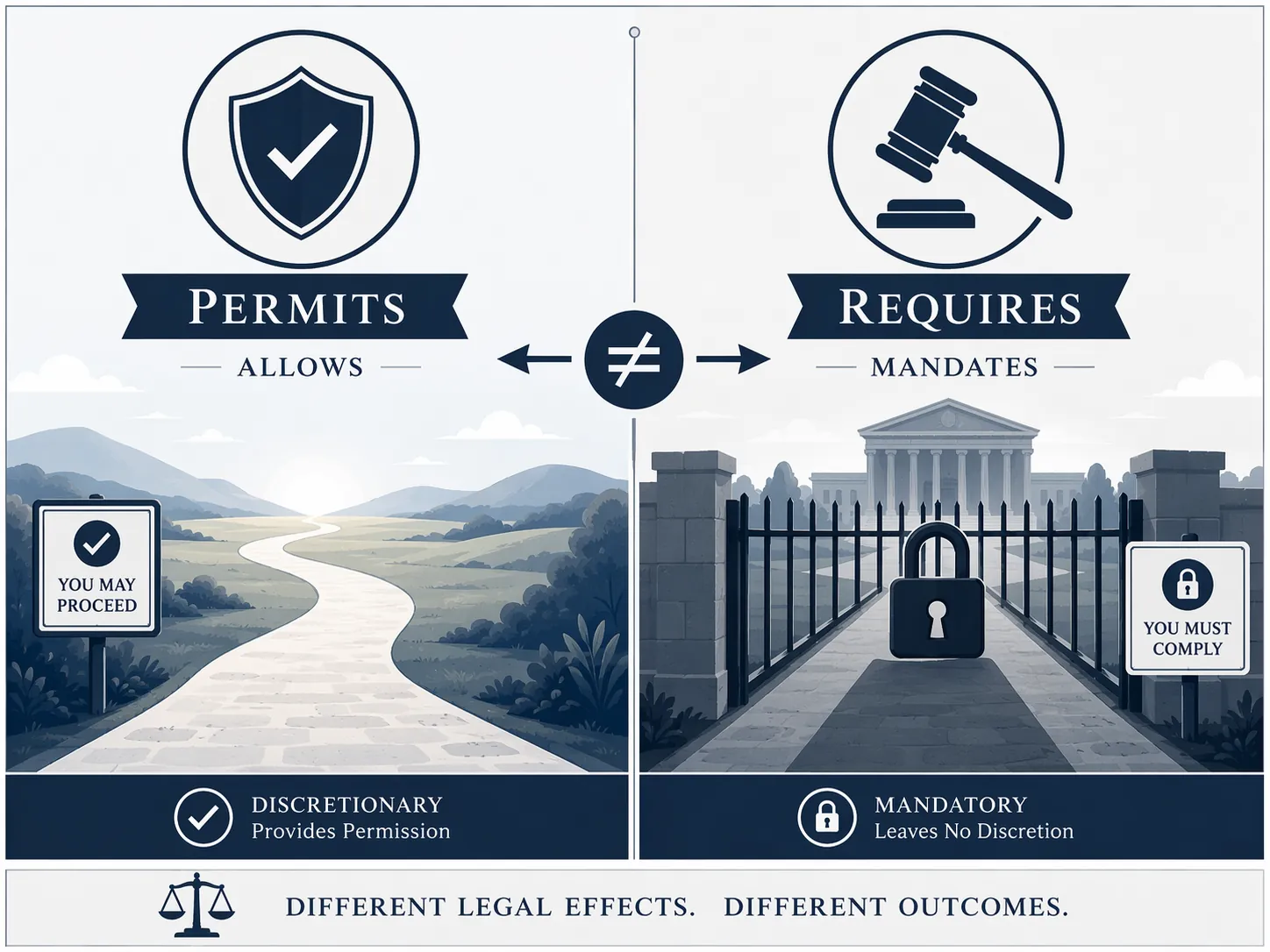
The central distinction in assessing Cunningham's Title IX stance is not whether the Court accepted the possibility of female-only athletic categories. It did. The distinction is whether Title IX itself compels that result everywhere. The commentary on B.P.J. consistently frames the Title IX holding in permissive terms: states may adopt biological-sex-based restrictions on women's sports participation.[2][3][4]
| Claim Form | Legal Accuracy After B.P.J. |
|---|---|
| Title IX permits states to restrict girls' and women's teams to biological females. | Supported by the reported 9-0 Title IX holding. |
| Title IX requires all schools to restrict girls' and women's teams to biological females. | Not established by the reported holding. |
| Title IX invalidates every inclusive athletics policy. | Not resolved by the reported holding. |
| The decision settles bathrooms, showers, locker rooms, and all sex-separated settings. | Overbroad under the cautionary legal commentary. |
That first line is where Cunningham's view is strongest. If her point is that Title IX can lawfully coexist with rules excluding biological males from women's sports, B.P.J. gives her substantial support. If the point becomes that Title IX demands those rules in every covered program, the cited materials do not support that stronger claim.
This is not a semantic quibble. A "permits" holding tells officials they may have legal room to act. A "requires" holding tells them they must act or face legal exposure. Moving from one to the other changes compliance advice, litigation risk, press coverage, and the choices available to state athletic associations and schools.
The Inclusive-Policy Question Remains Unresolved
The most important omission in Cunningham's framing is the status of inclusive policies. ATIXA's July 22, 2026 analysis, published the same day as Cunningham's press conference, warned that the decision "does not answer whether Title IX prohibits states or schools from adopting policies that permit transgender students to participate."[4] Crowell & Moring made the same boundary explicit, noting that the Court did not resolve whether inclusive policies themselves violate Title IX.[5]
That unresolved question is where public shorthand can mislead the fastest. A state ban surviving Title IX does not automatically mean a school with a different policy is violating Title IX. It means the Court upheld one kind of restriction against the challenges presented. The legality of a more inclusive rule may turn on a different record, a different policy design, different federal enforcement posture, and future litigation.
For a journalist, that means "the Supreme Court said states can exclude transgender athletes" is a much safer sentence than "the Supreme Court said Title IX bans transgender athletes from women's sports." The first sentence tracks the reported holding. The second adds a mandatory national rule the cited legal commentary does not identify.
For a compliance officer, the distinction is even less academic. A permissive Supreme Court holding may support a state-law defense or a policy revision. It does not, by itself, answer what a school in a different jurisdiction must do tomorrow morning with an existing inclusive policy, a pending complaint, or a student already participating under prior rules.
Bostock Was Preserved, Not Exported Everywhere
The third omitted nuance concerns Bostock v. Clayton County, the 2020 employment-discrimination decision that has hovered over many sex-discrimination disputes. In the B.P.J. commentary, Justice Gorsuch's concurrence is described as preserving Bostock as good law in the employment context while limiting its relevance to the sports dispute before the Court.[2][4]
That move matters because public debate often treats sex-discrimination law as one undifferentiated field. Employment, school athletics, bathrooms, locker rooms, housing, and other sex-separated settings may all use overlapping words, but they do not necessarily produce the same legal answer. The Court's treatment of Bostock in B.P.J. did not erase Bostock; it kept the employment holding in place while declining to let it control the athletics case in the way the challenger sought.[2][4]
Cunningham's "common sense" formulation does not grapple with that compartmentalization. That is understandable for an athlete speaking publicly about sports. It is less acceptable when commentators use her position as a bridge to broader claims about every sex-separated setting covered by federal civil-rights law.
Where the Surrounding Debate Overreaches
The sharper legal problem is easier to see by comparing Cunningham's sports-centered statement with broader political formulations around the same controversy. The Washington Times quoted Sen. Tommy Tuberville as saying Title IX "depends on keeping no men in women's sports, showers, or locker rooms."[6] That sentence may capture a policy preference, but it asks the B.P.J. holding to decide more than the cited commentary says it decided.
ATIXA's caution runs directly against that expansion. Its analysis warned that the opinion is narrower than many headlines suggest and that bathroom, locker room, and other sex-separated setting questions remain open.[4] Once the claim moves from sports-team eligibility to showers and locker rooms, the legal footing changes. The public sentence may still sound like the same argument. The holding is not doing the same work.
That is why Cunningham's narrower framing deserves a different accuracy grade from the broader claims around her. "Women's sports may be protected through biological-sex-based eligibility rules" is close to the legal center of B.P.J. "Title IX depends on excluding men from sports, showers, and locker rooms" is a much broader proposition. The first is supported by the reported athletics holding. The second reaches into questions the commentary says remain unresolved.[2][4][6]
The Post-Ruling Context Explains the Heat, Not the Holding
Cunningham did not speak into a quiet legal environment. Riley Gaines publicly called for Cunningham to speak out after the June 30 ruling, placing Cunningham's comments inside a larger athlete-driven campaign around women's sports.[7] Husch Blackwell also noted that, by the time of the decision, 27 states had laws limiting participation in girls' and women's sports based on biological sex, and it flagged a June 16, 2026 interagency agreement transferring Education Department Office for Civil Rights enforcement functions to the Justice Department's Civil Rights Division.[3]
Those facts help explain why the ruling was immediately treated as a national inflection point. They do not expand the holding. A 27-state landscape shows adoption and political momentum; it does not prove that every similar policy is required or that every different policy is unlawful. An enforcement shift may affect how federal officials pursue complaints; it does not rewrite the Supreme Court's operative verbs.
The same caution applies to administrative findings such as the Education Department's January 2026 conclusion that the University of Pennsylvania violated Title IX in connection with Lia Thomas.[8] That finding is relevant context for federal enforcement posture. It is not the same thing as a Supreme Court rule resolving all future athletics policies, and it should not be described as one.
The Dissent Also Limits How Much Certainty the Case Can Carry
Justice Sotomayor's dissent, as summarized by SCOTUSblog, argued that the Court resolved factual disputes without remanding for further factfinding.[2] That objection does not change the result, but it does matter for how confidently the decision should be generalized. The majority's rule is now controlling for the case's legal questions. The dissent is a reminder that records, classifications, and asserted justifications still matter in future disputes.
That is the part often lost when a Supreme Court decision is converted into a single sentence for television or social media. A holding can be decisive and still narrow. It can answer the question presented and leave adjacent questions untouched. B.P.J. appears to have done exactly that in the cited legal commentary.
Legal Accuracy Verdict
Cunningham's stance is legally supportable if read as a sports-specific claim that Title IX allows biological-sex-based restrictions in girls' and women's athletics after West Virginia v. B.P.J. The reported 9-0 Title IX holding gives that position substantial support, and the 6-3 Equal Protection holding further strengthens the legal position of states that adopt such restrictions.[2][3]
It becomes materially incomplete if read as saying Title IX requires those restrictions. It becomes misleading if used to claim that inclusive policies are now unlawful. And it becomes overbroad if extended to bathrooms, showers, locker rooms, or every other sex-separated setting. Those are not small editorial refinements. They are the difference between describing what the Court permitted and inventing what it commanded.
References
- Sophie Cunningham says it's 'common sense' to keep trans athletes out of women's sports, The Athletic, July 22, 2026
- Court rules that states can exclude transgender athletes from girls' and women's sports teams, SCOTUSblog, June 2026
- Supreme Court Holds That Title IX and the Equal Protection Clause Permit Biological-Sex-Based Restrictions on Women's Sports Participation, Husch Blackwell
- Therefore, What? The Supreme Court's Decision on Transgender Athletes, ATIXA, July 22, 2026
- Supreme Court Rules 9-0 on Title IX Athletics, Crowell & Moring
- WNBA's Sophie Cunningham sparks debate after speaking out on women's sports, Washington Times, July 22, 2026
- What the SCOTUS Title IX ruling could mean for lawsuits seeking damages, Fox News/OutKick
- Supreme Court allows state laws regulating transgender athletes, Constitution Center
Related records
Tool profile
Browse tool evaluations →Governing regulation
Browse the obligations tracker →Preventive workflow
Browse verification workflows →
Report a correction or tip
Spotted an outdated figure, a misstated fact, or a ruling this case record should reflect? Public comments are disabled for this content given the professional cost of a misreported case outcome, penalty amount, or rule text — use the structured correction channel instead.
Report a correction or tip for this record →