
Why the Southwest Boycott Misses the Legal Distinction
The recent ICE arrests of a Southwest flight attendant and a passenger have sparked boycott calls. This analysis explains why immigration status and work authorization are legally separate, why Southwest's actual liability is low, and why boycott demands face unresolved preemption questions.
- Jurisdiction
- United States
- Court
- General
- AI tool named
- None
- Ruling date
- Jul 20, 2026
- Source document
- View primary court order ↗
- Last verified
- Jul 27, 2026
Lex Machina Review is an independent risk-tracking and reference resource. Nothing on this site is legal advice, and using it does not create an attorney-client relationship. Every record is reviewed against primary sources but may not reflect the most current status of a matter — always verify directly against the cited court order, rule text, or a licensed attorney before relying on it.
Companion explanation — secondary to the source document above
The two July incidents that pushed Southwest Airlines into a boycott cycle look similar only at the level at which social media usually handles them: ICE, an airport, a person being taken away, and an airline name in the frame. On July 14, Lorenzo Thompson, identified in reporting as a Southwest Airlines flight attendant, was detained at Nashville International Airport after ICE alleged that he had overstayed a visa in 2021.[1] Six days later, Chantal Morales Rojas was detained at Denver International Airport while departing for California, in an encounter recorded on video near the gate area.[2]
The missing piece in much of the legal analysis around the Southwest boycott is not whether the arrests were frightening to watch. They were. It is whether the public debate has kept separate two legal questions that do not collapse into one another: whether a person is removable, and whether that person is authorized to work.
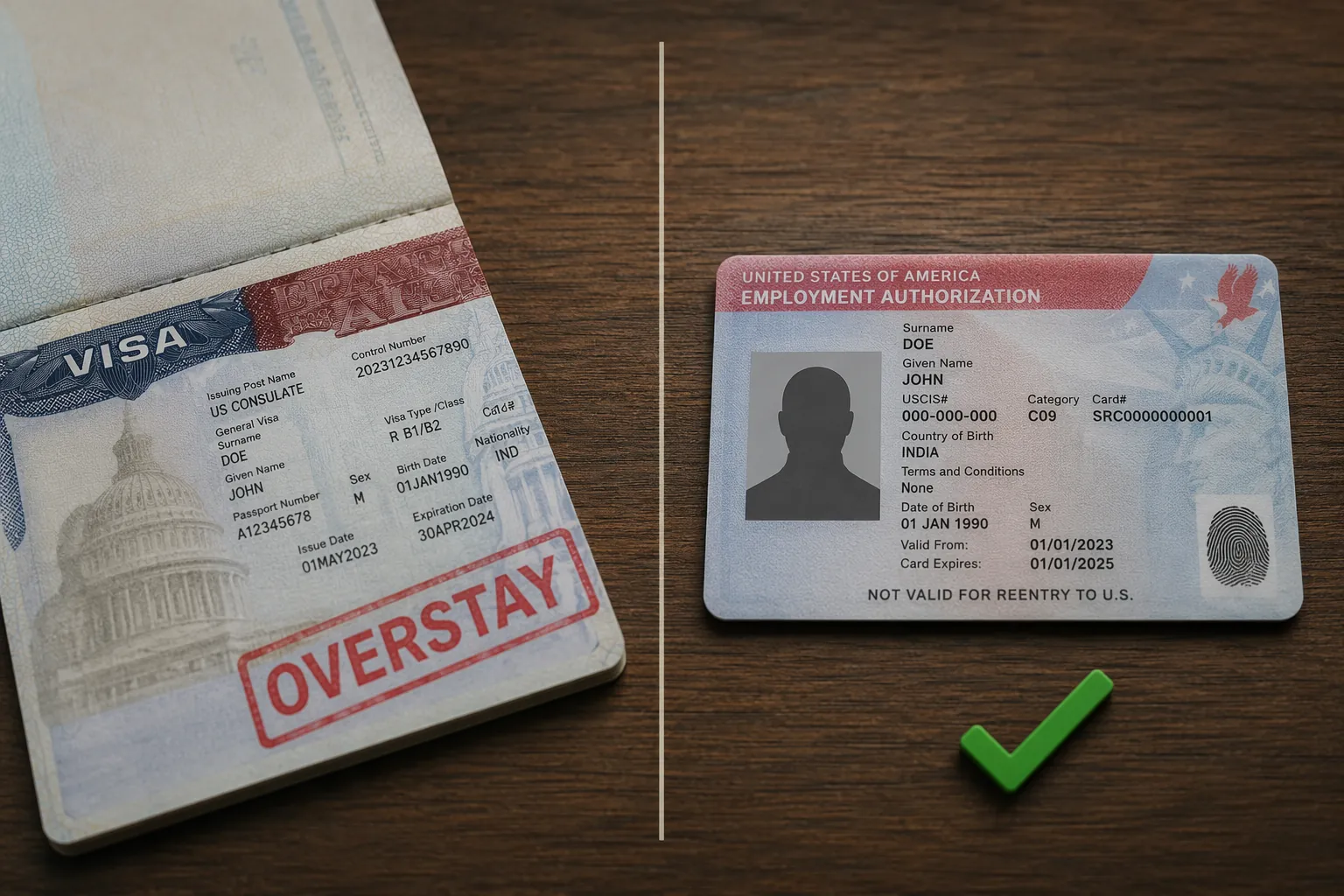
They are separate questions. A visa overstay can make a person removable. It does not, by itself, prove that the person lacked a currently valid federal Employment Authorization Document. Reporting on Thompson’s case states that he had work authorization connected to a pending asylum case while ICE alleged a prior overstay, a pairing that sounds contradictory only if “status” and “authorization to work” are treated as the same legal object.[3][4]
The distinction that carries the legal analysis
A noncitizen’s immigration status answers one set of questions: how the person entered, what terms governed that entry, whether those terms expired or were violated, and whether the person may now be subject to removal. Work authorization answers a different question: whether the federal government has authorized that person to accept employment during a defined period or under a defined category.
That distinction matters most in Thompson’s case because the public shorthand — “ICE says he overstayed, so Southwest employed an unauthorized worker” — skips the document that an employer is actually required to inspect. An EAD issued through a pending asylum process can be facially valid even where ICE later asserts that the person overstayed a visa years earlier.[3][4] Those facts may coexist. They do not answer every removal question, but they sharply narrow the employer-liability question.
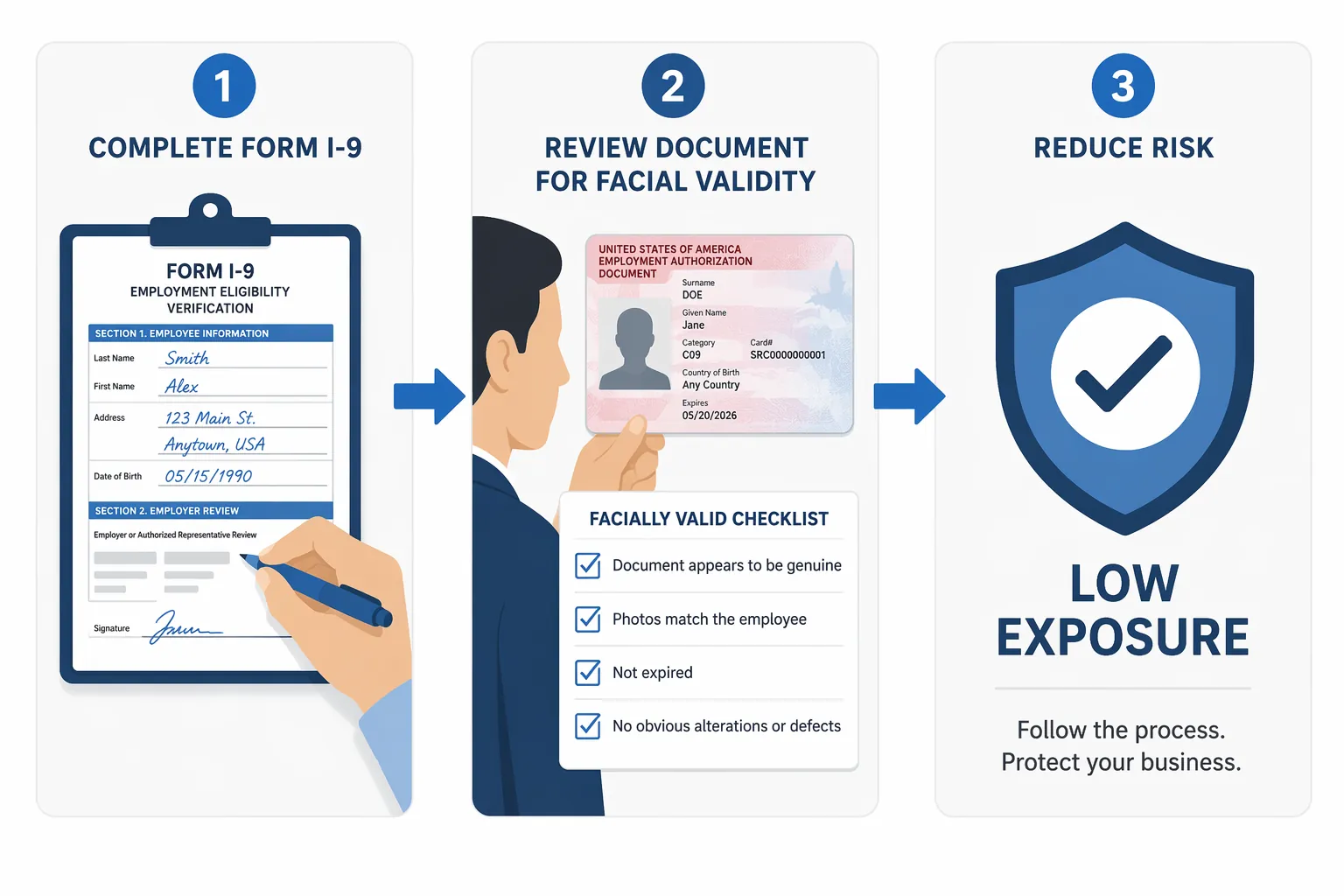
This is where the risk calculation often goes wrong. A company is not asked, in the ordinary I-9 process, to sit as an immigration court. It is asked to review documents presented for employment eligibility, determine whether they reasonably appear genuine and relate to the person presenting them, and complete the verification process. If the document is a valid EAD on its face, the employer’s job is not to re-litigate the underlying asylum posture or predict whether ICE will later pursue a removability theory.
That does not mean an EAD is magic paper. It can expire. It can be fraudulent. It can be revoked. It can be misused by someone else. But those are different facts from a historical overstay allegation. For a compliance team, the operative question is not “Did ICE later claim the employee was removable?” It is “What documents were presented, what did they show on their face, and did the employer complete the process it was legally assigned to complete?”
What Southwest could control as an employer
For Thompson, the legal exposure analysis starts with employment verification. If Southwest accepted a facially valid EAD and properly completed its verification obligations, the later ICE theory about a 2021 overstay does not automatically convert the company into an employer of an unauthorized worker.[3][4] The federal government may still detain the worker. The employer may still lose a scheduled employee without warning. The workplace may still face operational disruption. But those consequences are not the same as employer liability.
That is the uncomfortable part for executives who want a single sentence for employees or customers. The same file can contain a sympathetic detained worker, a valid-looking federal work document, a removability allegation, and an employer that did not have legal authority to decide the ultimate immigration-status question. A public statement that blurs those lanes may reduce heat for an afternoon, but it creates a worse compliance record than a careful statement that says less.
A careful employer response after an arrest like Thompson’s would preserve the I-9 file, identify the documents reviewed, determine whether any government notice was served on the company, separate employment-status decisions from public-relations statements, and avoid making admissions about the worker’s underlying immigration status unless those facts are actually known. None of that requires indifference to the employee. It requires not pretending that an employer has the same authority as ICE, USCIS, or an immigration judge.
| Question | Who usually answers it | Why it matters here |
|---|---|---|
| Was the person removable based on a prior overstay? | Federal immigration authorities and, if contested, immigration adjudicators | This goes to ICE’s theory for detention or removal. |
| Was the person authorized to work when hired or reverified? | The federal work-authorization system, as reflected in documents presented to the employer | This is the employment-verification track. |
| Did the employer properly complete I-9 verification? | The employer, subject to government review | This is the main corporate-liability question. |
| Did the airline initiate or direct the arrest? | Fact investigators, based on evidence of airline conduct | The current reporting does not establish that Southwest initiated either encounter. |
Thompson and Morales Rojas should not be treated as one legal event
Thompson’s detention raises employment-verification and workplace-disruption issues because he was reported as a Southwest flight attendant detained at Nashville International Airport.[1] Morales Rojas’s detention raises passenger-enforcement issues because she was reported as a traveler stopped at Denver International Airport while departing for California.[2] The airline appears in both stories, but not in the same legal role.
For Thompson, Southwest’s relevant file is likely an employment file: I-9 records, work-authorization documents, scheduling records, and any communications with federal agents. For Morales Rojas, the relevant file is not an employment-verification file at all. It is the airport and passenger-data environment: how government agencies know who is traveling, where federal officers operate inside airports, and what duties a carrier has when law enforcement appears at or near a gate.
That difference is not a technicality. It is the difference between asking whether an employer properly verified work authorization and asking whether a passenger’s airport detention complied with constitutional and statutory limits. Those questions may both be urgent. They are not interchangeable.
Airport gates are not controlled only by airlines
The intuitive boycott theory is simple: the arrest happened at a Southwest gate, so Southwest must have handed someone over. That theory assumes a level of airline control over the enforcement environment that is hard to square with how airport data and federal presence actually work.
The Electronic Frontier Foundation has documented a TSA-to-ICE data-sharing pipeline in which passenger lists are sent to ICE multiple times per week, and it has also reported that ARC sold more than 1 billion domestic flight records spanning 39 months to CBP.[5] Those reported data flows matter because they show how immigration authorities may identify travelers without a carrier employee making a tip or a gate agent deciding whom to target.
NILC’s July 2026 airport guidance separately reported ICE agents deployed at 14 U.S. airports since a February 14, 2026 DHS funding lapse.[6] That does not prove anything about the legality of a particular arrest. It does show that airport enforcement is not merely an ad hoc airline-calls-ICE model. Federal officers can be present in the terminal environment, and passenger information can move through government channels before an airline employee ever sees a gate interaction.
That is why Morales Rojas’s detention should be analyzed as a passenger-rights and federal-enforcement incident before it is analyzed as a Southwest-liability incident. The video may explain why the backlash spread. It does not, by itself, establish that the airline selected the target, initiated the stop, or had lawful power to block federal officers from acting in the airport.
There are real passenger-rights questions, but they are not solved by naming the carrier
The lower-liability analysis for Southwest should not be mistaken for a conclusion that every airport arrest is lawful. Airport terminals occupy a legally complicated space. Security screening, border-related authorities, domestic travel, immigration enforcement, and ordinary Fourth Amendment protections do not all operate under the same rule.
Dhar Law’s airport guidance discusses ICE warrantless arrest authority under 8 U.S.C. § 1357 and distinguishes airport-terminal encounters from the border-search and administrative-search exceptions that apply in narrower contexts.[7] The ACLU has also advanced Fourth Amendment theories challenging certain warrantless ICE tactics.[8] Those materials support a more careful conclusion than either side of the online fight tends to allow: travelers may have contestable rights in airport encounters, and some ICE tactics may be vulnerable to challenge, but that does not automatically make a private airline the legally responsible actor.
The practical danger for counsel is that the visible entity is not always the legally controlling entity. A passenger sees the brand on the boarding pass and the gate sign. The enforcement architecture may involve TSA data, DHS officers, CBP-accessible records, ICE priorities, airport authority rules, and federal statutory powers. A carrier can be implicated by what it voluntarily does, what it discloses, or how it treats passengers during an encounter. But those are fact-specific inquiries, not conclusions supplied by the location of the arrest.
The boycott demand runs into federal-control problems
Boycott calls followed the viral airport-arrest coverage and Southwest’s public response, with reporting documenting demands that the airline refuse cooperation with federal immigration enforcement.[9] The moral logic of that demand is easy to understand. A passenger is detained in a public-facing travel setting, the carrier’s name is visible, and customers want the company to do something more than issue a compliance-shaped statement.
The legal version of the demand is much harder. “Refuse cooperation” can mean several different things, and those differences matter:
- declining voluntary assistance that is not legally required;
- refusing to provide information that federal law or security systems require the carrier to provide;
- instructing employees not to answer informal questions from officers;
- physically or operationally interfering with federal officers at a gate;
- challenging a government demand in court rather than complying immediately.
Those are not variations of the same corporate choice. Some may be available in carefully defined circumstances. Some may be preempted by federal law. Some may expose employees to obstruction or security consequences. Some may be impossible because the relevant data has already moved through TSA or other federal channels before the airline is asked to do anything.
This is where federal preemption and supremacy questions become unavoidable. Immigration enforcement is an area of dominant federal control, and commercial aviation operates inside a dense federal security regime. A private airline can review its voluntary practices, train employees on lawful limits, document government requests, and litigate overbroad demands where it has standing and time to do so. It cannot simply announce that federal immigration authority will not operate at its gates.
Nor does the current reporting support confident claims about the boycott’s economic effect. The available material documents backlash and calls for a boycott, not booking cancellations, revenue impact, or market-wide consumer behavior.[9] For legal-risk purposes, the boycott is important because it shows how quickly an enforcement event can become a corporate-governance and communications problem. It is not yet evidence of measurable financial injury.
The risk signal is real, even if the airline-liability theory is weak
The Thompson and Morales Rojas incidents are significant because they show immigration enforcement reaching ordinary workplace and travel settings in ways that can destabilize a company’s schedule, workforce confidence, customer trust, and public narrative in a matter of hours. They are not legally significant because they prove that Southwest caused the arrests.
For employers, Thompson’s case is a reminder to keep the status-versus-work-authorization distinction intact and to be able to show what the I-9 process actually established. For travel-facing businesses, Morales Rojas’s case is a reminder that passenger enforcement at gates may arrive through federal data and federal personnel, not through a customer-service decision. For litigators, both incidents point to contested airport-enforcement questions that may belong in constitutional and statutory challenges against government actors rather than in a simplified theory of airline fault.
The strongest legal analysis points away from a simple boycott premise and toward a harder division of responsibility: moral protest against immigration enforcement, employer duties to verify facially valid work documents, passenger rights during airport encounters, and federal control over the immigration-enforcement infrastructure that private carriers operate around but do not command.
References
- Southwest Airlines flight attendant arrested by ICE for alleged visa overstay, Fox News
- Woman detained by ICE at Denver International Airport while departing for California, CBS Colorado
- ICE Detained a Southwest Flight Attendant With a Pending Asylum Case — Here's the Legal Distinction Everyone Is Missing, Legal Desire
- ICE Arrests Southwest Airlines Flight Attendant At Airport — He May Have Overstayed But Still Been Legal To Work, View from the Wing
- Data Brokers are Selling Your Flight Information to CBP and ICE, Electronic Frontier Foundation
- Community Alert: Immigration Arrests at Airports, National Immigration Law Center, July 2026
- ICE at the Airport: What Every Traveler Needs to Know Right Now, Dhar Law LLP
- This Deceptive ICE Tactic Violates the Fourth Amendment, ACLU
- Texas-born Southwest Airlines faces boycott calls after ICE airport arrest video goes viral, Yahoo News / San Antonio Express-News
Related records
Tool profile
Browse tool evaluations →Governing regulation
Browse the obligations tracker →Preventive workflow
Browse verification workflows →
Report a correction or tip
Spotted an outdated figure, a misstated fact, or a ruling this case record should reflect? Public comments are disabled for this content given the professional cost of a misreported case outcome, penalty amount, or rule text — use the structured correction channel instead.
Report a correction or tip for this record →