
Southwest Airlines Tests RLA Preemption Boundaries with ICE Detention Claim
This article analyzes whether Southwest Airlines can use the Railway Labor Act to compel arbitration of a flight attendant's ICE detention claims, a novel legal question at the intersection of RLA preemption and third-party sovereign enforcement.
- Jurisdiction
- United States
- Court
- Federal District Court
- AI tool named
- None
- Ruling date
- Jul 23, 2026
- Source document
- View primary court order ↗
- Last verified
- Jul 25, 2026
Lex Machina Review is an independent risk-tracking and reference resource. Nothing on this site is legal advice, and using it does not create an attorney-client relationship. Every record is reviewed against primary sources but may not reflect the most current status of a matter — always verify directly against the cited court order, rule text, or a licensed attorney before relying on it.
Companion explanation — secondary to the source document above
Lorenzo Thompson’s legal problem did not begin in a grievance meeting or at a system board. It began, according to the union account reported by Texas Public Radio and KERA, after he completed a Southwest Airlines work flight at Nashville International Airport on July 14, 2026, and was detained by ICE.[1] NBC 5 Dallas-Fort Worth described co-workers and union members rallying for him afterward, with TWU Local 556 treating the detention as an emergency affecting one of its flight attendants, not as an ordinary contract dispute.[2]
That sequence matters. The live labor-law question is not whether Southwest may ever invoke a collective bargaining agreement when a unionized flight attendant brings employment-related claims. It often can. The harder question is whether a federal immigration-enforcement detention during a work trip can be pushed into the Railway Labor Act’s minor-dispute machinery as though the dispute were, at bottom, about the meaning or application of the CBA.

The reported Southwest position should be handled with care. The Dallas Morning News reportedly described Southwest as arguing that the issue falls under its union contract and the Railway Labor Act, and that arbitration should replace a court trial. But as of July 25, 2026, the primary filing establishing the exact procedural vehicle, the cited provisions, and the claims being targeted has not been confirmed from the available record. That caveat is not clerical. In RLA preemption work, the form of the motion, the claims pleaded, and the CBA provisions identified usually decide whether the argument is a serious jurisdictional or preclusion problem, or simply an overbroad label attached to an employment dispute.
The Detention Is the Hard Fact; the Contract Theory Is Still the Unverified One
The public facts point first to a federal act. Thompson is described in the reporting as a Jamaican national who entered the United States in 2021 on a visa and has a pending asylum claim, though that immigration status has been reported through supporters rather than independently verified through court or DHS records in the sources available here.[1][3] ICE’s own statement, as reported by Eyes on ICE, said the agency “cannot search detainment records by employer,” which undercuts any easy assumption that the incident was part of a Southwest-specific enforcement program.[3]
Those details humanize the case, but they do not prove the RLA question. A pending asylum claim does not itself answer whether a state-law tort claim is preempted. A rally does not decide whether a system board has exclusive jurisdiction. Even the location of the detention, while practically important, does not by itself convert ICE conduct into a contractual airline labor dispute. The legal load has to be carried by the connection between the claims and the CBA.
That is where the reported theory becomes unusual. A conventional minor-dispute case starts with employer conduct: discipline, discharge, seniority, bidding, assignment, scheduling, pay, leave, or another workplace action that the carrier says is authorized by the agreement. Here, the event at the center of the public record is detention by a federal enforcement agency. Unless the pleaded claims turn on what Southwest did, failed to do, disclosed, requested, permitted, or contractually owed Thompson under a specific CBA provision, the RLA fit is not obvious.
What the RLA Minor-Dispute Frame Actually Requires
The Railway Labor Act channels many airline and railroad labor disputes into specialized dispute-resolution processes. The useful distinction here is between disputes over creating or changing collective bargaining agreements and disputes over interpreting or applying existing agreements. Employer-side summaries of the doctrine describe “minor disputes” as controversies grounded in the meaning or application of an existing CBA, typically resolved through adjustment-board arbitration rather than ordinary litigation.[4]
The Supreme Court’s familiar formulation from Consolidated Rail is that a carrier’s position must be “arguably justified” by the CBA for the dispute to fall within the minor-dispute category. Secondary RLA-preemption commentary uses that standard to explain why state-law claims may be displaced when a court cannot resolve them without interpreting the labor agreement, or when the employer’s defense is rooted in an arguable contractual right.[5]
| Question | Why it matters in Thompson’s case |
|---|---|
| Who performed the challenged act? | If the central act is ICE detention, the dispute begins outside the employer-employee contract relationship. |
| What claim is being litigated? | Wrongful arrest, invasion of privacy, negligent supervision, or related tort theories may require different degrees of CBA analysis. |
| Which CBA provision is invoked? | A general arbitration clause is weaker than a specific provision governing the employer conduct alleged. |
| Can the court decide the claim without interpreting the CBA? | If yes, ordinary RLA preemption is harder to establish. |
| Is the employer’s position arguably justified by the agreement? | That is the doctrinal hinge, not the mere fact that Thompson is union-represented. |
That frame does not make Southwest’s reported position frivolous. It does make it demanding. A carrier need not prove it will win on the contract interpretation to obtain minor-dispute treatment. But it normally must point to something in the agreement that plausibly governs the conduct being challenged. “This happened at work to a union employee” is not the same argument as “the agreement arguably authorized the employer action alleged in the complaint.”
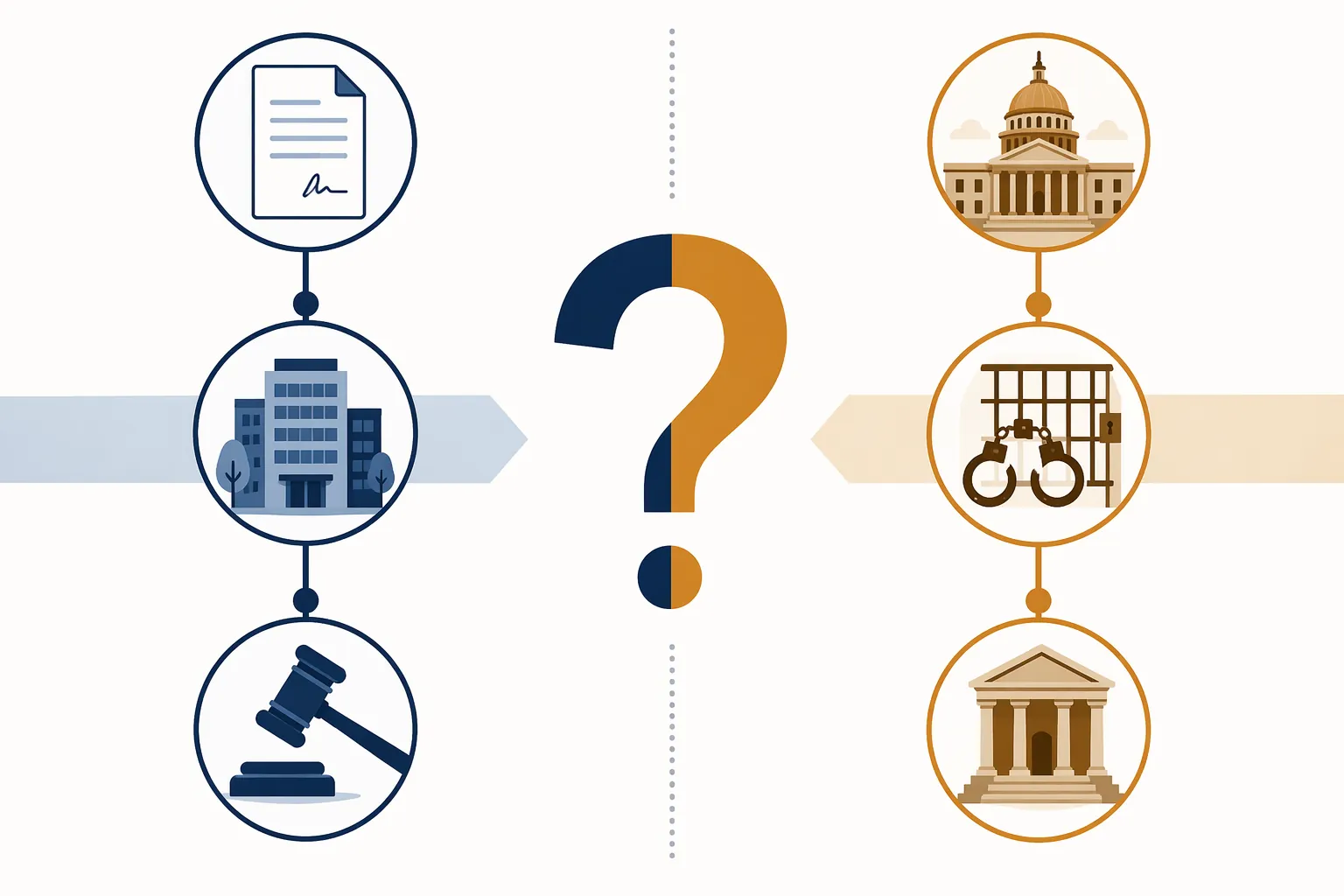
The Mismatch: Sovereign Enforcement Versus Contract Administration
The reported facts create a mismatch that should make litigators slow down. ICE is not a party to the Southwest-TWU Local 556 collective bargaining agreement. It does not administer the airline’s bid system, discipline rules, leave policies, grievance procedures, or work assignments. If the injury-producing act is detention by ICE, the first legal relationship is between Thompson and the federal government, with Southwest potentially relevant only if its own conduct contributed to the detention or violated an independent duty.
That distinction is not semantic. A state-law claim against an airline for mishandling employee information, negligently supervising personnel, assisting enforcement without lawful basis, or causing a wrongful arrest might require a court to ask what the airline did. Some versions might also require reference to workplace rules, security protocols, or contractual obligations. But reference is not always interpretation. The preemption question tightens only when the court must construe the CBA to determine the duty, breach, or defense.
Southwest’s strongest version would identify a concrete provision: for example, a clause allocating authority over work status after removal from a flight, employee documentation obligations, cooperation with airport or federal authorities, access to secure areas, or procedures following government action at an airport. That kind of provision could make a court ask whether the carrier’s conduct was arguably justified by the agreement. A weaker version would rely on the general existence of a union contract and arbitration mechanism. That is the jump the public description does not yet justify.
The claims also matter. A claim that Southwest disciplined Thompson because of the detention would look more like an ordinary airline labor dispute than a claim that ICE unlawfully detained him after a completed work flight. A claim that Southwest disclosed information in a way that violated an independent privacy duty might sit somewhere else again. Until the operative complaint and motion papers are available, the responsible answer is conditional.
Palova Is the Comparator to Pull, Not a Shortcut
The most relevant recent guidepost identified in the available research is Palova v. Southwest Airlines, a 2025 Fifth Circuit decision involving RLA preemption of employment-related claims. The full opinion text was not retrieved in the materials available for this article, so it should not be paraphrased as though its holding has been independently verified. But it is the case counsel would pull first because the forum, carrier, doctrine, and employment setting all overlap.
The right use of Palova is comparative. Did the Fifth Circuit require actual CBA interpretation, or was an arguable contractual defense enough? Did it treat the plaintiff’s state-law theory as independent of the CBA, or as inseparable from collectively bargained duties? Did the court distinguish between consulting the agreement and interpreting it? Those questions matter more than the case name. A broad reading of Palova might help Southwest if the Thompson claims are pleaded against the airline in a way that necessarily depends on CBA-created duties. A narrower reading could leave Southwest with the harder task of explaining how ICE’s sovereign enforcement act becomes a minor dispute.
This is also where procedural posture does real work. A motion to compel RLA arbitration, a motion to dismiss on preemption grounds, a removal argument, or a position in correspondence would each require different treatment. If Southwest has already identified specific CBA provisions, the analysis changes. If it has not, the reported legal position remains a headline description of a defense, not the defense itself.
Charlene Carter Shows Southwest Knows This Terrain, But It Does Not Control It
The Charlene Carter litigation is useful for a narrower reason. KERA reported in April 2026 that Southwest paid a $473,051 settlement after a jury found the airline violated a flight attendant’s religious-discrimination rights in a dispute arising from her firing after sharing abortion-related images.[6] RLA preemption was litigated in that matter, which makes it a recent example of Southwest pressing labor-law defenses in flight-attendant employment litigation.
It is not, however, a clean factual parallel. Carter involved employer discipline and alleged discrimination connected to discharge. Thompson’s public facts begin with ICE detention during a work trip. A firing case naturally invites arguments over just cause, workplace rules, discipline procedures, and contract administration. A federal detention case does not automatically do the same. The Carter matter shows Southwest’s familiarity with RLA preemption arguments; it does not answer whether those arguments reach third-party sovereign enforcement.
The Union’s Position Is More Than Rally Optics
TWU Local 556’s response has been described in practical terms: public support, retained counsel, rallies, and activation of a Critical Incident Stress Management response.[1][2] That matters because detention interrupts more than a legal theory. It removes a worker from the schedule, separates him from co-workers, and forces the representative institution to decide quickly whether the crisis is immigration counsel, labor counsel, grievance preparation, public advocacy, or all of the above.
The union also sits inside the very structure Southwest reportedly invokes. If the dispute is treated as an RLA minor dispute, Thompson may be pushed toward the adjustment-board process created for contract interpretation and administration. In that forum, the union’s role is not merely expressive. It may have to represent him, process a grievance, manage deadlines, evaluate CBA arguments, and decide how to frame employer conduct while continuing to support a member whose immediate harm arose from detention by a federal agency.
That dual posture is the workplace consequence that broad “historic case” language tends to flatten. A union can rally outside the courthouse or detention context and still be pulled back into a contractual forum where the questions become narrower, more technical, and less satisfying: Was there a grievable act by the carrier? Which article of the agreement applies? What remedy can a system board award? Can the board address harm produced by ICE, or only employer action connected to that harm?
The internal politics around TWU Local 556 should be kept in their lane. FOX 4 Dallas-Fort Worth separately reported a recall campaign involving 6,000 signatures seeking removal of union President Audrey Stone and the board.[7] That could affect representation stability if leadership changes while Thompson’s matter is pending. It should not be conflated with the Thompson rally or treated as evidence about the merits of Southwest’s RLA position.
Where the Boundary Should Be Drawn
The boundary question is easier to state than to litigate. If Thompson’s claim turns on ICE’s sovereign enforcement conduct, and Southwest’s role is collateral or governed by duties independent of the CBA, the case likely sits outside the classic minor-dispute frame. The RLA does not become a general workplace-events removal system simply because the employee is covered by an airline labor agreement.
If, however, Southwest can identify a specific agreement provision that arguably authorized the employer conduct challenged in the claims, the argument becomes harder to dismiss. The court would then have to decide whether resolving the claim requires interpreting that provision, not merely whether the detention was upsetting, public, or immigration-related. In that version, the sovereign act may be the factual trigger while the litigated duty remains contractual.
That is why the missing filing matters so much. The public record supports concern about an expansive RLA theory. It does not yet support a confident declaration that Southwest’s precise argument fails. The decisive materials will be the operative complaint, the motion or correspondence asserting RLA preemption, the CBA provisions Southwest identifies, and the court’s treatment of whether the claims require interpretation rather than factual reference.
Accepting the broadest version of Southwest’s reported theory would move RLA preemption toward workplace events triggered by government enforcement, even when the immediate actor is a sovereign agency outside the bargaining relationship. Rejecting it would preserve a more familiar line between contractual airline labor disputes and third-party enforcement acts. For airline counsel and union lawyers, that line is the case.
References
- Southwest flight attendant detained by ICE while working, union says, Texas Public Radio / KERA, July 23, 2026
- Southwest flight attendant detained by ICE as co-workers, union rally to support, NBC 5 Dallas-Fort Worth
- Flight Attendant Detained by ICE Mid Shift Despite Pending Asylum Case, Eyes on ICE
- The Railway Labor Act: A Practical Guide For Employers In Air And Rail Transportation, Fisher Phillips LLP
- RLA “Minor Dispute” Preemption Alive and Well As a Potential Defense in State Court, Management Writes / Employer Labor Relations
- Southwest flight attendant gets $500,000 payout after she was fired for sharing fetus photos, KERA News, April 29, 2026
- Southwest Airlines flight attendants rally against union leaders, FOX 4 Dallas-Fort Worth
Related records
Tool profile
Browse tool evaluations →Governing regulation
Browse the obligations tracker →Preventive workflow
Browse verification workflows →
Report a correction or tip
Spotted an outdated figure, a misstated fact, or a ruling this case record should reflect? Public comments are disabled for this content given the professional cost of a misreported case outcome, penalty amount, or rule text — use the structured correction channel instead.
Report a correction or tip for this record →