
Space Needle Shooting Prosecution Faces AI Evidence Risk
The Seattle Space Needle shooting prosecution may face material AI-evidentiary risk because the King County Prosecutor's Office categorically rejects AI-generated police reports, yet Seattle Police have no policy prohibiting such use. This analysis explains what counsel should demand in discovery to protect against suppressed evidence or Brady violations.
- Jurisdiction
- United States, Washington, King County
- Court
- King County Superior Court
- AI tool named
- Axon Draft One
- Ruling date
- Jul 26, 2026
- Source document
- View primary court order ↗
- Last verified
- Jul 27, 2026
Lex Machina Review is an independent risk-tracking and reference resource. Nothing on this site is legal advice, and using it does not create an attorney-client relationship. Every record is reviewed against primary sources but may not reflect the most current status of a matter — always verify directly against the cited court order, rule text, or a licensed attorney before relying on it.
Companion explanation — secondary to the source document above
| Risk item | Current status |
|---|---|
| Jurisdiction | Seattle Police Department investigation; King County Prosecuting Attorney's Office charging and discovery risk |
| Incident date | July 26, 2026 |
| Case status | Media reports state one suspect was arrested and a second suspect was being sought; charging documents and discovery are not yet public |
| Source confidence | High for the KCPAO AI-report policy and reported incident facts; limited for any claim about actual AI use in this shooting |
| Last verified | July 27, 2026 UTC |
| Scope note | This is legal-risk analysis, not legal advice, and it does not assert that any Space Needle shooting report was AI-generated |
The evidentiary problem is already visible before the first public discovery packet. A high-profile Seattle shooting prosecution may depend on reports from many officers, while the King County Prosecuting Attorney's Office has said it will not accept police report narratives produced with AI assistance and Seattle Police had no adopted policy, as of the shooting, that clearly blocked or audited such use. For readers arriving through the phrase Space Needle shooting casualties law enforcement response 2025, the date matters: the reported incident at issue here occurred in 2026, not 2025.
News reports describe a July 26, 2026 shooting during Bite of Seattle near Seattle Center and the Space Needle in which three people were killed and four were injured, including a toddler. The reported account was not a single-shooter narrative: two suspects allegedly shot at each other in a crowd, one was arrested, and police continued searching for another suspect as of the initial reports.[1][2]
That kind of scene produces a discovery file with a long tail: event-security officers, responding officers, body-worn video, radio traffic, civilian cellphone footage, witness statements, officer narratives, supplemental reports, use-of-force paperwork if any force was used, and supervisor review. The larger the file, the less comfort there is in saying that no one intended to create an AI problem. Intent is not what gets litigated first. The first motion usually asks what happened, who knew it, when it was retained, and why it was not disclosed.
The Prosecutor's Line Is Harder Than a General AI Warning
The controlling local fact is the September 2024 King County Prosecuting Attorney's Office memo, reported by GeekWire, warning Seattle-area law enforcement not to use AI to write police reports.[3] The memo did not merely ask officers to be careful with generative tools. It told agencies that prosecutors would categorically reject AI-generated police narratives, including narratives produced by tools such as Axon Draft One or ChatGPT.[3]
That distinction matters in court. A soft guidance document can be argued around. A categorical refusal rule creates an intake problem: if a narrative was AI-assisted, prosecutors have already said it should not enter the prosecution file as an acceptable police report narrative. If nobody has a reliable way to detect that assistance, the file may look complete while carrying an undisclosed admissibility and credibility defect.
The memo's most concrete warning was not futuristic. KOMO reported the memo's example of an AI-generated report that hallucinated an officer who was not even at the scene.[4] In a mass-casualty case, that is not a harmless typo. A nonexistent officer can distort the sequence of witnesses, make body-camera correlation harder, confuse who observed what, and force prosecutors to spend hearing time repairing confidence in documents that should have been boring.
The KCPAO memo also raised Criminal Justice Information Services concerns and warned about Brady and potential impeachment disclosure consequences, as later discussed by the Electronic Frontier Foundation.[5] Those are not abstract ethics labels. If a report narrative was generated through a tool that processed protected criminal-justice information outside permitted controls, or if an officer submitted an AI-assisted report without disclosure, the issue can become both a document-integrity problem and an officer-credibility problem.
The Gap Is Not the Memo. It Is Enforcement.
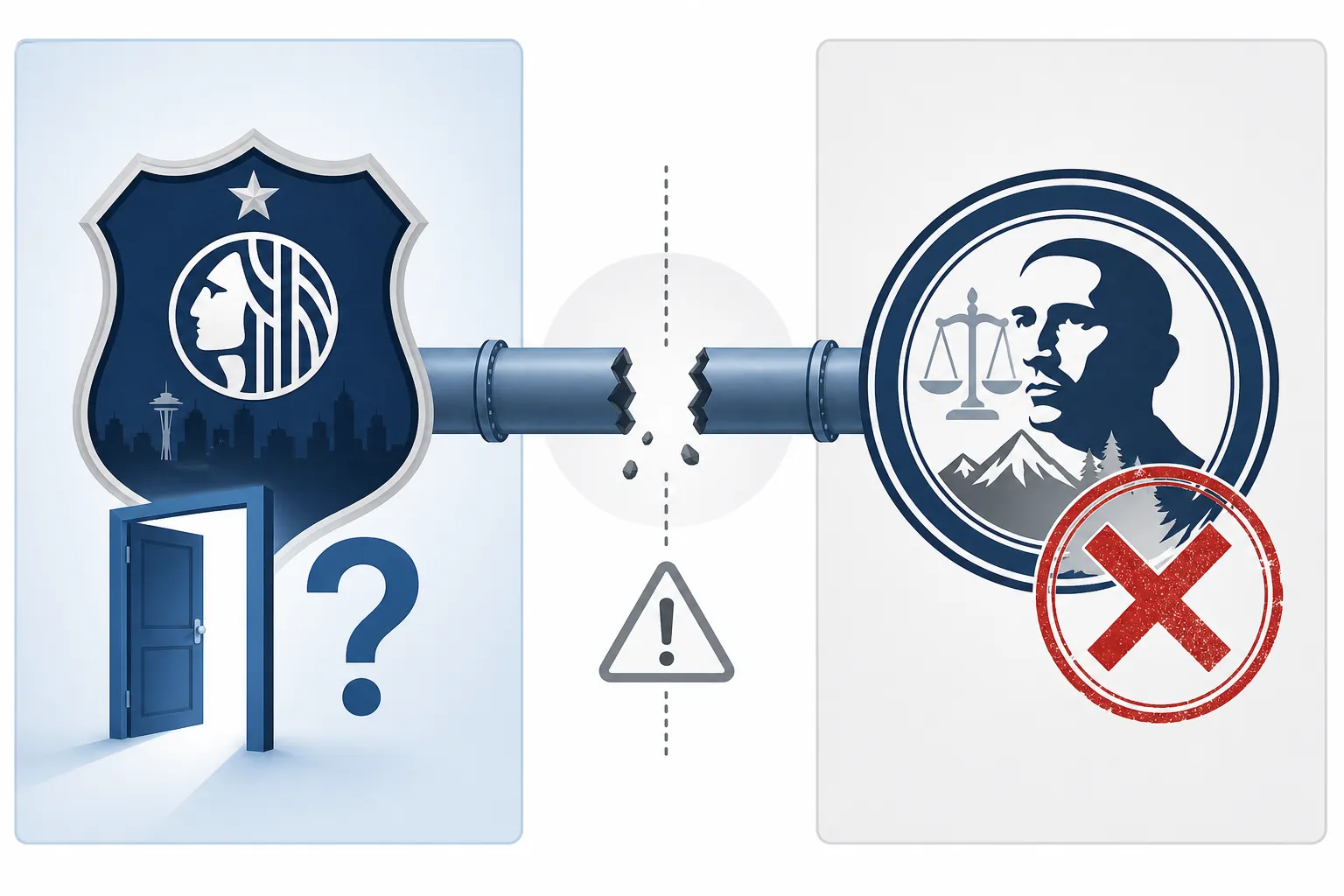
A prosecutor's memo can tell prosecutors what not to accept. It cannot, by itself, stop an officer from pasting body-camera-derived notes into a public AI tool, using a vendor report-drafting product, rewriting an AI draft into a final report, or deleting the draft before anyone knows it existed. The memo binds the receiving end of the pipeline. The risk in the Space Needle case sits upstream, where reports are created.
That upstream concern is not invented from panic about new software. In April 2025, FOX 13 Seattle reported that SPD's Office of Police Accountability found an employee had used AI for Blue Team Reports, the department's internal use-of-force review reports, and recommended that SPD develop a policy around AI use.[6] The reported OPA matter involved internal use-of-force review paperwork, not criminal incident reports, so it cannot be treated as proof that officers used AI to write Space Needle shooting reports. It does show that SPD had already encountered AI use inside a police-reporting workflow before this prosecution.
Placed beside the KCPAO memo, the OPA finding creates the uncomfortable operational question: if prosecutors refuse AI-assisted narratives, and SPD had been told to develop an AI policy but had not adopted one as of the July 2026 shooting, what is the mechanism for proving that every officer narrative in this case was human-authored from retained source material?
The answer cannot be a shrug toward ordinary officer credibility. Officer testimony may be necessary, but it is not the same thing as a preserved audit trail. A lawyer trying to defend the file needs to know whether drafts exist, whether metadata shows outside-tool use, whether any vendor system touched the narrative, whether prompts or outputs were retained, and whether supervisors asked the AI-use question before approving the report.
What Discovery Should Ask For Now
Counsel should not wait for a report to look strange before asking. AI use can leave obvious nonsense, but it can also leave smooth narrative regularity that makes a file appear cleaner than the underlying observations. The first discovery demand should separate officer memory, officer notes, machine-generated drafts, supervisory edits, and final narratives.
- AI-use attestations from every officer and supervisor who authored, edited, approved, or relied on an incident report, supplemental report, Blue Team Report, use-of-force report, probable-cause statement, or narrative summary connected to the shooting.
- Draft-retention information, including whether first drafts, AI drafts, prompt histories, pasted source text, rewrite outputs, and deleted versions were preserved or allowed to expire.
- Tool logs and vendor records for any report-writing, transcription, summarization, body-camera, records-management, or productivity tool capable of generating narrative text.
- Report metadata showing creation time, edit history, author accounts, device identifiers, document transfers, and supervisor approval timestamps.
- Internal communications about AI use, including emails, chat messages, roll-call instructions, supervisor reminders, legal bulletins, vendor notices, and post-incident guidance.
- KCPAO intake records showing whether prosecutors asked SPD to certify non-use of AI before accepting any police narrative into the case file.
The defense version of that demand is obvious. The prosecution version should be just as urgent. A line prosecutor does not want to learn at a suppression hearing that an officer quietly used an AI tool because the department never told officers not to, never required a certification, and never preserved the first draft. That is how a document problem becomes a witness problem.
Other States Show the Missing Machinery
California and Utah have moved toward statutory controls over AI-generated police reports. A 2026 tracker describes California SB 524 as requiring disclosure of the AI program, officer certification, retention of the first AI draft for the same period as the final report, an audit trail, and limits on vendor resale of data; it describes Utah SB 180 as effective in May 2025.[7] The tracker is a commercial source, so counsel should verify enacted language against official state materials before relying on it in briefing. Even so, the listed requirements identify the practical parts missing from a prosecutor-only ban: disclosure, certification, retained drafts, auditability, and vendor controls.
| Control | Why it matters in this prosecution |
|---|---|
| Disclosure | Lets counsel know whether an AI issue exists before motions practice turns into guesswork |
| Officer certification | Creates an accountable representation tied to each report, not a general agency assurance |
| First-draft retention | Allows comparison between source observations, machine text, edits, and final narrative |
| Audit trail | Shows who used which tool, when, and with what source material |
| Vendor limits | Addresses whether criminal-justice information left the agency's controlled environment |
King County's policy anticipates several of those concerns, but it does not itself create the machinery. Without a department rule, a retention mandate, or a tool-level audit trail, the prosecutor's rejection rule can operate only after the fact and only if somebody discovers the AI use.
Courts Have Little Patience for Hallucinated Legal Work
The closest cautionary example is not a criminal police report case. In July 2025, NPR reported that a federal judge in Colorado sanctioned attorneys in litigation involving Mike Lindell after AI-generated filings included hallucinated citations, ordering $3,000 per attorney.[8] That case concerned court filings, not police narratives, and it should not be stretched beyond that. Its useful lesson is narrower: when AI-generated text reaches a court file with false support, judges may treat the error as a professional failure, not as a charming technology mishap.
A criminal prosecution raises sharper consequences. A hallucinated case citation wastes judicial time. A hallucinated officer, witness observation, timeline detail, or source of knowledge can affect probable cause, impeachment, suppression, and disclosure. The courthouse reaction will not turn on whether the software was marketed as efficient. It will turn on whether the state can prove what entered the file and whether the defense received what it was entitled to receive.
The Narrow Point Counsel Can Actually Prove
There is no public evidence, as of July 27, 2026, that any SPD officer used AI to write a report in the Space Needle shooting investigation. The reported OPA matter involved Blue Team Reports, not the criminal incident reports that may become central here. No public charging file, police report set, report metadata, vendor log, or discovery certification has yet shown AI use in this case.
The risk is different and more immediate: King County has drawn a hard evidentiary line, while SPD's publicly reported governance gap leaves counsel without an obvious way to verify compliance. In a small case, that is bad practice. In a shooting prosecution with multiple casualties, many officers, competing suspect narratives, civilian video, body-camera footage, and likely intense public scrutiny, it is a case-management hazard.
The demand should be made while the file is still fresh: attestations, draft-retention answers, tool logs, vendor involvement, metadata, officer certifications, and internal AI-use communications. The unmanaged risk is not that AI definitely infected the Space Needle case. It is that, unless someone asks now, nobody may be able to prove it did not.
References
- Seattle Space Needle shooting: 3 dead, search for second shooter continues, NewsNation, July 26, 2026
- Police arrest 1 person and search for another after Seattle festival shooting that killed 3, PA Now, July 26, 2026
- Internal memo: Don't use AI for police reports, prosecutor tells Seattle-area law enforcement, GeekWire, September 2024
- King County's new policy: No AI in police report writing over error concerns, KOMO News, September 2024
- Prosecutors in Washington State Warn Police: Don't Use Gen AI to Write Reports, Electronic Frontier Foundation, October 2024
- SPD recommended to develop policy around AI use, FOX 13 Seattle, April 2025
- AI Police Report Laws by State: 2026 Tracker, Barricade.tech, June 2026
- AI hallucination in Mike Lindell case serves as a stark warning, NPR, July 2025
Related records
Tool profile
Browse tool evaluations →Governing regulation
Browse the obligations tracker →Preventive workflow
Browse verification workflows →
Report a correction or tip
Spotted an outdated figure, a misstated fact, or a ruling this case record should reflect? Public comments are disabled for this content given the professional cost of a misreported case outcome, penalty amount, or rule text — use the structured correction channel instead.
Report a correction or tip for this record →