
How the Stefon Diggs Sexual Assault Lawsuit Unfolded in Court
A sequentially organized, docket-sourced record of the Stefon Diggs v. Christopher Griffith civil lawsuit — tracing the defamation complaint, sexual-battery counterclaim, discovery disputes, and the July 2026 motion for partial summary judgment.
- Jurisdiction
- US-Federal
- Court
- U.S. District Court for the District of Maryland
- AI tool named
- None
- Ruling date
- Jun 3, 2026
- Source document
- View primary court order ↗
- Last verified
- Jul 26, 2026
Lex Machina Review is an independent risk-tracking and reference resource. Nothing on this site is legal advice, and using it does not create an attorney-client relationship. Every record is reviewed against primary sources but may not reflect the most current status of a matter — always verify directly against the cited court order, rule text, or a licensed attorney before relying on it.
Companion explanation — secondary to the source document above
Current Posture: An Active Federal Case, Not a Merits Ruling
For readers trying to pin down the Stefon Diggs civil sexual assault lawsuit details from 2025, the first fact is procedural: Diggs v. Griffith, No. 8:25-cv-03767, is a federal civil action in the U.S. District Court for the District of Maryland, and as of July 26, 2026, the docket does not show a trial verdict, a dispositive summary-judgment ruling, or any merits determination resolving the competing claims.[1]
The case began as a defamation action by Stefon Diggs against Christopher Griffith. It became something more procedurally complicated when Griffith answered with counterclaims that included sexual battery, civil conspiracy, battery, intentional infliction of emotional distress, and defamation. The factual center is an alleged May 22-23, 2023 incident. That incident has been pleaded and publicly reported, but it has not been judicially found to have occurred.

The operative status is therefore narrower than many summaries suggest. The Maryland case is a live pre-trial dispute with contested pleadings, discovery motions, a June 3, 2026 protective-order and discovery ruling, and a July 14, 2026 motion for partial summary judgment filed by Diggs that remains pending on the docket as of this article’s July 26, 2026 review date.[1]
Compressed Timeline
| Date or period | Procedural event | What it does and does not establish |
|---|---|---|
| May 22-23, 2023 | Alleged incident later described in Griffith’s counterclaim and media reports | Provides the factual core of Griffith’s counterclaims; does not establish that the alleged conduct occurred.[3] |
| October 2025 | Diggs files the federal defamation complaint in Maryland | Starts the federal case; puts Griffith’s public allegations and related statements at issue.[1][2] |
| November 2025 | Griffith files counterclaims including sexual battery, civil conspiracy, battery, IIED, and defamation | Expands the case from a defamation suit into a cross-claim dispute over alleged assaultive conduct and allegedly defamatory speech.[1][3] |
| 2026 discovery | The parties litigate production, subpoenas, and access to communications | Moves the dispute into evidence-gathering; does not by itself prove either side’s version.[1][4] |
| June 3, 2026 | Court enters a protective-order and discovery ruling | Resolves discovery management issues reflected on the docket; it is not a merits ruling on the pleaded claims.[1] |
| July 2026 | Separate Darez Diggs assault suit settles confidentially | Ends that separate matter by settlement; does not resolve the Maryland federal claims between Stefon Diggs and Griffith.[5] |
| July 14, 2026 | Diggs files a motion for partial summary judgment | Asks the court to rule on part of the case before trial; the motion remains pending as of July 26, 2026.[1] |
The October 2025 Complaint: Defamation Was the Door Into Federal Court
The docket spine starts with Diggs as plaintiff and Griffith as defendant in the District of Maryland.[1] Media coverage in November 2025 reported that Diggs sued after Griffith made public Instagram allegations concerning Diggs, including allegations tied to sexual assault.[2] That public-facing sequence matters because it explains why the first filed federal claim was not sexual battery; it was defamation.
A defamation complaint does not ask a court to decide, in the abstract, whether every underlying event happened. It asks whether challenged statements were actionable under the governing law. In practical terms, Diggs’ filing put Griffith’s public statements, their alleged falsity, and their alleged harm at issue. The complaint did not, by itself, prove the statements false.
That distinction is not cosmetic. In a case built around public allegations of private misconduct, “Diggs sued for defamation” and “a court found Griffith lied” are not interchangeable sentences. The second has not happened on the docket reviewed here.[1]
The November 2025 Counterclaim: The Case Becomes a Cross-Suit
Griffith’s response changed the case’s center of gravity. According to reporting on the counterclaim, Griffith asserted claims for sexual battery, civil conspiracy, battery, intentional infliction of emotional distress, and defamation.[3] The docket reflects the case continuing after that point as a dispute with claims running in both directions, not simply as a one-way complaint by Diggs.[1]
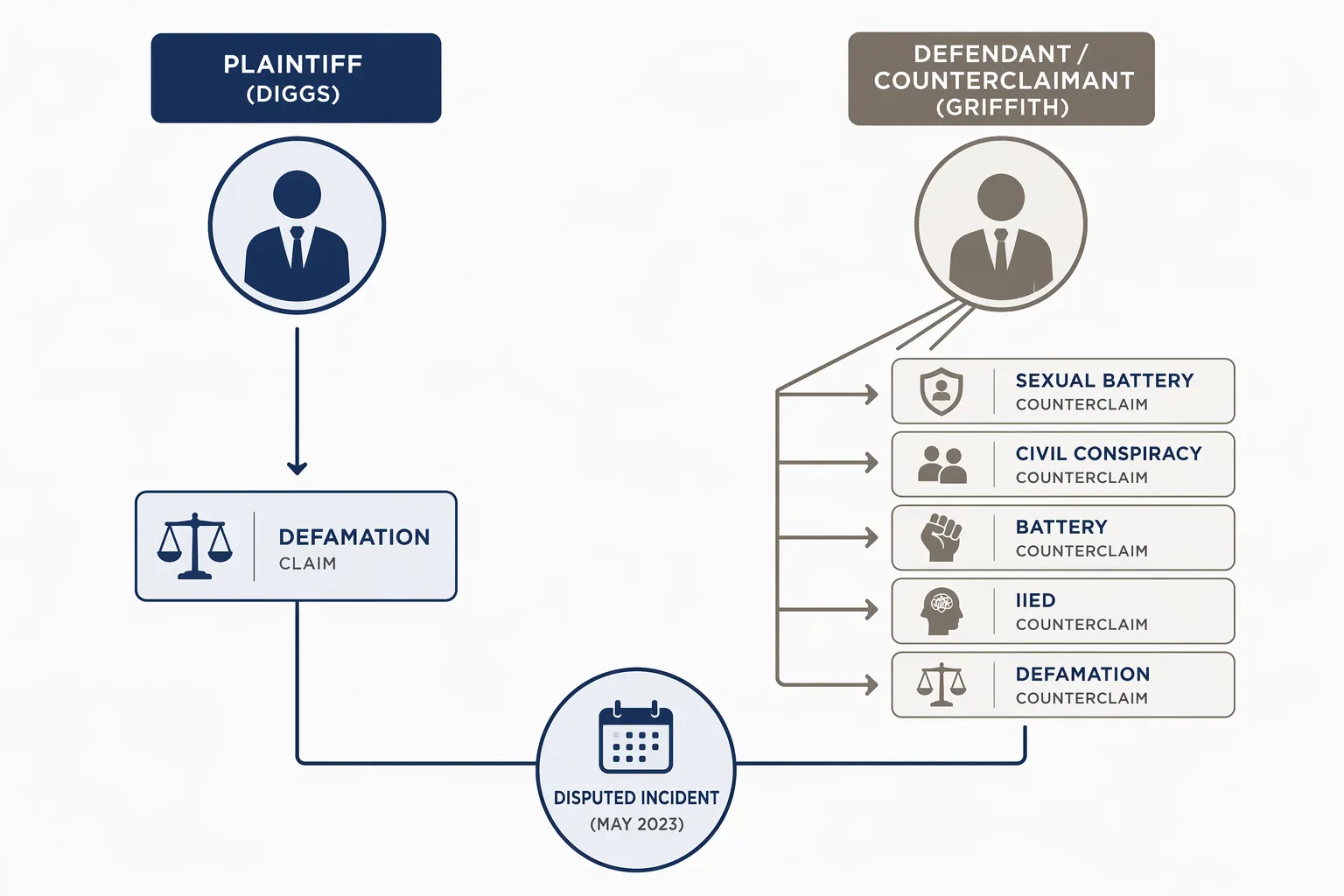
The reported counterclaim described an alleged May 22-23, 2023 episode involving drug-laced candy and unwanted sexual advances.[3] Those descriptions should be read in their procedural posture: they are allegations attributed to Griffith’s pleading and related reporting, not findings by the court.
The counterclaim also explains why the case cannot be accurately described as only a reputation dispute. Once Griffith asserted sexual-battery and related tort claims, the litigation required the court and the parties to address both allegedly defamatory speech and alleged physical or sexual misconduct. The existence of the counterclaim, however, is not evidence admitted at trial. It is a pleading.
FindLaw’s legal coverage framed the dispute as a collision between defamation and sexual-assault allegations, with each side using civil claims to contest the other’s account.[6] That is a useful description of the pleadings, provided it is kept at that level. A cross-suit may clarify what the parties are willing to put at issue under Rule 11 and pleading standards; it does not collapse the distance between accusation and proof.
What the Alleged May 2023 Incident Does in the Case
The alleged May 22-23, 2023 incident is the factual core because it sits beneath both sides’ legal theories. For Griffith, the alleged incident is tied to the sexual-battery and related counterclaims. For Diggs, Griffith’s public account of alleged misconduct is tied to the defamation theory reported at the outset of the case.[2][3]
That does not make the incident a settled event in the court record. At this stage, the safer formulation is deliberately plain: Griffith alleges misconduct connected to May 22-23, 2023; Diggs disputes the allegations and sued over public statements; the court has not resolved the factual dispute.[1][3]
Discovery in 2026: Messages, Subpoenas, and Access Disputes
By 2026, the action had moved into the part of civil litigation where many public summaries become least reliable: discovery. The docket reflects contested discovery activity, including motions to compel, non-party subpoena disputes, and a June 3, 2026 protective-order and discovery ruling.[1]
The most publicized discovery dispute concerns communications. TMZ reported in July 2026 that Griffith claimed he had produced more than 100 pages of iMessage and Instagram communications, while Diggs responded that he had been blocked from accessing the materials.[4] The important limitation is built into the report: the contents of those communications are not independently available to the reader through that article, and their evidentiary significance has not been determined by a merits ruling.
There are at least three separate questions that should not be merged. First, whether the materials were produced. Second, whether the receiving party could access and review them in usable form. Third, whether any particular message is admissible, authentic, complete, and material to a claim or defense. The docket can show litigation over those questions; it does not make every referenced message meaningful evidence.[1][4]
Non-party subpoenas add another layer. A subpoena can seek documents or testimony from someone outside the immediate plaintiff-defendant pairing, but a subpoena dispute is still a discovery dispute. It may reveal where a party believes useful evidence exists. It does not, standing alone, establish what that evidence says or how a court will treat it.
The June 3 Protective-Order and Discovery Ruling
The June 3, 2026 docket event is important because it is an actual court ruling, not a party characterization. But its importance should not be inflated. The ruling addressed protective-order and discovery issues in the pre-trial management of the case; it did not decide whether Diggs defamed Griffith, whether Griffith defamed Diggs, or whether the alleged May 2023 sexual battery occurred.[1]
Protective orders often regulate how sensitive material may be handled, designated, filed, or disclosed. Discovery rulings often determine whether material must be produced, whether a request is too broad, or how the parties should proceed. Those orders can shape leverage and timing. They are still different from a merits ruling.
The Darez Diggs Case: Related, Settled, and Not Dispositive Here
The related litigation involving Darez Diggs belongs in the chronology because it arises from the broader factual orbit around Griffith and the Diggs family, but it must not be treated as a ruling in the Maryland federal case. TMZ reported on July 10, 2026 that Griffith’s separate $10 million civil suit against Darez Diggs had settled confidentially, and that Darez had pleaded no contest to felony assault for a May 29, 2023 attack on Griffith.[5]
A confidential settlement does not disclose its terms unless the parties or a court record make them public. The available reporting supports the fact of settlement, not an inference about the settlement amount, the parties’ motivations, or the truth of the allegations in the separate Maryland action.[5]
NBC Boston’s overview placed the Stefon Diggs and Darez Diggs matters within a larger cluster of civil disputes involving public accusations and litigation, but the Maryland federal docket remains its own case with its own pleadings, discovery record, and pending motions.[7][1]
The July 14, 2026 Motion for Partial Summary Judgment
The latest major procedural marker in the reviewed docket is Diggs’ July 14, 2026 motion for partial summary judgment.[1] A motion for summary judgment asks the court to decide claims or issues without trial where the movant contends there is no genuine dispute of material fact and the movant is entitled to judgment as a matter of law. A partial motion seeks that treatment for less than the whole case.
The filing of the motion is not the same thing as the granting of the motion. As of July 26, 2026, the posture supported by the docket is pending motion practice, not a resolved liability finding.[1]
That pending motion is the correct place to stop the merits analysis for now. If the court later grants, denies, or narrows the motion, the procedural picture will change. Until then, the case remains in active pre-trial litigation with the central factual disputes unresolved.
What Can Be Safely Said as of July 26, 2026
- Diggs sued Griffith for defamation in federal court in Maryland; that filing opened Diggs v. Griffith, No. 8:25-cv-03767.[1]
- Griffith responded with counterclaims including sexual battery, civil conspiracy, battery, intentional infliction of emotional distress, and defamation.[1][3]
- The alleged May 22-23, 2023 incident remains disputed and has not been resolved by trial, summary judgment, or another merits ruling.[1][3]
- The 2026 docket reflects discovery litigation, including motions to compel, subpoena disputes, and a June 3 protective-order and discovery ruling.[1]
- Griffith’s reported production of more than 100 pages of iMessage and Instagram materials is a discovery event; the public record cited here does not establish the contents’ ultimate evidentiary weight.[4]
- The separate Darez Diggs civil assault suit settled confidentially in July 2026, but that settlement does not dispose of the Maryland federal claims between Stefon Diggs and Griffith.[5]
- Diggs’ July 14, 2026 motion for partial summary judgment is pending as of the July 26, 2026 review date.[1]
The cleanest description is also the least dramatic one: this is a defamation complaint and sexual-battery counterclaim in active federal pre-trial litigation. The pleadings are serious. The discovery fights are consequential. The related settlement is real. None of those facts is a substitute for a merits ruling that the docket has not yet entered.
References
- Diggs v. Griffith, CourtListener, https://www.courtlistener.com/docket/71922990/diggs-v-griffith/
- Stefon Diggs Sues Influencer Chris Blake Griffith For Defamation Over Sex Assault Claims, TMZ, Nov. 16, 2025, https://www.tmz.com/2025/11/16/stefon-diggs-chris-blake-griffith-defamation-lawsuit-nfl/
- Chris Blake Griffith Files Countersuit Against Stefon Diggs, Complex, Nov. 21, 2025, https://www.complex.com/sports/a/treyalston/chris-blake-griffith-stefon-diggs-counter-suit
- Stefon Diggs Accuser Says He Gave Up Text Evidence, TMZ, July 9, 2026, https://www.tmz.com/2026/07/09/stefon-diggs-accuser-says-he-gave-up-text-evidence/
- Stefon Diggs Male Sexual Assault Accuser Settles Lawsuit With Brother, TMZ, July 10, 2026, https://www.tmz.com/2026/07/10/stefon-diggs-male-sexual-assault-accuser-settles-lawsuit-with-brother/
- Battle Between Influencer and NFL Receiver Gets Legal Amid Sexual Assault Claims, FindLaw, https://www.findlaw.com/legalblogs/legally-weird/battle-between-influencer-and-nfl-receiver-gets-legal-amid-sexual-assault-claims/
- Stefon Diggs, Patriots civil lawsuits, NBC Boston, https://www.nbcboston.com/news/local/stefon-diggs-patriots-civil-lawsuits/3873044/
Related records
Tool profile
Browse tool evaluations →Governing regulation
Browse the obligations tracker →Preventive workflow
Browse verification workflows →
Report a correction or tip
Spotted an outdated figure, a misstated fact, or a ruling this case record should reflect? Public comments are disabled for this content given the professional cost of a misreported case outcome, penalty amount, or rule text — use the structured correction channel instead.
Report a correction or tip for this record →