
The stopgap funding bill freezes the federal grant rule
The Senate stopgap bill makes one grant-specific legal change: it freezes OMB's proposed 2 CFR Part 200 overhaul through Dec. 11, 2026. The freeze defers, rather than resolves, the dispute over the rule's termination and political-priorities provisions — and sets the calendar grant-funded organizations should watch before the CR expires.
- Jurisdiction
- US federal
- Court
- U.S. District Court for the District of Massachusetts
- AI tool named
- None
- Ruling date
- Jul 17, 2026
- Source document
- View primary court order ↗
- Last verified
- Aug 4, 2026
Lex Machina Review is an independent risk-tracking and reference resource. Nothing on this site is legal advice, and using it does not create an attorney-client relationship. Every record is reviewed against primary sources but may not reflect the most current status of a matter — always verify directly against the cited court order, rule text, or a licensed attorney before relying on it.
Companion explanation — secondary to the source document above
Status as of Aug. 4, 2026 (UTC), last verified Aug. 4, 2026: the Senate stopgap funding bill’s direct grant-specific legal impact is a temporary block on OMB’s proposed “Regulation for Federal Financial Assistance,” the 2 CFR Part 200 rewrite in docket OMB-2026-0034, through the continuing resolution’s reported Dec. 11, 2026 endpoint. Reporting on the Senate package says the CR would fund the government through Dec. 11 and block the grant rule during that window; this analysis has not independently parsed the Senate Appropriations PDF, so provision-level descriptions of the Senate bill are attributed to those reports rather than to a direct bill-text reading. [1][2]
That is a narrow answer, but it is the one grant counsel need first. The proposal has not been defeated. Nor has the stopgap bill rewritten federal grants law across the board. If enacted in the reported Senate form, it would pause the contested OMB rule during a funding window that includes OMB’s stated Oct. 1, 2026 effective date for the proposed rule. OMB published the proposal on May 29, 2026 and described an Oct. 1, 2026 effective date, but that remains a proposed-rule timeline, not a final rule already in force. [3]
This is editorial analysis, not legal advice. The practical status line is: rule blocked for now if the Senate language is enacted in that form; dispute unresolved; Oct. 1 falls inside the CR period; Dec. 11 is the next deadline grant-funded organizations should place on the compliance calendar.
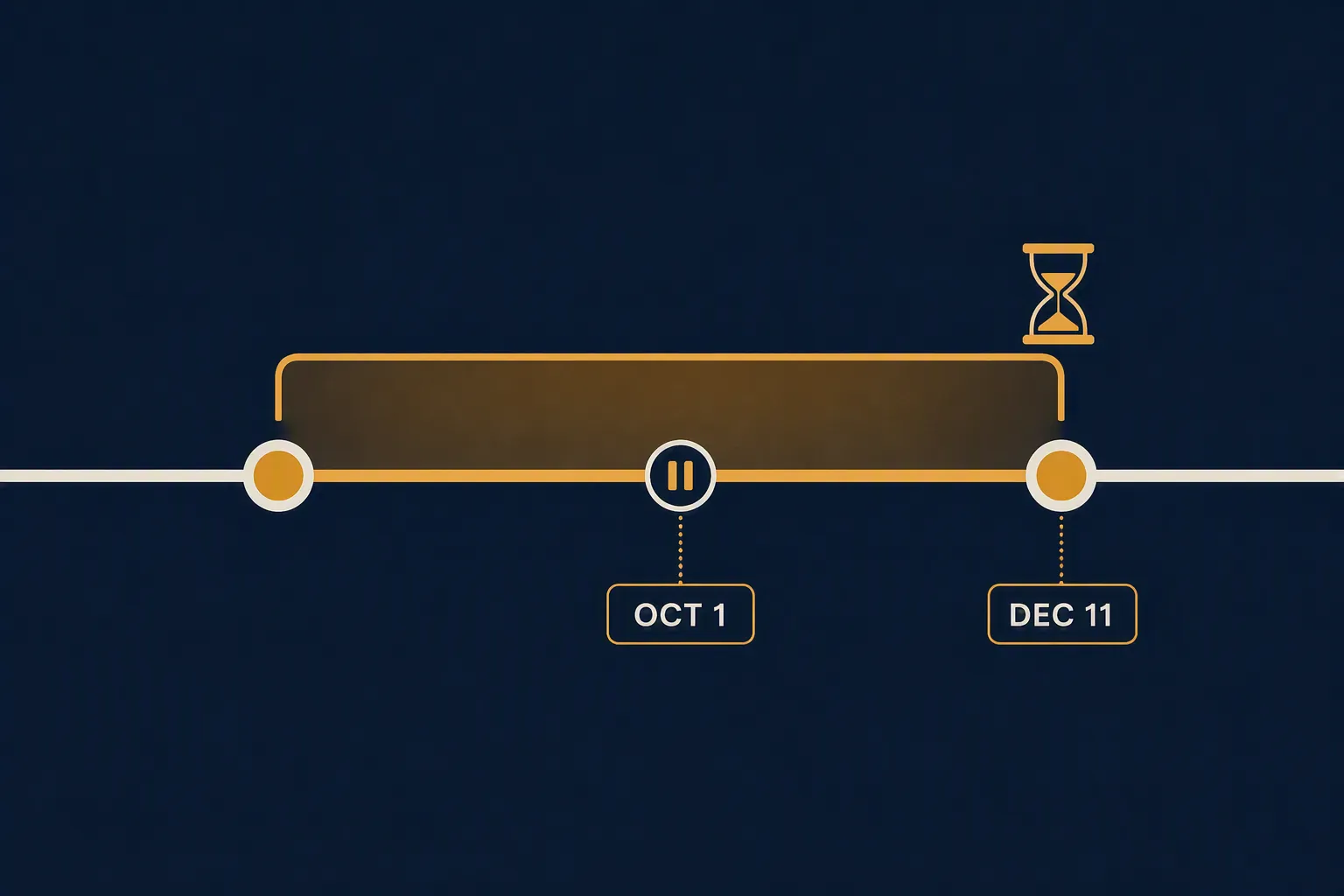
What the Senate bill is reported to do
The Senate funding patch introduced by Sens. Susan Collins and Patty Murray is reported to carry the government through Dec. 11, 2026 and to include a temporary block on OMB’s proposed grant-rule overhaul. Roll Call reported that Collins described the grant-rule provision as a response to the rule’s “potential to politicize grants and harm small, rural communities, families, and biomedical research.” [1]
The House-passed continuing resolution is the useful contrast. It passed on July 21, 2026 by a 220-205 vote and would have funded the government through Dec. 4; reporting on the later Senate package described the House version as lacking the grant-rule block that the Senate added. [4][1]
Other reported features of the Senate package may matter to agencies and appropriators, but they do not change the grant-law answer here. For a university, health center, nonprofit, or local government asking whether the stopgap changes the legal footing of an FY2027 grant, the sourced change is the temporary freeze of the OMB proposal.
Why Oct. 1 versus Dec. 11 matters
The collision is not abstract. Federal fiscal years begin on Oct. 1. OMB’s proposal states an Oct. 1, 2026 effective date. The Senate CR is reported to run through Dec. 11, 2026. If the Senate language becomes law in that form, the rule’s stated effective-date window sits inside the appropriations restriction rather than outside it. [3][1][2]
| Date | Why it matters for grants |
|---|---|
| May 29, 2026 | OMB published the proposed 2 CFR Part 200 rewrite, docket OMB-2026-0034. [3] |
| July 13, 2026 | The 45-day comment period closed. [5] |
| Oct. 1, 2026 | OMB stated this as the proposed rule’s effective date; it should not be treated as a final-rule effective date unless the rule is finalized and legally operative. [3] |
| Dec. 11, 2026 | The Senate CR is reported to fund the government through this date and to block the rule during the same window. [1][2] |
That timing affects the Monday-morning instruction more than the headline politics. Program staff may already be drafting notices of funding opportunity, reviewing subaward templates, preparing board materials, and making FY2027 budget assumptions. A temporary pause still forces a legal-status decision: do not operationalize the proposed OMB changes as settled federal requirements during the freeze, but do not tell recipients that the rule has disappeared after Dec. 11.
The word “temporary” is doing real work. It means the CR can prevent the rule from taking effect during the covered appropriations period if enacted as reported. It does not answer whether OMB may finalize the rule later, whether Congress will extend the block, whether the rule will be litigated, or whether the Congressional Review Act becomes part of the next round.
The provisions being deferred
The freeze matters because the proposed rule is not a housekeeping edit. OMB’s Federal Register notice and provision-level analysis from Potomac Law identify changes that would alter approval, termination, suspension, verification, subaward reporting, and cost treatment for federal financial assistance. [3][6]

- Political-appointee preapproval for certain discretionary awards. The proposed rule would require senior political appointees to pre-approve discretionary awards that “demonstrably advance the President’s policy priorities.” [3]
- Discretionary termination authority. The proposal would add authority to terminate awards in circumstances tied to agency priorities and presidential policy objectives, a point that has drawn particular attention because termination rules determine whether an already-awarded grant can be cut off after recipients have accepted conditions and begun performance. [3][6]
- A 90-day suspension authority. Potomac Law’s analysis identifies a new suspension mechanism that could place awards on hold for up to 90 days. [6]
- E-Verify enrollment. The proposed changes include an E-Verify enrollment requirement for recipients. [6]
- Expanded subaward reporting. The proposal would increase reporting obligations for subawards, which would move compliance pressure down to pass-through entities and subrecipients rather than stopping at the prime recipient. [6]
- Cost-allowability restrictions. The proposal includes restrictions affecting what costs may be charged to federal awards. [6]
Those provisions should be described as deferred, not resolved. A recipient does not need to rewrite its Oct. 1 grant manual around them if the CR block is enacted as reported. But the organization also should not assume that a December budget meeting, a continuation application, or a subaward issued after the CR expires will remain outside their reach.
The comment record explains pressure, not legality
The rule drew an unusually large comment record. Roll Call reported 496,769 submissions during the 45-day comment period, which closed July 13, 2026. It also reported that an analysis of a 51,000-comment sample found 94 percent opposed, but that figure should be read as a sample analysis, not as a complete tally of all comments. [5]
For legal-status purposes, the comment volume does not decide whether OMB has authority to finalize the rule, whether the rule would survive review, or whether the Senate block will remain in a final funding measure. It does help explain why the grant provision landed in a stopgap bill rather than waiting for a standalone grants debate.
New Jersey v. OMB is the backdrop, not the answer
The rule fight is also unfolding against recent litigation over the existing termination regulation. In New Jersey v. OMB, the U.S. District Court for the District of Massachusetts ruled on July 17, 2026 that the existing Termination Clause, 2 C.F.R. § 200.340(a)(4), does not permit agencies to terminate grants based on program goals or agency priorities identified after award; client alerts describing the ruling emphasize the court’s reliance on Spending Clause clarity principles associated with Pennhurst. [7][8]
That ruling matters because it limits how agencies may use the current termination clause for post-award priority shifts. It does not decide the legality of OMB’s proposed rewrite. The proposed rule is an attempted change to the regulatory text; the court ruling addressed the meaning and use of the existing clause. The Senate freeze operates in that unsettled space.
One caution on the case record: public summaries have reported the plaintiff group differently. Feldesman describes the challengers as twenty-three states and the District of Columbia, while Dorsey describes twenty states, three governors, and the District of Columbia. Those counts are not necessary to the grant-status question here, so the safer point is the ruling’s operative limit on the existing termination clause. [7][8]
What grant recipients can say before Dec. 11
Before Dec. 11, the careful compliance answer is conditional. If the Senate CR is enacted in the reported form, grant-funded organizations should treat OMB’s proposed 2 CFR Part 200 overhaul as paused for the CR period, not as governing award terms on Oct. 1 and not as defeated after Dec. 11.
- For current awards, do not assume the proposed termination, suspension, political-priority, E-Verify, subaward-reporting, or cost-allowability provisions have become operative merely because Oct. 1 arrives.
- For FY2027 planning, keep Dec. 11 visible in budget, board, and subrecipient communications. A temporary appropriations rider is not the same as a final merits decision on the rule.
- For legal review, watch four tracks before relying on any post-Dec. 11 status: final rule movement at OMB, CR negotiations, litigation over termination and grant conditions, and possible Congressional Review Act activity.
The Senate stopgap funding bill therefore changes the near-term legal calendar for federal grants. It does not settle the underlying authority fight. Through the CR window, the operative instruction is pause; after Dec. 11, the answer depends on what Congress, OMB, and the courts have done by then.
References
- Senate’s funding patch adds Trump requests but blocks grant rule — Roll Call, Aug. 2, 2026
- Funding deal could spare agencies another shutdown fight — Government Executive, Aug. 3, 2026
- Regulation for Federal Financial Assistance — Federal Register, May 29, 2026
- Government funding: House vote continuing resolution — NPR, July 21, 2026
- Critics mount offensive against change to federal grant rules — Roll Call, July 20, 2026
- Major Overhaul Affecting Federal Grant Rececipients — Potomac Law, June 4, 2026
- Court Ruling Limits Agencies’ Power to End Grants Based on Changing Priorities — Feldesman, July 22, 2026
- Court Limits Termination of Existing Grants Based on Changing Agency Priorities — Dorsey, July 27, 2026
Related records
Tool profile
Browse tool evaluations →Governing regulation
Browse the obligations tracker →Preventive workflow
Browse verification workflows →
Report a correction or tip
Spotted an outdated figure, a misstated fact, or a ruling this case record should reflect? Public comments are disabled for this content given the professional cost of a misreported case outcome, penalty amount, or rule text — use the structured correction channel instead.
Report a correction or tip for this record →