
How to Evaluate Subpotent Levothyroxine Recall Legal Claims
A structured assessment of viable legal claims from the 2025 Accord and 2026 Major Pharmaceuticals subpotent levothyroxine recalls, covering product liability theories, damages benchmarks (including the Acella $41M settlement), and the evidentiary significance of the 2023 FDA warning letter to Intas Pharmaceuticals — along with a current-litigation status that no complaint has been publicly filed as of July 2026.
- Jurisdiction
- US-Federal
- Court
- None
- AI tool named
- None
- Ruling date
- Jul 28, 2023
- Source document
- View primary court order ↗
- Last verified
- Jul 28, 2026
Lex Machina Review is an independent risk-tracking and reference resource. Nothing on this site is legal advice, and using it does not create an attorney-client relationship. Every record is reviewed against primary sources but may not reflect the most current status of a matter — always verify directly against the cited court order, rule text, or a licensed attorney before relying on it.
Companion explanation — secondary to the source document above
The subpotent levothyroxine recall legal claims now being screened sit in an awkward but important posture. Accord Healthcare’s levothyroxine recall covered more than 160,000 bottles across multiple strengths and was upgraded to an FDA Class II recall on July 23, 2025, after stability testing showed below-specification assay results.[1] A separate Major Pharmaceuticals levothyroxine recall followed in July 2026.[2] The strongest public liability document is not the recall notice itself, but the FDA’s July 28, 2023 warning letter to Intas Pharmaceuticals, the manufacturer tied to the recalled Accord product, which described significant CGMP and data-integrity failures at the Sanand, India facility.[3]
As of July 28, 2026, no public complaint, docketed class action, or filed personal-injury lawsuit specific to the Accord/Intas levothyroxine recall has been identified in the public materials reviewed here. Plaintiff firms are investigating claims, which is different from filed litigation.[4] That distinction matters: this is a claim-screening and exposure analysis, not a report on an active mass tort or a settled docket. It is also not medical or legal advice.
| Issue | Public posture as of July 28, 2026 | Why it matters legally |
|---|---|---|
| Accord Healthcare recall | More than 160,000 bottles; FDA Class II upgrade on July 23, 2025.[1] | Creates a defined recall event and potential exposure window, but the exact potency shortfall has not been publicly disclosed. |
| Major Pharmaceuticals recall | Separate levothyroxine recall reported in July 2026.[2] | Earlier-stage record; it should not be treated as if it carries the same evidentiary support as the Accord/Intas recall. |
| Intas warning letter | FDA warning letter dated July 28, 2023, citing significant CGMP violations and data-integrity failures.[3] | Supports manufacturing-defect, negligence, and punitive-damage arguments if tied to a claimant’s recalled product exposure. |
| Litigation status | Investigation pages exist; no public Accord/Intas complaint or class action was identified in the reviewed materials.[4] | Claim value remains untested. Pleading, causation, injury proof, and class-certification issues are still open. |
The recall facts create the claim; the warning letter gives it weight
A subpotent drug recall can support a product-liability theory without much drama. The product allegedly failed to meet its approved specification; patients may have taken a dose that delivered less active ingredient than expected; some may have needed testing, dose adjustment, or clinical follow-up. That is enough to begin asking legal questions, but not enough to assume recoverable injury.
The Intas warning letter changes the strength of the inquiry because it points to quality-system problems before the Accord recall. FDA described torn and discarded CGMP documents in scrap areas, analysts destroying quality records with acetic acid, aborted chromatographic sequences between January 2020 and November 2022, manual reprocessing without management approval, missing laboratory raw data, inadequate process validation, and a quality unit that failed to exercise adequate oversight.[3] FDA also placed Intas on Import Alert 66-40 on June 1, 2023.[3]
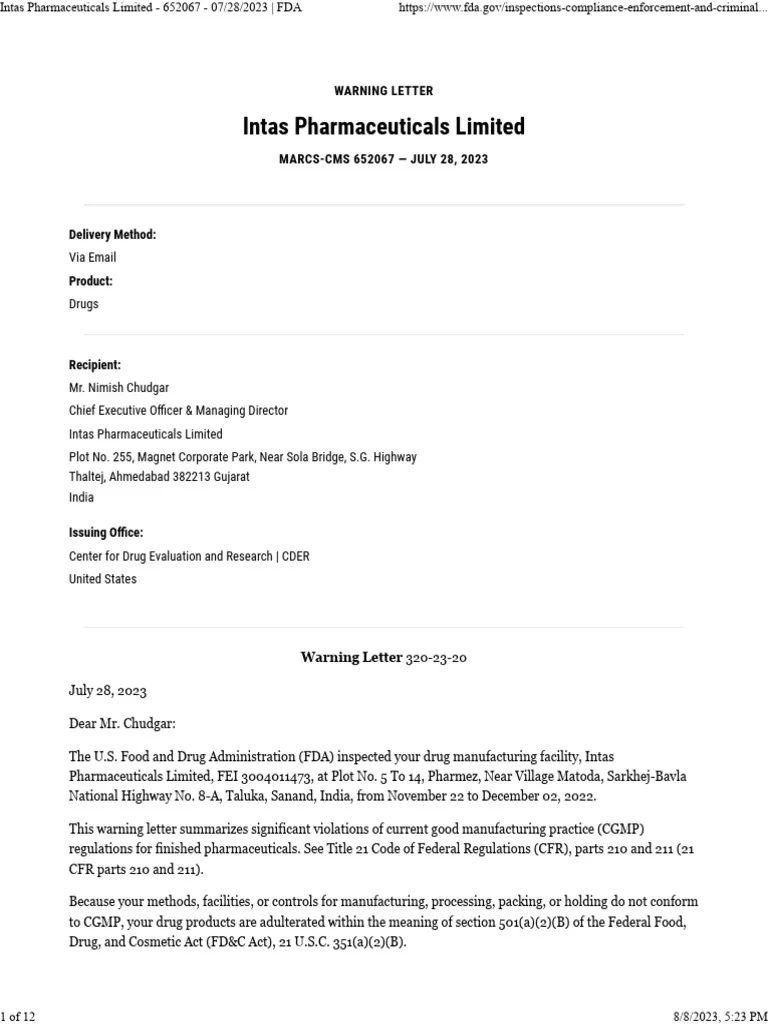
Those are not cosmetic inspection findings. In a recall case, data integrity is often where the defense line between “isolated batch error” and “foreseeable manufacturing failure” is tested. If laboratory records were missing, destroyed, reprocessed, or never properly reviewed, a plaintiff can argue that the manufacturer’s own quality system was unreliable at the point when it should have detected potency drift.
The public reporting connecting the warning letter to the Accord recall is also important. AboutLawsuits reported that the plant quality problems identified in the FDA warning letter involved the facility that manufactured the recalled thyroid medication and that the recall was triggered after stability testing found out-of-specification assay results.[5] That does not prove that every recalled bottle injured a patient. It does, however, make the recall harder to frame as a clean, unforeseeable, one-off deviation.
What “subpotent” needs to become in a complaint
The exact potency shortfall in the Accord and Major recalls has not been publicly disclosed. That is a central limitation. The FDA Class II designation indicates a situation in which use of or exposure to the product may cause temporary or medically reversible adverse health consequences, or where the probability of serious adverse health consequences is remote.[1] It does not supply the percentage of labeled levothyroxine actually present in the recalled lots.
For legal claims, that missing number affects both causation and damages. A claimant with no symptoms, no lab movement, no medical visit, and no recalled-lot documentation may have a refund or economic-loss theory at most, and even that may face standing and damages challenges. A claimant with pharmacy records, a recalled lot, thyroid lab changes, clinical symptoms, and medical follow-up is in a different posture.
| Evidence category | What it would need to show | Why it matters |
|---|---|---|
| Product identification | Prescription fills, pharmacy records, NDC information, bottle photographs, lot information, or recall-matching documentation. | Without product identification, the claimant may not be able to connect the injury to the recalled Accord or Major tablets. |
| Exposure window | Use of recalled tablets during the relevant recall period, with attention to refill dates and dose strength. | A levothyroxine user may have multiple refills and dose changes; the recalled product must be separated from non-recalled supply. |
| Objective lab movement | Thyroid labs before, during, and after suspected exposure, especially TSH and free T4. | Subpotency has to translate into a measurable endocrine effect if the claim seeks more than a refund. |
| Clinical consequences | Symptoms, complications, pregnancy-related monitoring, cardiac events, developmental concerns, or documented dose adjustment. | Damages require more than the fact of recall; they require injury or medically necessary response. |
| Medical follow-up | Prescriber visits, lab orders, dose corrections, emergency care, specialist referral, or monitoring instructions. | These records help distinguish recall anxiety from compensable medical consequence. |
| Alternative explanations | Medication adherence, interacting medications, absorption issues, new diagnoses, dose changes, or unrelated thyroid instability. | The defense will not need to disprove the recall if it can show another plausible reason for the lab change. |
The medical mechanism is straightforward enough for pleading but still needs proof in an individual record. Levothyroxine replaces thyroid hormone. If the medication is subpotent, a patient may receive inadequate hormone replacement, which can appear in standard testing as rising TSH and falling free T4. Professional thyroid guidance and recall reporting identify particular concern for pregnant patients, infants, and patients with cardiac disease, because thyroid instability can carry consequences beyond inconvenience in those groups.[2][6]
That is where the sympathetic facts become evidentiary facts. A pregnant patient who can show recalled product exposure, a thyroid lab shift, additional obstetric monitoring, dose adjustment, or a pregnancy complication presents a materially different file from a patient who simply received a pharmacy notice. An elderly cardiac patient with arrhythmia-related follow-up after a destabilized thyroid dose raises different damages questions than a patient with no medical contact. An infant’s developmental-risk theory would require careful medical proof, not a generic assertion that thyroid medication matters.
The legal theories are familiar, but the proof is not generic
The main theories likely to be evaluated are manufacturing defect, negligence, negligence per se, failure to warn or failure to timely warn, breach of warranty, and consumer-protection or economic-loss claims. Those theories are not interchangeable. A manufacturing-defect claim asks whether the product deviated from its approved specification. A negligence theory asks whether the manufacturer or distributor failed to use reasonable care in making, testing, releasing, monitoring, or recalling the product. A negligence per se theory may try to use CGMP violations as the standard-of-care breach, depending on state law.
- Manufacturing defect: The recall’s below-specification assay finding is the starting point. The plaintiff still has to tie the recalled product to the claimant’s use and injury.
- Negligence: The Intas warning letter gives plaintiffs a way to argue that the problem was not merely an unfortunate stability failure, but part of a broader breakdown in quality oversight.[3]
- Negligence per se: CGMP violations may support the argument that the defendant violated drug-manufacturing standards designed to protect patients, though state law will determine whether and how that theory can be used.
- Failure to warn or failure to timely warn: This theory depends on what the manufacturer or distributor knew, when it knew it, what was communicated to FDA, pharmacies, prescribers, and patients, and whether earlier notice would have changed medical management.
- Warranty and economic-loss claims: These may fit patients who paid for a medication that allegedly did not conform to specification, but they do not automatically solve injury, standing, reliance, or class-certification problems.
The most legally useful function of the FDA warning letter is punitive-damage pressure. Punitive damages are not guaranteed, and many states impose demanding standards before they reach a jury. Still, a plaintiff will prefer to argue punitive exposure from contemporaneous regulatory findings: destroyed records, aborted testing sequences, missing raw data, manual reprocessing without approval, and a quality unit FDA found inadequate.[3] Those facts can support an argument that the manufacturer knew, or should have known, that its quality controls were compromised before patients relied on the medication.
A defense response would be equally predictable. It would separate the warning-letter findings from the specific lots, emphasize that the Accord recall potency percentage has not been publicly disclosed, challenge medical causation in patients with fluctuating thyroid labs, and distinguish regulatory noncompliance from proof of compensable personal injury. The better plaintiff files will be the ones that make those separations difficult.
Damages: Acella is a benchmark, not a valuation model
The nearest public compensation reference is the Acella NP Thyroid class action settlement. That settlement was reported at $41 million, involved approximately 1.2 million class members, and produced individual payments in the range of about $10 to $50 per claimant.[7] It is the right comparison to mention because it involved thyroid medication potency allegations. It is the wrong comparison to treat as a forecast.
Acella involved a different manufacturer, different recall dates, and an actual settled class action. The public record for the Accord and Major recalls is not in the same place. No public Accord/Intas complaint has been identified as of July 28, 2026, and the exact Accord and Major potency shortfalls remain undisclosed. The Acella/RLC Labs precedent also included public discussion of potency as low as 87% of labeled amount; no comparable percentage has been publicly reported for Accord or Major in the public materials reviewed here.[7]
That difference matters because low-dollar class payments often reflect broad economic-loss resolution, not the value of a documented personal-injury case. A claimant who only seeks reimbursement for ineffective tablets is not similarly situated to a claimant who can prove lab-confirmed destabilization, additional treatment, pregnancy-related monitoring, infant developmental concerns, or cardiac complications. The latter file still has to survive causation challenges, but it is not priced by a $10-to-$50 class payment.
| Potential damages category | What strengthens it | What weakens it |
|---|---|---|
| Refund or economic loss | Proof of purchase of recalled tablets. | No symptoms, no lab change, no medical follow-up, or inability to show recalled-lot exposure. |
| Testing and medical monitoring | Prescriber-directed labs or follow-up after recalled-product exposure. | Testing done only from concern, without physician connection to exposure or abnormal results. |
| Dose adjustment and treatment costs | Documented TSH/free T4 movement and provider-directed dose correction. | Preexisting instability, adherence issues, medication interactions, or unclear exposure timing. |
| Personal injury | Objective endocrine disruption plus documented clinical consequence. | Symptoms without labs, labs without exposure proof, or complications with stronger alternative causes. |
| Enhanced or punitive damages | A state-law path to punitive damages plus evidence connecting injury to the quality failures described by FDA. | Failure to connect warning-letter conduct to the recalled product, the claimant’s use, or the injury alleged. |
The Major recall should be evaluated separately
The July 2026 Major Pharmaceuticals recall belongs in the same monitoring file because it involves subpotent levothyroxine and the same clinical concern: patients relying on a daily thyroid replacement medication may receive less active ingredient than expected.[2] It does not automatically inherit the Intas warning-letter evidence. Unless public materials connect the Major recall to the same manufacturing facility, the same quality-system findings, or comparable data-integrity problems, the legal record is thinner.
That distinction is not favorable or unfavorable to either side; it is simply necessary. The Accord/Intas analysis has a recall, a Class II upgrade, a reported out-of-specification assay issue, and a serious preexisting FDA warning letter. The Major recall is newer. It may generate claims, but the evidentiary spine is not yet the same.
Filing posture and deadlines
The absence of a public complaint as of July 28, 2026 should not be read as proof that no claims exist. It means the claims have not yet appeared in a public docket identified in the reviewed materials. Plaintiff-firm investigation pages commonly precede filed complaints, especially where lawyers are still collecting pharmacy records, lot information, lab histories, and medical-causation proof.[4]
Limitations periods are state-specific, and the relevant date may depend on purchase, ingestion, injury discovery, recall notice, or other state-law rules. A serious evaluation should preserve records first: medication bottles, pharmacy printouts, refill histories, recall notices, lab results, portal messages, dose-change instructions, pregnancy or pediatric records, cardiology records where relevant, and communications with pharmacies or prescribers.
The viable path is therefore narrow but real. A subpotent levothyroxine recall can support product-liability claims, and the 2023 Intas warning letter materially strengthens manufacturing-defect, negligence, and punitive-damage theories for the Accord recall. The two constraints remain just as important: no public Accord/Intas lawsuit has been identified as of this publication date, and the precise potency shortfall for the Accord and Major recalls has not been disclosed.
References
- FDA Upgrades Recall on 160,000+ Bottles of Thyroid Medication — empr.com
- FDA Recalls Popular Thyroid Medication Nationwide — Prevention.com
- Intas Pharmaceuticals Limited - 652067 - 07/28/2023 — FDA — July 28, 2023
- Accord Healthcare Subpotent Levothyroxine Sodium Lawsuit Lawyers — YourLawyer.com
- Quality Problems At Plant That Made Recalled Thyroid Drug Highlighted in FDA Warning Letter — AboutLawsuits.com — July 2025
- FDA Alert for Levothyroxine — American Thyroid Association
- Acella Pharmaceuticals Hit with Class Action Over Alleged Sale of Defective Thyroid Medication — ClassAction.org
Related records
Tool profile
Browse tool evaluations →Governing regulation
Browse the obligations tracker →Preventive workflow
Browse verification workflows →
Report a correction or tip
Spotted an outdated figure, a misstated fact, or a ruling this case record should reflect? Public comments are disabled for this content given the professional cost of a misreported case outcome, penalty amount, or rule text — use the structured correction channel instead.
Report a correction or tip for this record →