
What the Supreme Court Firing Ruling Means for Agency Risk
The Supreme Court's Trump v. Slaughter decision eliminates for-cause removal protection for most independent agencies. This registry tracks the resulting commissioner firings, quorum breakdowns, enforcement shifts, and pending litigation across FTC, SEC, NLRB, EEOC, FCC, and FERC.
- Jurisdiction
- US Federal
- Court
- Supreme Court of the United States
- AI tool named
- None
- Ruling date
- Jun 29, 2026
- Source document
- View primary court order ↗
- Last verified
- Jul 24, 2026
Lex Machina Review is an independent risk-tracking and reference resource. Nothing on this site is legal advice, and using it does not create an attorney-client relationship. Every record is reviewed against primary sources but may not reflect the most current status of a matter — always verify directly against the cited court order, rule text, or a licensed attorney before relying on it.
Companion explanation — secondary to the source document above
As of July 24, 2026, the Supreme Court ruling on firing independent agency heads is no longer just a constitutional-law headline. Trump v. Slaughter has turned removal protection into a live agency-by-agency tracking problem: which commissioners are gone, which seats are vacant, which boards can still act, which enforcement signals have shifted, and which pending cases could change the risk picture again. The Court allowed President Trump to remove FTC Commissioner Rebecca Kelly Slaughter and overruled the core restraint associated with Humphrey’s Executor for multi-member independent agencies exercising executive power.[1]
That holding is broad enough to reset the dashboard, but not clean enough to close it. The majority left unresolved boundaries for non-Article III courts and for functions traditionally handled outside the Executive Branch, including examples such as the Tax Court and Court of Federal Claims.[1][4] For a legal team trying to decide whether an agency is still a stable enforcement counterparty, the useful question is not whether “independent agencies” survived as a category. It is whether the particular agency in front of the client has lost members, lost quorum, changed enforcement direction, or entered litigation that can affect pending matters.
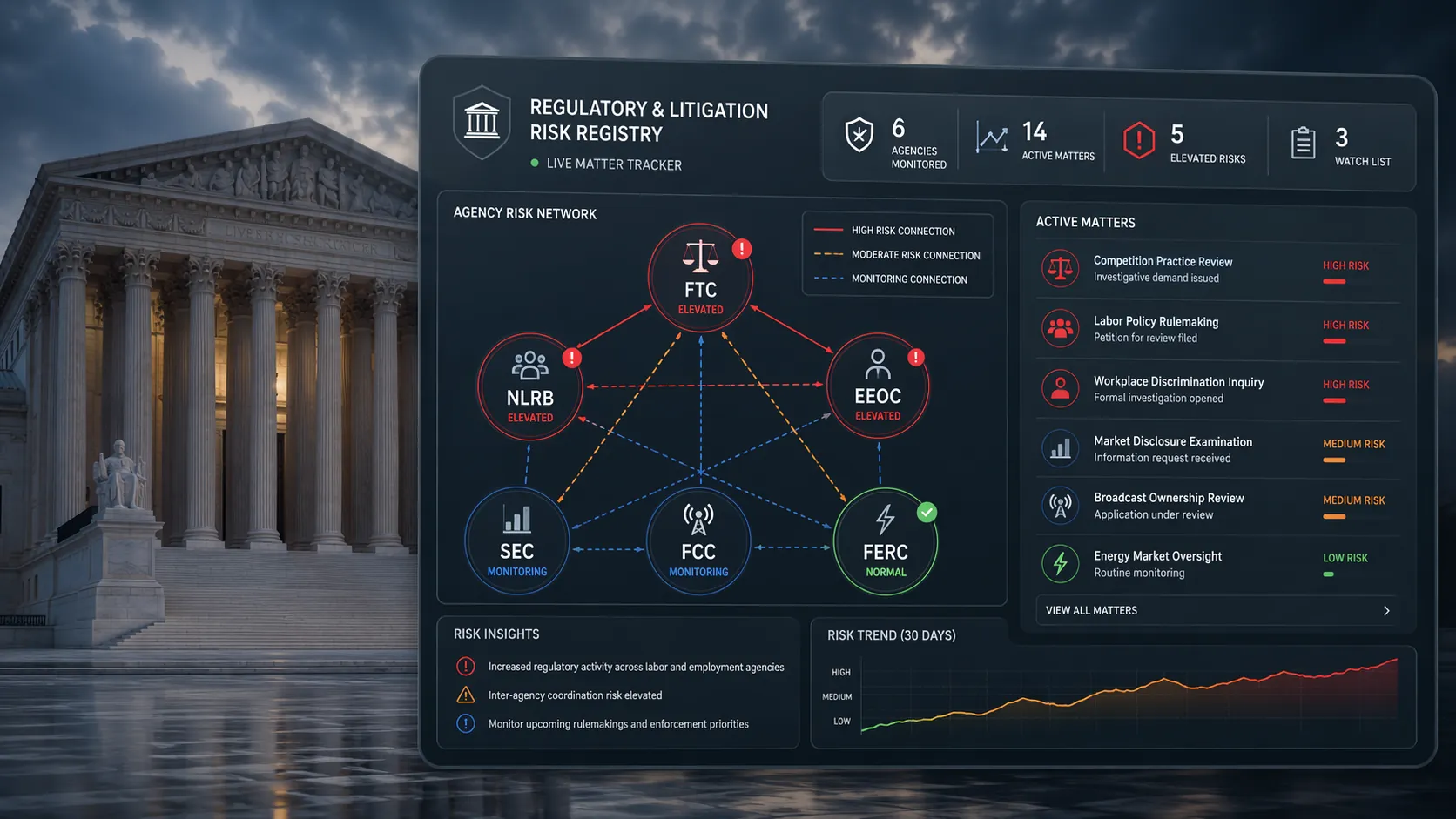
How to read the post-Slaughter agency registry
The table below is the working registry, not a decorative summary. It draws from the agency-specific client alerts and commentary now being used by regulated businesses to triage Slaughter exposure: K&L Gates, Holland & Knight, Arnold & Porter, Bloomberg Law/Hogan Lovells, Fisher Phillips, and CDF Labor Law.[2][3][4][5][6][7] Each field matters for a different operational reason.
- Removal-protection posture tells the team whether the agency’s statutory for-cause language is now materially weakened by Slaughter.
- Board or seat status tells the team who is actually available to vote, not merely what the organic statute contemplates.
- Removal and quorum risk separates a firing that changes partisan balance from one that may disable agency action.
- Pending litigation identifies whether the status entry is settled, stayed, or still vulnerable to a lower-court or Supreme Court update.
- Enforcement or governance signal captures the practical consequence: a changed agenda, a less predictable vote count, or a pending challenge that affects settlement posture.
| Agency | Removal-protection posture after Slaughter | Board or seat status supported by current materials | Removal or quorum risk event | Pending litigation / unresolved issue | Enforcement or governance signal | Tracker status as of July 24, 2026 |
|---|---|---|---|---|---|---|
| FTC | For-cause removal protection for commissioners is treated as overruled for executive-function purposes after Slaughter.[1][2][3] | Materials report only two sitting commissioners, both Republican, after the removal of Democratic Commissioner Alvaro Bedoya.[5] | Bedoya’s removal makes the ruling immediately operational; Bloomberg Law/Hogan Lovells flags the resulting two-commissioner posture as below statutory quorum for some purposes.[5] | Slaughter itself resolved the principal removal-protection question for the FTC, but downstream challenges to particular actions may still turn on authority, timing, or quorum arguments. | All-Republican two-member posture changes how merger, consumer-protection, and competition risk should be briefed; prior enforcement assumptions need agency-specific recheck. | Active operating-risk entry |
| NLRB | For-cause protection for Board members is materially weakened, but the agency-specific litigation path remains important.[2][7] | CDF Labor Law identifies a single Democratic member scenario in which removal would leave the Board without quorum.[7] | Wilcox v. Trump is the key removal event to watch; removal of the remaining Democratic member would create a quorum problem rather than only a partisan-balance change.[7] | Wilcox v. Trump was not yet decided as of July 24, 2026.[7] | Labor enforcement, unfair-labor-practice processing, and Board-level review become harder to model if removal litigation affects quorum. | Active litigation and quorum-risk entry |
| EEOC | Commissioner removal protection is impaired by Slaughter under the same broad executive-power logic applied to independent commissions.[2][6] | Two Democratic commissioners were fired in January 2025, and Fisher Phillips describes the Samuels litigation as having been paused pending Slaughter.[6] | The firings are no longer only personnel events; after Slaughter, they become authority and governance events for pending and future EEOC action.[6] | Samuels v. Trump was paused pending Slaughter and, in the current materials, is treated as resolved against the commissioner after Slaughter.[6] | Employment enforcement priorities may shift with commission composition; litigants should distinguish agency policy reversals from case-processing mechanics. | Active operating-risk entry |
| SEC | The Commission’s statutory independence is affected by the same removal doctrine, subject to agency-specific application and future litigation.[2][3][4] | Current materials report no sitting Democratic commissioners after Slaughter.[5] | No parallel quorum breakdown is supplied in the materials, so the risk entry is governance and enforcement direction rather than confirmed inability to act. | No specific pending SEC removal case is identified in the provided materials. | Absence of sitting Democratic commissioners is a governance signal for enforcement agenda, settlement appetite, rulemaking priorities, and regulated-entity advocacy. | Governance and enforcement-signal watch entry |
| FCC | Multi-member independent-agency removal protections are implicated by Slaughter, but the current materials do not supply the same personnel detail as FTC, NLRB, or EEOC.[2][3] | Not specified in the provided materials. | No confirmed firing or quorum event is supplied in the provided materials. | No specific FCC removal case is identified in the provided materials. | Regulated parties should monitor for commissioner removals and policy reversals, but the record here does not support a stronger agency-specific claim. | Watch entry |
| FERC | FERC is among the independent agencies whose removal protections are implicated; Justice Sotomayor’s dissent named FERC among agencies affected by the ruling’s reach.[1][8] | Bloomberg Law/Hogan Lovells reports two minority commissioners currently sitting.[5] | No completed FERC removal event is supplied in the materials; the presence of minority commissioners matters because a later removal would be a trackable governance shift. | No specific FERC removal case is identified in the provided materials. | Energy-market participants should treat FERC as a watch item, not as a confirmed operational crisis. | Watch entry with minority-commissioner flag |
| CPSC | Sotomayor’s dissent named CPSC among agencies exposed by the ruling’s reach.[1][8] | Not specified in the provided materials. | No confirmed removal or quorum event is supplied in the provided materials. | No specific CPSC removal case is identified in the provided materials. | Monitor for removals and enforcement-priority changes; current record does not support a more specific risk rating. | Watch entry |
| NRC | Sotomayor’s dissent named NRC among agencies exposed by the ruling’s reach.[1][8] | Not specified in the provided materials. | No confirmed removal or quorum event is supplied in the provided materials. | No specific NRC removal case is identified in the provided materials. | Nuclear-sector regulated parties should track membership and decisional authority, but the current materials do not show a concrete post-Slaughter disruption. | Watch entry |
| MSPB | Sotomayor’s dissent named MSPB among agencies exposed by the ruling’s reach.[1][8] | Not specified in the provided materials. | No confirmed removal or quorum event is supplied in the provided materials. | No specific MSPB removal case is identified in the provided materials. | Federal employment and civil-service matters may be affected if removals impair adjudicatory capacity, but that is not confirmed in the provided record. | Watch entry |
| Federal Reserve Board | Cook is a narrow uncertainty marker, not a general safe harbor for other agencies.[9] | Not treated in the materials as part of the ordinary independent-agency bucket after Cook. | The Supreme Court protected the Federal Reserve Board on a 5-4 stay application, not a final merits ruling.[9] | Justice Barrett warned in dissent that the Cook stay posture sits in “serious tension” with Slaughter’s categorical rule.[9] | Do not export the Federal Reserve carve-out to FTC, NLRB, EEOC, SEC, FCC, or FERC without a specific legal basis. | Exception / uncertainty entry |
FTC: the abstract holding already has a personnel file
The FTC is the easiest place to see why Slaughter should be tracked as a sequence of events rather than a single case note. The Court’s decision did not merely announce that for-cause removal protection had yielded to presidential control. It allowed the removal of an FTC commissioner, and the downstream status now includes a reduced Commission with only two Republican commissioners after Bedoya’s removal.[1][5]
For litigation and compliance teams, that matters in at least three separate fields. First, commission composition is now an enforcement signal. A client that modeled FTC risk under an earlier partisan balance should not assume the same merger posture, consumer-protection appetite, or settlement dynamics. Second, the two-commissioner posture is a quorum flag, not just a political fact; Bloomberg Law/Hogan Lovells describes it as below statutory quorum for some purposes.[5] Third, future challenges may not need to relitigate the whole removal question to create uncertainty. They can target whether a particular agency act was authorized at a particular moment.
That is why the FTC entry should not be reduced to “Humphrey’s Executor overruled.” For the working file, the usable event chain is: Slaughter removed; Court permits removal; Bedoya removed; Commission reduced to two Republican members; quorum and authority issues flagged for some purposes. Each entry has a different date, a different consequence, and a different audience inside a legal department.
NLRB: Wilcox is a quorum problem before it is a theory problem
The NLRB file is less settled than the FTC file, and that is the point. Wilcox v. Trump had not been decided as of July 24, 2026, so the correct status is not “resolved by Slaughter.” It is pending, with a specific quorum consequence if the removal succeeds.[7]
CDF Labor Law’s alert identifies the practical risk: a single Democratic member scenario in which removal would leave the Board without quorum.[7] That is not the same as saying every NLRB act is invalid or every labor matter should pause. It means the Board’s ability to act at the top level can turn on the litigation status of a member-removal dispute. For employers, unions, and labor litigators, the relevant tracker fields are member status, quorum, pending petition posture, and whether the agency action at issue requires Board-level approval.
A risk memo that treats NLRB exposure as merely “lower under this administration” misses the sharper problem. A reduced enforcement agenda and a disabled adjudicatory body are different things. The former changes expected behavior; the latter may change what the agency can lawfully do.
EEOC: Samuels turns earlier firings into post-Slaughter authority questions
The EEOC risk entry starts before Slaughter. Two Democratic commissioners were fired in January 2025, and the Samuels litigation challenging one of those removals was paused pending the Supreme Court’s decision.[6] After Slaughter, Fisher Phillips describes the case as resolved against the commissioner, reframing the earlier firings under the new removal rule.[6]
That sequence matters because employment-law teams often separate “agency leadership” from “case pipeline.” Slaughter makes that separation less comfortable. A change in commission composition can affect strategic enforcement priorities, litigation approval, guidance posture, settlement incentives, and the tone of systemic enforcement. At the same time, the materials here do not support a blanket statement that all EEOC processes have stopped or that every pending matter has changed. The stronger entry is narrower: commissioner removals have been validated or materially strengthened, and enforcement-priority assumptions should be rechecked against the current Commission posture.
The tracking discipline is simple: log the firing date, the litigation status, the current commission composition, and any formal enforcement-priority reversal separately. Do not bury them inside a single “EEOC after Slaughter” note. A client asking about an active charge or systemic investigation needs to know which of those facts actually affects the matter.
SEC: no sitting Democratic commissioners is a signal, even without a quorum crisis
The SEC entry should be kept concise but not ignored. The current materials report no sitting Democratic commissioners after Slaughter.[5] They do not supply the same kind of quorum crisis identified for the NLRB or the same two-commissioner operational posture flagged for the FTC. That distinction matters. The SEC risk entry is a governance and enforcement-direction entry, not a confirmed inability-to-act entry.
For securities litigators and public-company counsel, the absence of sitting Democratic commissioners affects how to read enforcement priorities, rulemaking direction, settlement posture, and agency advocacy. It does not, on the materials provided, justify a broader conclusion that SEC action is categorically disabled. The useful monitoring questions are narrower: have enforcement priorities been formally reversed, has a pending rulemaking changed direction, has a settlement vote changed, or has a removal dispute been filed that affects Commission authority?
FERC, FCC, CPSC, NRC, and MSPB: affected does not mean equally disrupted
Justice Sotomayor’s dissent named FERC, CPSC, NRC, MSPB, and other agencies as exposed by the Court’s ruling.[1][8] That is important for the watch list. It is not, by itself, a current operational finding for every agency on the list.
FERC deserves a separate flag because Bloomberg Law/Hogan Lovells reports that two minority commissioners are still sitting.[5] That fact makes FERC a live watch item: a later removal could change the Commission’s voting profile and agency predictability. But the materials do not show a completed FERC removal, a quorum breakdown, or a pending FERC-specific removal case. For energy-market risk, the entry should read “monitor closely,” not “crisis confirmed.”
The same restraint applies to FCC, CPSC, NRC, and MSPB. Slaughter weakens the protection structure that helped define independent agencies, and the dissent’s agency list is a useful scoping device. But for an agency risk register, a named agency is not the same as a logged event. The event is a removal, a vacancy, a failed quorum, a case filing, a lower-court ruling, or a formal enforcement reversal.
The April 2026 baseline is already stale, but still useful
A Partnership for Public Service count published in April 2026 put the number of board or commission members fired or targeted for firing by Trump since the start of his second term at 20.[8] That number should be treated carefully because it predates the June 29, 2026 Slaughter decision. It is a baseline, not a current ceiling.
Its value is not that it proves how many removals will occur after Slaughter. It shows that the removal campaign was already an observable governance pattern before the Supreme Court supplied the broader constitutional rule. In a matter-status tracker, that means pre-Slaughter removals and post-Slaughter removals should not be merged without a date field. The legal consequences may differ depending on when the removal occurred, what litigation was pending, and what the agency did afterward.
The Federal Reserve carve-out is not a portable answer
Cook is the wrong place to look for comfort unless the question is specifically about the Federal Reserve. The Supreme Court protected the Federal Reserve Board in a 5-4 stay posture, while allowing the broader independent-agency removal rule to stand elsewhere.[9] Justice Barrett’s dissent warned that the Cook order sat in “serious tension” with Slaughter’s categorical rule.[9]
That procedural posture matters. A stay application is not a final merits decision. For a risk register, the Federal Reserve entry should be marked as an exception and uncertainty marker, not as a doctrine that stabilizes other agencies. If a client asks whether Cook protects the SEC, FTC, NLRB, EEOC, FCC, or FERC, the answer should start with the agency-specific statute and the current litigation posture, not with a generalized Federal Reserve analogy.
What should be logged next
The next meaningful Slaughter developments may not look like Slaughter. They may be short personnel notices, nominations that change partisan balance, lower-court orders in Wilcox or Samuels-related disputes, board minutes showing a vote count, agency statements reversing enforcement priorities, or litigants raising quorum objections in matters that otherwise look routine.
| Trackable event | Why it matters | Agencies where it is already prominent in the materials |
|---|---|---|
| Commissioner removal | Changes agency composition and may trigger authority challenges. | FTC, EEOC, NLRB |
| Vacancy or nomination | Changes voting math and enforcement predictability. | FTC, SEC, FERC |
| Quorum loss or quorum challenge | Can affect whether the agency can act, not merely how it acts. | NLRB, FTC |
| Pending removal litigation | Keeps agency status provisional even after Slaughter. | NLRB, EEOC |
| Formal enforcement-priority reversal | Changes compliance and settlement assumptions. | FTC, SEC, EEOC |
| Lower-court ruling applying Slaughter | May define agency-specific boundaries not resolved by the Supreme Court. | All affected agencies |
The safer post-Slaughter habit is to stop treating independent-agency risk as a single label. FTC risk now has a different factual posture from NLRB risk. NLRB risk differs from EEOC risk. SEC risk differs from FERC risk. The ruling supplies the constitutional force, but the operating risk is created in smaller units: who was removed, who remains, whether a quorum exists, whether litigation is pending, and whether enforcement direction has actually changed.
That is the file to maintain after Slaughter: dated, sourced, agency-specific, and updateable. The next risk event may be a Supreme Court merits opinion. It may also be a commissioner removal, a broken quorum, an enforcement reversal, or a district-court order that changes one agency’s status before the broader doctrine settles.
References
- Supreme Court allows Trump to fire FTC commissioner and overturns major restraint on presidential power, SCOTUSblog, June 29, 2026
- Supreme Court Expands Presidential Control Over Independent Agencies: Key Takeaways for Regulated Businesses, K&L Gates, June 30, 2026
- What the Trump v. Slaughter Decision Means for Independent Agency-Regulated Companies, Holland & Knight, July 2026
- The End of For-Cause Removal?, Arnold & Porter, July 2026
- Companies Need New Playbook for Agency Advocacy After Slaughter, Bloomberg Law / Hogan Lovells
- SCOTUS Just Expanded President's Power to Fire Members of Independent Agencies, Fisher Phillips, 2026
- Supreme Court's Trump v. Slaughter Decision Reshapes the Administrative State – What it Means for the NLRB, EEOC, and Beyond, CDF Labor Law
- Supreme Court cements Trump's power over independent agencies, NPR, June 29, 2026
- Supreme Court: Trump may fire heads of independent agencies, but not the Federal Reserve, LA Times, June 29, 2026
Related records
Tool profile
Browse tool evaluations →Governing regulation
Browse the obligations tracker →Preventive workflow
Browse verification workflows →
Report a correction or tip
Spotted an outdated figure, a misstated fact, or a ruling this case record should reflect? Public comments are disabled for this content given the professional cost of a misreported case outcome, penalty amount, or rule text — use the structured correction channel instead.
Report a correction or tip for this record →