
Who Bears Liability in the Taco Bell Cyclospora Outbreak?
Multiple lawsuits over the 2026 cyclospora outbreak name Taco Bell, its franchisee Pacific Bells, and supplier Taylor Farms. This article examines how franchise agreement sourcing and indemnification clauses combine with Taylor Farms' prior outbreak history to shape each defendant's liability exposure.
- Jurisdiction
- United States
- Court
- United States District Court
- AI tool named
- N/A
- Ruling date
- Jul 24, 2026
- Source document
- View primary court order ↗
- Last verified
- Jul 25, 2026
Lex Machina Review is an independent risk-tracking and reference resource. Nothing on this site is legal advice, and using it does not create an attorney-client relationship. Every record is reviewed against primary sources but may not reflect the most current status of a matter — always verify directly against the cited court order, rule text, or a licensed attorney before relying on it.
Companion explanation — secondary to the source document above
The useful starting point for legal liability in the Taco Bell cyclospora outbreak is not the lettuce bowl. It is the caption. The reported lawsuits do not put only Taco Bell in the defendant box. They put Taco Bell, franchisee Pacific Bells LLC, and supplier Taylor Farms into the same liability frame, even though each allegedly occupied a different place in the chain: brand controller, restaurant operator, and produce supplier.
As of July 24, 2026, at least seven lawsuits had been reported across three federal districts, with filings led by plaintiff firms including Marler Clark and Ron Simon & Associates; the outbreak remained ongoing, case counts were preliminary, and no court had made a final liability ruling on causation, indemnity, or punitive damages.[1][2][3] The FDA’s July 20 retraction of a false-positive lettuce test also narrows what can be claimed from that test, even though the recall’s epidemiologic basis remained in place. That posture matters. The filings are not verdicts. They are maps of where plaintiffs think pressure can be applied.
The awkward fact is Pacific Bells. Restaurant Dive and Bloomberg Law both reported that Pacific Bells was sued even though the franchise-law analysis of the Taco Bell documents describes the franchisee as having no discretion over lettuce sourcing.[4][5][6] In a cleaner corporate diagram, the operator serves the food and therefore sits nearest the injured customer. In the litigation diagram, that same operator may also be the party least able to choose the ingredient source.
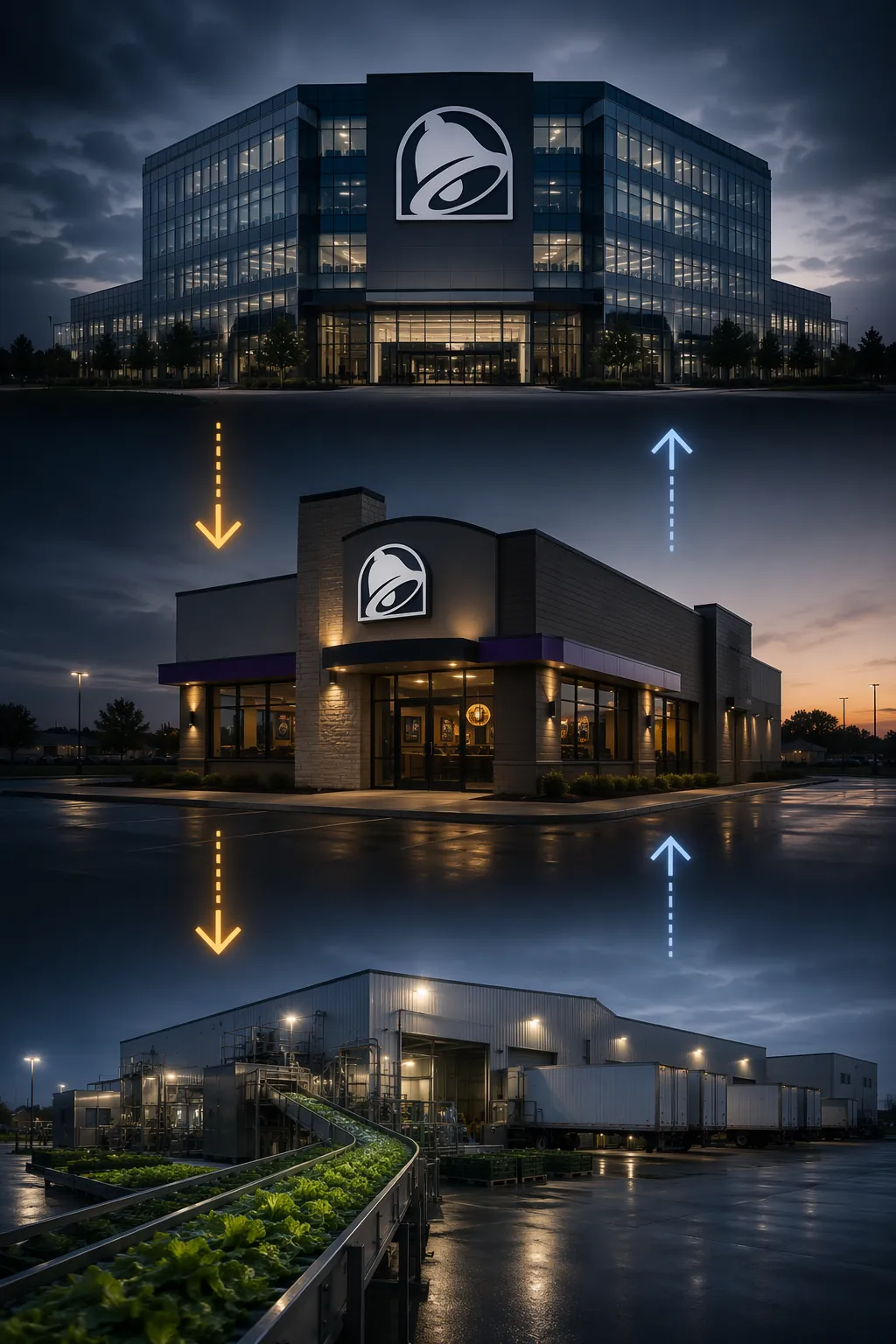
The Caption Shows the Stack Before the Contract Does
Pacific Bells’ presence in the pleadings is not a clerical curiosity. It shows why indemnity language never ends the first litigation question. A customer plaintiff does not need to respect the private cost-allocation plan between franchisor and franchisee when deciding whom to sue. If the restaurant served the product, the restaurant operator can be named. If the brand allegedly controlled the supplier list, the franchisor can be named. If the supplier processed or distributed the implicated ingredient, the supplier can be named.
The LinkedIn franchise-law analysis attributes two clauses to Taco Bell’s franchise materials: an Item 8 sourcing requirement under which franchisees must buy all food products from Yum-approved vendors at Yum’s sole discretion, and a Section 10 indemnity obligation requiring the franchisee to indemnify Yum for food-safety claims, including customer injury or death.[6] That source is expert commentary, not a judicial finding or a primary filing reproduced in the research record. The legal argument depends on those clause descriptions being borne out by the actual franchise documents.
If those descriptions hold, the allocation is severe. Downward, the brand allegedly controls approved sourcing. Upward, the franchisee allegedly absorbs indemnity exposure. Outward, the customer can still name the franchisee that handed over the food. That is not a contradiction in litigation practice. It is the structure plaintiffs can use to keep all three defendants in the case long enough to test who knew what, who selected whom, and who had the power to change vendors.
| Layer | Alleged role in the outbreak litigation | Main exposure theory |
|---|---|---|
| Taco Bell / Yum | Franchisor and alleged controller of approved sourcing | Control, negligent supplier selection, failure to act on supplier-history notice |
| Pacific Bells LLC | Franchise restaurant operator that allegedly served implicated food | Operational defendant status, with possible indemnity obligations back to Yum |
| Taylor Farms | Supplier associated with the recalled ingredient | Product contamination, negligence, notice from prior outbreak history, punitive-damages theory |
Why Indemnity Does Not Make Pacific Bells Disappear
Indemnity is often written as if it answers the uncomfortable question. It rarely does. It may decide who reimburses whom after defense costs, settlement payments, or judgments are incurred. It does not, by itself, prevent a plaintiff from naming the party that sold the meal. It also does not prevent the franchisee from becoming a fact witness against the franchisor’s own sourcing architecture.
That is the practical irritation in the Pacific Bells position. If the franchisee lacked sourcing discretion, then its defense will naturally point upward: it operated inside a brand-mandated supply system. But if the indemnity clause is enforced as described, the same franchisee may still owe Yum protection for food-safety claims arising from a supplier it allegedly did not select.[6] Plaintiffs do not need to resolve that private fight at the pleading stage. They benefit from the tension.
For Taco Bell, the risk is not merely that a franchisee was sued. The risk is that the franchisee’s lack of choice makes the franchisor’s choice more visible. A brand can centralize purchasing for good reasons: consistency, bargaining power, traceability, and uniform food-safety standards. But once centralized sourcing becomes part of the plaintiff’s theory, the brand’s approved-vendor decision is no longer background administration. It becomes a disputed safety decision.
Item 8 Turns Supplier Approval Into a Control Theory
The alleged Item 8 sourcing requirement is the hinge. If Taco Bell franchisees were required to purchase 100% of food products from Yum-approved vendors at Yum’s sole discretion, plaintiffs can argue that supplier selection was not a local restaurant decision.[6] That does not prove Taco Bell caused contamination. It does give plaintiffs a route around the familiar defense that the franchisor was too remote from the food-handling event.
The strongest version of the claim is not “Taco Bell touched the lettuce.” It is narrower and more durable: Taco Bell allegedly built and enforced the sourcing system that required franchisees to use approved vendors, and Taylor Farms’ history gave Taco Bell reason to scrutinize whether that vendor should remain in the system. That is a negligent-selection theory, not a kitchen-floor theory.
This is also where overstatement would help no one. The reported materials do not establish that Taco Bell had actual knowledge of every prior Taylor Farms event, that it ignored a specific warning, or that the franchise documents will be interpreted exactly as the LinkedIn analysis describes them. Those questions belong in document production, depositions, and motions practice. The point at the filing stage is that mandated sourcing gives plaintiffs a reason to ask those questions of the franchisor rather than only of the restaurant operator.
Taylor Farms’ History Matters as Notice, Not Atmosphere
The Taylor Farms chronology matters because prior incidents can become notice material. CBS News reported that Taylor Farms de Mexico was linked to a 2013 cyclospora outbreak, and the CDC’s 2013 record describes a multistate cyclospora outbreak investigation involving restaurant-associated illnesses.[7][8] Newsweek reported that 2026 complaints also referenced Taylor Farms’ prior outbreak history, including the 2013 cyclospora event, a 2020 salmonella onion recall, and a 2024 E. coli outbreak.[9]
The legal use of that history is not to say that a 2013 outbreak proves a 2026 contamination. It does not. The use is to argue notice: a repeat supplier with documented foodborne-illness events may have had reason to maintain heightened controls, and a franchisor mandating that supplier may have had reason to ask harder questions before keeping it in the approved chain.
That distinction becomes important because the contamination location may remain disputed. The FDA retraction narrows what can responsibly be said about a specific lettuce test. It does not erase the broader pleading theory built on epidemiology, recall connection, sourcing control, and prior supplier history.
For Taylor Farms, the prior events support the plaintiffs’ effort to move beyond ordinary negligence. Punitive damages usually require more than a bad outcome; plaintiffs need to allege conduct that looks reckless, willful, or consciously indifferent under the applicable law. A history of similar food-safety events is the kind of material plaintiffs will use to argue that the supplier had notice of recurring hazards and failed to respond adequately. Whether that survives a motion or reaches a jury is a later question.
For Taco Bell, the same history does different work. Plaintiffs can use it to challenge the reasonableness of the approved-vendor decision. The more the franchisor claims uniform control over sourcing, the harder it is to treat supplier history as somebody else’s problem. A franchise system cannot comfortably argue that vendor approval is central enough to mandate but too peripheral to create selection exposure.
The FDA Retraction Helps the Defense, but It Does Not Collapse the Pleadings
A retracted positive test is not a footnote. Defense counsel will use it, and properly so, to attack any claim that rests too heavily on a single laboratory result. It may matter to causation, product identification, and the credibility of early public reporting. It may also complicate efforts to tie a particular lot, facility, or handling step to particular illnesses.
But the retraction does not answer the whole lawsuit if the recall still rests on epidemiologic evidence and the cases plead a broader supplier-selection theory. Plaintiffs at the pleading stage do not have to identify every microscopic path the parasite traveled. They have to allege a plausible path of responsibility: customers became ill, the implicated product was served through Taco Bell locations, Taylor Farms was tied to the recall theory, and Taco Bell allegedly required franchisees to use approved suppliers.
That is why the litigation will likely spend as much time on documents as on food science. Approved-vendor files, audit records, recall communications, supplier scorecards, franchise correspondence, and indemnity notices may matter as much as the question of where a particular leaf became contaminated. In a franchise supply-chain case, causation and control usually travel together, but they are not the same issue.
What Each Defendant Wants the Case to Be About
Each defendant has an incentive to describe the case at a different level of altitude. Pacific Bells benefits from making the case about supplier selection: it allegedly operated inside a mandatory system. Taco Bell benefits from making the case about supplier conduct or local food handling: it can argue that brand standards and approved purchasing do not equal contamination control. Taylor Farms benefits from making the case about proof of actual contamination in the 2026 event, especially in light of the retracted test.
Plaintiffs benefit from refusing to choose too early. They can plead that the franchisee served the food, the franchisor controlled the supplier list, and the supplier had a history relevant to notice. That is not elegant, but pleadings in outbreak litigation are not paid to be elegant. They are paid to preserve paths to discovery.
- Pacific Bells’ pressure point is operational proximity: it allegedly sold or served the implicated product, even if it did not choose the supplier.
- Taco Bell’s pressure point is control: the alleged sourcing clause gives plaintiffs a way to frame supplier approval as a corporate safety decision.
- Taylor Farms’ pressure point is notice: the prior outbreak chronology gives plaintiffs material for negligence and punitive-damages arguments.
- The indemnity clause’s pressure point is allocation: it may shift defense and payment obligations between defendants without eliminating plaintiff-facing exposure.
The Liability Map, Not the Verdict
The present record does not support a final answer that Taco Bell is liable, Pacific Bells is absolved, or Taylor Farms will face punitive damages. It supports a more precise risk conclusion. Mandated sourcing and franchisee indemnification do not shield Taco Bell from plaintiff claims. They create a stack in which Pacific Bells remains a named operational defendant, Taco Bell faces control and negligent-selection theories, and Taylor Farms carries supplier-history exposure.
That stack is why the case is worth watching beyond the outbreak headlines. If the franchise documents match the reported clause descriptions, Taco Bell’s strongest efficiency argument also becomes plaintiffs’ strongest control argument. If Taylor Farms’ prior outbreak history is admitted for notice purposes, the supplier case becomes more than a one-off contamination dispute. And if Pacific Bells is required to indemnify Yum for claims tied to a supplier it allegedly could not avoid, the private contract allocation may become the most revealing fact in the public litigation.
References
- Taco Bell Hit With Federal Lawsuits Over Cyclosporiasis Infections, Forbes, July 17, 2026
- Cyclospora outbreak Taco Bell lawsuit, The Hill
- Class Action Lawsuit Alleges Taylor Farms, Taco Bell Failed to Warn Consumers of Cyclosporiasis Contamination, ClassAction.org
- Taco Bell, Taylor Farms, franchisee sued over cyclosporiasis, Restaurant Dive
- Taco Bell Franchisee Sued Over Cyclospora Outbreak Illness, Bloomberg Law
- Who Really Owns the Risk? Taco Bell’s Cyclospora Outbreak Clause, LinkedIn
- Taylor Farms cyclospora outbreak, CBS News
- Multistate Cyclospora Outbreak, Centers for Disease Control and Prevention
- Taco Bell Customers Launch Lawsuits Over Cyclospora Outbreak, Newsweek
Related records
Tool profile
Browse tool evaluations →Governing regulation
Browse the obligations tracker →Preventive workflow
Browse verification workflows →
Report a correction or tip
Spotted an outdated figure, a misstated fact, or a ruling this case record should reflect? Public comments are disabled for this content given the professional cost of a misreported case outcome, penalty amount, or rule text — use the structured correction channel instead.
Report a correction or tip for this record →