
How Strict Liability Enabled the Taco Bell Cyclospora Lawsuit Flood
This article examines how strict liability doctrine and plaintiff infrastructure accelerated the Taco Bell cyclospora outbreak litigation, with lawsuits filed before CDC confirmation, and offers lessons for corporate counsel preparing for the next foodborne-illness outbreak.
- Jurisdiction
- US Federal
- Court
- Ohio Federal Court
- AI tool named
- None
- Ruling date
- Jul 16, 2026
- Source document
- View primary court order ↗
- Last verified
- Jul 28, 2026
Lex Machina Review is an independent risk-tracking and reference resource. Nothing on this site is legal advice, and using it does not create an attorney-client relationship. Every record is reviewed against primary sources but may not reflect the most current status of a matter — always verify directly against the cited court order, rule text, or a licensed attorney before relying on it.
Companion explanation — secondary to the source document above
Four dates explain why the Taco Bell cyclospora litigation became a boardroom problem before it became a settled traceback story. On July 14, 2026, CDC issued a Health Alert Network advisory tied to a rapidly expanding cyclospora investigation.[1] On July 16, Ayyad v. Pacific Bells was filed in Ohio federal court against a Taco Bell operator, before CDC had publicly linked the outbreak to Taco Bell.[2] On July 17, CDC’s public link to Taco Bell became visible, and federal lawsuits followed within hours.[3]
The legal record forcing the current conversation is the 2026 Taco Bell/Taylor Farms outbreak, not an earlier 2025 liability episode. The year matters because the sequence matters. The legal system did not wait for the science to reach its final form. It moved when plaintiffs’ counsel had enough to allege illness, food exposure, and a contamination theory.
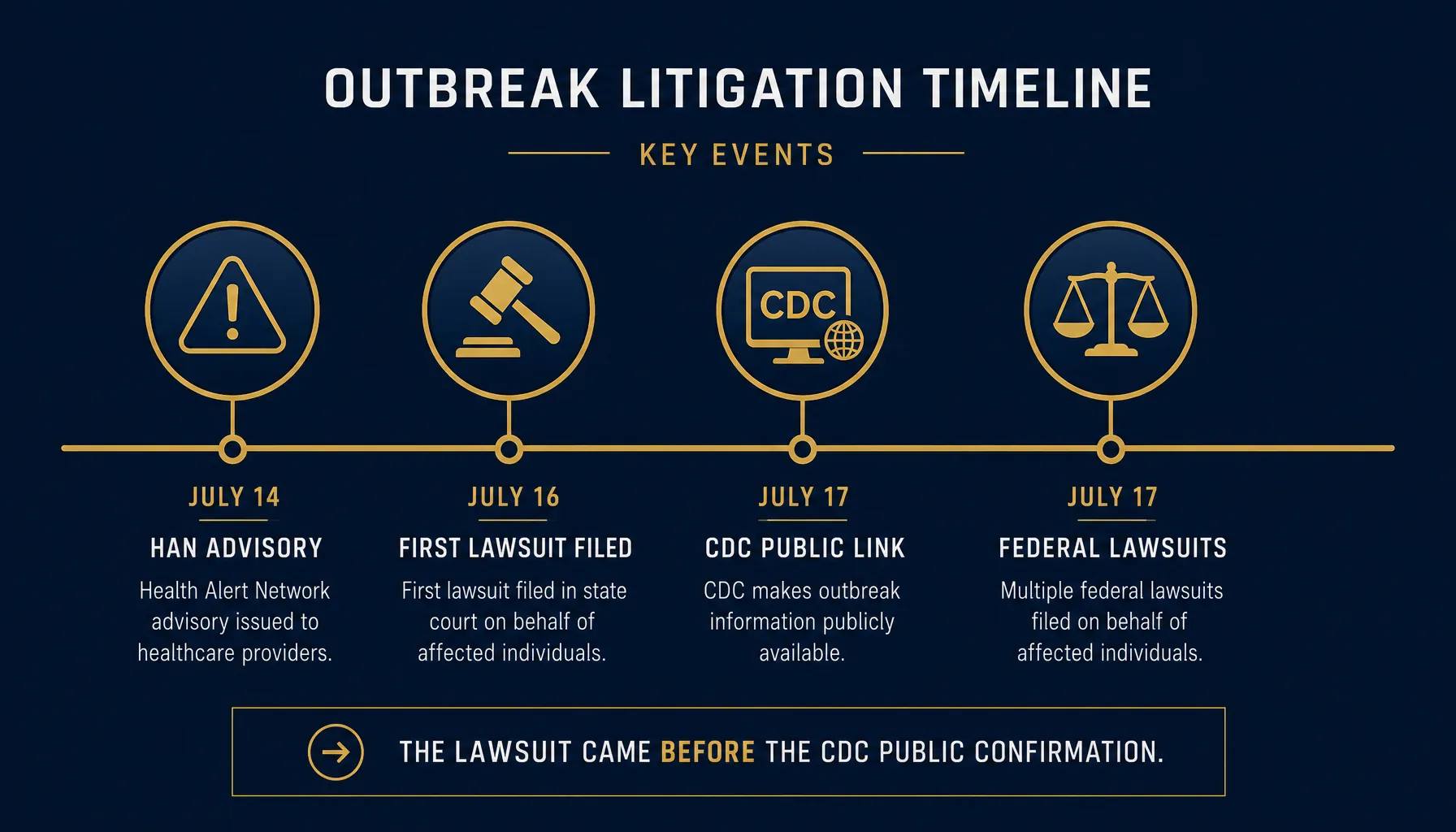
That is the feature corporate counsel should study. As of CDC’s July 24 update, the agency reported 4,173 confirmed domestically acquired cyclosporiasis cases, more than 7,400 additional cases under investigation, 34 affected states, and more than 141 hospitalizations.[4] Those figures were still preliminary as of July 28, 2026. They are important for scale, not for premature certainty. The source confirmation issues remained fluid, and the outbreak was ongoing.
The legal clock started before the traceback clock stopped
The first filing did not need to prove, on day one, every link in the chain that epidemiologists and regulators were still testing. A complaint is not a final causation report. It is a pleading that starts a case, preserves claims, fixes venue, and puts defendants on notice. In contaminated-food litigation, strict product liability gives plaintiffs a route that does not begin with a fully developed negligence story.
| Date | Public-health or litigation event | Why it mattered legally |
|---|---|---|
| July 14, 2026 | CDC HAN advisory issued.[1] | The public-health signal gave outbreak lawyers a basis to begin intake and screening. |
| July 16, 2026 | Ayyad v. Pacific Bells filed in Ohio federal court.[2] | The first lawsuit arrived before CDC’s public Taco Bell link. |
| July 17, 2026 | CDC publicly linked the outbreak to Taco Bell, according to contemporaneous reporting.[3] | The public link became a litigation accelerant, not the start of legal preparation. |
| July 17, 2026 | Additional federal complaints followed within hours.[3] | Plaintiffs’ firms converted the signal into filed cases almost immediately. |
That sequence is more useful than a doctrinal lecture. It shows why the general counsel’s problem is not merely whether the company will ultimately be found liable. The first problem is that the docket, the press cycle, insurer notice, franchisee coordination, supplier preservation demands, and executive briefings begin while the traceback is still being refined.
Why strict liability made the filing speed rational
Strict liability matters because it changes what plaintiffs must emphasize at the starting line. In a negligence-centered case, the early pleading instinct is to tell a story of carelessness: failed sanitation, ignored warnings, broken cold-chain controls, inadequate supplier audits, or delayed response. Those allegations may still appear. But a strict product liability theory is more direct. If the food was contaminated, if the plaintiff consumed it, and if that contamination caused compensable illness, the claim does not depend on first proving that the restaurant or supplier behaved unreasonably.
That distinction does not make causation easy. It does not make every claimant viable. It does not convert a public-health advisory into a judgment. What it does is permit plaintiffs’ lawyers to file before they possess the complete operational failure narrative that defendants and insurers often expect to fight about later.
The early Taco Bell-related complaints reportedly included multiple legal theories, including negligence, strict product liability, breach of warranty, and state consumer-protection claims.[5] That mix is ordinary in foodborne-illness pleading. The practical point is narrower: strict liability gives plaintiffs a cause of action that can survive the absence of a polished negligence account at filing. If the complaint can plausibly allege contaminated food, consumption, illness, diagnosis, and damages, the case can be put on file while the defendants argue over who controlled the implicated ingredient.
The same outbreak also produced economic-loss class action allegations, including claims that Taco Bell and Taylor Farms failed to warn consumers of alleged cyclospora contamination.[6] Those cases are not the same as individual personal-injury claims. A consumer who became ill, obtained medical care, and missed work presents a different damages and causation profile from a purchaser seeking reimbursement or warning-based relief. Treating them as one litigation mass obscures how the docket actually pressures a company: personal-injury cases drive medical causation and damages reserves; class actions drive notice, consumer-protection exposure, and settlement architecture.
Plaintiff infrastructure turned a signal into filed litigation
The speed was not just a product of doctrine. It was also a product of prepared plaintiff-side machinery. Marler Clark’s materials are useful here for what they show about capacity, not because they settle disputed facts. The firm announced the first lawsuit and, according to plaintiff-side reporting, had signed more than 30 plaintiffs within one week.[2] That is an adversarial statement from counsel with every incentive to project momentum. It is still operationally significant.
An experienced outbreak plaintiffs’ firm does not begin from a blank page when CDC posts an update. It already has intake scripts, medical-record authorization forms, symptom timelines, laboratory-result review processes, location and purchase-history questions, complaint templates, media channels, and venue preferences. When a public-health signal appears, the firm can ask a short series of triage questions: Did the person eat at a potentially implicated restaurant? When? What did they order? Were they diagnosed? Was there a stool test? Did they go to urgent care, an emergency department, or a hospital? Are there wage losses, ongoing symptoms, or vulnerable household members?
That intake discipline matters more than press-release volume. A firm that can quickly separate a lab-confirmed, medically documented claimant from a vague stomach-illness caller can move faster without taking every call into court. It can also choose the first plaintiffs strategically: a clean exposure history, a plausible incubation period, a jurisdiction with workable product-liability law, and a defendant connected to the restaurant where the meal was purchased.
For defense counsel, this is the uncomfortable part. The plaintiffs’ bar may already have its first complaint drafted while the company is still deciding whether a public statement should say “linked,” “suspected,” “under investigation,” or “confirmed.” The internal legal review that once assumed a neat progression — regulator update, source confirmation, recall decision, insurer notice, supplier tender, franchisee alignment, then litigation response — now collides with complaints filed in the middle of that sequence.
Reuters reported Bill Marler’s estimate that prior cyclospora cases have settled in a broad range from about $25,000 to $1 million depending on severity.[7] That range is useful as a risk-sizing reference, not as a forecast for this docket. Prior case values may not scale cleanly when the confirmed count is already in the thousands and thousands more are under investigation. Severe individual cases still matter most for personal-injury valuation, but aggregate pressure changes the defense budget, document burden, and settlement posture long before a bellwether trial is visible.
The defendant map spread across the supply chain
The defendant taxonomy also explains why early outbreak litigation creates so much corporate noise. Reported defendants and implicated entities included Taco Bell Corp., franchisee Pacific Bells LLC, Taylor Fresh Foods, Taylor Farms California, and unnamed John Doe growers.[3][5] That is not a tidy two-party dispute. It is a brand, franchisee, processor, and grower problem, with each layer asking a different version of the same question: who had control, who had notice, who preserved what, and who must indemnify whom?
A national restaurant brand faces reputational exposure even when the alleged operational act happened at a franchise location or upstream supplier. A franchisee may hold the immediate customer relationship and meal-location evidence. A processor may hold lot, wash, packaging, and distribution records. Growers may hold field, water, labor, and harvest information. Those records do not sit in one legal department, and they do not move on one clock.
The FDA’s July 19 false-positive retraction adds a caution that should keep the analysis disciplined.[7] A traceback can shift. A preliminary signal can weaken or be narrowed. That kind of development may become important to causation, allocation, and public messaging. It does not erase the fact that complaints can already be pending. The defense cannot wait for scientific finality before preserving evidence and coordinating positions across the chain.
Nor should the absence of a multidistrict litigation proceeding be mistaken for calm. The materials available as of July 28 did not show that an MDL had been sought or ordered. That leaves posture fluid: individual federal cases, possible related-case arguments, state-court filings, class action motion practice, and informal coordination can all develop before any formal consolidation decision.
Prior cyclospora outbreaks help, but only up to a point
Cyclospora litigation is not legally novel just because the parasite is less familiar to the public than E. coli or salmonella. Earlier matters included a 2013 Taylor Farms-linked cyclospora outbreak with 631 cases and a 2018 McDonald’s salads outbreak with more than 500 cases.[8][9] Those comparisons are useful because they show that the legal theories, claimant screening problems, and produce-supply questions have precedent.
But precedent is not the same as a template. The 2026 Taco Bell/Taylor Farms matter combines unusually large reported numbers, fast public-health updates, sophisticated plaintiff intake, and immediate national media attention. A company that benchmarks only against prior cyclospora settlements may underestimate the front-end burden: crisis communications review, privilege protocols, data preservation, complaint tracking, and supplier alignment all arrive before the company can confidently describe the final source narrative.
That is why the older outbreaks should be read less as valuation anchors than as rehearsal footage. They show what categories of evidence will matter: meal histories, ingredient sourcing, distribution records, testing results, sanitation records, prior complaints, customer notices, and medical documentation. The 2026 outbreak shows how little time counsel may have to collect them before pleadings, press calls, and executive questions converge.
What should change inside the outbreak playbook
The first change is the trigger. A Health Alert Network advisory, CDC investigation page, state health department update, or credible plaintiff-firm announcement should no longer be treated as only a food-safety or communications event. It is also a litigation-readiness event. That does not mean assuming liability. It means assigning litigation counsel, preservation leads, insurer-notice responsibility, franchise contact points, and supplier-tender review immediately.
- Preservation should reach beyond the suspected restaurant location: POS data, ingredient lot records, distribution logs, complaint databases, vendor communications, training records, sanitation records, and customer-contact scripts may all become relevant.
- Privilege protocols should be set before cross-functional outbreak calls become sprawling fact meetings with unclear legal purpose.
- Supplier and franchise agreements should be reviewed for indemnity, insurance, audit rights, defense control, notice deadlines, and access to records.
- Public statements should distinguish suspected exposure, epidemiological association, laboratory confirmation, recall action, and final source attribution.
- Complaint monitoring should include federal dockets, state courts, class action filings, plaintiff-firm intake pages, and local health department developments.
The second change is sequencing. Counsel cannot assume that recall decisions, source confirmation, insurance coordination, franchisee alignment, and complaint response will occur one after another. In a fast outbreak, they happen together. The legal department may need to brief the board on pending complaints while regulatory language is still provisional and while the supply-chain team is still reconstructing ingredient movement.
The third change is claimant modeling. A large outbreak does not mean every reported illness becomes a viable claim, but it does require early segmentation. Lab-confirmed hospitalized plaintiffs, diagnosed but non-hospitalized plaintiffs, symptomatic consumers without confirmation, economic-loss class members, and derivative family claims carry different defense strategies. Treating all contacts as one undifferentiated mass will distort reserves and settlement authority.
The fourth change is internal message discipline. Executives often want a simple sentence: Are we responsible? In the first days of an outbreak, the better legal answer may be narrower: claims have been filed; strict liability theories reduce the need for plaintiffs to plead negligence at the outset; traceback is still developing; evidence preservation is underway; insurer and supplier notices are being prepared; and public statements should not outrun confirmed facts.
The bounded lesson as of Q3 2026
It would be too much to say, on the current public record, that the Taco Bell/Taylor Farms litigation has resolved causation, allocation, or ultimate liability. It has not. Case counts were preliminary, the outbreak was ongoing, the FDA retraction complicated the traceback story, and no MDL had been ordered in the materials reviewed as of July 28.
It would also be too little to treat the early complaints as routine noise. The July 14 to July 17 sequence shows that strict liability and organized plaintiff response have shortened the time between public-health signal and filed litigation. For restaurant chains, franchisors, franchisees, processors, and growers, “wait for confirmation” is no longer a viable first move. Complaints can arrive while traceback is still contested, and the legal department has to be ready before the science is finished.
References
- Health Alert Network (HAN) - 00531, CDC, July 14, 2026.
- First Lawsuit in 2026 Multistate Cyclospora Outbreak Filed Against Taco Bell Operator in Ohio Federal Court, Marler Clark.
- Taco Bell Hit With Federal Lawsuits Over Cyclosporiasis Infections, Forbes, July 17, 2026.
- Investigation Update: Outbreak of Cyclosporiasis, CDC, July 24, 2026.
- Taco Bell, Taylor Farms, franchisee sued over cyclosporiasis, Restaurant Dive.
- Class Action Lawsuit Alleges Taylor Farms, Taco Bell Failed to Warn Consumers of Cyclospora Contamination, ClassAction.org.
- Food poisoning cases mount as lawsuits follow, Reuters, July 20, 2026.
- The Cyclospora Outbreak now has two names on it – Taylor Farms and Taco Bell – both have been here before and so have I, Marler Blog.
- Taylor Farms cyclospora outbreak, CBS News.
Related records
Tool profile
Browse tool evaluations →Governing regulation
Browse the obligations tracker →Preventive workflow
Browse verification workflows →
Report a correction or tip
Spotted an outdated figure, a misstated fact, or a ruling this case record should reflect? Public comments are disabled for this content given the professional cost of a misreported case outcome, penalty amount, or rule text — use the structured correction channel instead.
Report a correction or tip for this record →