
Teacher loses license for stepping on students during drill
A Minnesota teacher pleaded guilty to malicious punishment for stepping on students during a lockdown drill. This case record details the charges under Minn. Stat. §609.377, the stay-of-adjudication sentence, and the court-ordered teaching license surrender across all states.
- Jurisdiction
- Minnesota
- Court
- Otter Tail County District Court
- AI tool named
- None
- Ruling date
- Jul 30, 2026
- Source document
- View primary court order ↗
- Last verified
- Jul 31, 2026
Lex Machina Review is an independent risk-tracking and reference resource. Nothing on this site is legal advice, and using it does not create an attorney-client relationship. Every record is reviewed against primary sources but may not reflect the most current status of a matter — always verify directly against the cited court order, rule text, or a licensed attorney before relying on it.
Companion explanation — secondary to the source document above
| Field | Record |
|---|---|
| Jurisdiction | Minnesota; Otter Tail County District Court attribution in published sentencing coverage [1][2] |
| Case status | Stay of adjudication after guilty plea to three gross-misdemeanor counts of malicious punishment of a child [1][2] |
| Ruling / sentencing date | July 30, 2026 [1][2] |
| Last verified | July 31, 2026 UTC |
| Underlying conduct date | Feb. 10, 2025, during a lockdown drill at Underwood School [3][4] |
| Charges | Three counts under Minn. Stat. §609.377, malicious punishment of a child [3][5] |
| Reasonable-force statute | Minn. Stat. §121A.582, limiting reasonable force by school personnel to preventing imminent bodily harm or death [6] |
| License-reporting statute | Minn. Stat. §122A.20, including license-revocation grounds and district reporting after resignation during an active investigation [7] |
| Known licensing consequence | Court-ordered surrender of teaching license in any state [1] |
| Unconfirmed items | No public docket number or separate PELSB disciplinary order was located in the research materials. |
This lockdown-drill case is best read first as a sentencing record, not as a school-discipline anecdote. Jason Lowell Rogers, a former sixth-grade teacher in Underwood, Minnesota, received a stay of adjudication, two years of supervised probation, $2,250 in fines and fees, 90 hours of community service, an anger-management assessment, written apology letters to three students, and a requirement that he surrender his teaching license in any state [1][2].
That disposition matters because it is narrower than a conventional conviction and broader than an employment reprimand. If Rogers completes probation, the charges may be dismissed; if he violates probation, the court may enter convictions on the guilty pleas [1][2]. The license consequence, however, is already part of the reported court sentence: Rogers must surrender teaching licensure across states [1].
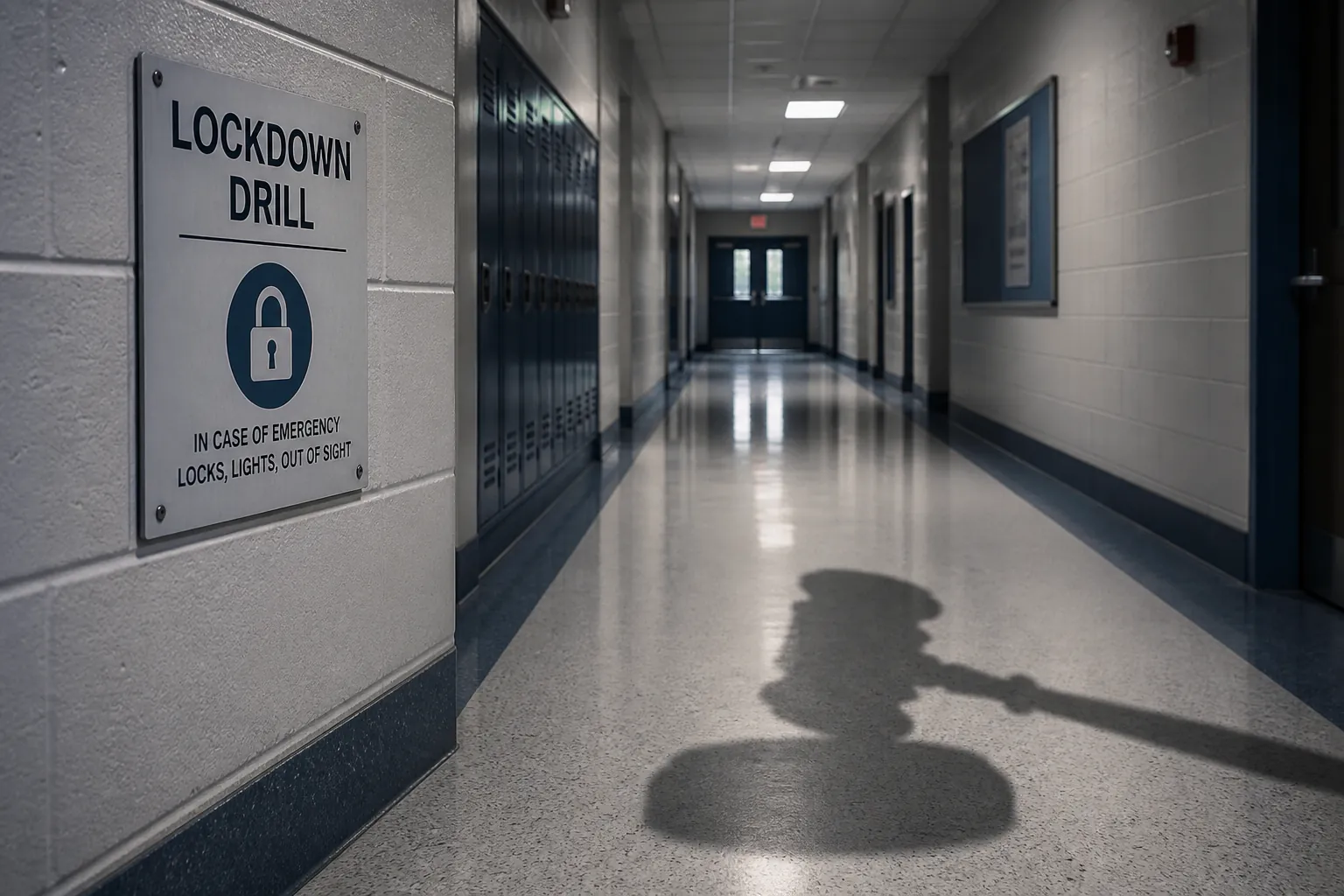
What the charging record says happened during the drill
The conduct at the center of the case occurred on Feb. 10, 2025, during a lockdown drill at Underwood School. Published charging coverage reported that Rogers told the class the drill was “a joke” and that students needed to learn to take it seriously, then stepped on a sixth-grade student’s back for about 10 seconds; the complaint coverage also reported that Rogers weighed more than 350 pounds [3][4]. Two other students were identified as additional victims in the criminal case [1][3].
Those facts are not legally important merely because they are disturbing. They matter because the physical force was tied to correction, punishment, or dramatizing seriousness during a drill. The reported purpose was not stopping an immediate assault, separating students from an imminent danger, or preventing death or bodily harm in the moment. It was making children understand the seriousness of a safety procedure.
That distinction is where the drill setting does real work. A lockdown drill is built around risk simulation, adult authority, and student compliance. But a simulated emergency does not turn classroom discipline into emergency force. The legal question is not whether a teacher may insist that students take a drill seriously. It is whether stepping on students can fit within Minnesota’s remaining reasonable-force authority.
The malicious-punishment counts
Prosecutors charged Rogers on March 25, 2025, with three counts of malicious punishment of a child under Minn. Stat. §609.377 [3]. The statute covers a parent, legal guardian, or caretaker who, by an intentional act or series of intentional acts, uses unreasonable force or cruel discipline that is excessive under the circumstances [5]. The charged counts were gross misdemeanors [3].
The statutory phrasing keeps the case from turning on whether the classroom objective sounded educational. “Seriousness” may describe a lesson objective. It does not answer whether the force was reasonable, whether the discipline was cruel, or whether it was excessive under the circumstances. In this record, the conduct described was a teacher placing body weight on students’ backs during a school drill.
Why the drill did not supply a reasonable-force defense
Minnesota’s school reasonable-force statute is the necessary companion to the malicious-punishment charge. Minn. Stat. §121A.582 permits reasonable force by teachers, principals, school employees, school bus drivers, and other agents of a district only when necessary to restrain a student or prevent bodily harm or death to another [6]. The available statutory context identifies a 2023 amendment as removing the former standalone “to correct” justification, leaving prevention of imminent bodily harm or death as the operative boundary [6].
On the reported facts, the teacher’s stated purpose sits on the wrong side of that boundary. A student who is not treating a drill seriously may create a classroom-management problem. That does not, by itself, create imminent bodily harm or death. Force used to make a point about the seriousness of lockdown procedures remains force used to correct, punish, or impress a lesson on a child.
This is why the case should not be flattened into a general warning that any touching during a drill is criminal. The statutory problem is more specific: Minnesota law did not leave a free-standing physical-discipline justification for a teacher to step on students because they were insufficiently serious during a safety exercise.
Timeline from classroom conduct to sentencing
| Date | Event | Legal significance |
|---|---|---|
| Feb. 10, 2025 | Lockdown drill incident at Underwood School [3][4] | Conduct later charged as malicious punishment of a child. |
| March 25, 2025 | Initial charges filed [3] | Three gross-misdemeanor counts under §609.377 placed the matter in criminal court. |
| April 12, 2025 | Rogers resigned [7] | Because charges had already been filed, the district-reporting obligation under §122A.20 is relevant. |
| July 30, 2026 | Sentencing after guilty plea [1][2] | Stay of adjudication, probation, fines and fees, community service, anger-management assessment, apology letters, and license surrender. |
The timeline also matters for licensure reporting. Minn. Stat. §122A.20 requires a school board to report to the Professional Educator Licensing and Standards Board within 10 days when a licensed teacher resigns while an investigation is pending for alleged conduct that could be grounds for discipline [7]. The statute includes “immoral character or conduct” among grounds that may support license suspension or revocation [7].
Rogers resigned on April 12, 2025, after the March 25, 2025 criminal charges had already been filed [3][7]. That sequence makes the reporting rule more than a background licensure provision. It is the mechanism that prevents a resignation during an active misconduct matter from quietly ending the regulatory trail.
What the stay of adjudication does, and does not, mean
A stay of adjudication is not the same as an ordinary conviction judgment. Sentencing reports state that Rogers pleaded guilty and received two years of supervised probation, with dismissal of the charges available if he successfully completes probation and conviction entry available if he violates it [1][2].
That distinction should be preserved. A headline that says only that a teacher was convicted over the lockdown-drill incident would overstate the present posture. A description that treats the case as minor because adjudication was stayed would understate the court’s orders. Probation, apology letters, community service, financial penalties, anger-management assessment, and license surrender are not informal consequences.
- Probation term: two years of supervised probation [1][2]
- Financial terms: $2,250 in fines and fees [1]
- Service term: 90 hours of community service [1]
- Treatment-related term: anger-management assessment [1]
- Victim-facing term: written apology letters to all three students [1]
- Licensure term: surrender of teaching license in any state [1]
The license consequence reaches beyond the district job
The employment consequence had already moved once: Rogers resigned from the district after charges were filed [3][7]. The sentencing consequence moved further. The court-ordered license surrender in any state makes the classroom incident portable across future employment decisions, rather than leaving it as a local personnel file outcome [1].
There is one important verification limit. The materials reviewed did not locate a separate public PELSB disciplinary order for Rogers. Section 122A.20 explains Minnesota’s licensure-discipline framework and reporting channel, but the confirmed license consequence in this record is the court-ordered surrender reported at sentencing, not an independently verified board order [1][7].
The boundary this case marks
The case does not require a broad theory about lockdown drills. It marks a narrower and more useful boundary: when a teacher uses physical force to make students take a safety drill seriously, Minnesota’s reasonable-force statute does not treat that purpose as enough. The remaining statutory justification is tied to preventing imminent bodily harm or death, not to correcting attitude or dramatizing consequences [6].
The resulting risk is also not confined to one forum. The same classroom act produced criminal charges under §609.377, a probationary criminal disposition, mandatory-reporting implications after resignation, and a license-surrender term that reaches beyond Minnesota employment [1][3][5][7]. The record stops short of a public docket number and a separate PELSB order, but it is clear on the central point: a safety drill does not expand a teacher’s authority to use physical force as discipline.
References
- Underwood teacher gets probation, loses teaching license after stepping on students during lockdown drill, Valley News Live, July 30, 2026
- Former teacher who allegedly stood on a student sentenced to 2 years of probation, KSTP, July 30, 2026
- Underwood teacher charged with malicious punishment of child, Valley News Live, March 25, 2025
- Charges: 6th grade teacher stood on student’s back during lockdown drill, KSTP, March 2025
- Minn. Stat. §609.377, Minnesota Revisor of Statutes
- Minn. Stat. §121A.582, Minnesota Revisor of Statutes
- Minn. Stat. §122A.20, Minnesota Revisor of Statutes
Related records
Tool profile
Browse tool evaluations →Governing regulation
Browse the obligations tracker →Preventive workflow
Browse verification workflows →
Report a correction or tip
Spotted an outdated figure, a misstated fact, or a ruling this case record should reflect? Public comments are disabled for this content given the professional cost of a misreported case outcome, penalty amount, or rule text — use the structured correction channel instead.
Report a correction or tip for this record →