
Why Tesla's Phantom Braking Closure Won't Stop the Lawsuits
NHTSA closed its four-year phantom braking investigation without a recall, but the agency's own caveat and root-cause finding leave Tesla's class actions and consumer-fraud lawsuits intact. This article analyzes the legal significance of the closure for pending litigation in the U.S. and Australia.
- Jurisdiction
- United States
- Court
- U.S. District Court for the Northern District of Illinois
- Judge
- Georgia Alexakis
- AI tool named
- Tesla Vision
- Ruling date
- Jul 2, 2026
- Source document
- View primary court order ↗
- Last verified
- Jul 29, 2026
Lex Machina Review is an independent risk-tracking and reference resource. Nothing on this site is legal advice, and using it does not create an attorney-client relationship. Every record is reviewed against primary sources but may not reflect the most current status of a matter — always verify directly against the cited court order, rule text, or a licensed attorney before relying on it.
Companion explanation — secondary to the source document above
NHTSA’s closure of PE22002 is a strong defense fact for Tesla. It is not a litigation kill switch.
The agency opened the phantom braking preliminary evaluation in February 2022 and closed it on July 2, 2026, without ordering a recall, after reviewing unexpected-braking complaints involving about 695,000 Model 3 and Model Y vehicles.[1][2] That matters. So does the reason it closed: the reported complaint trend fell sharply, NHTSA found a “low demonstrated hazard,” and the record cited by Reuters and Quartz reported no crashes attributable to the condition.[1][2]
But the same closure record contains the sentence that keeps civil lawyers employed: NHTSA said closing the probe “does not constitute a finding that a safety-related defect never existed.”[1] In a product-safety enforcement file, that caveat may sound routine. In a consumer-fraud or misleading-conduct case, it is the line that prevents “no recall” from becoming “no liability.”
What NHTSA Actually Closed
The cleanest version of Tesla’s argument starts with the agency’s numbers. Complaints were reportedly running at roughly 300 per month in February 2022, then fell to 45, then 19, and finally to 3 complaints during January through June 2026.[1][2] NHTSA also described the reported braking events as generally involving 10-to-20 mph deceleration over 1-to-3 seconds, with no obstacle ahead.[1][2]
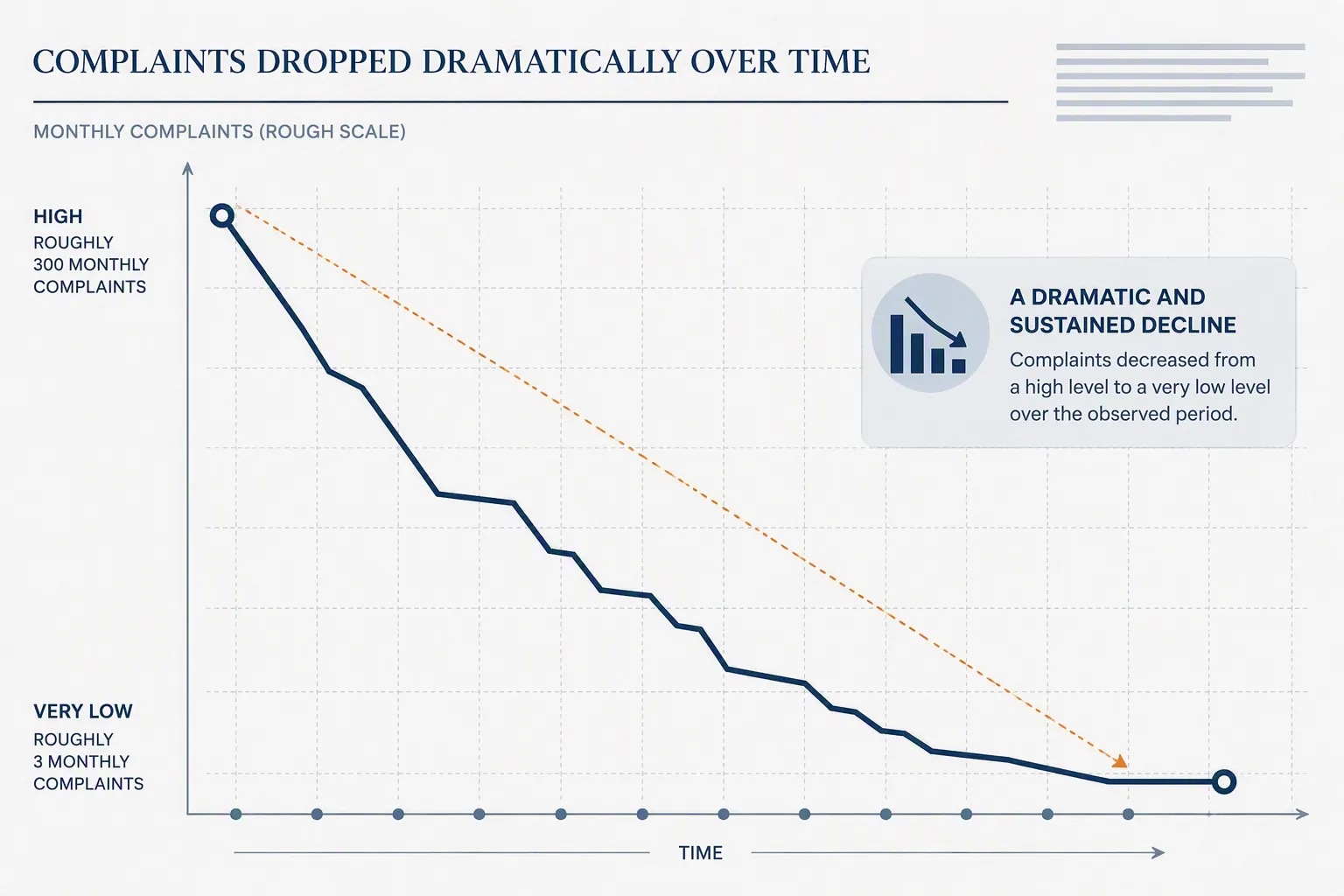
That trajectory is not cosmetic. It is the factual center of the closure. If complaints collapse after software changes, a defendant is entitled to say the agency saw a diminishing field problem rather than an unresolved defect population. For claims teams, that affects valuation. For class-certification briefing, it affects common proof. For settlement posture, it gives Tesla a better answer than “trust the brand.”
The reported root-cause finding is more complicated. NHTSA attributed the likely cause to Tesla’s 2021 transition away from radar toward camera-only Tesla Vision.[1][2] That helps Tesla if the argument is that later over-the-air updates materially reduced the problem. It helps plaintiffs if the argument is that a design transition created a braking behavior customers were not adequately told about before purchase or continued use.
There is also a record limitation worth keeping visible. The ODI closing resume itself could not be directly accessed here; the closure facts come from Reuters and Quartz reporting that cited the closing resume. That does not make the facts unusable, but it does mean a litigator should pull the underlying NHTSA PDF before quoting it in a brief.
The Defense Argument Is Real, Just Smaller Than the Headline
Tesla’s best sentence is straightforward: NHTSA investigated for more than four years, covered about 695,000 vehicles, found low demonstrated hazard, identified no attributable crashes, saw complaints fall to near zero, and closed without recall.[1][2] A plaintiff who ignores that sentence is not doing legal analysis; they are doing mood.
In a defect-disclosure dispute, Tesla can use the closure to argue that the challenged condition was not the kind of safety defect that required the disclosures plaintiffs say were missing. It can also argue that software updates reduced the alleged condition in a way that undermines damages models based on a persistent, uniform defect. Those are serious points.
They are not the same point as immunity. NHTSA decides whether to continue a federal safety-defect investigation or require a recall. State consumer-protection claims ask different questions: what did the company know, what did it say or omit, what would a reasonable purchaser have considered material, and did the alleged omission cause economic injury? A closure letter can influence those questions without answering them.
Why Santiago Still Matters
Santiago v. Tesla is the U.S. case to watch because it is not simply a personal-injury theory dressed up as a class action. The plaintiffs’ surviving theory is omission-based consumer fraud: they allege Tesla failed to disclose material information about phantom braking and purchaser reliance can be tied to what Tesla did, and did not, say on its website.
In November 2024, Judge Georgia Alexakis allowed part of the phantom braking lawsuit to proceed, with Reuters reporting that the court found the plaintiffs had “successfully connect[ed] the dots” between Tesla’s website omissions and purchaser reliance.[3] Bloomberg Law later reported a June 2025 partial trimming of claims, but the omission-based core was not described as eliminated.[4]
That procedural posture matters more than the broad phrase “phantom braking lawsuit.” If a claim turns on whether Tesla omitted material facts from consumer-facing representations, NHTSA’s later decision not to order a recall does not retroactively answer reliance, materiality, or statutory deception. It gives Tesla a factual defense to materiality and defect characterization. It does not erase the alleged omission.
The mid-2026 docket posture should be treated cautiously. Public reporting confirms the November 2024 survival ruling and the June 2025 partial dismissal; later docket developments could not be confirmed from an accessible public source.[3][4]
The Same Closure Gives Plaintiffs Material Too
Plaintiffs do not need to pretend NHTSA found an active safety defect. It did not. Their better use of the closure is narrower: the agency reportedly identified the 2021 radar-to-camera transition as the likely root cause, and it expressly refused to say that a safety-related defect never existed.[1][2]
That distinction is especially relevant to omission theories tied to Tesla Vision. A regulator can decide, in 2026, that the remaining hazard profile no longer justifies recall enforcement. A purchaser can still argue that, in an earlier sales period, the company knew a design transition created unexpected-braking behavior that reasonable buyers would have wanted disclosed.
The complaint decline cuts both ways. Tesla will say the drop shows effective remediation and low current risk. Plaintiffs will say the need for over-the-air changes supports knowledge, causation, and the existence of a design-driven condition. Which argument carries more weight depends on the claim element being litigated. Effectiveness of a later fix is not automatically a defense to an earlier omission.
Preemption Does Not Do the Heavy Lifting
The tempting defense move is to say federal safety regulators looked at the condition and walked away, so state consumer claims should walk away too. That overstates what federal closure does.
A no-recall closure is not a federal command that Tesla’s disclosures were adequate. It is not a finding that purchasers received all material information. It is not a damages ruling. It is not a class-certification ruling. And because the agency expressly avoided finding that a safety-related defect never existed, the closure is poorly suited to support a broad impossibility or obstacle-preemption theory.
That does not make the closure irrelevant. It can narrow the language plaintiffs use. It can blunt arguments that phantom braking remained a high-hazard condition across the covered population through 2026. It can support expert cross-examination. It may reduce settlement pressure in cases that depend on dramatic safety narratives rather than transaction-level proof. But preemption requires more than regulatory non-enforcement.
Australia Is a Parallel Compensation Fight, Not a Footnote
The Australian proceeding shows why the U.S. regulatory closure should not be treated as a global endpoint. ABC News reported in June 2025 that about 10,000 Australian Tesla owners had registered in a class action seeking compensation over phantom braking and related Autopilot complaints.[5]
The legal frame there is misleading conduct, not whether NHTSA should order a U.S. recall. That makes the proceeding useful as a risk comparison but not as a direct translation exercise. Australian plaintiffs still have to prove their own statutory elements. Tesla can still cite the same low-hazard and complaint-decline record as practical context. What the NHTSA closure does not do is automatically dispose of purchaser-compensation claims in another jurisdiction.
Return-date details for the Australian case should not be overstated here. The available material supports the existence and approximate registration scale of the proceeding, not a precise late-2026 docket forecast.[5]
Same-Week Regulatory Context
The phantom braking closure did not arrive in isolation. Reuters also reported that NHTSA closed a Tesla power-steering probe, EA24001, on June 27, 2026, covering 376,241 vehicles.[6] That is useful context only to a point. It shows Tesla received more than one favorable federal enforcement outcome in the same week. It does not prove a judicial trend, a merits trend, or a rule that software-related complaints are now low-value civil claims.
For broader software-defect risk, the better comparison is not whether a regulator issued a recall in a given file. It is how the documented condition, fix timing, customer notice, and damages theory line up. That same distinction appears in other automotive software disputes, including unintended-deceleration recall analysis and consumer-remedy cases where recall scope and nonconformity dates do not map neatly onto civil exposure. For related comparisons, see the internal discussions of Hyundai Tucson software recalls and Subaru recall options.
The Practical Litigation Read
Tesla leaves PE22002 with a valuable evidentiary record. A four-year federal probe closed without recall is not a minor event. The complaint collapse gives Tesla a serious answer to claims framed around continuing danger. The no-attributable-crash finding helps against overheated safety rhetoric. The low-hazard language will appear in motions, expert reports, mediation statements, and class-certification briefing.
The overreach would be treating that record as dispositive. Santiago is built around alleged omissions and purchaser reliance, not merely the existence of an open NHTSA investigation. The Australian case is framed as a compensation and misleading-conduct dispute, not a request for NHTSA enforcement. Plaintiffs can still point to the reported radar-to-camera root cause, the timing of Tesla Vision, the need for software changes, and NHTSA’s own caveat that closure is not a finding that no safety-related defect ever existed.
So the legal answer is narrow and important: the Tesla phantom braking probe closure improves Tesla’s defense posture on hazard, defect disclosure, and damages; it does not preempt state consumer-protection claims or end omission theories built around the 2021 Tesla Vision transition. Anyone briefing it as “Tesla cleared” is skipping the sentence that matters.
References
- U.S. closes 2022 probe into 695,000 Tesla vehicles over unexpected braking. Reuters. July 2, 2026.
- NHTSA closes Tesla phantom braking probe after complaints drop. Quartz. July 2, 2026.
- Tesla must face part of phantom braking lawsuit, US judge rules. Reuters. November 22, 2024.
- Tesla Trims Claims in Suit Over Phantom Braking Vehicle Defect. Bloomberg Law. June 2025.
- Australian Tesla owners seeking compensation as phantom braking leaves drivers completely terrified. ABC News. June 11, 2025.
- NHTSA closes Tesla power steering probe. Reuters. June 27, 2026.
Related records
Tool profile
Browse tool evaluations →Governing regulation
Browse the obligations tracker →Preventive workflow
Browse verification workflows →
Report a correction or tip
Spotted an outdated figure, a misstated fact, or a ruling this case record should reflect? Public comments are disabled for this content given the professional cost of a misreported case outcome, penalty amount, or rule text — use the structured correction channel instead.
Report a correction or tip for this record →