
Texas Power Grid Emergency Order Litigation, 2021-2026
A chronological reference tracing every major court ruling, administrative action, and legislative response in the Texas power grid emergency order litigation from Winter Storm Uri through the March 2026 mandamus denial, showing that Texas courts resolved the central legal question of PUC emergency pricing authority while leaving the new federal-state tension from DOE's Section 202(c) order untested.
- Jurisdiction
- US-TX
- Court
- Texas Supreme Court
- AI tool named
- None
- Ruling date
- Jun 14, 2024
- Source document
- View primary court order ↗
- Last verified
- Jul 30, 2026
Lex Machina Review is an independent risk-tracking and reference resource. Nothing on this site is legal advice, and using it does not create an attorney-client relationship. Every record is reviewed against primary sources but may not reflect the most current status of a matter — always verify directly against the cited court order, rule text, or a licensed attorney before relying on it.
Companion explanation — secondary to the source document above
Last checked: Q3 2026. This is a legal-analysis reference, not legal advice. It treats the Texas Supreme Court’s June 2024 Luminant decision as the controlling state-law authority on the Public Utility Commission of Texas’s Winter Storm Uri emergency pricing orders, the March 2023 Third Court of Appeals decision as the displaced intermediate-court view, and the March 2026 mandamus denial as practical closure of the remaining Uri liability track rather than a new merits opinion. Any direct quotation from the Texas Supreme Court opinions should be reverified against the original opinions before final publication because the materials reviewed here include secondary legal analyses and legal journalism, not the court PDFs themselves.
The short answer for anyone tracking Texas power grid emergency order legal analysis is now fairly stable on the state-law side: Texas courts have accepted broad PUC emergency pricing authority under PURA §39.151, even where that authority displaces the usual competition-pricing objective in PURA §39.001. The more unsettled question has moved elsewhere. In January 2026, the U.S. Department of Energy used Federal Power Act Section 202(c) for ERCOT for the first time, and that federal-state emergency-control layer has not yet been tested in the litigation sequence that followed Uri.
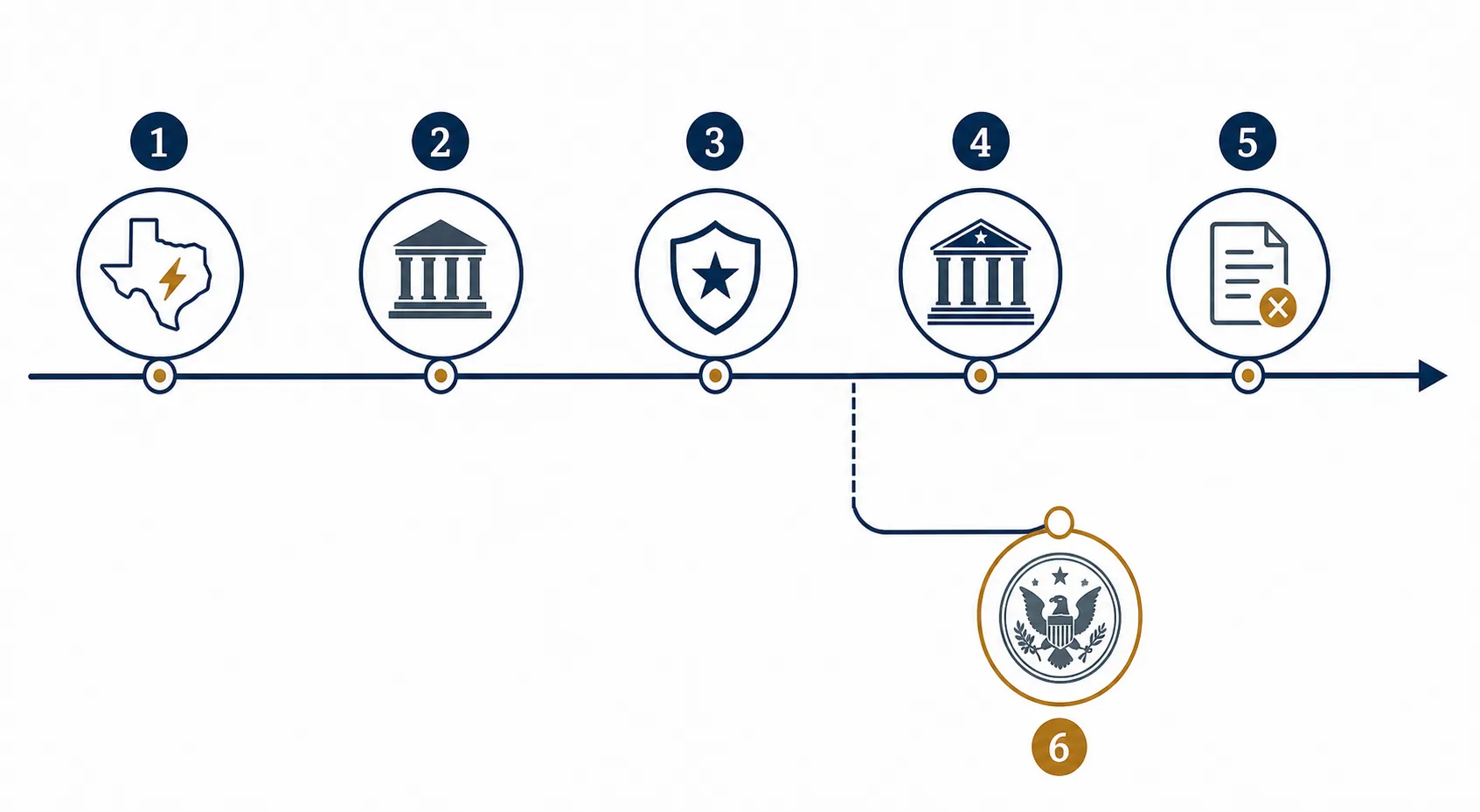
What Was Settled By 2026
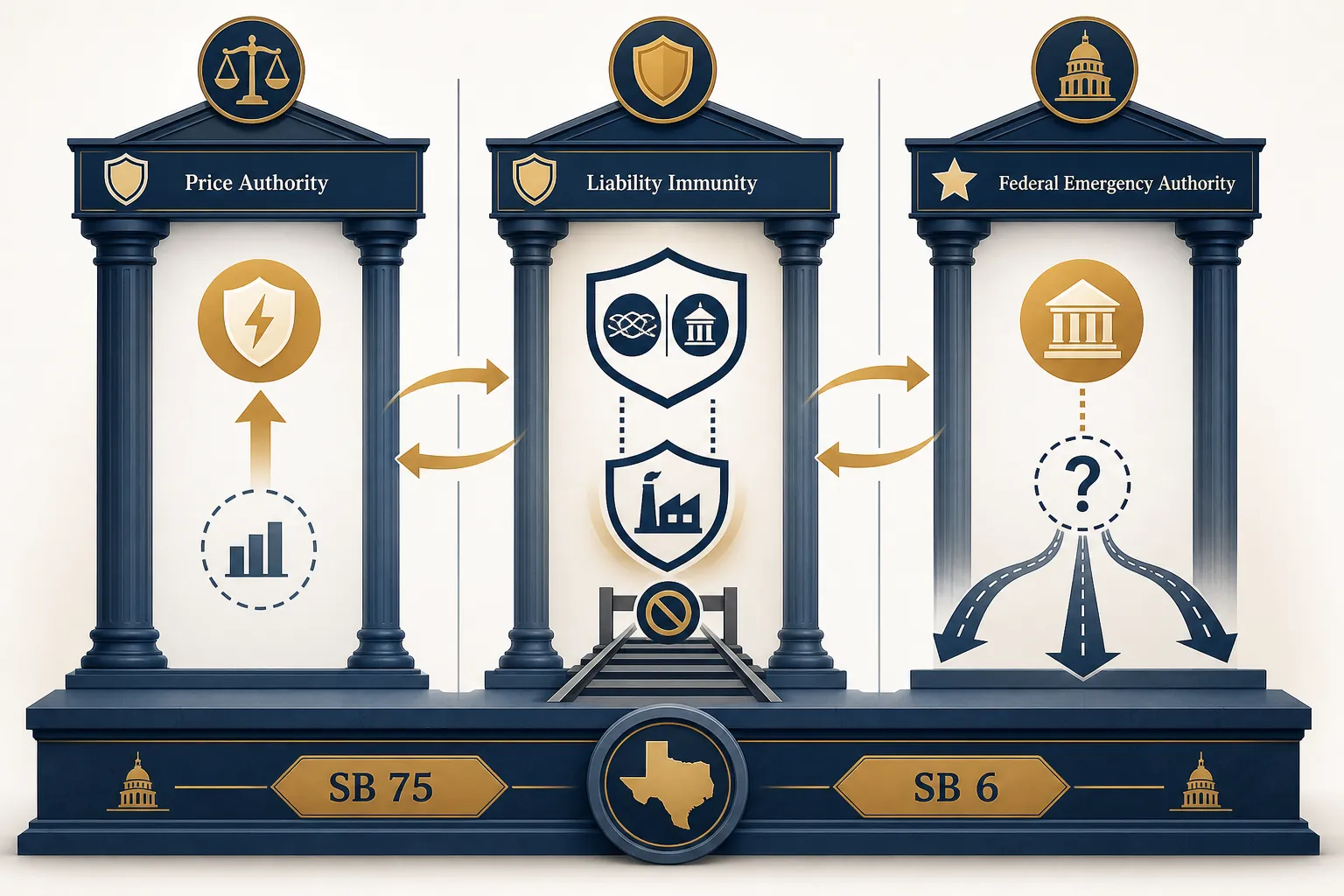
By March 2026, three tracks had separated. The price-authority track ended with the Texas Supreme Court’s 2024 conclusion that the PUC had statutory authority to order emergency scarcity pricing during Uri. The liability track was largely foreclosed by immunity rulings and the March 2026 refusal to disturb dismissal of claims against power generators. The federal emergency-authority track began with DOE’s January 2026 Section 202(c) order for ERCOT and remains prospective, not decided.
| Track | Key Event | Status As Of Q3 2026 |
|---|---|---|
| PUC emergency pricing authority | Texas Supreme Court reversed the Third Court in Luminant on June 14, 2024 | Settled in favor of broad PUC authority under PURA §39.151 |
| Uri civil liability | ERCOT immunity ruling in 2023; generator claims effectively closed after March 27, 2026 mandamus denial | Practically closed for the major consolidated claims |
| DOE Section 202(c) authority over ERCOT | DOE issued, amended, and later addressed rehearing on a January 2026 emergency order | Untested in court on the materials reviewed |
| Texas legislative response | SB 75 and SB 6 in 2025 | New state tools for grid security and large-load curtailment, not substitutes for the Uri holdings |
That division matters because the phrase “grid emergency order” can hide several different legal questions. A court may uphold an agency’s emergency pricing authority without creating a general rule that all emergency conduct is immunized. A legislature may add curtailment tools for large loads without answering the scope of federal emergency power. And a mandamus denial without opinion is not the same thing as a fresh appellate endorsement of every argument made below.
February 2021: The Pricing Order That Became The Legal Fact
The litigation did not turn merely on the emotional force of Winter Storm Uri. It turned on an administrative act: on February 15-16, 2021, the PUC issued emergency orders that held the ERCOT system-wide offer cap at $9,000 per megawatt-hour. Reed Smith’s summary describes that price as roughly 300 times a normal market price of about $30/MWh and about 7.5 times an SPM-generated price of roughly $1,200/MWh.[1]
The legal dispute was not whether $9,000/MWh was large. It was whether the PUC could make that kind of pricing instruction while the statutory design of the Texas electricity market also directed that prices be set by customer choice and normal competitive forces. The number became the focal fact because it made the conflict between reliability administration and market-price formation impossible to smooth over.
For market participants, that distinction was not academic. If the PUC order was ultra vires, the financial consequences of the Uri pricing interval looked different. If the order was authorized emergency reliability action, the same price shock sat inside a different statutory hierarchy. That is why the later fight over PURA §39.151 and §39.001 did the real work.
The Third Court Read The Order As Price-Setting By Fiat
On March 17, 2023, the Third Court of Appeals sided against the PUC in Luminant Energy Co. v. Public Utility Commission. The court held that the Uri pricing orders violated PURA §39.001’s requirement that prices be determined by customer choices and normal forces of competition, and characterized the challenged pricing action as “regulatory fiat.”[2]
That decision supplied the cleanest version of the challengers’ theory. If Texas’s restructured electricity market depends on competition rather than administrative price command, then an emergency order instructing ERCOT to keep prices at the cap could be seen as stepping outside the statutory design. Under that framing, scarcity pricing is still market pricing only if the scarcity signal is produced by the market mechanism the statute permits.
It was a serious theory, not a pleading slogan. But it treated §39.001 as doing more limiting work than the Texas Supreme Court later allowed. It also put courts in the position of reviewing an emergency reliability instruction as though the central problem were ordinary price administration, not system integrity during a near-collapse event.
ERCOT Immunity Changed The Litigation Terrain Before Luminant Was Reversed
Before the Texas Supreme Court resolved the PUC pricing question, it narrowed the liability landscape. On June 23, 2023, in a 5-4 decision, the court held that ERCOT was immune as a governmental entity providing an essential governmental service under PUC oversight. The dissent, according to the reporting reviewed, urged legislative abrogation.[3]
That immunity holding was not the same issue as the legality of the $9,000/MWh order. It mattered because it changed who remained exposed, what theories could realistically proceed, and how much leverage plaintiffs retained in sprawling Uri litigation. A claimant can have a vivid injury and still face an immunity wall; those are different legal propositions.
The scale explains the procedural pressure. The Uri multidistrict litigation included more than 200 consolidated cases, more than 30,000 individual plaintiffs, two putative class actions, and more than 1,500 insurance companies bringing subrogation claims for more than 250,000 policyholders against more than 500 defendants.[4][5]
Those numbers are not included for atmosphere. They explain why immunity and mandamus posture mattered so much. In litigation that large, a threshold ruling does not merely remove a defendant; it can redirect discovery, settlement pressure, causation theories, insurance recovery strategy, and the administrative burden of keeping claims alive.
The 2024 Luminant Reversal Put Reliability Above The Competition Objective
The central state-law turn came on June 14, 2024. The Texas Supreme Court unanimously reversed the Third Court and held that PURA §39.151 authorized the PUC’s emergency pricing orders. Reed Smith’s summary reports the court’s view that §39.001’s competition objective “may in some circumstances have to yield” to the reliability authority in §39.151.[1]
That is the load-bearing move. The court did not simply say that Uri was terrible and therefore the PUC won. It treated the reliability provision as statutory authority capable of prevailing over the competition-pricing objective when the agency determines that emergency grid conditions require intervention. The result is a hierarchy within PURA: competition remains the norm, but it is not the only command in the statute.
The court also applied the “purely textual” agency-deference standard associated with Texas Board of Chiropractic Examiners v. Texas Medical Association, as described in the secondary analyses reviewed.[1][6] That standard matters because it avoids both extremes. The court did not rubber-stamp the PUC because an emergency existed, but it also did not treat the agency’s reliability authority as fragile merely because the order affected price formation.
For counsel advising after the fact, the practical conclusion is blunt: a challenge framed only as “the PUC displaced market pricing” is no longer enough. After Luminant, the better question is whether the agency can point to textual reliability authority and emergency conditions that bring the order within §39.151. In the Uri pricing orders, the Texas Supreme Court said yes.
The Notice Holding Was Shorter, But Not Minor
The Texas Supreme Court also rejected the notice challenge. According to Reed Smith and Crain Caton, the court held that the PUC substantially complied with the Texas Administrative Procedure Act by posting notice on its website and emailing market participants, treating those methods as better and faster notice than Texas Register publication under the emergency circumstances.[1][6]
That holding should not be inflated into a general permission slip for casual agency procedure. Its force comes from speed, audience, and emergency administration. The relevant market participants could be reached faster through website posting and email than through the ordinary publication channel. In a grid emergency, the court was willing to measure substantial compliance against the practical function of notice, not merely the usual ritual of publication.
For future emergency orders, that part of Luminant is useful but fact-bound. A later agency still would be better off creating a record that shows who received notice, when they received it, why ordinary publication was too slow, and how the chosen method matched the regulated audience.
RWE Renewables Marked A Direct-Appeal Boundary
The companion RWE Renewables ruling should be kept in its lane. On the same date as Luminant, the Texas Supreme Court held that PUC approval of an ERCOT protocol revision was not a “competition rule” subject to direct appeal, according to the Texas Civil Justice League summary.[7]
That is important for appellate routing and jurisdictional screening. It is not a second centerpiece on emergency pricing authority. Its practical use is to remind counsel that not every ERCOT-related PUC action travels through the same direct-review path, even when the challenged action has market consequences.
March 2026 Closed The Generator Liability Track In Practice
The remaining Uri civil litigation reached practical closure on March 27, 2026, when the Texas Supreme Court denied mandamus without opinion. Four of the nine justices were recused. The Texas Tribune reported that the First Court of Appeals had dismissed the claims as having “no basis in law or fact.”[8]
A mandamus denial without opinion should be read carefully. It does not produce the same precedential explanation as Luminant. But in a litigation environment of this size, it can still end the case map. Once immunity had protected ERCOT and the PUC, and once the claims against generators failed to survive the appellate path, the practical ability to use tort litigation as the main Uri accountability vehicle was gone.
That closure also clarifies why the $9,000/MWh fight and the mass-damages litigation should not be blended into one undifferentiated Uri story. The pricing cases asked whether the PUC had emergency statutory authority. The civil cases asked whether injured plaintiffs and subrogated insurers could impose liability on grid actors. By 2026, both tracks had become unfavorable to challengers, but through different doctrinal doors.
What Counsel Can Reliably Take From The Uri Cases
The safest reading is narrow but significant. Texas courts have accepted that the PUC’s reliability authority under PURA §39.151 can support emergency action that affects wholesale prices, even where challengers invoke §39.001’s competition-pricing objective. They have also accepted substantial APA compliance where emergency notice reached market participants faster through website and email channels than through Texas Register publication.
- A future challenger will need more than a generalized objection that emergency pricing displaced market outcomes.
- A future agency will still need to tie its order to text, especially reliability text, rather than relying on emergency rhetoric alone.
- Notice challenges remain possible, but Luminant makes speed and audience fit central to substantial-compliance analysis.
- Civil liability claims against ERCOT, the PUC, and power generators face a litigation record that is now severely adverse to plaintiffs.
What should not be taken from the cases is equally important. Luminant is not a universal emergency exception to Texas utility law. The ERCOT immunity decision is not a merits holding on every operational failure alleged during Uri. And the March 2026 mandamus denial does not explain a new rule; it leaves the existing adverse path in place.
The New Unresolved Layer: DOE Section 202(c) And ERCOT
The next frontier is not another replay of the Uri pricing challenge. It is federal emergency authority. On January 24, 2026, DOE announced an emergency order to secure the Texas grid during Winter Storm Fern, and DOE’s Section 202(c) ERCOT docket identifies the order as authorizing ERCOT to direct backup generation at data centers. The order was amended on January 25, and DOE issued a rehearing order on February 4, 2026.[9][10]
The research materials describe this as the first DOE emergency order for ERCOT. That fact should be handled with care. It makes the order important, but it does not create a litigated doctrine. There is no reported litigation history in the materials reviewed that answers how a court would evaluate DOE’s Section 202(c) authority when applied to ERCOT’s unusual grid structure, large-load backup generation, state reliability authority, or Texas market rules.[9]
The obvious pressure points are statutory and constitutional, but they remain predictive. A future challenge might test whether DOE’s emergency finding adequately supports the operational command, whether the federal order conflicts with or complements ERCOT and PUC authority, and how far Section 202(c) can reach when the directed resources are tied to data centers rather than traditional utility generation. Those are litigation questions, not holdings.
SB 75 And SB 6 Are Legislative Responses, Not Litigation Endnotes
Texas also legislated after Uri and amid the new large-load problem. In 2025, SB 75 created the Texas Grid Security Commission, and SB 6 gave ERCOT authority to mandate curtailment of noncritical large loads, including data centers, during firm load shed events while also establishing new interconnection and cost-allocation rules.[8]
SB 6 belongs near the Section 202(c) discussion because both concern the operational problem of large loads during grid stress. But they operate in different legal registers. SB 6 is a state-law tool for ERCOT authority over noncritical large-load curtailment. DOE’s Section 202(c) order is a federal emergency intervention. The existence of one does not settle the boundary of the other.
The 2021-2026 arc therefore ends in an uneven place. Texas emergency pricing authority is settled in favor of broad PUC power under §39.151, and the Uri liability track is effectively closed. The open question is whether the next grid emergency will be governed mainly by that state-law settlement, by new Texas curtailment statutes, or by a federal Section 202(c) order whose limits ERCOT participants have not yet litigated.
References
- Supreme Court of Texas affirms PUC’s pricing orders during Winter Storm Uri, Reed Smith
- Third Court of Appeals Decides Public Utility Commission Exceeded Authority During Winter Storm Uri, LGLawFirm
- Texas high court saves state grid manager from liability in avalanche of litigation, Courthouse News
- Result: Winter Storm Uri Power Generators, Jackson Walker
- SCOTX Ends Uri Litigation Against Power Generators, Texas Lawbook
- Texas Supreme Court Upholds Emergency Utility Orders, Crain Caton
- SCOTX Overturns Austin Court of Appeals Decision Invalidating PUC’s Approval of ERCOT Emergency Wholesale Pricing Protocol, Texas Civil Justice League
- Texas Supreme Court denies request to revive Winter Storm Uri lawsuits, Texas Tribune, March 27, 2026
- Energy Secretary Issues Emergency Order to Secure Texas Grid Amid Winter Storm Fern, U.S. Department of Energy
- Federal Power Act Section 202(c) ERCOT 202-26-01, U.S. Department of Energy
Related records
Tool profile
Browse tool evaluations →Governing regulation
Browse the obligations tracker →Preventive workflow
Browse verification workflows →
Report a correction or tip
Spotted an outdated figure, a misstated fact, or a ruling this case record should reflect? Public comments are disabled for this content given the professional cost of a misreported case outcome, penalty amount, or rule text — use the structured correction channel instead.
Report a correction or tip for this record →