
Thune's weaponized DNI warning reveals AI risks to FISA safeguards
Sen. John Thune's June 2026 warning about a politicized intelligence leadership directly intersects with a novel class of legal risk: large language models are systematically eroding FISA Section 702 minimization procedures that protect Americans' incidentally collected communications, compounding surveillance-law exposure for litigators and in-house counsel.
- Jurisdiction
- US Federal
- Court
- Foreign Intelligence Surveillance Court (FISC)
- AI tool named
- Large Language Models (LLMs)
- Ruling date
- Mar 1, 2026
- Source document
- View primary court order ↗
- Last verified
- Jul 25, 2026
Lex Machina Review is an independent risk-tracking and reference resource. Nothing on this site is legal advice, and using it does not create an attorney-client relationship. Every record is reviewed against primary sources but may not reflect the most current status of a matter — always verify directly against the cited court order, rule text, or a licensed attorney before relying on it.
Companion explanation — secondary to the source document above
Sen. John Thune’s June 2 warning about a “weaponized DNI” was easy to read as another confirmation-process skirmish. It should not be left there. The more durable legal-risk point is narrower and more practical: politicized intelligence leadership and opaque AI-assisted intelligence processing both weaken confidence that surveillance safeguards are being applied as written.
That is why Thune’s opposition to the Trump DNI nominee confirmation process now raises a question bigger than one nomination. If the intelligence community’s leadership chain is treated as politically pliable at the same time large language models are being used to process foreign-intelligence data, the relevant failure mode is not only institutional mistrust. It is a recordkeeping and compliance problem: who can later show what was retained, what was masked, what was queried, and why?
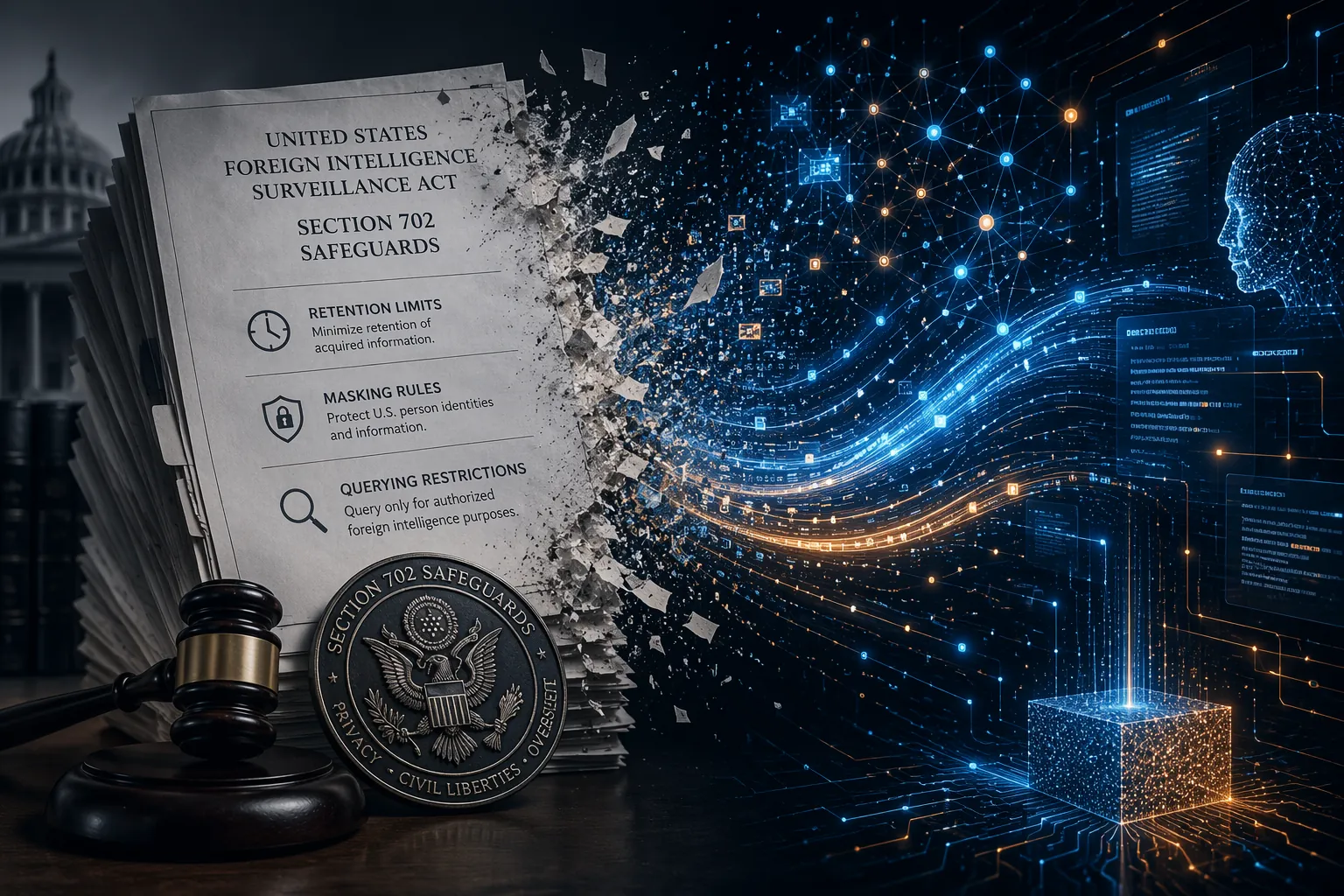
The immediate political chronology is brief but relevant. The Pulte acting-DNI episode prompted Thune’s June 2 warning. On June 17, the Trump administration’s handling of the nomination process derailed Jay Clayton’s confirmation hearing. On July 22, Clayton advanced from committee on a 9-8 party-line vote, with a full Senate vote still pending as of July 25, 2026. Those dates matter less as parliamentary drama than as governance signals: leadership instability and partisan pressure make it harder to trust that disputed surveillance practices will be surfaced, corrected, and documented before they become litigation issues.
The safeguard problem is already concrete
Section 702 is not a general domestic surveillance authority. It permits targeting of non-U.S. persons reasonably believed to be outside the United States, but Americans’ communications can be incidentally collected when they communicate with those targets. The legal protection for those Americans is not a promise that collection never happens. It is a set of downstream controls: minimization, retention limits, masking, and querying restrictions.
The scale alone should keep compliance lawyers alert. The NSA had roughly 350,000 foreign Section 702 targets in 2025, according to the Just Security/Brennan Center analysis of AI and foreign-intelligence surveillance.[1] That number does not prove misuse. It does show why safeguards have to function as systems, not as after-the-fact assurances.
The Foreign Intelligence Surveillance Court’s March 2026 finding that FBI query violations were “persistent and widespread” adds a different kind of pressure.[1] Again, the point is not that AI caused those violations. The point is that documented query-compliance problems already existed before large language models added a new layer of semantic inference, summarization, and opacity.
Sen. Ron Wyden put another marker on the record in an April 16, 2026 floor speech, reporting that warrantless searches for “sensitive” targets, including journalists and elected officials, more than tripled in the first year of the Trump administration and that the FBI refused to explain why.[2] That is an allegation from a senator, not a judicial finding. But for risk analysis, it identifies exactly the class of queries most likely to become discoverability, privilege, source-protection, or oversight flashpoints.
Retention limits fail differently when summaries become new records
A retention rule is supposed to answer a basic legal question: how long may the government keep information about U.S. persons that was incidentally collected through foreign-intelligence surveillance? In a conventional review system, that question attaches to identifiable records. A communication is retained, minimized, purged, or disseminated under procedures that can be audited.
LLM-assisted processing complicates that map. If a model summarizes, clusters, embeds, or extracts facts from communications before the original material reaches its retention limit, the compliance question shifts. Has the system merely helped an analyst read a record, or has it generated a derivative intelligence object that preserves the substance of material that should later expire?
The Just Security/Brennan Center analysis frames this as a structural erosion of minimization: large-scale AI processing can make privacy violations harder to identify after the fact because the relevant information may no longer sit in the original document alone.[1] That is not the same as a court holding that every AI summary violates Section 702. It is a warning that retention compliance may become unprovable if systems cannot trace what input produced what output, when, under which authority, and subject to which deletion rule.
For lawyers, that distinction matters. A retention policy that looks adequate on paper may fail in operation if it governs source communications but not embeddings, generated summaries, analyst notes auto-populated by model output, or downstream workspaces that preserve extracted U.S.-person information. The legal problem is not that the model is impressive. It is that the model may quietly create new artifacts that the minimization procedure did not name.
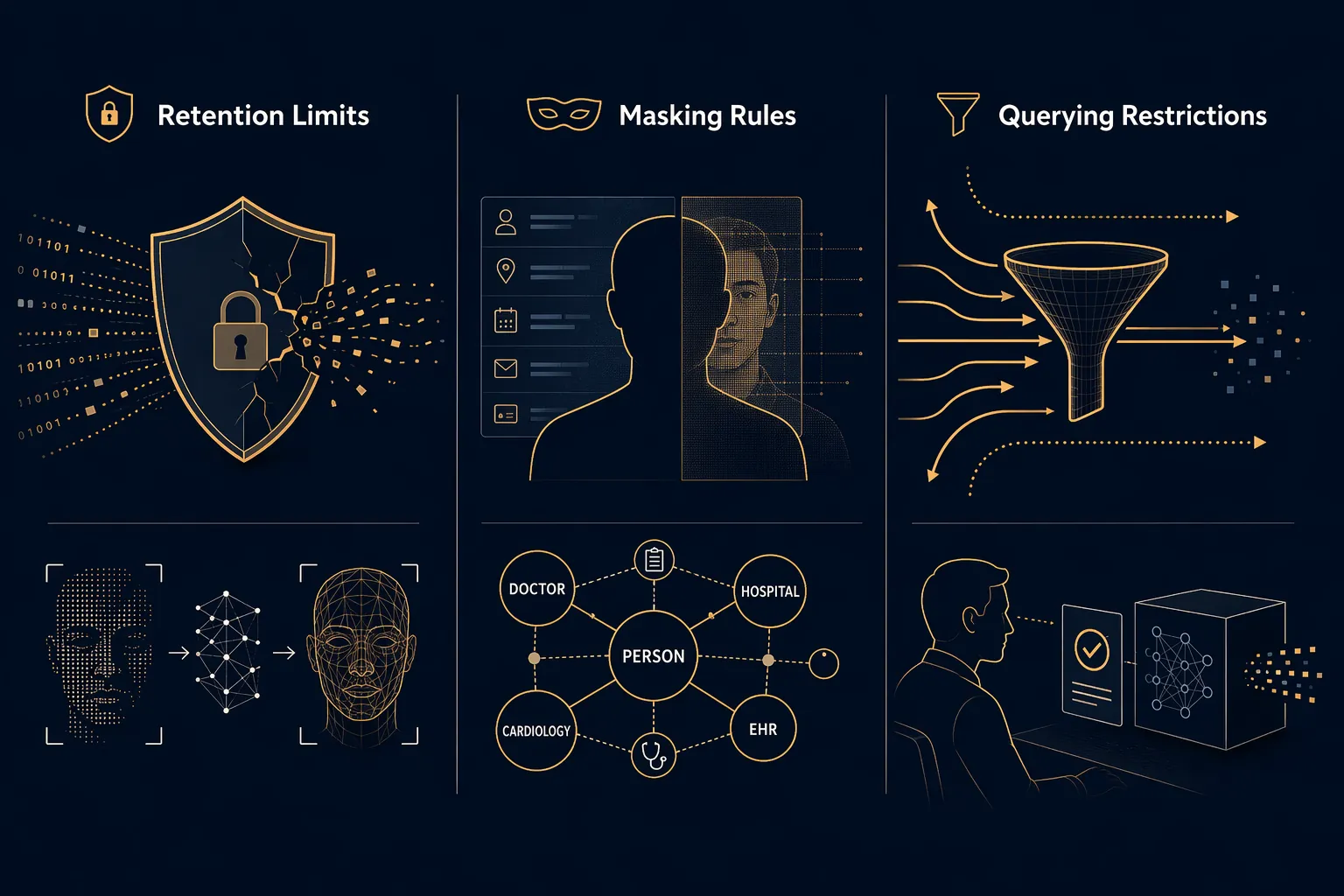
Masking rules depend on more than deleting a name
Masking is a legal control with an administrative form. A U.S.-person identity may be replaced with a generic label, withheld from a report, or disseminated only under an approved unmasking standard. The control assumes that removing the explicit identifier meaningfully reduces exposure.
LLMs stress that assumption because they are built to infer context. A masked name can become functionally identifiable if the surrounding facts are distinctive enough. A model that connects occupation, timing, location, counterparties, writing style, or repeated relationship patterns may not need the name to identify the person. The masking rule remains formally applied, while the practical privacy protection has been weakened.
This is where civil-liberties analysis becomes operationally useful. The Brennan Center’s concern is not just that AI produces more surveillance output. It is that re-identification and pattern inference can defeat safeguards designed for a more literal document environment.[1] A masked report that was defensible when reviewed line by line may carry a different risk once it is pooled with other records and processed for semantic relationships.
The compliance file then has a familiar weakness: it can show that a field was masked, but not necessarily that the person could not be reconstructed through the system’s other outputs. That is a dangerous gap for anyone later asked to certify that minimization worked. In litigation or oversight, “the name was removed” is not the same answer as “the person was not reasonably identifiable through the system.”
Semantic querying can broaden a search without looking like a broader search
Querying restrictions are supposed to discipline access. They define when analysts may search Section 702 repositories using U.S.-person identifiers or other sensitive terms, and they create a record that can be reviewed. In the older compliance model, a query has a visible relationship to the term entered and the database searched.
Semantic search changes the shape of that act. A user may enter a narrower prompt, but the system may retrieve or rank material based on inferred meaning, related concepts, embeddings, or model-generated associations. The search can become broader than the operator understands, while the query log still looks administratively tidy.
That is the AI failure point most likely to matter in a later review. A compliance officer may be able to see the prompt, the user, and the timestamp. But if the system cannot explain why particular communications surfaced, or whether the retrieval swept in U.S.-person information outside the permitted purpose, the log documents activity without documenting legality.
The March 2026 FISC finding on “persistent and widespread” FBI query violations gives this concern its legal context.[1] The record already contains court-recognized query failures. LLMs do not need to introduce a brand-new category of misconduct to increase exposure. They can make an existing control harder to test, harder to explain, and easier to scale.
Automation bias makes a weak trail look complete
The most deceptively clean AI risk is automation bias. A model-generated answer can arrive in polished language, with apparent confidence, and with enough surface coherence to move through an intelligence workflow faster than a messy human note. In a surveillance setting, that polish can become a compliance hazard.
Litigators already know the litigation version of this problem: a hallucinated citation looks professional until someone checks the source. In the surveillance context, the equivalent is not only a false case citation. It is an intelligence summary, selector association, or relevance explanation that cannot be traced back to credible, properly handled source material.
The Just Security/Brennan Center analysis identifies a specific tradecraft conflict here: intelligence standards such as ICD 203 and ICD 206 require traceable, credibility-rated sourcing, while LLM outputs can be opaque about source weighting and reasoning.[1] That does not mean an LLM can never be used in an intelligence workflow. It means the output cannot be treated as a legally meaningful justification unless the system preserves enough source lineage to satisfy the standards that human analysts remain bound to follow.
The practical test is blunt. If an analyst cannot reconstruct which records supported a model-generated conclusion, which U.S.-person information appeared in those records, whether masking applied, and whether retention limits later required deletion, the system has shifted risk onto the reviewer. The burden does not disappear because the interface looks orderly.
EO 12333 turns the same concern into a larger accountability gap
Section 702 is only part of the surveillance-law picture. The cited analysis also warns that LLMs may operate inside EO 12333 bulk-collection programs that lack judicial supervision.[1] That point should not be inflated into a claim that every EO 12333 AI use is unlawful. The narrower concern is enough: when AI processing occurs outside the FISC-supervised structure, the already difficult questions about retention, masking, querying, and traceability may receive less external review.
A June 2026 coalition letter from 14 civil-society groups put the operational concern in unusually direct terms, warning that AI “will not just expand existing privacy violations, but will make them harder to detect, easier to scale, and far more dangerous to democracy.”[3] The democracy language is broad. The compliance mechanism inside the sentence is more concrete: harder to detect and easier to scale.
Those two properties are what turn an intelligence-policy dispute into a legal-risk issue. A one-off improper query can be investigated through user logs, training records, approval chains, and database returns. A model that normalizes, summarizes, or semantically links large volumes of data can spread the effect of a bad input or impermissible access pattern across outputs that no longer look like the original violation.
Where the confirmation fight intersects with practitioner exposure
Thune’s warning matters here because surveillance safeguards depend on institutional behavior, not only statutory text. Retention limits need enforcement. Masking rules need conservative interpretation. Query restrictions need honest logging and remedial discipline. When senior intelligence leadership is perceived as politically contingent, lawyers have less reason to assume that internal escalation will catch borderline AI uses before they harden into practice.
For litigators, the downstream questions are predictable. Was evidence or investigative direction derived from AI-processed intelligence? Were U.S.-person communications included in training, retrieval, summarization, or analytic outputs? Did a semantic query reach material a conventional query would not have returned? Were masked identities inferable from model-generated context? Were derivative records purged when source records reached a retention limit?
For in-house counsel and compliance teams working near government contracts, classified analytics, or law-enforcement data interfaces, the exposure is different but no less concrete. Procurement language that says a tool supports “AI-assisted review” is not enough. The reviewable terms are audit logs, source lineage, deletion propagation, access boundaries, prompt retention, model-output retention, re-identification testing, and procedures for disabling semantic expansion when a legal authority requires a narrower query.
The hardest problem is proof. A lawyer challenging surveillance-derived evidence may suspect that an AI system broadened a query or preserved minimized information, but the system architecture may make that claim difficult to substantiate. A government lawyer defending the process may face the mirror-image problem: the agency may believe the safeguard worked, but lack a traceable record that proves it.
The current legal posture is unsettled, which is the risk
As of July 25, 2026, Clayton had not received a full Senate confirmation vote. Section 702 statutory authority had lapsed in June 2026, but the program continued operating under pre-expiration FISC approvals.[1] No court or bar authority had yet converted the AI-surveillance critique into a practitioner rule.
That absence of a settled rule should not be mistaken for an absence of legal risk. The documented safeguards are already strained: FISC has found persistent and widespread FBI query violations, Wyden has raised unexplained sensitive-target search increases, and civil-society analysis has identified AI mechanisms that make privacy violations harder to detect and easier to scale.[1][2][3] The next serious dispute may not ask whether an LLM is good or bad for intelligence work. It may ask whether anyone can prove that the retention, masking, and querying rules survived contact with the system.
References
- How AI Undermines Foreign Intelligence Surveillance Safeguards, Just Security / Brennan Center, July 22, 2026.
- Senator Wyden floor speech on warrantless searches for sensitive targets, wyden.senate.gov, April 16, 2026.
- Civil-society coalition letter on AI and surveillance privacy violations, ari.us, June 2026.
Related records
Tool profile
Browse tool evaluations →Governing regulation
Browse the obligations tracker →Preventive workflow
Browse verification workflows →
Report a correction or tip
Spotted an outdated figure, a misstated fact, or a ruling this case record should reflect? Public comments are disabled for this content given the professional cost of a misreported case outcome, penalty amount, or rule text — use the structured correction channel instead.
Report a correction or tip for this record →