
Four Litigation Risks From the Todd Blanche Confirmation Controversy
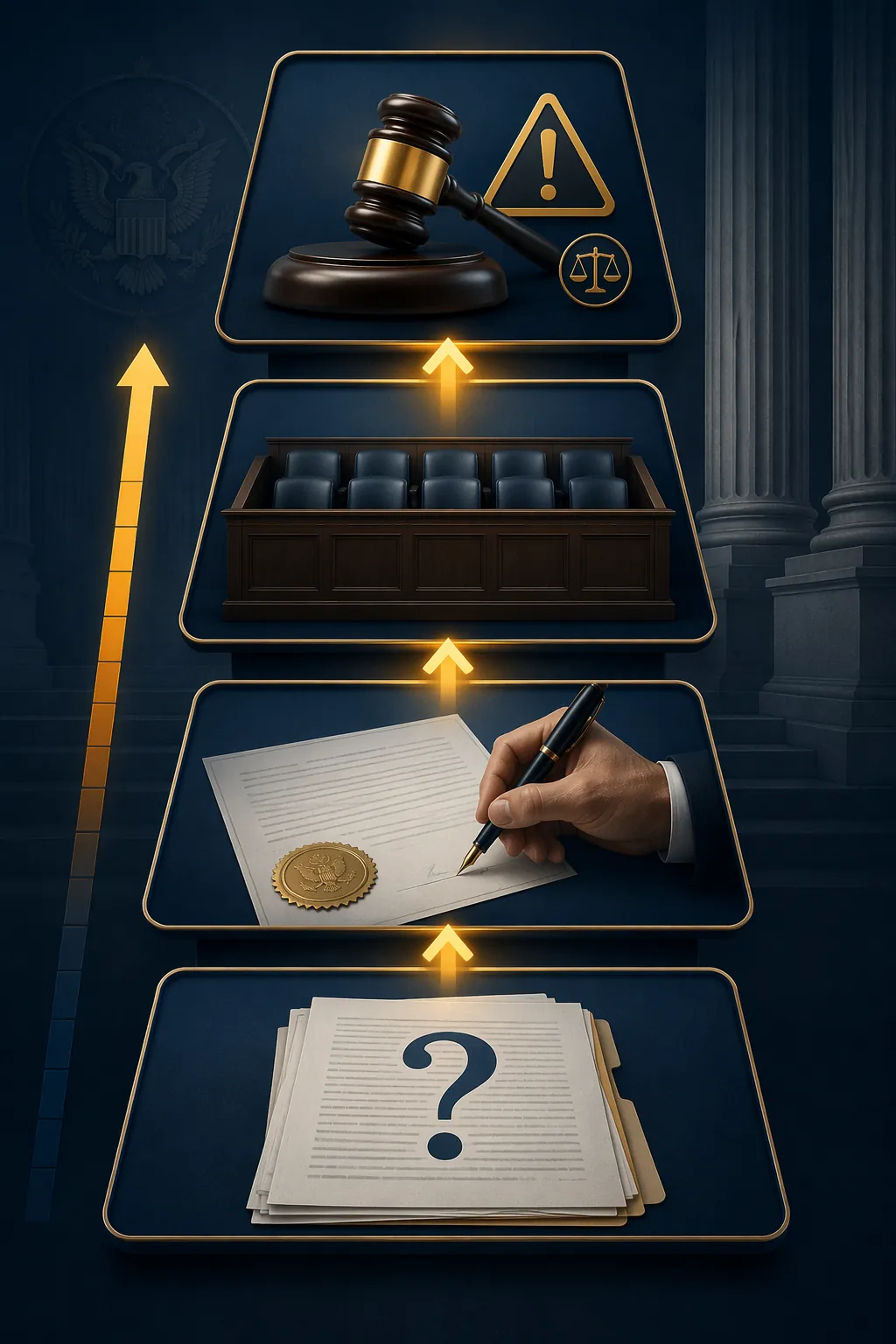
The Todd Blanche confirmation controversy has led federal courts to issue unusually harsh findings against DOJ, eroding the presumption of regularity. This article identifies four specific litigation risks that federal practitioners must address, from increased bad-faith discovery burdens to potential grand jury refusals.
- Jurisdiction
- U.S. District Court
- Ruling date
- Jul 15, 2026
- Source document
- View primary court order ↗
Lex Machina Review is an independent risk-tracking and reference resource. Nothing on this site is legal advice, and using it does not create an attorney-client relationship. Every record is reviewed against primary sources but may not reflect the most current status of a matter — always verify directly against the cited court order, rule text, or a licensed attorney before relying on it.
Companion explanation — secondary to the source document above
The practical problem in the Todd Blanche attorney general confirmation controversy is not whether lawyers find the hearing persuasive. It is whether a federal practitioner can still treat “DOJ represented” as enough when the representation concerns politically sensitive enforcement, high-level intervention, contested compliance, or prosecutorial motive.
As of July 23, 2026, the confirmation process is still a live matter in the available sources: the hearing was reported as occurring July 15–16, and no floor vote has been reported in those materials. That status matters, but it is not the center of gravity. The more immediate litigation fact is that multiple federal courts have already used unusually severe language about Department of Justice conduct during Blanche’s tenure. For lawyers opposite the government, that changes the cost of reliance.

The sharpest example is Judge Kathleen Williams’s order in Trump v. IRS, where the court described a DOJ-brokered IRS settlement as a “fraud on the court” and a “product of collusion.”[1] Senator Sheldon Whitehouse later described that allegation as unprecedented in DOJ history, but the litigation significance does not depend on accepting the senator’s characterization as a historical survey. It depends on the order itself: a federal judge concluded that the government-backed resolution was not merely mistaken, aggressive, or poorly defended, but infected by collusion and fraud on the tribunal.[1][2]
That is the point at which courthouse habits begin to change. The presumption of regularity has not been formally abolished. Many judges will continue to credit government lawyers in ordinary cases, especially where the record is routine and the representation is specific. But a practitioner who hears an unsworn assurance from DOJ in a politically charged matter now has a stronger reason to ask: who authorized that representation, what record supports it, and what remedy follows if it proves incomplete?
The pattern that matters in court
A Senate floor statement can be useful as an index. It cannot substitute for the docket. Whitehouse’s June 30, 2026 floor statement catalogued judicial descriptions of DOJ positions as “pretextual,” “disingenuous,” “bad faith,” “shoddy,” and “unconscionable,” and cited a Trump-appointed judge’s description of a “concerted effort by the Executive to smear and impugn individual judges who rule against it.”[2] Those phrases should be treated as litigation facts only when tied back to the underlying orders. Still, even as an index, the statement points to the right place: federal judges are no longer limiting themselves to quiet skepticism.
The outside filings are less authoritative than court orders but harder to dismiss as ordinary opposition politics. Thirty-five former federal judges signed a filing stating that “corruption of the judicial process is exactly what happened here” through an “unprecedentedly fraudulent scheme.”[3] Separately, 101 current and former federal judges sent a 73-page ethics complaint to the New York Attorney Grievance Committee in June 2025.[4] Those materials do not prove misconduct in any particular pending case. They do show that the credibility concern has moved beyond cable commentary and into the professional vocabulary of judges and former judges.
The same distinction matters for personnel data. A Justice Connection letter with more than 1,200 signatories reported that more than 16,000 DOJ employees had departed and that more than one quarter of DOJ attorneys were gone.[5] Those figures do not establish that low morale caused any court finding. They do, however, help explain why representations may feel less institutionally buffered than they once did. A line attorney may be defending a position shaped above them, with fewer internal checks, fewer veterans in the chain, and less confidence that the representation being made in court will remain stable.
| Risk | Where it appears first | Practical adjustment |
|---|---|---|
| Bad-faith discovery burdens | Motions to compel, protective-order fights, privilege disputes, compliance representations | Build the record from orders, correspondence, and contradictions rather than adjectives |
| Sworn-declaration requirements | Emergency relief, status reports, representations about searches, custody, production, or agency action | Ask for declarants, scope, personal knowledge, and document preservation |
| Grand jury refusal | Politically charged criminal matters | Treat motive and regularity as live issues, while recognizing the narrow setting |
| Contempt and bar-referral exposure | Escalating noncompliance, misleading statements, or conduct attributed to individual attorneys | Protect the record without assuming discipline will follow |
Risk one: bad-faith discovery becomes easier to plead and harder to wave away
The first litigation risk is the most immediate: parties opposing DOJ can now make bad-faith discovery arguments with a less speculative foundation. That does not mean every missed deadline, narrowed search, or privilege assertion becomes sanctionable. It means a court may be more receptive to a showing that asks for testing rather than trust.
In ordinary federal practice, government counsel often receives a long leash. Courts accept representations that searches are underway, that a production is complete, that a policy is being reconsidered, that a custodian has been contacted, or that an agency’s position reflects regular process. That trust is not sentimental. It keeps litigation moving. If every routine assurance required declarations, custodial logs, or evidentiary hearings, many cases would grind into satellite disputes.
The problem is that severe judicial findings change what counts as a reasonable request. A lawyer who previously might have hesitated to accuse DOJ of strategic concealment can now cite actual orders finding fraud, collusion, bad faith, or pretext in DOJ-related litigation, provided the cited order matches the requested relief. The better motion will not say, in effect, “DOJ has lost credibility everywhere.” It will identify the specific representation at issue, explain why reliance would prejudice the client, and ask for a proportionate verification mechanism.
That distinction matters because judges still dislike overreach. A broad attack on the Department may sound political. A narrow record may sound like case management: DOJ represented that no responsive material exists; the surrounding record suggests otherwise; the representation concerns a politically sensitive instruction or compliance issue; the court should require a declaration or targeted discovery before relying on it.
The strongest discovery applications will likely arise in four settings: when DOJ invokes deliberative-process or law-enforcement privilege around high-level intervention; when the government describes the completeness of a search; when an agency’s litigation position changes abruptly after political attention; and when the requested relief depends on accepting DOJ’s account of motive or compliance. In each setting, the practitioner’s task is not to declare the presumption dead. It is to make blind reliance look unnecessary.
How to build the motion without overclaiming
- Quote the underlying order, not only a senator’s summary or a news account.
- Tie the prior finding to a procedural request: declaration, custodian identification, limited deposition, privilege log revision, status conference, or preservation order.
- Separate institutional credibility from individual misconduct unless the record supports naming an attorney.
- Ask for the least intrusive verification that would let the court rely on the representation.
- Preserve correspondence showing when DOJ made, narrowed, corrected, or retreated from the representation.
This is also where the line DOJ attorney can be exposed. If the position was dictated from above, the courtroom lawyer may be the one answering the judge’s questions. Opposing counsel should not exploit that asymmetry carelessly, but they should not ignore it either. Asking who has personal knowledge, who authorized the representation, and whether the statement is based on counsel’s understanding or a client declaration is now basic risk control.
Risk two: judges may require sworn support where attorney representations once carried the day
The second risk follows naturally from the first. If courts are less willing to rely on DOJ’s unsworn assurances, sworn declarations become more important. That change can affect emergency motions, stays, injunction compliance, removal disputes, agency-record disputes, criminal discovery, immigration custody matters, and any case where timing makes verification difficult.
The practical difference is substantial. An attorney representation often arrives quickly and carries professional consequences if false, but it may blur the source of knowledge. A declaration forces a named person to state what they know, how they know it, and what records or subordinates support the statement. It also gives the court a cleaner path if the statement later proves wrong: correction, evidentiary hearing, contempt inquiry, or referral.
That is why the Trump v. IRS order matters beyond tax confidentiality or the settlement itself. Once a court uses “fraud on the court” and “product of collusion” for a DOJ-brokered resolution, a later judge does not need to adopt a new doctrine to demand more paper before crediting the government.[1] The judge can simply say that the representation is material, disputed, and capable of sworn support.
For practitioners, the request should be concrete. “We want a declaration” is weaker than “we ask that DOJ identify the official with personal knowledge of the search, describe the databases searched, state the date range, and confirm whether any responsive materials were withheld under a privilege claim.” The latter gives the court a manageable order and makes refusal more meaningful.
A sworn-support strategy also protects against a common failure mode: the government modifies its position in stages, and each modification appears harmless in isolation. A declaration fixes time, scope, source, and responsibility. If the government later narrows the statement, the court can see the movement.
Representations that deserve special treatment
- Assertions that a challenged policy has been rescinded, suspended, or superseded.
- Statements that all responsive records have been searched for or produced.
- Claims that no high-level official directed or influenced an enforcement decision.
- Assurances that a person, file, fund, or agency action is being preserved pending judicial review.
- Descriptions of why the government changed position after public or political criticism.
None of this requires a judge to announce that DOJ is no longer trustworthy. Federal judges often prefer narrower moves. They can preserve the presumption of regularity as doctrine while requiring declarations in cases where the consequences of misplaced trust are unusually high.
Risk three: grand juries may refuse the politically charged case
The grand jury risk is narrower, but it is too concrete to ignore. The Kilmar Abrego Garcia prosecution was dismissed as a bad-faith “vindictive prosecution” in May 2025, according to the underlying order and reporting on the case.[6][7] That finding does not mean grand juries will routinely reject DOJ presentations. It does mean that in a politically charged prosecution, motive and regularity may become part of the practical litigation environment before trial.
Grand juries are not ordinary motion judges. They do not write opinions explaining why they refused a charge. Their refusal is also not a tool available to civil litigators, regulated entities, or most lawyers dealing with DOJ in administrative matters. That is why this risk should not be overstated as a universal defense strategy.
Still, prosecutors depend on institutional credibility in the grand jury room. If a case arrives wrapped in public threats, unusual timing, visible high-level pressure, or a record of shifting explanations, the presentation may no longer benefit from the same quiet assumption that the Department is simply applying ordinary charging standards. Defense counsel should preserve evidence of timing, public statements, comparator treatment, and internal departures from normal process early, because vindictive-prosecution arguments are difficult to build after the record has gone cold.
The Abrego Garcia example is important precisely because it remains bounded. It is a real case, not proof of a general refusal trend. The lesson is not that grand juries have become a broad institutional check on DOJ. The lesson is that politically charged prosecutions now carry a credibility tax that can show up at charging, dismissal, and remedy stages.
Risk four: contempt findings and bar referrals become escalation tools
The fourth risk sits at the top of the escalation ladder. It should not be treated as inevitable, or even likely in most cases. Contempt and professional-discipline referrals require a much more developed record than skepticism about a representation. But the threshold for asking the court to preserve that path may be lower when other judges have already found fraud, bad faith, collusion, or vindictiveness in DOJ-related matters.
Whitehouse’s June 30 statement referred to two misconduct referrals against DOJ in Rhode Island in recent weeks.[2] The 101-judge ethics complaint to the New York Attorney Grievance Committee adds a separate professional-responsibility pressure point, though a complaint is not a disciplinary finding.[4] The distinction is critical. A referral or complaint shows that lawyers and judges are willing to frame the conduct as professional misconduct. It does not show that a bar authority will impose discipline.
For lawyers opposite DOJ, the safer move is to preserve options without turning every dispute into a disciplinary fight. If a government representation proves false or materially incomplete, ask first for correction, sworn supplementation, production of the supporting record, or an evidentiary hearing. If the record then shows knowing misrepresentation, violation of a court order, or concealment, the request for sanctions or referral will rest on case facts rather than generalized distrust.
For DOJ line attorneys, this is the part of the controversy with the most personal consequence. A court’s anger may be directed at institutional conduct, but orders, sanctions proceedings, and referral letters often require names. A lawyer asked to carry a representation that depends on facts outside their knowledge should consider whether the record needs a client declaration, a supervisor’s written authorization, or a narrower statement in court.
What has changed, and what has not
The legal doctrine has not formally caught up to the risk environment. Courts still invoke regularity, still distinguish advocacy from misconduct, and still expect lawyers to avoid turning political controversy into irrelevant briefing. A judge may reject a discovery motion that relies on broad attacks against DOJ without showing why the representation in the pending case is unreliable.
What has changed is the practitioner’s burden of prudence. In a case involving politically sensitive DOJ conduct, high-level intervention, contested compliance, or disputed prosecutorial motive, reliance on unsworn government assurances is now more expensive. The lawyer who accepts the assurance may later have to explain why no declaration was requested, why no status conference was sought, why no preservation issue was raised, or why no record was made when the representation first became material.
The best filings will be verification-first. They will distinguish court orders from Senate summaries, press releases, press reporting, advocacy letters, and professional complaints. They will use the harshest judicial language sparingly and precisely. They will avoid claiming a new rule where the record supports a narrower case-management request.
This is a Risk Digest issue more than a conventional confirmation profile. The site’s usual verification concern is often AI hallucination or source integrity; here the verification problem is institutional and procedural. The question is whether a court should rely on an official representation without more. In this record, the safer answer is increasingly: not when the representation is material, disputed, and easy to support under oath.
Preserve the record. Request sworn support for material representations. Build bad-faith arguments from orders rather than rhetoric. Treat DOJ credibility as a case-management variable, not a background assumption.
References
- Order in Trump v. IRS, U.S. District Court.
- Senator Whitehouse June 30, 2026 floor statement, U.S. Senate, June 30, 2026.
- Thirty-five former federal judges filing on corruption of the judicial process, Senator Whitehouse press release.
- Ethics complaint to the New York Attorney Grievance Committee by 101 current and former federal judges, New York Attorney Grievance Committee, June 2025.
- Justice Connection letter on DOJ departures, Justice Connection.
- Order dismissing Kilmar Abrego Garcia indictment, U.S. District Court, May 2025.
- Slate reporting on Kilmar Abrego Garcia vindictive-prosecution dismissal, Slate.
Related records
Tool profile
Browse tool evaluations →Governing regulation
Browse the obligations tracker →Preventive workflow
Browse verification workflows →
Report a correction or tip
Spotted an outdated figure, a misstated fact, or a ruling this case record should reflect? Public comments are disabled for this content given the professional cost of a misreported case outcome, penalty amount, or rule text — use the structured correction channel instead.
Report a correction or tip for this record →