
How Tony Romo's Refusal Led to a Blood-Draw Warrant
When a driver refuses a chemical test during an OWI stop, law enforcement must follow specific procedural steps to obtain a blood-draw warrant. This article traces that pathway through Tony Romo's July 2026 arrest, covering Wisconsin's statutory requirements, bodycam documentation, and the warrant application process.
- Jurisdiction
- Wisconsin
- Court
- Milwaukee County Circuit Court
- AI tool named
- None
- Ruling date
- Jul 23, 2026
- Source document
- View primary court order ↗
- Last verified
- Jul 29, 2026
Lex Machina Review is an independent risk-tracking and reference resource. Nothing on this site is legal advice, and using it does not create an attorney-client relationship. Every record is reviewed against primary sources but may not reflect the most current status of a matter — always verify directly against the cited court order, rule text, or a licensed attorney before relying on it.
Companion explanation — secondary to the source document above
The legally useful moment in Tony Romo's July 2026 OWI stop was not the booking photo or the celebrity name on the citation. It was the refusal. Once Romo declined the requested chemical test, the roadside encounter moved into a different procedural track: a refusal citation under Wisconsin's implied-consent law, officer documentation of probable cause, and, according to video-based reporting, a blood-draw warrant whose result had not been publicly disclosed as of July 29, 2026.
The current verified posture is narrow. Romo was stopped on July 23, 2026, on the I-43 high-rise bridge in Milwaukee County, with local reporting placing the stop at about 6:18 p.m.; a first appearance was scheduled for Sept. 21, 2026.[1] Bodycam-based reporting described the officer's observations, Romo's refusal, and a later warrant-backed blood draw, but the blood-test result remained undisclosed approximately six days after the arrest.[2] That makes the case a useful procedural reference for the Romo OWI stop, not yet a public BAC case.
This is also a standalone Risk Digest record, not an example of the site's usual AI-sanctions work. The risk here is more ordinary and more document-bound: what happens when a refusal creates a second administrative consequence and forces the government to preserve enough facts to support the next evidentiary step.
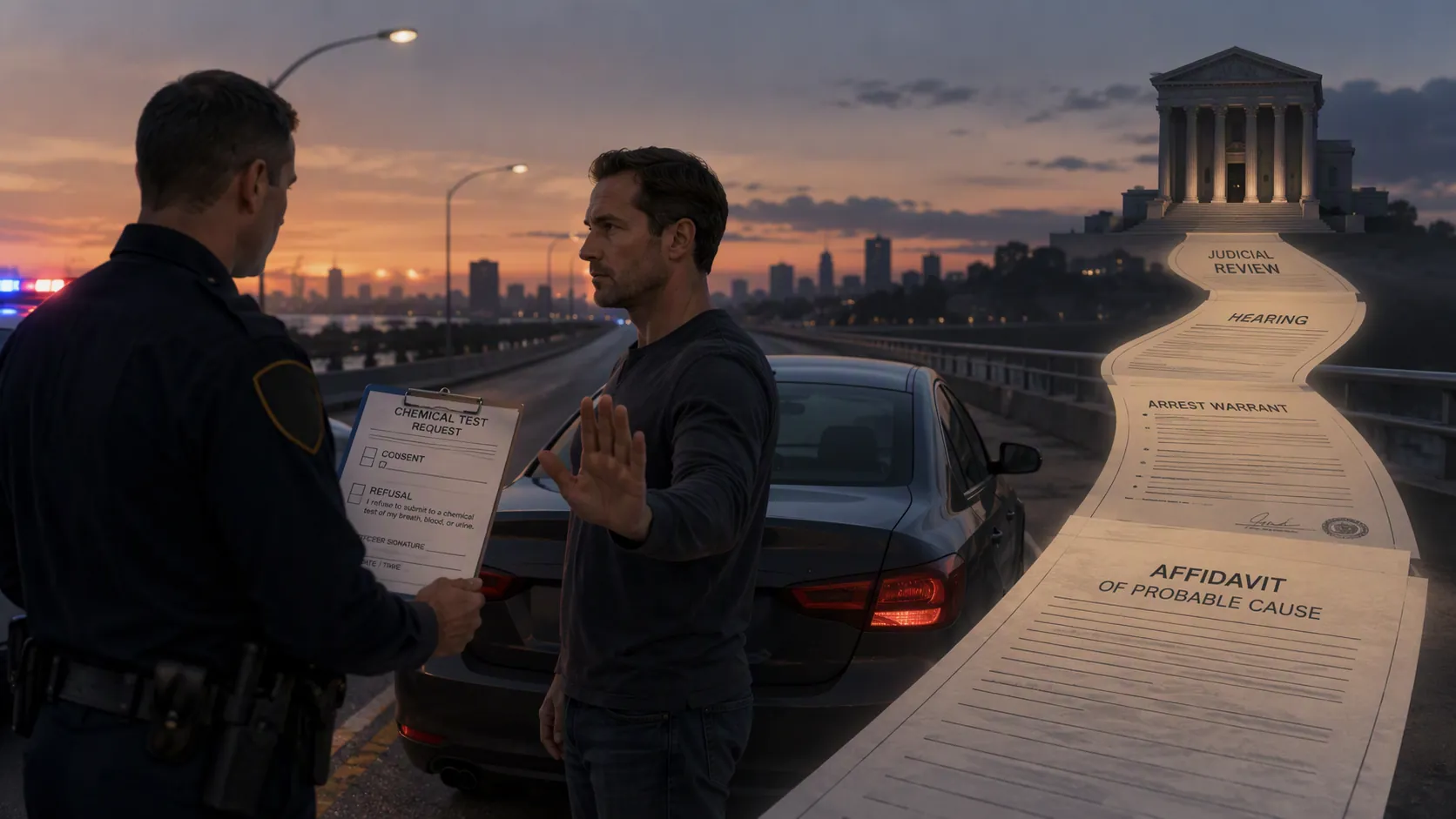
The Refusal Changed The Procedure
In Wisconsin, a first-offense OWI is commonly handled as a civil forfeiture matter rather than a criminal prosecution. The Milwaukee County District Attorney's office publicly characterized Romo's matter as “a traffic violation and not a criminal charge,” a distinction that matters for stakes, scheduling, and the kind of litigation likely to follow.[3] It does not mean the stop becomes casual. It means the proof issues travel through traffic-court procedure, implied-consent consequences, and any challenge to the basis for the stop, arrest, refusal, or warrant.
The reported stop began with driving observations. CBS News Texas, relying on newly released video, reported that Romo's vehicle was observed weaving and crossing the center line; the officer also described red and glassy eyes, an odor of alcohol, and unopened shooter bottles in the vehicle.[2] Those details are not decoration. They are the facts that make the refusal legally consequential because a warrant application after refusal cannot rest on the refusal alone as if it were a shortcut around probable cause.
The bodycam detail that traveled furthest was Romo's explanation for refusing: “I've heard from all the lawyers don't ever do that.”[2] It is vivid, but the more important point is that the refusal was recorded as an event in a sequence. The officer requested a chemical test. The driver declined. The officer had already identified facts that could support suspicion of impairment. The refusal then triggered a separate implied-consent path.
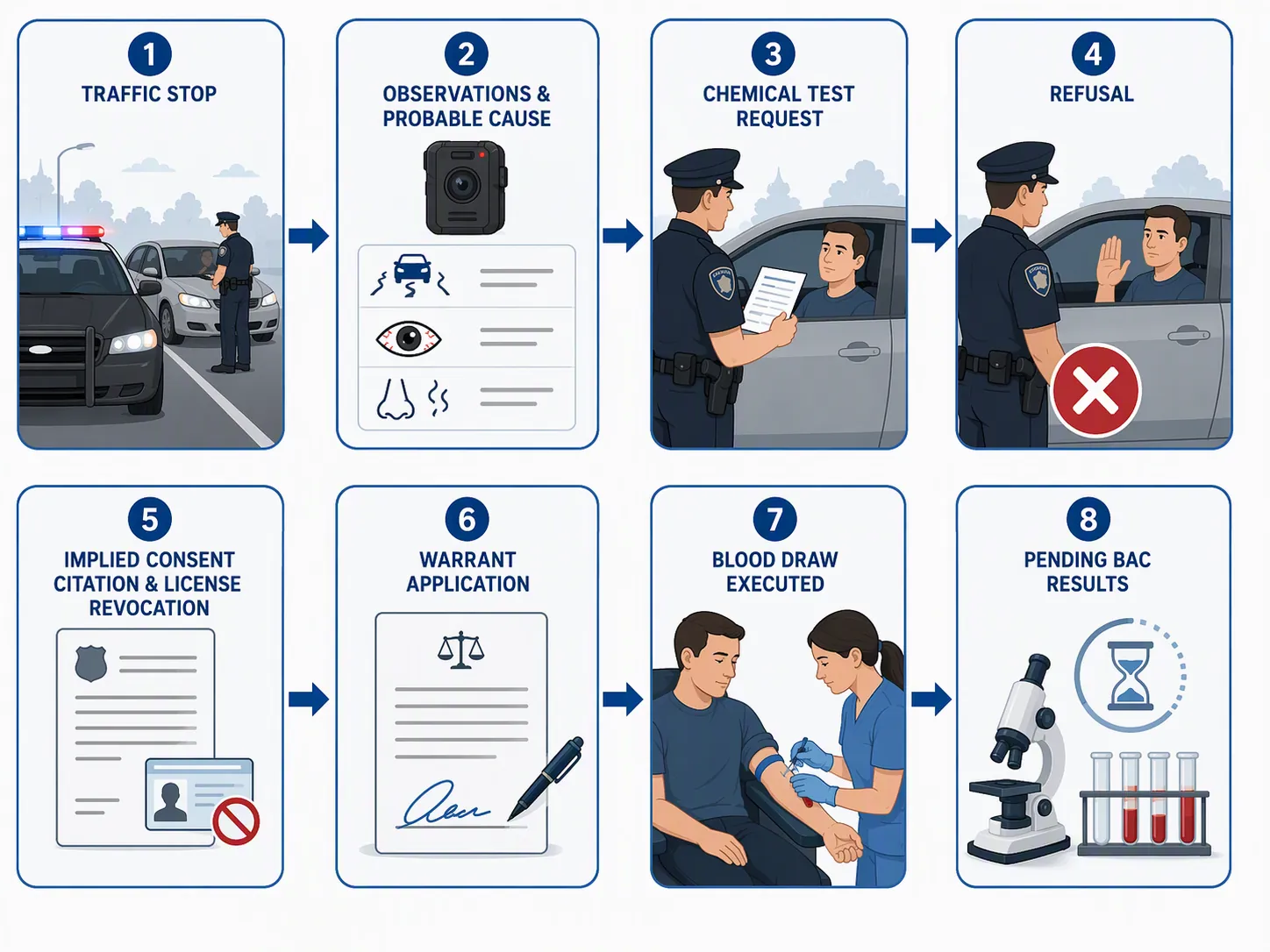
| Step | What The Public Record Currently Supports |
|---|---|
| Traffic stop | Stopped on I-43 in Milwaukee County on July 23, 2026, with local reporting placing the time at about 6:18 p.m. |
| Observed indicators | Reported weaving, crossing the center line, red and glassy eyes, odor of alcohol, and unopened shooters. |
| Chemical-test request | Officer requested a chemical test during the OWI investigation. |
| Refusal | Bodycam reporting captured Romo declining, followed by a refusal citation. |
| Implied-consent consequence | Wisconsin law treats refusal as its own matter with license-revocation consequences. |
| Warrant pathway | CBS News Texas reported that officers obtained a warrant for a blood draw. |
| Blood result | No public BAC result had been disclosed as of July 29, 2026. |
Wisconsin Treats Refusal As Its Own Legal Event
Wisconsin's implied-consent framework is the hinge. Wis. Stat. § 343.305 provides the structure for chemical testing and refusal consequences, while Wis. Stat. § 340.01(46w) defines chemical-test refusal. Reporting on Romo's refusal citation tied the citation to that implied-consent framework.[4] The important operational point is that refusal does not simply leave the government without chemical evidence. It creates a separate refusal issue and can push officers toward a warrant application if they believe probable cause supports a blood draw.
That separation is easy to miss in national coverage. A driver may face an OWI citation and a refusal citation arising from the same stop, but they answer different questions. The OWI matter asks whether the government can prove operation while under the influence or with a prohibited alcohol concentration, depending on the charged theory and evidence. The refusal matter asks whether the officer properly requested a chemical test and whether the driver unlawfully refused under the implied-consent statute.
For a first-offense OWI, the financial exposure reported by The Athletic, citing Wisconsin Department of Transportation penalty information, was a $150 to $300 forfeiture range plus a mandatory $435 OWI surcharge under Wis. Stat. § 346.65(2); because first offense is treated as a civil violation, there is no jail exposure on that first-offense OWI citation.[3] Actual court costs and assessments can change what a person pays, but the absence of jail exposure is one reason the administrative record becomes the center of gravity.
The refusal consequence is not the same as the OWI forfeiture. Under Wisconsin's implied-consent process, refusal can produce automatic license revocation independent of the OWI outcome.[4] That is why the bodycam record matters even before any blood result appears. The video helps answer whether the officer made the request, whether the driver declined, and whether the surrounding facts support the later warrant request.
Why Refusal Does Not End Evidence Collection
A refusal is sometimes described as if it stops the chemical-test portion of a case. In practice, it often changes the paperwork. If officers have probable cause to believe the driver operated while impaired, they may seek judicial authorization for a blood draw. The warrant application then has to stand on the officer's observations, the driving behavior, the testing request and refusal, and any other facts gathered during the stop.
In the Romo matter, the publicly reported warrant pathway appears to rest on the familiar pieces: observed lane movement, physical signs associated with alcohol use, odor, containers, refusal, and bodycam documentation of the exchange.[2] Those facts do not themselves disclose a BAC. They explain why an officer could ask a judge for permission to obtain blood evidence after the roadside request failed.
This is where timestamps and source discipline matter. FOX6 Milwaukee reported the local timeline and Sept. 21 court date, while CBS News Texas supplied the bodycam account and warrant reference.[1][2] Some early national accounts used different timing, including an “around 8 p.m.” formulation later overtaken by more precise local and arrest-report-based reporting. For procedural tracking, the more useful record is the one tied to the stop time, docket date, and described video sequence.
Booking and release details are relevant, but only as context. The New York Post reported that Romo was arrested and booked in Milwaukee County after returning from a golf outing, and that he was released the same evening.[5] Those details help place the stop in a same-day processing timeline. They do not resolve whether the government will have admissible chemical evidence or whether the blood result, once disclosed, will support a prohibited-alcohol-concentration theory.
What The Bodycam Preserves
Bodycam footage is not valuable merely because it is visual. In a refusal-to-warrant sequence, it can preserve the order and wording of legally relevant acts. It may show when the officer began the encounter, what the officer said about testing, how the driver responded, whether the response was equivocal or clear, and whether the officer documented impairment indicators before or after the refusal.
That order can matter later. A defense challenge may focus on the initial stop, the expansion of the stop into an OWI investigation, the arrest decision, the implied-consent request, the refusal citation, or the warrant application. A prosecutor or agency lawyer will want the record to show that the warrant did not materialize from a celebrity refusal alone, but from a sequence of observations and decisions that a court can review.
The Romo footage, as reported, appears to supply several of those anchors: the driving behavior, the officer's stated observations, the refusal statement, and the subsequent blood-draw warrant reference.[2] The limits are just as important. Public reporting does not yet supply the warrant affidavit, the judge's warrant, the blood-draw time, the lab report, the chain-of-custody materials, or the BAC result. Those are the materials that would turn the case from a refusal-process example into a more complete evidentiary file.
The Court Date Is Not The Evidence Date
Romo's first appearance was scheduled for Sept. 21, 2026.[1] That date is useful for docket tracking, but it should not be mistaken for the moment when all evidence becomes public. Blood-test results may be generated, reviewed, disclosed to the defense, contested, or resolved through traffic-court procedure before they become visible to the public, if they become visible at all.
As of July 29, 2026, the public record supported the existence of an OWI stop, a refusal citation, reported warrant-backed blood collection, and a pending first appearance. It did not support a public claim about Romo's BAC. Any analysis that treats the case as already proving a particular alcohol concentration is running ahead of the disclosed record.
How Wisconsin Differs From No-Refusal States
The Wisconsin pathway should not be collapsed into the “no-refusal weekend” model familiar from some other jurisdictions. Texas, Arizona, and Colorado have used no-refusal programs under different statutory and operational schemes that streamline warrant applications and reduce turnaround time. Those programs are designed to make the warrant step faster and more routinized when a driver refuses a test.
Wisconsin's model, as illustrated here, is more conventionally warrant-required. The officer still needs to document probable cause, the refusal still generates its own implied-consent consequence, and the chemical evidence still depends on a judicially authorized blood draw if the driver does not consent. The comparison is useful mainly to prevent a false assumption: a refusal does not have the same operational meaning in every state.
The Present Boundary
The Romo case is procedurally useful because it shows the post-refusal chain in public view: a stop, observations, a chemical-test request, a recorded refusal, implied-consent consequences, and a reported blood-draw warrant. It is not yet a definitive BAC case. Until the warrant materials and blood-test result are disclosed through court records or reliable reporting, the strongest conclusion is procedural: Wisconsin law supplies a documented path after refusal, and this stop appears to have followed that path as publicly reported.
References
- Tony Romo OWI arrest in Milwaukee, court date scheduled, FOX6 Milwaukee, July 24, 2026.
- New video shows Tony Romo's arrest in Wisconsin on suspicion of driving while intoxicated, CBS News Texas, July 25, 2026.
- Tony Romo arrested on suspicion of intoxicated driving in Milwaukee, The Athletic, July 24, 2026.
- Tony Romo cited for refusing intoxication test after OWI arrest, Yahoo Sports, July 27, 2026.
- Tony Romo arrested and booked for DUI on golf trip home, NY Post, July 24, 2026.
Related records
Tool profile
Browse tool evaluations →Governing regulation
Browse the obligations tracker →Preventive workflow
Browse verification workflows →
Report a correction or tip
Spotted an outdated figure, a misstated fact, or a ruling this case record should reflect? Public comments are disabled for this content given the professional cost of a misreported case outcome, penalty amount, or rule text — use the structured correction channel instead.
Report a correction or tip for this record →