
Why CBS Didn't Fire Tony Romo After His First-Offense OWI
An analysis of the four legal frameworks—Wisconsin's civil classification of first-offense OWI, at-will employment, morality-clause interpretation, and disparate-treatment risk—that made CBS's decision not to terminate Tony Romo defensible, conditional on contract language and self-reporting behavior.
- Jurisdiction
- Wisconsin
- Court
- Wisconsin state court
- AI tool named
- None
- Ruling date
- Jul 28, 2026
- Source document
- View primary court order ↗
- Last verified
- Jul 29, 2026
Lex Machina Review is an independent risk-tracking and reference resource. Nothing on this site is legal advice, and using it does not create an attorney-client relationship. Every record is reviewed against primary sources but may not reflect the most current status of a matter — always verify directly against the cited court order, rule text, or a licensed attorney before relying on it.
Companion explanation — secondary to the source document above
The useful legal question after Tony Romo’s July 2026 OWI arrest is narrower than the public one. CBS did not have to decide, on July 29, whether the conduct was admirable, harmless, or permanently forgiven. It had to decide whether the known facts gave the network a defensible basis to impose the most severe employment consequence before the case record matured, before the contract language became public, and before Romo’s September 21, 2026 court date arrived.[1]
On the public record available now, the answer is yes: CBS could defend not firing him. That conclusion rests on four overlapping frameworks, each with a different threshold: Wisconsin’s treatment of a first-offense OWI, the default rules of employment law, the wording of any broadcaster morality or “cause” clause, and the risk of treating an arrest as if it were already a proven disqualifying event.
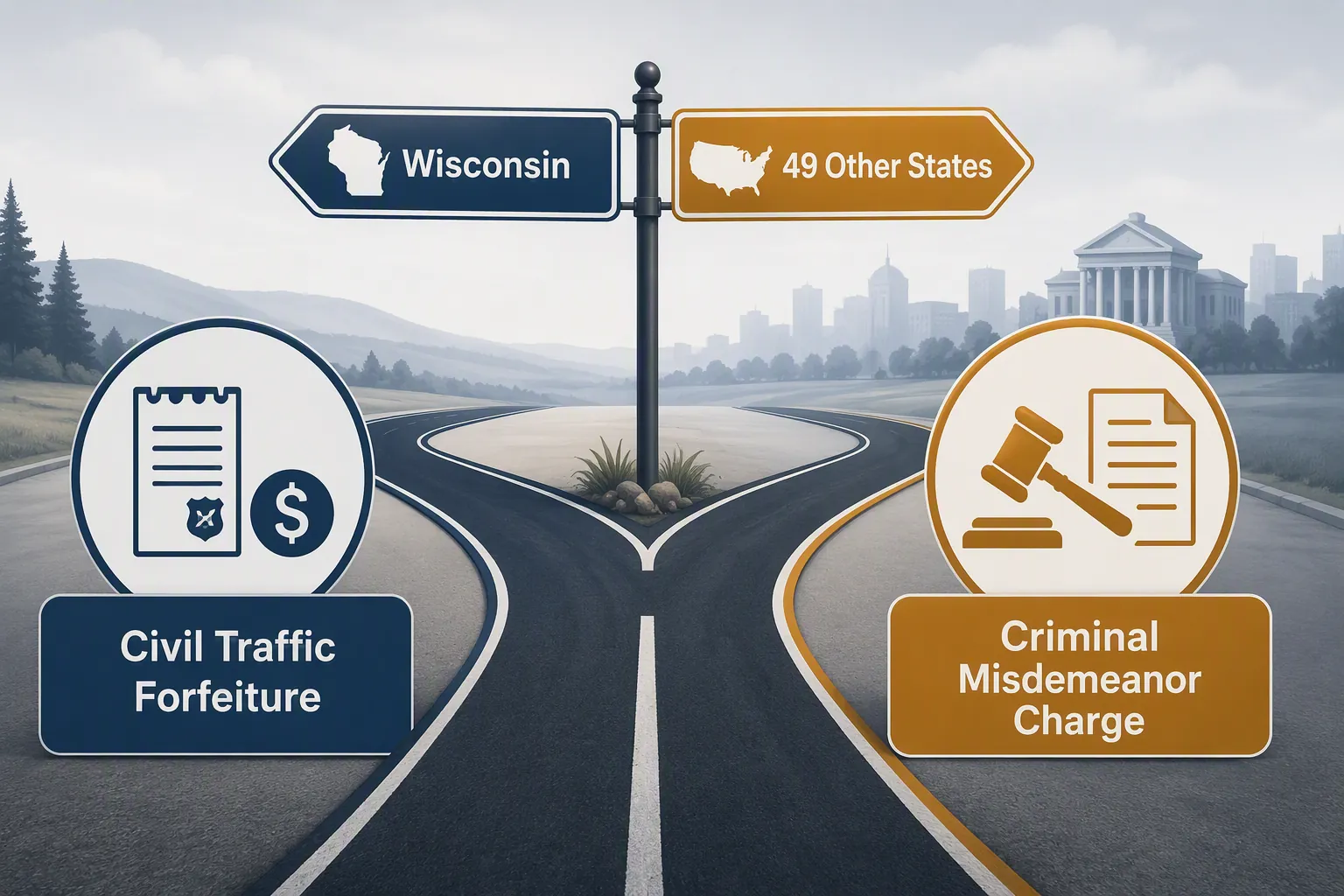
The Wisconsin Classification Does Most of the Legal Work
Wisconsin is not the jurisdiction lawyers should treat casually in a first-offense OWI analysis. The state’s Department of Transportation describes a first-offense operating-while-intoxicated matter as a civil violation carrying license consequences and forfeitures, not as a criminal charge.[2] That does not make the conduct employment-neutral. It does make the cleanest termination theory harder to state if the contract trigger is drafted around a criminal charge, criminal conviction, or criminal conduct.
That distinction matters because many public discussions collapse “arrest,” “charge,” “conviction,” and “criminal offense” into the same bucket. They are not the same bucket for a lawyer reviewing a high-value broadcaster agreement. If Romo’s CBS contract conditions termination for cause on a criminal conviction, the public facts do not show that trigger has occurred. If it conditions termination on being charged with a crime, Wisconsin’s civil classification again narrows the argument. If it uses broader language—conduct bringing the network into disrepute, conduct prejudicial to CBS, impairment of public trust, or employer judgment—the analysis becomes less mechanical and more dependent on wording.
This is why the Wisconsin point is not a technicality. It changes the posture of the memo. A first-offense OWI can still carry license penalties, public embarrassment, sponsor discomfort, and operational disruption. But a civil forfeiture gives CBS less reason to say it had no choice. It also gives Romo’s side a more obvious response to any immediate “criminal misconduct” theory: the state itself has not put the first offense in that category.
A $180 Million Contract Makes Precision Expensive to Ignore
Romo’s deal with CBS has been reported as a 10-year, $180 million agreement signed in 2020 and running through 2030.[3] The dollar figure is not interesting because celebrity compensation needs another lap around the internet. It is interesting because a termination decision under a contract of that size would be scrutinized by litigators, insurers, executives, agents, and possibly arbitrators before anyone finished using the phrase “lapse in judgment.”
The public does not have Romo’s actual CBS contract language. That is the central limitation on any firm conclusion. Still, the usual drafting choices point in different directions:
| Possible contract trigger | What CBS would need to show | How the public facts affect CBS’s firing case |
|---|---|---|
| Conviction-based cause | A qualifying conviction, often for a criminal offense | Weak firing theory now because the matter remains unresolved and Wisconsin treats first-offense OWI as civil |
| Criminal charge trigger | A qualifying criminal charge or prosecution | Also narrowed by Wisconsin’s first-offense classification |
| Conduct bringing disrepute | Harm to the network, broadcast role, sponsors, or public trust under the clause wording | Possible, but fact-intensive and more contestable before official findings |
| Employer-judgment clause | CBS’s good-faith or reasonable judgment that the conduct harms its interests | Broader room to act, but still exposed to consistency and reasonableness arguments |
A well-negotiated morality clause often uses conviction rather than arrest as the cleanest trigger, precisely because arrest reports can be incomplete, wrong, or resolved in ways that do not match the initial narrative.[4] Broadcasters can and do negotiate broader language, especially for public-facing talent. But the broader the clause, the more CBS would have to rely on judgment, reputational effect, and internal consistency rather than a simple “the contract automatically fired him” position.
At-Will Employment Is Background, Not the Whole Answer
The at-will employment default gives U.S. employers broad room to end employment relationships, and employer-side arrest guidance commonly begins from that flexibility. But Romo is not best analyzed as a generic at-will employee with no negotiated protections. A long-term, individually negotiated network contract can replace or complicate the default rule through notice provisions, cure rights, guaranteed compensation, morals language, dispute procedures, or defined “cause.”
That does not mean CBS lacked leverage. Public-facing broadcasting roles create reputational risk that ordinary private employment may not. A network can legitimately care that an NFL analyst’s off-duty conduct becomes part of the broadcast brand. The narrower point is that leverage is not the same as a low-risk termination record. If CBS fired Romo immediately, the network would want the contract clause, investigation notes, comparable prior decisions, and communications chronology to line up cleanly.
Self-Reporting Helped CBS More Than an Apology Would
Several outlets reported that Romo contacted CBS management directly after the arrest.[3][5][6] That fact is more operationally important than the familiar celebrity apology script because it changes what the employer can do next. Early notice lets the company preserve documents, ask for the employee’s account, check whether the employee has work duties affected by license restrictions or travel issues, prepare communications, and avoid learning about the incident from a reporter’s call.
Employer-side guidance on off-duty arrests generally treats prompt disclosure as relevant to the response, even though it does not immunize the employee from discipline. Ogletree Deakins advises employers to investigate the facts, consider the job relationship, and avoid reflexive arrest-based action.[7] Employers Council similarly frames an off-duty DUI arrest or conviction as a situation requiring individualized review of job duties, policy terms, and business impact rather than an automatic termination event.[8]
For CBS, self-reporting also reduced surprise risk. That is not a moral defense. It is a process fact. The network could say it knew promptly, assessed the known facts, considered the civil first-offense posture, and chose retention while the legal matter remained pending. If the contract gave CBS discretion rather than an automatic trigger, that sequence is easier to defend than a rushed firing based primarily on headlines.
The “Twice the Legal Limit” Report Should Not Carry More Weight Than the Record
The most inflammatory reported fact is also one of the least settled. Fox News reported, citing unnamed sources, that Romo allegedly refused an intoxication test and was believed to be around twice the legal limit after a Milwaukee-area golf event.[9] The public record available now does not show that figure confirmed in official charging documents. That gap matters.
An employer may consider credible information before a final court outcome, especially when the employee is a public representative of the brand. But a lawyer defending a termination decision would prefer official records, documented admissions, test results, or a completed internal investigation over anonymous-source reporting. The unconfirmed BAC allegation may influence reputational assessment. It should not be treated as the same thing as an adjudicated fact.
Arrest-Only Discipline Creates Its Own Liability Problem
The strongest reason not to overreact is not sympathy for Romo. It is the legal mess an employer can create by treating an arrest as conclusive when its own policies, past practice, or employee demographics make that approach uneven.
Employer guidance repeatedly warns that discipline based on arrest alone can raise disparate-treatment concerns if the employer applies that standard inconsistently or uses it in a way that maps onto protected-class disparities.[7][8] Garrison Law likewise distinguishes an arrest from proof of misconduct and cautions that employers should consider policy language, job relationship, and consistency before terminating based on arrest information.[10]
For a network, consistency is not only an HR problem. It is a contract problem. If CBS has treated comparable off-duty, first-time, noncriminal or unresolved incidents with lesser discipline, immediate termination of Romo would need a reasoned distinction. If it has a stricter written standard for on-air talent, it would need to show that standard was known, applied, and tied to the role. The more discretionary the clause, the more important the paper trail becomes.
CBS’s “Isolated Lapse” Framing Is Useful, but Not Free
Reports citing CBS’s internal posture described the network as treating the incident as an “isolated lapse in judgment,” while also indicating that a second incident would change the calculus.[3][5][6] That is a sensible employment-risk position on a first event: reserve rights, avoid final legal conclusions, and leave room to escalate if the facts worsen.
It is also a position CBS would want documented carefully. Calling the first incident isolated helps explain retention now. It also creates a comparison point later. If a similar second incident occurs, CBS cannot easily pretend the first decision said nothing. Counsel would want the file to show what CBS knew, what it did not know, what Romo reported, what policies applied, and why the network reserved a different response for repeat conduct.
That future problem is not theoretical in the way public-relations speculation is theoretical. Once an employer identifies a threshold—first incident handled one way, second incident handled differently—it has created a standard it may later need to apply across people, contracts, and facts. The second case is where restraint on the first case can become either a well-documented progression or an inconsistency exhibit.
Why Retention Was Defensible as of July 29
CBS did not need to prove Romo’s conduct was harmless. It needed a defensible reason not to impose termination before the legal process moved further. Wisconsin’s civil treatment of first-offense OWI weakened the cleanest criminal-charge or conviction-based cause theory. At-will principles gave CBS room to act, but Romo’s long-term broadcaster contract likely made cause language and consistency more important than the default rule. A morality clause may still matter, but its force depends on words the public has not seen. Arrest-only discipline would have carried its own disparate-treatment and consistency risks if CBS could not show a uniform standard.
On those facts, not firing Romo was a defensible legal decision. It was not a permanent waiver. The reported CBS position that a second incident would change the calculus is exactly the kind of statement employment counsel should preserve, define, and apply carefully before the next facts arrive.
References
- Details of Tony Romo OWI arrest, Yahoo Sports, https://sports.yahoo.com/articles/details-tony-romo-owi-arrest-200512150.html
- Wisconsin DMV Official Government Site - First OWI, Wisconsin Department of Transportation, https://wisconsindot.gov/Pages/dmv/license-drvs/susp-or-rvkd/1stOWI.aspx
- Tony Romo might step back from spotlight after arrest as CBS makes decision, New York Post, https://nypost.com/2026/07/28/sports/tony-romo-might-step-back-from-spotlight-after-arrest-as-cbs-makes-decision/
- Morals Clauses and Criminal Charges, Varghese Summersett, https://versustexas.com/blog/morals-clauses-and-criminal-charges/
- Tony Romo CBS Sports decision arrest fired future contract, talkSPORT, https://talksport.com/nfl/4469324/tony-romo-cbs-sports-decision-arrest-fired-future-contract/
- Tony Romo OWI arrest CBS fired step back, FTW / USA Today, https://ftw.usatoday.com/story/sports/nfl/2026/07/28/tony-romo-owi-arrest-cbs-fired-step-back/91077852007/
- Avoiding Legal Pitfalls When Employees Are Arrested Off Duty, Ogletree Deakins, https://ogletree.com/insights-resources/blog-posts/avoiding-legal-pitfalls-when-employees-are-arrested-off-duty/
- How to Respond to an Employee’s Off-Duty DUI Arrest or Conviction, Employers Council, https://www.employerscouncil.org/resources/how-to-respond-to-an-employees-off-duty-dui-arrest-or-conviction/
- Tony Romo allegedly refused intoxication test in OWI arrest following Milwaukee golf event: report, Fox News, https://www.foxnews.com/sports/tony-romo-allegedly-refused-intoxication-test-owi-arrest-following-milwaukee-golf-event-report
- Can My Employer Terminate Me After Learning That I Was Arrested?, Garrison Law, https://garrisonlaw.com/can-my-employer-terminate-me-after-learning-that-i-was-arrested/
Related records
Tool profile
Browse tool evaluations →Governing regulation
Browse the obligations tracker →Preventive workflow
Browse verification workflows →
Report a correction or tip
Spotted an outdated figure, a misstated fact, or a ruling this case record should reflect? Public comments are disabled for this content given the professional cost of a misreported case outcome, penalty amount, or rule text — use the structured correction channel instead.
Report a correction or tip for this record →