
Why Tony Romo's OWI Arrest is a Civil, Not Criminal, Offense
This article examines the legal details of Tony Romo's July 23, 2026 OWI arrest in Milwaukee, focusing on Wisconsin's unique classification of first-offense OWI as a civil violation, the specific penalties including mandatory license revocation, and the interstate and professional risks for Texas residents.
- Jurisdiction
- US-Wisconsin
- Court
- Milwaukee County Circuit Court
- AI tool named
- None
- Ruling date
- Jul 23, 2026
- Source document
- View primary court order ↗
- Last verified
- Jul 25, 2026
Lex Machina Review is an independent risk-tracking and reference resource. Nothing on this site is legal advice, and using it does not create an attorney-client relationship. Every record is reviewed against primary sources but may not reflect the most current status of a matter — always verify directly against the cited court order, rule text, or a licensed attorney before relying on it.
Companion explanation — secondary to the source document above
The first legal point in the Tony Romo OWI arrest in Milwaukee is also the one easiest to misstate: if the matter remains a first-offense Wisconsin OWI, it is not a criminal DUI prosecution. Wisconsin treats a first offense under its operating-while-intoxicated statute as a civil forfeiture action, not as a misdemeanor, and that classification changes the procedural posture before it changes the practical risk.[1]
The reported incident began on July 23, 2026, on the I-43 southbound high-rise bridge in Milwaukee. FOX6 Now, citing a Milwaukee County Sheriff's Office detention report that has not itself been published online, reported that Romo was stopped at about 6:15 p.m., arrested at 6:18 p.m., booked at 9:45 p.m., and released at 11:00 p.m. on a cited first-offense OWI. His court date is set for September 21, 2026.[2] As of July 25, 2026, public reporting has not confirmed whether he submitted to or refused a chemical test, and no confirmed blood-alcohol concentration has been reported.
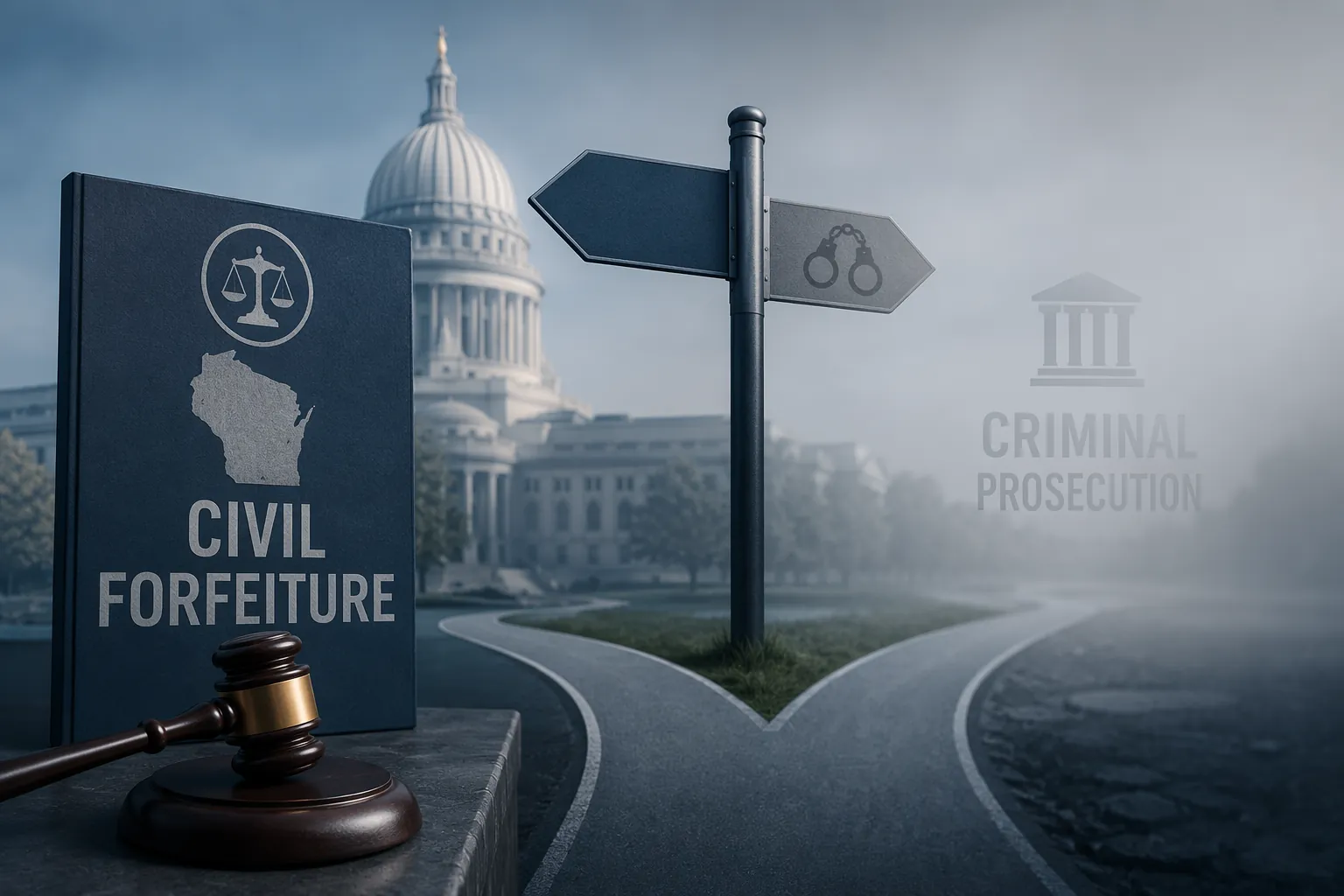
The Citation Sits in Wisconsin's Civil OWI Framework
Wisconsin's OWI statute prohibits operating a motor vehicle while under the influence of an intoxicant, controlled substance, or other drug to a degree that renders the person incapable of safely driving, as well as operating with a prohibited alcohol concentration.[3] The unusual part is not that Wisconsin has an OWI statute. It is that the first offense, absent aggravating circumstances that would move the case elsewhere, is treated as a civil violation.
That civil label has real procedural consequences. A first-offense Wisconsin OWI is not a crime, does not create a criminal record, and does not carry a right to a jury trial.[1] Those points matter for lawyers, employers, licensing reviewers, and anyone asked to describe the case accurately. “Arrested for OWI” is not the same as “convicted,” and “first-offense Wisconsin OWI” is not the same procedural object as a misdemeanor DUI in many other states.
But the opposite error is just as common. Civil forfeiture does not mean informal, consequence-free, or irrelevant outside Wisconsin. It means the case is processed outside the criminal track for a first offense. The state can still impose mandatory licensing consequences, financial penalties, assessment obligations, and ignition-interlock restrictions if statutory triggers are met.
| Issue | What is currently supported |
|---|---|
| Classification if treated as first offense | Civil forfeiture, not a criminal prosecution |
| Criminal record from first-offense OWI | No criminal record under Wisconsin's first-offense framework |
| Jury-trial right | No jury-trial right for the civil first offense |
| License consequence | Mandatory 6–9 month revocation upon conviction |
| Chemical-test consequence | IID may apply if BAC is at least 0.15 or if testing was refused |
| Romo's BAC or refusal status | Not publicly confirmed as of July 25, 2026 |
The Penalties Are Administrative, but Not Cosmetic
The Wisconsin Department of Transportation's first-offense OWI schedule identifies a forfeiture range of $150 to $300, a mandatory $435 OWI surcharge, and a driver's license revocation of 6 to 9 months upon conviction.[4] The monetary number is modest compared with many white-collar regulatory penalties. The revocation is not.
The DOT also states that an alcohol or drug assessment and a Driver Safety Plan are required upon conviction.[4] That matters because the case does not end at a citation amount. A respondent who wants driving privileges restored must deal with a state-supervised remedial process, not merely pay a forfeiture and treat the file as closed.
Ignition-interlock exposure is the major unresolved penalty question in the public record. Wisconsin DOT materials state that an ignition interlock device is required for at least one year if the driver's alcohol concentration is 0.15 or greater, or if the driver refused chemical testing.[4] Because Romo's BAC and refusal status have not been publicly confirmed, any categorical statement that an IID will or will not be required would overrun the available record.
What the Unknown Chemical-Test Record Changes
For briefing purposes, the chemical-test issue should be kept separate from the arrest itself. The arrest report timeline, as described by news accounts, supports that Romo was stopped, arrested, booked, released, and given a court date.[2] It does not, on the current public record, establish a reported BAC, a refusal, or an IID-triggering fact. Those are not cosmetic gaps; they affect the penalty analysis.
The careful formulation is therefore narrow: if convicted of a first-offense Wisconsin OWI, Romo faces the mandatory first-offense revocation, forfeiture, surcharge, and assessment-plan consequences. If the chemical-test record later shows a BAC of at least 0.15 or a refusal, the IID analysis changes. If it does not, that particular trigger may not apply.
A Civil Wisconsin Case Can Still Travel
Romo is a Texas resident, which makes the civil label less tidy in practice. JSOnline reported that Wisconsin is a Driver License Compact member and that a Wisconsin OWI conviction would be reported to the Texas Department of Public Safety, where Texas may impose separate license consequences under Texas Transportation Code § 521.142 despite Wisconsin's civil treatment.[5]
That is the kind of downstream risk that tends to disappear in celebrity arrest coverage. The Wisconsin court classification answers one question: whether the first-offense matter is criminal in Wisconsin. It does not, by itself, answer how another state agency, an employer, an insurer, or a licensing reviewer will code the event once it appears in a reporting stream.
Texas's precise treatment would depend on the reported disposition and the way the violation is transmitted and classified. The available materials support the existence of a Driver License Compact issue; they do not support a final conclusion about a specific Texas suspension outcome before the Wisconsin case is resolved and reported.
The CBS Risk Is Contractual, Not Statutory
The employment question is even more conditional. The Guardian reported that CBS declined public comment after the arrest.[6] The Athletic reported the arrest in the context of Romo's CBS role and noted the professional implications, but Romo's actual CBS contract language has not been made public.[7] Without that text, no one outside the contracting parties can say whether a particular clause has been triggered.
The relevant legal distinction is that employment and endorsement contracts do not have to wait for a criminal conviction if their morality, conduct, notice, or cooperation provisions are drafted around arrests, charges, public disrepute, or network judgment. That is not a conclusion about Romo's CBS contract. It is the risk category a lawyer would check because the Wisconsin case being civil does not necessarily control a private contract's response.
For public analysis, the clean answer is limited: CBS has not publicly commented, the contract is not public, and the employment consequences cannot be determined from the OWI statute alone. The arrest may create professional risk independent of criminal classification, but the degree of that risk turns on documents and institutional choices not currently available.
What Can Safely Be Said Now
The safest current description is that Romo was reportedly arrested in Milwaukee on July 23, 2026, for a first-offense OWI, with a September 21, 2026 court date, based on news accounts citing a Milwaukee County Sheriff's Office detention report rather than a publicly available primary report.[2] If the matter remains a Wisconsin first-offense OWI, it proceeds as a civil forfeiture matter rather than a criminal prosecution.[1]
That classification reduces some criminal-law exposure many readers may assume exists: no misdemeanor conviction, no criminal record from the first-offense OWI, and no jury-trial right in the civil proceeding.[1] It does not eliminate mandatory license consequences, financial penalties, assessment obligations, or possible IID restrictions if the chemical-test facts support them.[4]
The case is significant because Wisconsin separates criminal classification from mandatory administrative and collateral consequences. Romo therefore appears to face fewer criminal-law consequences than the phrase “OWI arrest” may suggest to an out-of-state reader, but more license, reporting, and professional risk than the word “civil” comfortably implies.
References
- Wisconsin first-offense drunken driving OWI crime civil violation, Wisconsin Watch, February 2026.
- Tony Romo arrested in Milwaukee for OWI, 1st; court date set, FOX6 Now.
- Wisconsin Statutes § 346.63, Wisconsin Legislature.
- 1st OWI offense, Wisconsin Department of Transportation.
- Tony Romo arrested OWI Milwaukee, JSOnline, July 24, 2026.
- Tony Romo arrest OWI, The Guardian, July 24, 2026.
- Tony Romo arrest OWI DUI CBS Sports Cowboys, The Athletic, July 24, 2026.
Related records
Tool profile
Browse tool evaluations →Governing regulation
Browse the obligations tracker →Preventive workflow
Browse verification workflows →
Report a correction or tip
Spotted an outdated figure, a misstated fact, or a ruling this case record should reflect? Public comments are disabled for this content given the professional cost of a misreported case outcome, penalty amount, or rule text — use the structured correction channel instead.
Report a correction or tip for this record →