
Tony Romo’s Wisconsin Refusal Citation: Legal Track and Penalties
This article examines the sole refusal-to-test citation issued to Tony Romo after his July 23, 2026 arrest in Milwaukee County, explaining the distinct implied-consent proceeding under Wis. Stat. § 343.305, its mandatory penalties including one-year license revocation, and the strict 10-day hearing deadline that operates independently of any OWI charge.
- Jurisdiction
- Wisconsin
- Court
- Milwaukee County Intake Court
- AI tool named
- None
- Ruling date
- Jul 27, 2026
- Source document
- View primary court order ↗
- Last verified
- Jul 29, 2026
Lex Machina Review is an independent risk-tracking and reference resource. Nothing on this site is legal advice, and using it does not create an attorney-client relationship. Every record is reviewed against primary sources but may not reflect the most current status of a matter — always verify directly against the cited court order, rule text, or a licensed attorney before relying on it.
Companion explanation — secondary to the source document above
Last checked: July 29, 2026, UTC. This is a case-record reference for legal professionals and records readers, not legal advice. The materials now available point to a Milwaukee County matter, trackable on WCCA by party name as of July 28 because the case number had not been publicly available. The public court trail reported so far shows one filed citation: refusal to take a test for intoxication after arrest, filed July 27, with an intake-court appearance set for September 21, 2026, at 8:30 a.m. in Milwaukee County Intake Court.[1]
That matters more than the headline phrasing. A search for tony romo owi arrest wisconsin court records can easily land on a public retelling that treats arrest, OWI, citation, refusal, and payment as if they sit in the same procedural box. They do not. On the reported record, the document to read first is the refusal citation, not a presumed OWI conviction or a resolved traffic forfeiture.

What The Reported Record Actually Shows
The reported incident began July 23, 2026, at about 6:15 p.m. on I-43 southbound in Milwaukee County. The Milwaukee County Sheriff’s Office arrest report, as reported by FOX6, says Romo performed poorly on standardized field sobriety tests, was booked at 9:45 p.m., and was released at 11:00 p.m. the same evening.[2]
The later court-record fact is narrower and cleaner: a refusal citation was filed July 27. The initial appearance is reported for September 21, 2026, at 8:30 a.m., and attorney Julius Kim is retained.[1] The exact reason for the original traffic stop has not been disclosed in the source materials summarized here. Reports about a blood-draw warrant or body-camera footage should be treated as secondhand unless a primary court, warrant, or agency page is produced.
There is also a small but important records-language caution. A Facebook post reportedly suggested the citation was “paid,” while the Milwaukee Journal Sentinel reporting described the citation as “received.”[1] The September 21 intake-court date is not consistent with treating the matter as safely closed. That does not prove bad faith by anyone repeating the “paid” phrasing; it simply means “paid” is not the safe records conclusion on the materials now available.
A Refusal Citation Is Its Own Wisconsin Track
Wisconsin’s implied-consent statute, Wis. Stat. § 343.305, is the controlling starting point. A person who drives on Wisconsin highways is deemed to have consented to chemical testing for alcohol, controlled substances, or related compounds when the statutory conditions are met. If an officer requests a test after an arrest covered by the statute and the person refuses, the refusal does not merely become a fact in an OWI file. It creates a separate implied-consent proceeding.[3]
The difference is practical, not academic. The refusal proceeding asks statutory questions about the arrest, the officer’s request, the information given to the driver, and the refusal. It does not require the state to first prove a prohibited alcohol concentration from a completed breath or blood test. That is why a refusal citation can carry consequences even when the public materials do not show a BAC result.
The timing is the part that gets missed when coverage is written around an “OWI arrest” headline. Under § 343.305, a person served with a notice of intent to revoke after refusal must request a hearing in writing within 10 days. If that written request is not made on time, the statute directs revocation to proceed.[3] A September intake date does not stretch that 10-day refusal deadline.
| Records Question | Reported Answer As Of July 29, 2026 |
|---|---|
| What was filed? | One refusal-to-test citation after arrest |
| When was it filed? | July 27, 2026 |
| Where is the matter pending? | Milwaukee County Intake Court |
| What date is reported for intake court? | September 21, 2026, at 8:30 a.m. |
| What is the deadline problem? | The implied-consent hearing request must be made in writing within 10 days |
The Penalty Is Not Waiting For An OWI Conviction
For a refusal arising from an OWI-type arrest, the reported materials support the key sanction point: the refusal track carries a mandatory one-year license revocation and an ignition-interlock requirement.[3][5] Those consequences are not described as optional public-relations fallout. They are statutory driving-privilege consequences attached to the refusal mechanism.
That is why the filed citation cannot be treated as a footnote to a possible OWI case. In a normal criminal or traffic case, counsel may be tempted to calendar the first appearance, wait for discovery, and sort the merits later. A refusal notice does not run on that slower rhythm. The hearing request protects the chance to contest the refusal issues before revocation becomes the default administrative result.
- The citation filed in court is a refusal citation, not proof that a separate OWI charge has been filed.
- The refusal proceeding can move on written-deadline rules before an ordinary first appearance resolves anything.
- The sanctions concern driving privileges and ignition-interlock requirements, not only a fine.
- The absence of a public BAC figure does not make the refusal citation procedurally harmless.
Why First-Offense OWI Comparisons Can Mislead
Wisconsin first-offense OWI has its own statutory home in Wis. Stat. § 346.63, which prohibits operating while under the influence and operating with a prohibited alcohol concentration.[4] The Wisconsin Department of Transportation describes a first OWI as a civil offense with a $150 to $300 forfeiture plus a $435 OWI surcharge; Wisconsin is also the only state where a first OWI is classified as a civil traffic violation rather than a crime.[5]
That civil label can cause the wrong kind of comfort. A first-offense OWI proceeding and an implied-consent refusal proceeding are related because they arise from the same traffic investigation, but they do not ask the same questions. The OWI case focuses on impaired operation or prohibited alcohol concentration. The refusal case focuses on whether the statutory request and refusal process supports revocation.
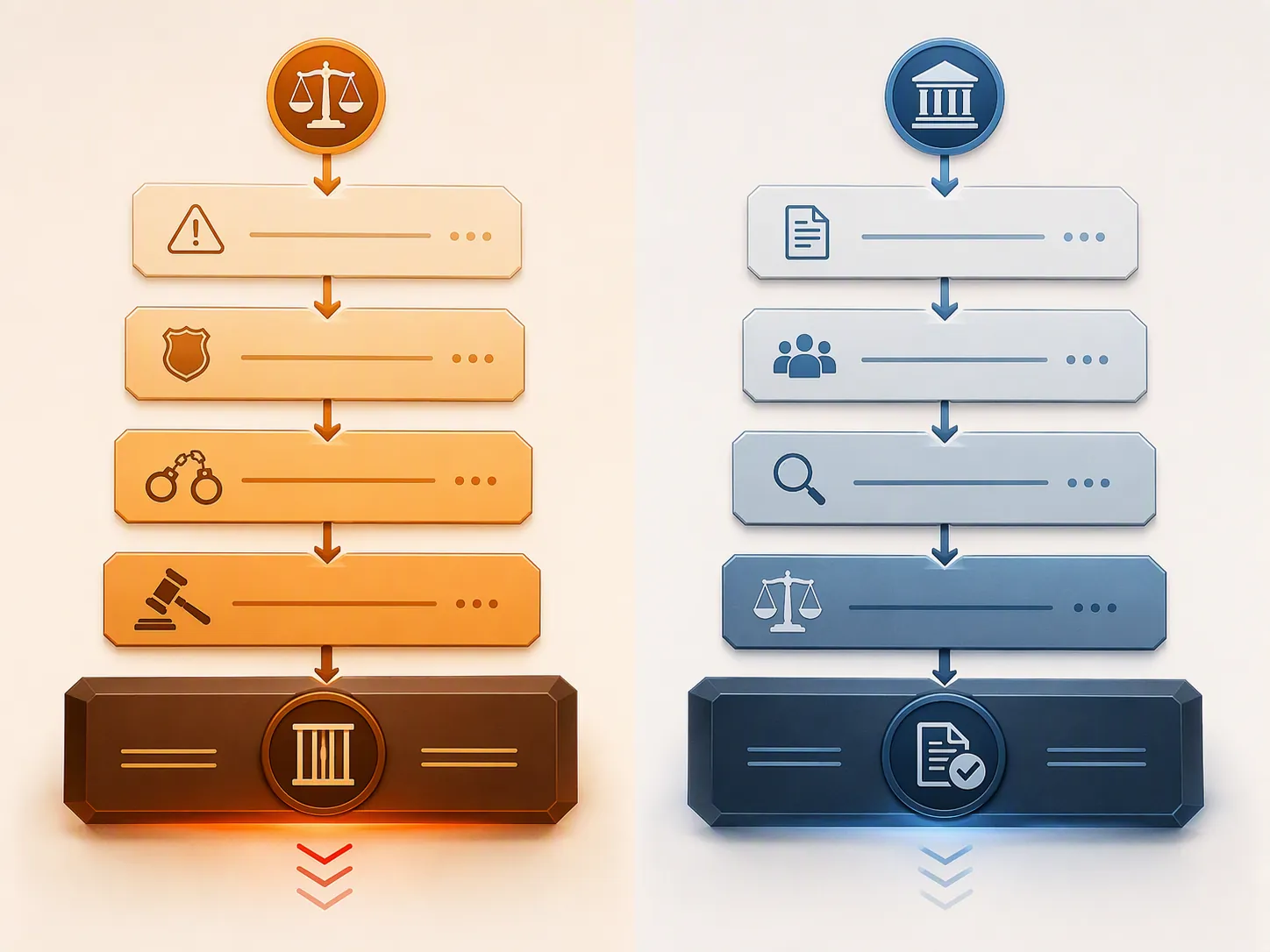
| Issue | Refusal Track | First-Offense OWI Track |
|---|---|---|
| Statutory source | Wis. Stat. § 343.305 | Wis. Stat. § 346.63 |
| Core question | Whether the driver unlawfully refused a requested chemical test after arrest | Whether the driver operated while impaired or with a prohibited alcohol concentration |
| Timing pressure | Written hearing request within 10 days | Ordinary court scheduling does not replace the refusal deadline |
| Key consequence discussed here | Mandatory one-year revocation and ignition interlock | Civil first-offense forfeiture framework, including $150–$300 fine and $435 surcharge |
| Evidence emphasis | Implied-consent advisement, request, refusal, and statutory prerequisites | Operation, impairment evidence, and any admissible chemical-test evidence |
The public record may later show additional filings, amendments, dismissals, or hearing outcomes. That is ordinary case movement. It would not change the basic records point: the refusal citation is already a procedural object with its own statutory clock.
What A Practitioner Should Verify Before Repeating The Claim
The safe records check is modest. First, confirm the party-name search and any later case number on WCCA. Second, check whether the filed matter still shows only the refusal citation or whether an OWI citation or charge has separately appeared. Third, verify service and deadline facts for the refusal notice rather than relying on the September court date. Fourth, distinguish any payment entry from a resolved court disposition.
That last step is not bookkeeping fussiness. Public-facing traffic entries often invite overreading. “Received,” “filed,” “paid,” “posted,” and “disposed” can describe different events. If a citation is reported as received and a future intake-court appearance is still on the calendar, the stronger conclusion is that the matter is pending unless the court record itself shows otherwise.
Based on the reported Milwaukee County court record and Wisconsin implied-consent law, the Romo matter should be read first as a refusal proceeding: one filed refusal citation, a reported September 21 intake date, mandatory refusal consequences if not successfully contested, and a 10-day written hearing deadline that cannot be managed by waiting for the ordinary OWI-case timeline. Later court-record updates may change the posture. They do not make the refusal track safe to ignore.
References
- Tony Romo cited for refusing OWI test in Milwaukee County, Milwaukee Journal Sentinel, July 2026.
- Tony Romo arrested for OWI in Milwaukee County, FOX6 Milwaukee, July 2026.
- Wis. Stat. § 343.305, Tests for intoxication; administrative suspension and court-ordered revocation, Wisconsin Legislature.
- Wis. Stat. § 346.63, Operating under influence of intoxicant or other drug, Wisconsin Legislature.
- Operating While Intoxicated (OWI) penalties, Wisconsin Department of Transportation.
Related records
Tool profile
Browse tool evaluations →Governing regulation
Browse the obligations tracker →Preventive workflow
Browse verification workflows →
Report a correction or tip
Spotted an outdated figure, a misstated fact, or a ruling this case record should reflect? Public comments are disabled for this content given the professional cost of a misreported case outcome, penalty amount, or rule text — use the structured correction channel instead.
Report a correction or tip for this record →