
Building an evidence record for toxic cabin air claims
A guide to the time-sensitive biomarker tests, neuroimaging protocols, and maintenance records that courts accept as evidence in toxic cabin air litigation, based on the 2023 International Fume Events Task Force medical protocol.
- Jurisdiction
- Scotland
- Court
- Court of Session (Scotland)
- AI tool named
- International Fume Events Task Force medical protocol
- Ruling date
- Jan 1, 2025
- Source document
- View primary court order ↗
- Last verified
- Jul 28, 2026
Lex Machina Review is an independent risk-tracking and reference resource. Nothing on this site is legal advice, and using it does not create an attorney-client relationship. Every record is reviewed against primary sources but may not reflect the most current status of a matter — always verify directly against the cited court order, rule text, or a licensed attorney before relying on it.
Companion explanation — secondary to the source document above
In a toxic cabin air claim, evidence can decay before a lawyer has a file number. The first blood draw may need to occur within hours. The cabin crew report may be written before anyone knows which terminology an expert will later use. Maintenance records may be routine business documents one day and the only objective exposure proxy the next. This article is a litigation evidence record guide, not medical advice, legal advice, or a diagnosis page.
The best current organizing tool is the 2023 International Fume Events Task Force medical protocol published by Burdon and colleagues in Environmental Health. It gives litigants a peer-reviewed, time-stamped collection framework: in-flight documentation, immediate post-flight testing, and later follow-up. That framework can make a causation record harder to dismiss. It does not remove the largest vulnerability for plaintiffs: “aerotoxic syndrome” is not an ICD-recognized diagnosis and is not accepted as a diagnosis by major aviation medical bodies, which leaves room for Daubert attacks in U.S. litigation. [1]
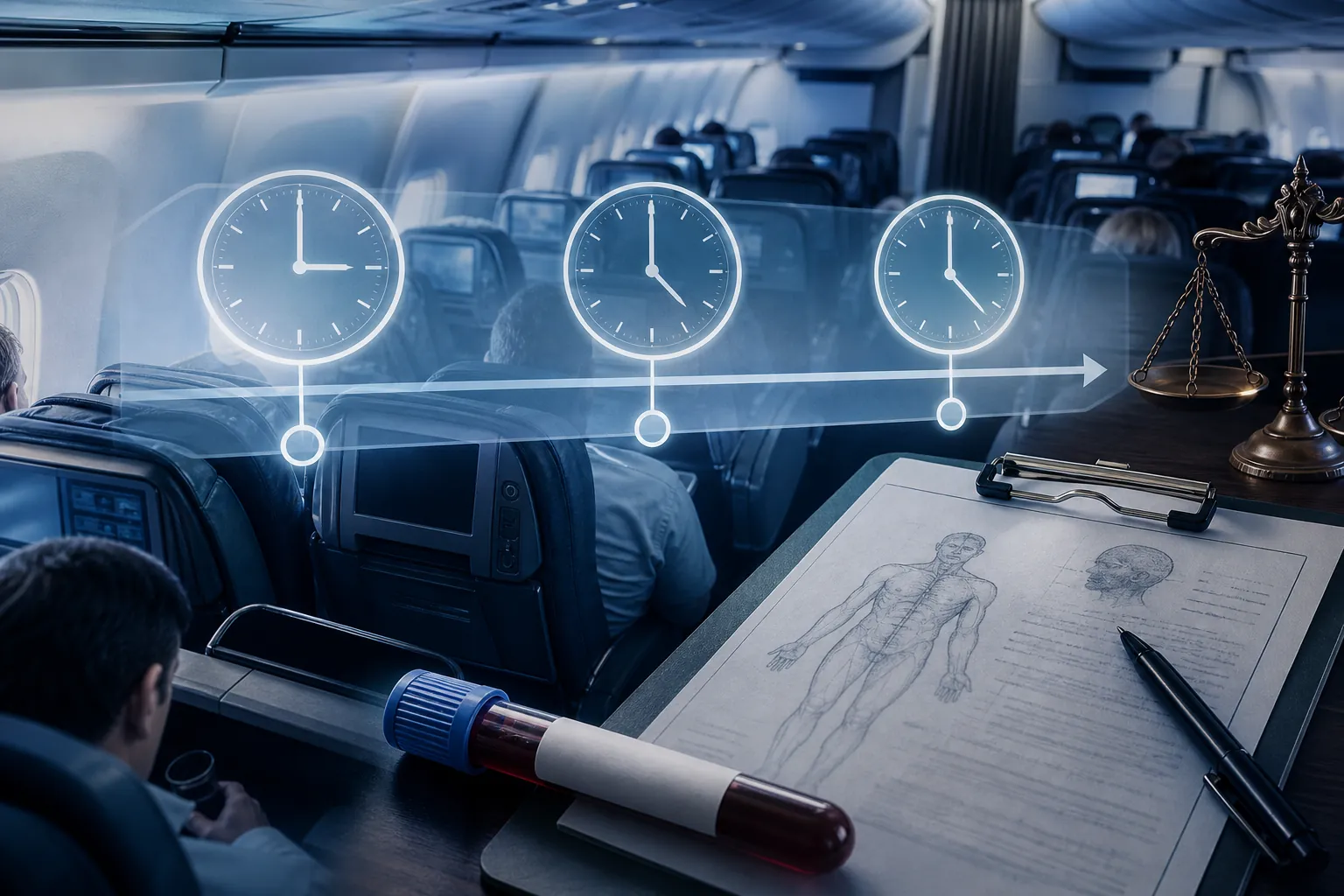
The first issue is not the label. It is the clock.
A fume-event file often begins with reported symptoms: headache, dizziness, cognitive problems, respiratory irritation, tremor, fatigue, or sensory disturbance. Those symptoms matter, but a contested case cannot rest on narrative alone if a time-sensitive blood marker was available and nobody ordered it. The opposing expert will not need to prove the event never happened; it may be enough to show that the claimant’s own record cannot anchor symptoms to a documented exposure.
Burdon et al. place particular weight on three linked tables: Table 6 for in-flight documentation, Table 7 for immediate post-flight collection within the 24–48 hour period, and Table 8 for later or subsequent follow-up. Those tables are useful in litigation because they do not merely say “evaluate the patient.” They identify what should be recorded, when specimens should be collected, and what later evidence can still be developed after the initial biomarker window has narrowed or closed. [1]
| Evidence window | What the record should capture | Why it matters in a legal claim |
|---|---|---|
| During the flight | Odor, smoke or haze description, timing, location in cabin, phase of flight, aircraft details, crew and passenger symptoms, oxygen use, operational reports | Creates a contemporaneous exposure narrative before memory, terminology, and litigation incentives become attack points |
| First 24–48 hours | Medical examination, acute symptoms, targeted blood testing including cholinesterase-related markers, specimen handling, and early clinical observations | Preserves biological evidence that may be unavailable or weaker if counsel waits for later specialist review |
| Later follow-up | Baseline comparison samples, neurological evaluation, neuropsychological testing, DTI MRI or PET where clinically indicated, occupational and medical history | Helps distinguish transient symptoms from persistent impairment and gives experts material beyond self-report |
Use the IFETF protocol as a custody map
The protocol’s value is not that it declares every reported cabin-air illness compensable. Its value is procedural. It gives the treating clinician, claimant lawyer, airline risk manager, and expert witness a common collection map before the record becomes adversarial. That is exactly where many toxic cabin air cases are weakest: not in the intensity of symptoms, but in the missing link between aircraft event, biological timing, clinical workup, and maintenance history.
In-flight documentation should be treated as the first evidentiary layer. The record should identify the flight, aircraft, date, crew positions, seating or work location, phase of flight, odor character, visible haze or smoke if present, duration, recurrence, and who developed symptoms. If oxygen was used, if crew were removed from duty, if maintenance was requested, or if passengers complained, those facts belong in the same early record rather than in later witness recollections.
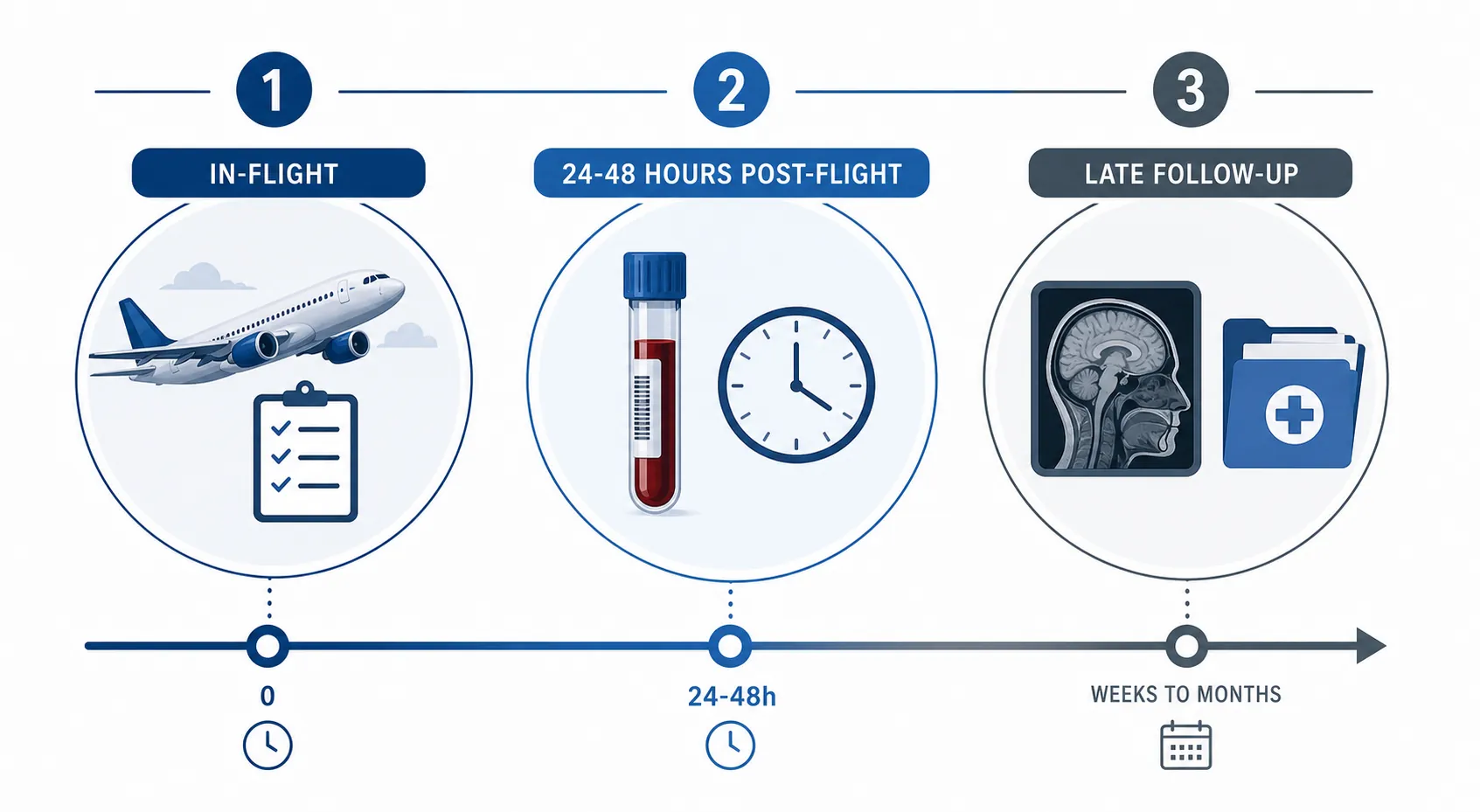
The post-flight record should not wait for a specialist who may not be available within the relevant window. Burdon et al. recommend acute assessment and targeted testing after suspected contaminated-air exposure, including butyrylcholinesterase and acetylcholinesterase testing within defined windows, followed by a later baseline sample for comparison. [1]
Later follow-up has a different job. It cannot recreate the first blood draw. It can document persistence, rule out competing explanations, compare later baseline values, and support neurological or occupational medicine opinions. In litigation terms, late follow-up is not a substitute for acute collection; it is the part of the record that helps experts explain whether the acute event plausibly contributed to continuing impairment.
Biomarker evidence: strong when timely, fragile when reconstructed
The protocol’s most litigation-sensitive items are the acute biological markers. Burdon et al. identify BChE testing within 4–24 hours and AChE testing within 4–48 hours, with a second baseline sample required later. Those windows should be written into intake instructions, union guidance, airline incident procedures, and counsel’s first-response checklist. [1]
The baseline sample matters because a single cholinesterase value may be difficult to interpret without comparison. A later baseline does not prove the exposure by itself, but it can give an expert a reference point instead of forcing the opinion to rest on a lab value floating without personal context. That distinction is important in admissibility briefing: a timed test plus a later comparator is a cleaner record than a late test accompanied by an expert’s reconstruction.
The research record also includes more targeted analytical work. Burdon et al. discuss a University of Washington mass spectrometry assay for cresyl phosphate-modified butyrylcholinesterase, reporting detection of TCP exposure markers in 6 of 12 asymptomatic jet passengers. That finding should be used carefully. It supports the sensitivity of the assay and the possibility of detecting exposure markers even without symptoms; it does not prove that every exposed passenger becomes ill or that marker detection alone establishes legal causation. [1]
NTE lymphocyte testing also appears in the protocol’s biomarker discussion. Its litigation use is narrower than a general claim that “organophosphates were present.” The better use is to show that counsel and clinicians followed a peer-reviewed post-event collection pathway, selected tests tied to the suspected exposure mechanism, and preserved specimens or results in a way that an opposing expert can actually review. [1]
What the biomarker record can and cannot do
- It can place biological testing close to the alleged event, which is stronger than a symptom history first documented weeks later.
- It can support or weaken an expert’s exposure opinion depending on timing, assay selection, and baseline comparison.
- It cannot, by itself, solve the diagnostic-recognition problem surrounding aerotoxic syndrome.
- It cannot repair a missed acute window unless some other contemporaneous evidence — medical, operational, or maintenance-related — was preserved.
Neuroimaging belongs in the follow-up record, not the first scramble
Neuroimaging is not the first thing to chase in the opening hours. Blood timing and contemporaneous event documentation come first. But for claimants with persistent neurological or cognitive symptoms, imaging may become important because it can move the file away from a purely subjective symptom account.
Burdon et al. discuss DTI MRI findings identifying white-matter microstructure defects in symptomatic aircrew. They also address PET as part of later evaluation in appropriate cases. The useful litigation point is not that DTI or PET creates an automatic diagnosis. It is that objective neurobiological findings may correlate with reported symptoms and give experts something measurable to analyze. [1]
That evidence remains vulnerable if the imaging expert overstates it. DTI findings can be attacked through alternative causation, protocol variance, clinical relevance, and the gap between group-level research and an individual claimant’s impairment. A careful report should identify the imaging protocol, the clinical indication, the claimant’s symptom course, other neurological explanations considered, and how the imaging fits with — rather than replaces — the acute exposure record.
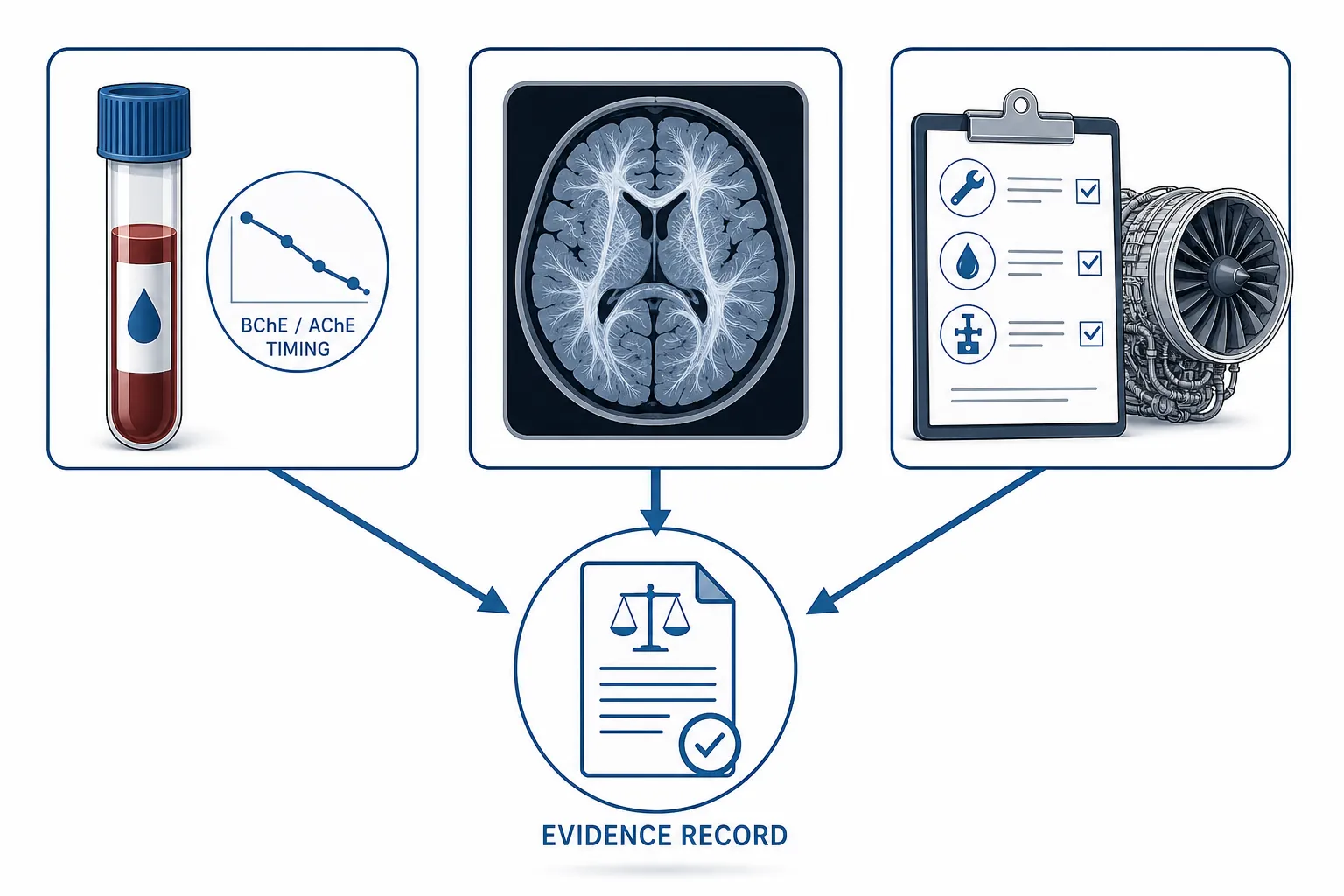
Maintenance records become exposure proxies when sensors are absent
Many toxic cabin air cases face the same missing-data problem: the aircraft did not capture real-time contaminant measurements during the event. Routine cabin air monitoring usually describes normal operating conditions, not the short window when crew or passengers reported fumes. Burdon et al. note the limited exposure data available from actual fume events and the broader problem of inconsistent fume-event reporting. [1]
That is why maintenance records matter. They may be the only objective record capable of connecting the reported odor or smoke to a mechanical condition involving oil or hydraulic fluid. Burdon et al. discuss Michaelis’s finding that 87% of investigated fume events had positive maintenance findings of oil or hydraulic fluid. That statistic should not be turned into a presumption for every aircraft event, but it is a serious reason to request the records before they disappear into ordinary maintenance systems. [1]
A preservation request should be specific enough to be useful. Counsel should seek aircraft tail number, engine and auxiliary power unit records, defect logs, pilot reports, cabin crew reports, maintenance write-ups, oil and hydraulic servicing records, component removals, bleed-air system inspections, prior similar complaints, and post-event corrective action. If the aircraft was released back into service, the timing and basis for release belong in the record as well.
For airlines and in-house counsel, the same list is a risk-management list. A fume report should trigger legal hold analysis before the company knows whether the matter will become a workers’ compensation claim, passenger claim, product claim, or employment dispute. Morgan Lewis’s 2026 toxic fume litigation risk guidance emphasizes prompt notice obligations in this context, particularly where insurance and claim reporting duties may be implicated. [2]
Causation is built from alignment, not from one perfect test
The strongest file aligns four clocks: the flight event, the symptom onset, the biological testing, and the aircraft record. If the odor was reported during climb, symptoms were documented before landing, BChE or AChE testing was ordered within the protocol window, and maintenance later found a plausible oil or hydraulic source, the expert has a materially different record than a claimant who first sought care months later with no aircraft documentation.
This is also where terminology needs discipline. “Aerotoxic syndrome” may appear in the medical literature and in claimant descriptions, but in U.S. court it invites a predictable fight because it lacks ICD recognition and acceptance by major aviation medical bodies. A more defensible expert structure may focus on documented exposure to contaminated aircraft air, acute clinical findings, biomarker timing, neurological sequelae where supported, and differential assessment of other causes. [1]
Ramsden’s 2025 review is useful here as an update on susceptibility and recovery patterns, including the reality that exposed people may not follow a uniform course. Its proper role is not to convert variable recovery into automatic causation. It can help an expert explain why differences in symptom persistence or susceptibility do not, by themselves, end the analysis. [3]
The frequency of fume events should receive less emphasis than some advocacy writing gives it. Published estimates vary widely, from 1 in 66 flights to 1 in 22,000 flights, because definitions and reporting practices are inconsistent and under-reporting is acknowledged. In an individual case, the court will care less about the global rate than whether this aircraft, on this date, generated a preserved exposure and injury record. [1]
Gough is useful, but it is not a U.S. merits ruling
Gough v Cannons Law Practice [2025] CSOH 28 deserves attention because the Scottish Court of Session accepted, in that procedural setting, that precise chemical identification was not essential if employment materially contributed to symptoms, and that causation could survive even without full medical consensus. That is a helpful comparison for claimants facing the familiar “no exact toxin, no recognized syndrome” argument. It is not binding U.S. authority, and it was a Scottish loss-of-chance decision rather than a full trial on the merits of a toxic cabin air injury claim. [4]
The lesson is narrower and more useful than treating Gough as a breakthrough. Courts may be willing to examine a materially contributing exposure theory even where science has not settled every diagnostic label. But the file still needs contemporaneous event records, medical timing, expert discipline, and maintenance evidence. A plaintiff cannot import a Scottish reasoning pattern into a Daubert hearing and expect it to substitute for proof.
A practical collection sequence
A claimant-side intake process should assume the acute window is closing. The first call should identify the flight, time of exposure, symptom onset, whether any medical care has already occurred, and whether blood testing can still be ordered within the IFETF windows. The intake should also ask whether other crew members or passengers reported symptoms, whether an official safety report was filed, and whether the aircraft continued in service.
- Within the first hours: document the flight, aircraft, crew position or seat location, odor or haze description, symptom onset, oxygen use, and all contemporaneous reports.
- Within the BChE and AChE windows: arrange clinical evaluation and targeted blood testing consistent with the protocol, while recording specimen timing and chain of custody.
- Within the first 24–48 hours: secure medical notes, incident reports, airline communications, and witness names before informal accounts diverge.
- After the acute phase: obtain baseline comparison samples, evaluate persistent neurological or cognitive symptoms, and consider DTI MRI, PET, or neuropsychological testing where clinically justified.
- Before ordinary retention cycles run: preserve aircraft maintenance records, defect logs, pilot and cabin reports, oil or hydraulic servicing records, component changes, and post-event inspections.
Defense counsel and in-house legal teams should read the same sequence in reverse. If the airline receives a fume report, the defensible file is the one that can later show what was reported, what was inspected, what maintenance found or did not find, which records were preserved, and what notice was given to insurers or other stakeholders. A thin file helps neither side; it merely shifts the dispute from exposure science to missing evidence.
What should not be overstated
The IFETF protocol does not prove that a particular plaintiff was injured. It does not make aerotoxic syndrome an ICD-recognized diagnosis. It does not eliminate alternative causation. It does not turn a maintenance finding into a dose reconstruction. It does not make a late, undocumented symptom history equivalent to a properly preserved acute file.
Its strength is more modest and more important: it tells the people nearest the event what to collect while collection is still possible. In a field where real-time onboard exposure data is often unavailable, that framework may be the difference between an expert opinion grounded in dated records and one built mainly from retrospective narrative.
Current litigation posture also has to be checked before anyone relies on broad statements about pending group claims, especially in the United Kingdom. As of July 2026, counsel should verify the status of any UK group litigation directly from current court and counsel sources rather than treating earlier public descriptions as still accurate.
Waiting for medical consensus may feel cautious, but it can destroy the record that experts and courts most need. Following the protocol does not win the case. It preserves the best available evidence while the clocks are still running.
References
- Health Consequences of Exposure to Aircraft Contaminated Air and Fume Events: A Narrative Review and Medical Protocol, Environmental Health, 2023.
- Clearing the Air: Navigating Toxic Fume Litigation Risk, Morgan Lewis, January 2026.
- Aerotoxic Syndrome—Susceptibility and Recovery, Toxics, 2025.
- Gough v Cannons Law Practice [2025] CSOH 28.
Related records
Tool profile
Browse tool evaluations →Governing regulation
Browse the obligations tracker →Preventive workflow
Browse verification workflows →
Report a correction or tip
Spotted an outdated figure, a misstated fact, or a ruling this case record should reflect? Public comments are disabled for this content given the professional cost of a misreported case outcome, penalty amount, or rule text — use the structured correction channel instead.
Report a correction or tip for this record →