
What Trey Mullinax's Doping Case Means for Sports Law
Trey Mullinax's six-month PGA Tour suspension for failing to obtain a Therapeutic Use Exemption exposes a structural gap in private sports disciplinary systems: the TUE process has no safety net for unintentional ingestion, and the policy explicitly rejects lack of knowledge as a defense. The case gives legal practitioners a concrete example of how such design choices create contractual and career exposure that extends well beyond the suspension period.
- Jurisdiction
- US Federal
- Court
- PGA Tour
- AI tool named
- None
- Ruling date
- Jul 29, 2026
- Source document
- View primary court order ↗
- Last verified
- Jul 30, 2026
Lex Machina Review is an independent risk-tracking and reference resource. Nothing on this site is legal advice, and using it does not create an attorney-client relationship. Every record is reviewed against primary sources but may not reflect the most current status of a matter — always verify directly against the cited court order, rule text, or a licensed attorney before relying on it.
Companion explanation — secondary to the source document above
The legal analysis of Trey Mullinax’s doping violation and career consequences starts with four verbs in the PGA Tour’s own notice: admitted, used, diagnosed, failed. On July 29, 2026, the Tour announced that Mullinax had admitted using medication for a condition diagnosed in college, but had not obtained pre-approval through the Tour’s Therapeutic Use Exemption process. His suspension began that day and runs through Jan. 16, 2027.[1]
That is the verified record. The Tour did not publicly identify the medication, the prohibited substance, the class of substance, or the medical condition. Those omissions are not invitations to fill in the facts. They are part of the legal shape of the case: the public is given enough to see a TUE failure, but not enough to evaluate why this case drew six months rather than a shorter sanction.
AP reported that Mullinax is the ninth player publicly suspended under the PGA Tour’s anti-doping program since it began in 2008, and the first since Byeong Hun An in October 2023.[2] Some contemporary coverage has used narrower counting language, such as “at least five,” but the AP count is the more useful benchmark here because it is more current and directly places Mullinax in the Tour’s public enforcement sequence.

The TUE Problem Is Procedural Before It Is Moral
The Tour’s statement does not accuse Mullinax of using a substance to gain an intentional performance advantage. It says he used medication for a long-standing medical condition without going through pre-clearance.[1] That distinction matters morally, but it does not appear to save the player from the violation itself.
A TUE process is supposed to reconcile two facts that do not fit neatly together: athletes sometimes need medications, and medications can contain prohibited substances. The legal risk comes from timing. If approval must come before use, then a player who treats first and asks later has already crossed the line, even if the medical need is real and even if the player did not understand the anti-doping consequence.
That is why the Mullinax case is not well served by a generic debate over “doping.” The useful question is narrower: what does a private disciplinary system do when the conduct is framed as medication use for a legitimate condition, but the athlete bypassed the clearance gate? In this case, the answer is a six-month loss of eligibility.
The Tour’s prohibited-substances list is built from the World Anti-Doping Agency prohibited list, but the PGA Tour is not itself a WADA signatory and operates its own anti-doping program.[7] That point keeps the analysis from drifting into the wrong rulebook. WADA’s default framework does not control the Tour’s penalty decision merely because the Tour uses WADA’s prohibited list as a reference point.
| Documented Fact | What It Supports | What It Does Not Support |
|---|---|---|
| Mullinax admitted using medication for a college-diagnosed condition without pre-approval. | A TUE-process violation analysis. | A conclusion about intent to enhance performance. |
| The suspension runs from July 29, 2026 through Jan. 16, 2027. | A six-month eligibility interruption. | A complete estimate of financial loss. |
| The substance and condition were not publicly disclosed. | A limit on public legal analysis. | Speculation about diagnosis, medication class, or treatment. |
Ignorance May Affect Sanction Length, But Not Liability
Private anti-doping systems often separate two questions that lay readers collapse. First, did the athlete commit a violation? Second, what sanction follows? The Mullinax record belongs in that gap. His explanation may be relevant to penalty length, but the public materials do not suggest that lack of knowledge or good-faith medical use works as a complete defense to the violation.
For lawyers advising athletes, the practical consequence is blunt: the clearance step is not administrative housekeeping. It is the event that changes the legal status of the medication. Without it, the player is not simply missing paperwork; he is exposed to discipline under a system that can treat the lapse as an anti-doping violation.
That does not mean intent is irrelevant. A system can reject ignorance as a defense to liability while still giving some weight to intent, source, disclosure, or degree of fault at sanctioning. The unresolved problem in Mullinax is that the public record gives the result but not the grid. Six months appears lenient compared with major intentional-doping frameworks, yet severe compared with the Tour’s closest public TUE-failure comparators.
The Three-Month Comparators Make the Six-Month Result Harder to Read
The most useful comparisons are not players accused of elaborate evasion. They are cases where the public explanation also involved medication, supplements, or inadvertent ingestion.
- Byeong Hun An received a three-month suspension in October 2023 after the Tour said he tested positive from an over-the-counter cough medicine available in Korea; the Tour also said An had cooperated fully and accepted his suspension.[4]
- Brad Fritsch received a three-month suspension in 2018 after ingesting DHEA through a weight-loss spray, according to CBS Sports coverage of the case.[5]
- Scott Stallings received a three-month suspension in 2015 after he self-reported use of a supplement related to chronic fatigue, according to The Guardian’s reporting.[6]
- Mullinax received six months after admitting medication use for a college-diagnosed condition without TUE pre-approval.[1]
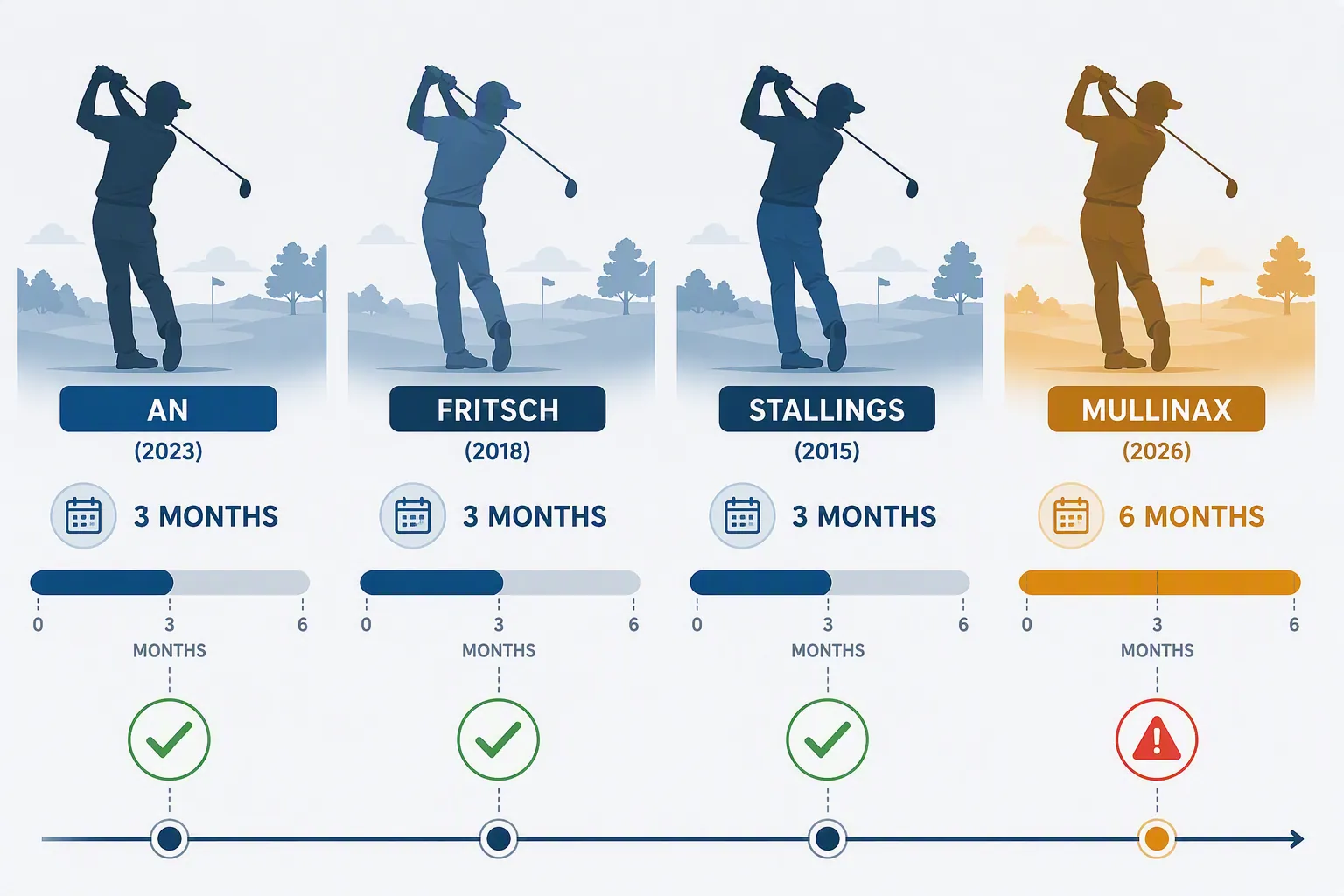
Those four matters are not identical. The public records differ in level of detail, timing, substance information, and whether the player self-reported before the Tour acted. The point is not to flatten them into one category. The point is that a lawyer reviewing sanction consistency will immediately ask what fact moved Mullinax from the three-month neighborhood to six months.
The Tour may have an internal answer. It may involve the substance, the timing of disclosure, the player’s conduct after notice, the applicable manual language, or some aggravating factor not included in the public statement. But as of July 30, 2026, the public explanation does not identify that reason. Opacity is not the same thing as arbitrariness, but it creates the conditions in which athletes, agents, and counsel have to price uncertainty into every medication decision.
Six Months Is Not the Same Sanction for Every Player
A suspension’s formal length tells only part of the story. CBS Sports reported that by July 2026 Mullinax had made two PGA Tour starts in the 2026 season, missing the cut in both, and one Korn Ferry Tour start, also missing the cut.[3] That record does not prove a financial consequence from the suspension. It does show that the sanction lands on a player operating near the competitive margin, not on a star with guaranteed visibility and a locked-in competitive calendar.
For a marginal-status player, six months can mean more than six months. Missed eligibility can affect entry opportunities, ranking momentum, medical or conditional status planning, sponsor deliverables, and the ability to assemble a schedule for the following year. Those consequences are not automatic legal findings in Mullinax’s case. They are exposure zones that counsel would need to test against the Tour’s governing documents, tournament eligibility rules, endorsement agreements, equipment contracts, appearance obligations, and any insurance or disability language.
Prize money is similar. It is tempting to treat forfeiture as part of the headline, but the public record here does not supply a forfeited amount. The safer legal statement is that anti-doping discipline can trigger prize-money and benefit questions, and that those questions depend on the governing documents and the dates tied to the violation. Without the manual section, tournament-by-tournament record, and any Tour communication to the player, the number cannot be responsibly supplied.
What Counsel Should Take From the Case
The first lesson is documentary, not motivational. Athlete-side counsel should assume that “I have taken this before,” “my doctor prescribed it,” or “I did not know it was prohibited” will not cure a missing TUE. Those facts may matter later, but later is a weaker position than pre-clearance.
The second lesson is contract review. A suspension notice should trigger immediate review of endorsement default provisions, morals clauses, cooperation duties, confidentiality restrictions, payment milestones, appearance obligations, equipment-use commitments, and any clause that ties compensation to eligibility or Tour membership status. The public Mullinax record does not show sponsor action; the point is that the suspension creates a reason to check.
The third lesson is system design. If a private regulator wants strict pre-clearance, it can write strict pre-clearance. But if the same system publicly groups good-faith medication mistakes with more culpable conduct under the anti-doping label, it should expect scrutiny over sanction differentials. The An, Fritsch, Stallings, and Mullinax sequence gives lawyers enough to ask about consistency, though not enough to answer the question from public materials alone.
The fourth lesson is communications discipline. The absence of a disclosed substance or condition protects privacy, but it also narrows the institution’s explanation for why six months was appropriate. A player may want more public context; a regulator may want less. Both choices carry legal and reputational tradeoffs.
The Narrow Conclusion
Mullinax’s case is a fresh, concrete example of how a private sports disciplinary system can turn a missed pre-clearance step into consequences that reach beyond the announced suspension window. The key feature is not that the Tour punished a player who claimed a medical explanation. It is that the TUE process appears to leave no harmlessness or good-faith safety valve at the liability stage, while the public sanction explanation does not show why comparable inadvertent-ingestion or TUE-adjacent cases drew three months and Mullinax drew six.
Because the notice is only one day old as of July 30, 2026, the risk assessment remains provisional. The substance identity, medical details, sponsor responses, appeal posture, and any fuller manual-based procedural explanation could change the legal reading if later sourced materials appear.
References
- Statement from the PGA TOUR regarding Trey Mullinax suspension, PGA Tour, July 29, 2026.
- Trey Mullinax suspended 6 months for violating PGA Tour drug policy, AP News.
- PGA Tour: Trey Mullinax suspension anti-doping policy, CBS Sports.
- Office of the Commissioner statement regarding Byeong Hun An, PGA Tour, Oct. 11, 2023.
- Journeyman pro golfer suspended from PGA Tour after ingesting weight-loss spray, CBS Sports.
- Scott Stallings suspended by PGA Tour for doping violation, The Guardian, July 8, 2015.
- 2026 Prohibited Substances and Methods List, PGA Tour.
Related records
Tool profile
Browse tool evaluations →Governing regulation
Browse the obligations tracker →Preventive workflow
Browse verification workflows →
Report a correction or tip
Spotted an outdated figure, a misstated fact, or a ruling this case record should reflect? Public comments are disabled for this content given the professional cost of a misreported case outcome, penalty amount, or rule text — use the structured correction channel instead.
Report a correction or tip for this record →