
How Tristan Thompson Filed for Amari Conservatorship
This article traces the three-step legal process Tristan Thompson used to gain guardianship and later file for limited conservatorship over his brother Amari, mapping each filing to its California Probate Code requirements. Readers will understand the statutory framework for adult protective conservatorships and the procedural standards for least restrictive intervention.
- Jurisdiction
- US - California
- Court
- Los Angeles Superior Court
- AI tool named
- None
- Ruling date
- Apr 27, 2026
- Source document
- View primary court order ↗
- Last verified
- Jul 30, 2026
Lex Machina Review is an independent risk-tracking and reference resource. Nothing on this site is legal advice, and using it does not create an attorney-client relationship. Every record is reviewed against primary sources but may not reflect the most current status of a matter — always verify directly against the cited court order, rule text, or a licensed attorney before relying on it.
Companion explanation — secondary to the source document above
This is a risk-digest procedural note, not legal advice, and not an AI-sanction incident analysis. The useful legal details in Tristan Thompson’s conservatorship filing for Amari Thompson start at the point where a minor guardianship stopped being the right tool: Amari became an adult, and California law required a different, narrower proceeding if someone else was to receive authority over his personal or financial decisions.
For the April 27, 2026 limited-conservatorship filing, the record used here is People’s report and Page Six’s parallel report; the underlying petition is not independently linked from a public court docket in the record reviewed here.[1][2] The governing adult-conservatorship standard comes from California Probate Code § 1801 and California Courts’ limited-conservatorship guidance.[3][4] The earlier guardianship order is traced through People’s February 2024 report on the Los Angeles Superior Court proceeding.[5]
The legal hinge was adulthood, not celebrity
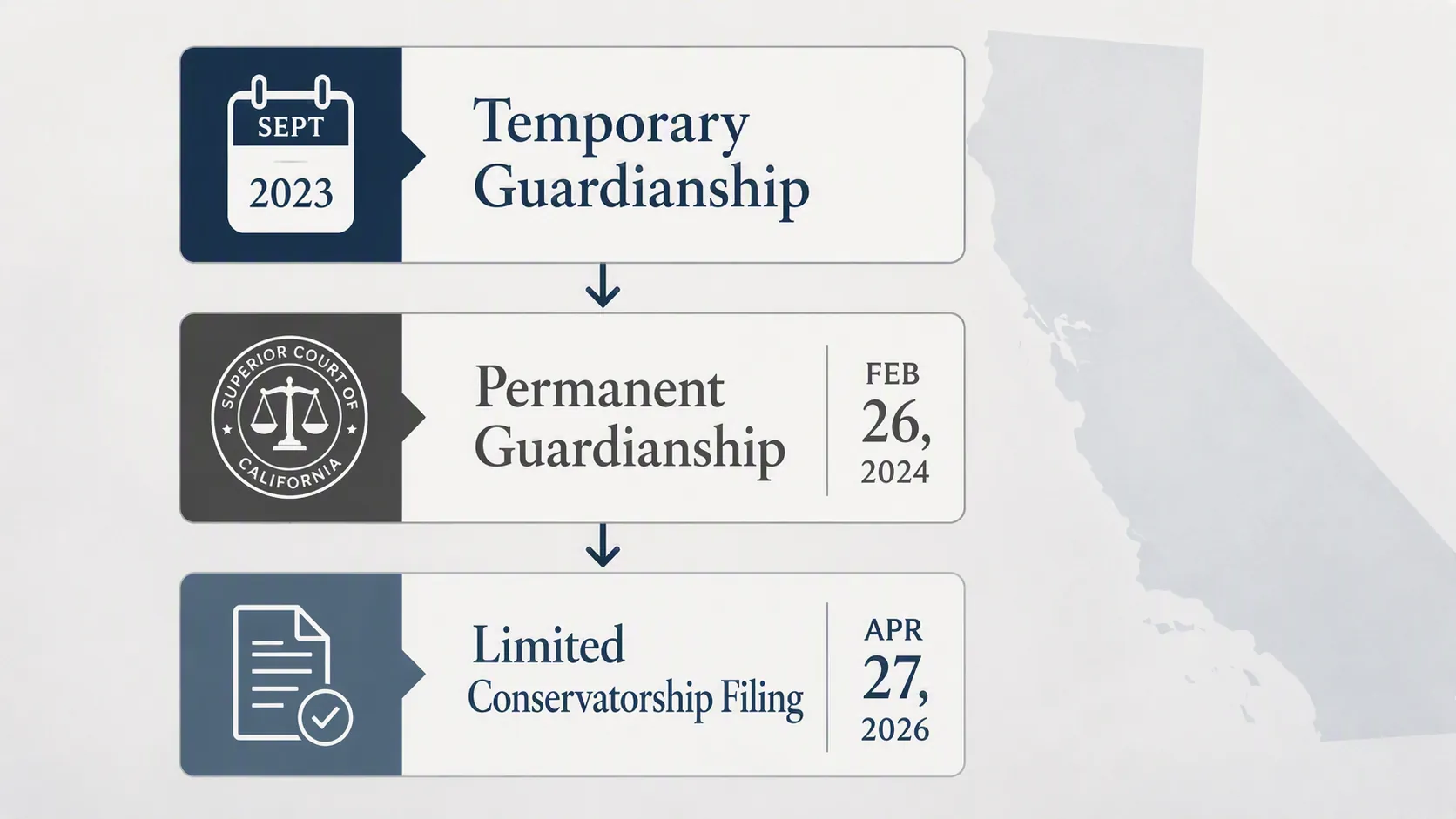
The public timeline is short, but each step did different work. Temporary guardianship gave immediate authority while Amari was still a minor. Permanent guardianship supplied continuing authority after the court made findings about parental abandonment and best interest. Limited conservatorship became the relevant filing only after Amari was no longer a minor.
| Step | Reported date | What it legally did |
|---|---|---|
| Temporary guardianship | September 2023 | Placed Tristan Thompson in a temporary caretaker role for Amari while the guardianship issue was pending and Amari was still a minor.[5] |
| Permanent guardianship | February 26, 2024 | Made Tristan Amari’s legal guardian after the Los Angeles Superior Court reportedly found that Amari’s father had abandoned him and that returning Amari to Canada was not in Amari’s best interest.[5] |
| Limited conservatorship filing | April 27, 2026 | Asked the court to appoint Tristan as limited conservator for Amari, then 19, under California’s adult developmental-disability framework.[1][2][3] |
Why the February 2024 guardianship order carried the case while Amari was still 17
People reported that Amari was 17 when the Los Angeles Superior Court granted Tristan permanent legal guardianship on February 26, 2024.[5] That age is not a background detail. It explains why the legal vehicle was guardianship at that time: the proceeding concerned authority over a minor.
The reported abandonment finding also explains why the court could look past the surviving father as the presumptive caretaker. Without that finding, a celebrity sibling’s willingness to step in would not answer the core question. The legal issue was not who seemed more responsible in public coverage. It was whether the court could place legal authority with someone other than a parent and still satisfy California’s child-protection standards.
That is the part of the story that often gets flattened. The order did not make Tristan a conservator. It made him a guardian for a minor after a court finding that parental return was not viable and that the guardianship served Amari’s best interest.[5] Once Amari became an adult, that structure could not simply continue as if nothing had changed.
At 18, guardianship stopped solving the legal problem
The available reports do not supply one cleanly sourced birth date for Amari. They do, however, establish the legally relevant age markers: he was 17 at the February 2024 guardianship order and 19 when Tristan filed for conservatorship in April 2026.[1][5]
California’s limited-conservatorship process is designed for adults with developmental disabilities, not for minors. California Courts describes limited conservatorship as a proceeding in which a judge may appoint a responsible adult to help an adult with a developmental disability in specific areas where help is needed.[4] That is why the April 2026 filing was not just a renewal of the old guardianship. It triggered a separate adult-rights analysis.
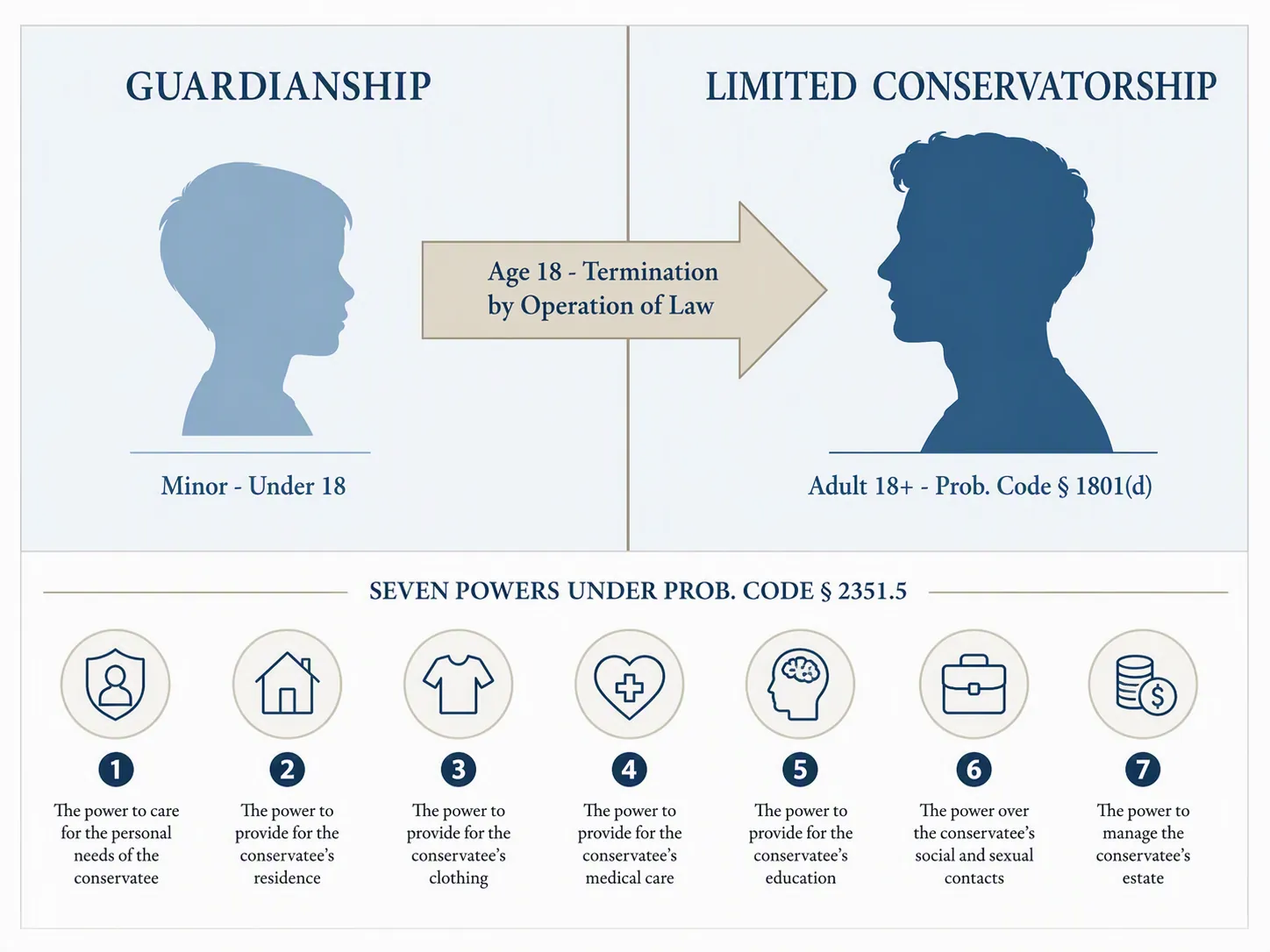
That distinction protects more than terminology. A minor guardianship substitutes adult authority because the person is legally a child. A limited conservatorship for an adult removes or transfers only powers the court finds necessary to transfer. The second proceeding therefore must do more than show continuity of family care.
What the April 2026 limited-conservatorship filing had to address
California Probate Code § 1801(d) allows a limited conservatorship for a person with a developmental disability, but only on clear-and-convincing evidence that a limited conservatorship is necessary and is the least restrictive alternative needed for the person’s protection.[3] The statutory words are doing real work there. A developmental disability alone is not enough. A caring proposed conservator is not enough. The court must connect the requested powers to the adult’s actual needs.
People reported that the April filing said Amari has an intellectual disability and developmental delay, cannot manage his personal needs or financial transactions, and is susceptible to fraud or undue influence.[1] Page Six reported the same general filing details.[2] Those allegations fit the kind of evidence a petitioner would be expected to present, but they are still allegations in a petition as reported by news outlets, not findings quoted from a final order.
The medical context helps explain why this proceeding exists, but it does not decide it. The LGS Foundation describes Lennox-Gastaut Syndrome in adults as involving drug-resistant seizures, frequent lifelong intellectual disability, and, for some adults, substantial or around-the-clock support needs.[6] That background can make developmental-disability planning legally relevant. It does not replace the required judicial findings about Amari’s own capacity, needs, and less restrictive alternatives.
“Does not object” is not the same as choosing a conservator
The April filing language is careful in a way celebrity coverage should not blur. People reported that the filing says Amari “does not object” to the conservatorship, while also saying he “is unable to comment on the selection of a conservator due to his developmental delay and intellectual disability.”[1] Page Six reported the same distinction.[2]
Those two statements are not interchangeable. “Does not object” describes the absence of opposition as reported in the petition. “Unable to comment on the selection of a conservator” points to a capacity limitation on a specific choice. Treating the first sentence as consent would skip the very procedural review California requires.
California Courts’ limited-conservatorship guidance identifies two safeguards that matter here: a court investigator evaluates the situation and reports to the judge, and a regional center assessment is required in limited-conservatorship cases involving developmental disability.[4] Those actors are not decorative. Their job is to help the judge decide whether intervention is needed at all, whether alternatives would be less restrictive, and whether the proposed conservator is appropriate.
Limited conservatorship means powers are itemized
A limited conservatorship is not a general license to run another adult’s life. Disability Rights California explains that California Probate Code § 2351.5 identifies seven powers a court may grant in a limited conservatorship, and the conservatee keeps the rights that are not expressly transferred.[7]
- Fixing the conservatee’s residence or specific dwelling.
- Accessing confidential records and papers.
- Consenting or withholding consent to marriage.
- Entering into contracts.
- Giving or withholding medical consent.
- Controlling social and sexual contacts and relationships.
- Making decisions about education.
The public reports do not identify which of those seven powers Tristan asked the court to grant. They describe a request to be appointed limited conservator, along with allegations about Amari’s personal-care needs, financial vulnerability, and inability to make certain comments about the choice of conservator.[1][2] Without the petition itself or an order listing granted powers, it would be overreading the record to say which rights the court was asked to transfer, much less which rights the court granted.
The same caution applies after appointment. Disability Rights California describes continuing review protections in limited conservatorships, including later court-investigator review.[7] The proceeding is not supposed to end with a family member’s assurance that care is needed.
What remains unresolved from the public record
The strongest supported conclusion is procedural. Tristan first received temporary guardianship while Amari was a minor, then permanent guardianship after the February 26, 2024 order, and later filed for limited conservatorship after Amari became an adult.[1][5] That sequence matches the basic California shift from child guardianship to adult limited conservatorship.
The weaker conclusions are the ones that would require documents not available in the research record. The public reports do not provide an independently hosted docket copy of the April 2026 filing. They do not identify the specific § 2351.5 powers requested. They do not establish a final order granting a conservatorship. They also do not eliminate the court’s duty to consider less restrictive alternatives.
So the legal picture is narrower than a headline about a brother “taking control.” The filings, as reported, address the framework California requires: developmental disability, asserted inability to manage personal and financial needs, vulnerability to undue influence, and the proposed conservatee’s limited ability to comment on the selection of a conservator.[1][2][3] A limited conservatorship still depends on independent court findings that the intervention is necessary, supported by clear-and-convincing evidence, and no broader than needed.
References
- Tristan Thompson Files for Conservatorship over Brother Amari, 19, People, April 28, 2026.
- Tristan Thompson files for conservatorship over 19-year-old brother Amari, Page Six, April 28, 2026.
- California Probate Code § 1801 (2025), Justia, 2025.
- Limited conservatorships, California Courts Self-Help Guide.
- Tristan Thompson Granted Legal Guardianship Over Younger Brother Amari After Their Mother's Death, People, February 28, 2024.
- Adults with Lennox-Gastaut Syndrome, LGS Foundation.
- Limited Conservatorships & Alternatives, Disability Rights California.
Related records
Tool profile
Browse tool evaluations →Governing regulation
Browse the obligations tracker →Preventive workflow
Browse verification workflows →
Report a correction or tip
Spotted an outdated figure, a misstated fact, or a ruling this case record should reflect? Public comments are disabled for this content given the professional cost of a misreported case outcome, penalty amount, or rule text — use the structured correction channel instead.
Report a correction or tip for this record →