
Trump 2028 Term Limits: The VP Loophole Examined
Can a twice-elected president serve a third term by running as vice president? This analysis examines why leading constitutional scholars across the ideological spectrum uniformly call the VP-loophole theory implausible under the 22nd and 12th Amendments.
- Jurisdiction
- United States
- Court
- Supreme Court of the United States
- AI tool named
- Not applicable
- Ruling date
- Jul 25, 2026
- Source document
- View primary court order ↗
- Last verified
- Jul 25, 2026
Lex Machina Review is an independent risk-tracking and reference resource. Nothing on this site is legal advice, and using it does not create an attorney-client relationship. Every record is reviewed against primary sources but may not reflect the most current status of a matter — always verify directly against the cited court order, rule text, or a licensed attorney before relying on it.
Companion explanation — secondary to the source document above
As of Q3 2026, the answer a lawyer would have to give is narrower than the public argument usually allows: a twice-elected Donald Trump could point to a textual opening in the 22nd Amendment, but the dominant constitutional-law view is that he could not appear on a 2028 ticket as vice president and then constitutionally succeed to the presidency. This is a predictive constitutional-law risk assessment, not legal advice and not a statement of settled Supreme Court precedent. No court has directly decided the question.
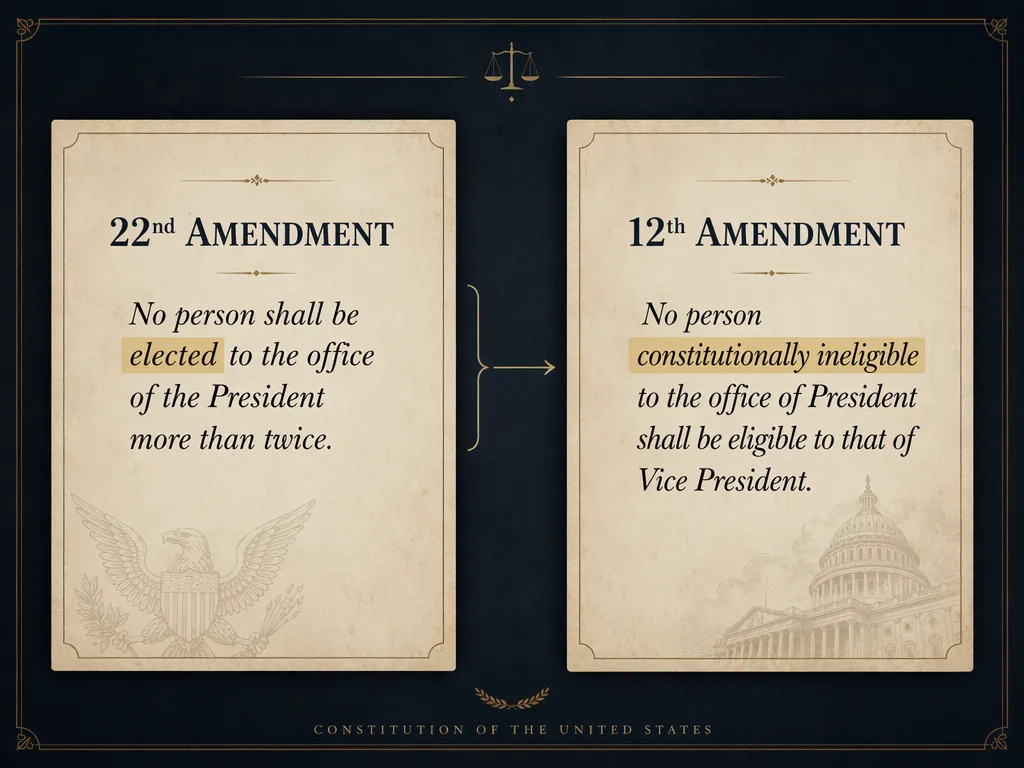
The reason is not that the proposed move is too strange to brief. It is that the move asks the 22nd Amendment to do only one thing—bar a third election to the presidency—while asking the 12th Amendment to ignore what that bar means for vice-presidential eligibility. That is a hard ask. The 12th Amendment says that “no person constitutionally ineligible to the office of President shall be eligible to that of Vice-President.” If the 22nd Amendment makes a twice-elected president constitutionally unable to be elected president again, the better reading is that the same constitutional disability follows him onto the vice-presidential line.
The strongest version of the VP-loophole argument
The VP-loophole theory begins with a clean textual distinction. The 22nd Amendment does not say that a twice-elected president may never again “serve” as president. It says that “no person shall be elected to the office of the President more than twice.” Peabody and Gant’s 1999 article, “The Twice and Future President,” is the familiar starting point for that elected-versus-eligible distinction: a person barred from being elected president, the argument runs, is not necessarily barred from holding the presidency by succession after being elected vice president. [1]
That distinction is not frivolous merely because it is inconvenient. Constitutional text often turns on chosen verbs, and “elected” is not the same word as “serve.” If the 22nd Amendment had meant to impose a complete service ban, it could have said so more directly. The amendment also contains a separate partial-term rule, which reinforces that its drafters knew how to regulate the relation between elections, service, and time in office.
The theory becomes concrete in the 2028 scenario usually described this way: Trump, having been elected president in 2016 and 2024, would run for vice president on another candidate’s ticket, perhaps with JD Vance at the top. After the election, the president-elect or president would resign, die, be removed, or otherwise be displaced, and Trump would succeed to the presidency without having been elected to that office a third time.
A careful analysis cannot skip that first step. The argument is not that the 22nd Amendment permits a third presidential election. It plainly does not. The argument is that the succession route is different enough to escape the text. Coenen’s 2015 article is useful because it does not treat the question as a single slogan. It separates four inquiries: whether a twice-elected president is eligible to be vice president, whether that person may be elected vice president, whether that person may succeed to the presidency, and whether any term-length limit would apply after succession. [2]
That framework matters because different institutional actors would face different questions. A state election official or challenger might focus on ballot access. Congress, counting electoral votes, might face objections to the validity of vice-presidential electors. A court could be asked to resolve the issue before the election, after certification, after the Electoral College vote, or only after an attempted succession. Treating the “loophole” as a single clever sentence hides the procedural problem: someone with authority would have to accept each link in the chain.
Why the 12th Amendment likely closes the opening
The operative obstacle is the last sentence of the 12th Amendment. It does not merely require a vice president to satisfy age, citizenship, and residency qualifications. It says no person “constitutionally ineligible to the office of President” may be vice president. The question is therefore not only whether Trump could be “elected” president again. It is whether the 22nd Amendment makes him constitutionally ineligible to the office of president for purposes of the vice presidency.
The incorporation argument is straightforward. The 12th Amendment sets a derivative rule: eligibility for the vice presidency depends on constitutional eligibility for the presidency. The 22nd Amendment later adds a constitutional disability triggered by two presidential elections. Once that disability attaches, the vice-presidential office cannot be used as a side entrance to an office the person is constitutionally barred from obtaining through election.
The counterargument is also textual. The 12th Amendment was ratified long before the 22nd Amendment. One can argue that “constitutionally ineligible” in the 12th Amendment refers only to the presidency’s baseline qualifications, not to a later-enacted election bar. On that view, a twice-elected president remains the kind of person who can hold the office—old enough, natural-born, sufficiently resident—but cannot be elected to it again.
That is the point at which the loophole theory starts asking too much. A court would not be reading the 12th Amendment in isolation from the later amendment. It would be reading a single Constitution after the 22nd Amendment changed the eligibility landscape. The phrase “constitutionally ineligible” is broad enough to pick up constitutional rules beyond the original qualifications clause. The 22nd Amendment is one of those rules.
The structural consequence is difficult to avoid. If a twice-elected president may be elected vice president precisely because he cannot be elected president, then the 12th Amendment’s final sentence does little work in the very case where it is supposed to matter most: ensuring that the vice president can constitutionally become president. The vice presidency is not merely an honorary office with separate ceremonial qualifications. Its succession function is built into the office.
| Question | Loophole theory | Likely court response |
|---|---|---|
| Does the 22nd Amendment literally bar a third presidential election? | Yes; the theory does not contest that. | A twice-elected president cannot be elected president again. |
| Does the amendment literally say “serve”? | No; it says “elected.” | The wording creates a colorable textual argument, but not the end of the analysis. |
| Can the person be vice president anyway? | Yes, if “constitutionally ineligible” means only baseline qualifications. | Probably not; the 12th Amendment likely incorporates the later 22nd Amendment bar. |
| Can succession cure the problem? | Yes, because succession is not election. | Probably not; the succession theory would defeat the two-election limit. |
What the scholarly weight adds
The important point about the scholarship is not that every scholar uses the same interpretive route. It is that scholars with different instincts about text, structure, and constitutional purpose converge on the same practical answer: the VP-loophole theory is highly unlikely to survive.
FactCheck.org’s April 2025 synthesis is especially useful because it put the question directly to constitutional-law professors rather than treating the issue as campaign chatter. David Super of Georgetown, Paul Gowder of Northwestern, and Jeremy Paul of Northeastern all rejected the theory’s viability. Super’s account emphasized that the 12th Amendment uses presidential eligibility as the gatekeeping rule for the vice presidency. Gowder described the theory as contrary to the constitutional design. Paul said the argument would defeat the 22nd Amendment’s purpose. [3]
Purpose alone should not be used as a solvent for text. But here the purpose and the cross-reference point in the same direction. The National Constitution Center’s account of the 22nd Amendment places it in the post-Franklin Roosevelt settlement over presidential tenure: after Roosevelt’s four elections, the amendment constitutionalized a limit on repeated presidential election beyond the prior two-term norm associated with George Washington. [4]
That history does not answer every hypothetical. It does, however, make the proposed route look less like a technical gap and more like a method of recreating the very accumulation of presidential tenure the amendment was adopted to prevent. The distinction between election and succession can matter in some settings. It becomes strained when the succession mechanism is deliberately arranged to return a twice-elected president to the office.
Paul’s separate public comments captured the same point in less judicial language. Northeastern Global News reported his description of the vice-presidential route as a “Bond-villain scheme,” while also noting that the text alone does not make the question disappear. [5] That combination is about right for litigation risk: the theory is not impossible to state, but its success would require a court to reward an evasion that the constitutional structure is built to prevent.
The Columbia Undergraduate Law Review’s 2025 synthesis is useful mostly as a map of the competing positions. It recognizes the textual opening while identifying the 12th Amendment and the 22nd Amendment’s anti-third-term function as the principal barriers. [6] It does not change the weight of authority, but it reflects the same pattern: the debate is real enough to describe, not strong enough to underwrite a campaign plan.
Unresolved is not the same as viable
There is no direct Supreme Court holding on whether a twice-elected president can be elected vice president and then succeed to the presidency. That absence matters. It means any confident statement that the issue is already “settled” should be qualified. A court would be deciding the question for the first time, likely under severe calendar pressure and with threshold disputes over standing, ripeness, political-question objections, remedy, and timing.
Those procedural uncertainties are not small. A pre-election challenge could be attacked as speculative if no succession has occurred. A post-election challenge could raise destabilizing remedy questions. State-by-state ballot litigation could produce inconsistent rulings before any federal appellate resolution. Congressional objections to electoral votes could add another institutional forum without removing the need for judicial review.
But none of that converts the merits into a coin flip. Courts routinely decide novel constitutional questions by reading related provisions together, especially where one interpretation would allow a party to accomplish indirectly what a later amendment forbids directly. The uncertainty is mainly procedural and remedial. On the substantive question, the 12th Amendment’s eligibility language gives courts a ready way to reject the maneuver without inventing a new constitutional doctrine.
The political facts cut in the same direction only modestly. BBC reported in October 2025 that Trump himself called the vice-presidential scenario “too cute” and said it “wouldn’t be right.” [7] That statement is not constitutional authority. It is relevant because it shows even the supposed beneficiary has publicly distanced himself from the cleanest version of the evasion. A court would not need that fact to rule, and counsel should not lean on it as a merits argument.
The practical risk judgment for 2028
For a client asking whether the VP-loophole theory is sanction-proof, briefable, and likely to prevail, the answers are not identical. It is briefable in the limited sense that the 22nd Amendment’s elected-versus-serve wording supplies a real textual hook. A lawyer could describe the argument without pretending the words are invented. That is the theory’s best feature.
Its weaknesses are larger. The theory depends on a narrow reading of the 12th Amendment’s “constitutionally ineligible” clause, a narrow reading of the 22nd Amendment’s function, and a court’s willingness to separate vice-presidential election from presidential succession even when the point of the arrangement is to produce a third Trump presidency. It also runs against the published assessments of leading scholars who have addressed the issue directly.
The most defensible advisory position is therefore sober rather than theatrical: no court has directly ruled on the VP-loophole theory, so litigation would carry genuine procedural uncertainty. On the merits, however, counsel should treat the theory as highly unlikely to prevail and not as a credible path to a constitutionally valid third Trump presidency.
References
- The Twice and Future President, Minnesota Law Review, 1999.
- Two-Time Presidents and the Vice-Presidency, Boston College Law Review, 2015.
- Legal Scholars Dispute Constitutional 'Loophole' for a Third Trump Term, FactCheck.org, April 2025.
- The 22nd Amendment and Presidential Service Beyond Two Terms, National Constitution Center, Nov. 2024.
- Trump keeps talking about a third term. Is that possible?, Northeastern Global News, March 2025.
- The 22nd Amendment and Trump’s Possible Path to Reelection, Columbia Undergraduate Law Review, Dec. 2025.
- Trump says he would 'love' third term but is 'not allowed', BBC, Oct. 2025.
Related records
Tool profile
Browse tool evaluations →Governing regulation
Browse the obligations tracker →Preventive workflow
Browse verification workflows →
Report a correction or tip
Spotted an outdated figure, a misstated fact, or a ruling this case record should reflect? Public comments are disabled for this content given the professional cost of a misreported case outcome, penalty amount, or rule text — use the structured correction channel instead.
Report a correction or tip for this record →