
No Law Required Tying Saudi Nuclear Aid to Abraham Accords
Examines whether US law required linking Saudi-Israel normalization to the civilian nuclear deal, and what legal leverage was lost when the Trump administration dropped that condition. The article concludes no statute mandated the linkage, but its removal shifted oversight to a congressional disapproval pathway with high procedural barriers.
- Jurisdiction
- United States
- Ruling date
- Jul 22, 2026
- Source document
- View primary court order ↗
Lex Machina Review is an independent risk-tracking and reference resource. Nothing on this site is legal advice, and using it does not create an attorney-client relationship. Every record is reviewed against primary sources but may not reflect the most current status of a matter — always verify directly against the cited court order, rule text, or a licensed attorney before relying on it.
Companion explanation — secondary to the source document above
The clean legal answer is also the uncomfortable one: no federal statute required the Trump administration to condition a Saudi civilian nuclear cooperation agreement on Saudi normalization with Israel. The Abraham Accords condition was a diplomatic bargain, not a statutory command. That distinction matters because once the administration stopped treating normalization as a prerequisite, Congress and Israel did not fall back on a hidden legal veto. They fell back on the ordinary Section 123 review process, which is much weaker than the phrase “Congressional review” often suggests.
The contrast with the Biden-era package is sharp. By mid-2024, the contemplated arrangement reportedly linked U.S.-Saudi nuclear cooperation to a larger regional bargain: Saudi-Israel normalization, a pathway involving the Palestinians, and security commitments between Washington and Riyadh. During Trump’s May 2025 visit to Riyadh, that linkage moved from the center of the bargain to the side of the stage. Trump described normalization with Israel as something Saudi Arabia could pursue on “its own time,” and called it a “dream,” while announcing major U.S.-Saudi deals without making normalization the price of nuclear cooperation.[1]

That was a policy reversal, not automatically a legal violation. The harder question is what kind of legal instrument would have been needed to make the linkage enforceable. The answer is not “the Abraham Accords” by themselves. It is not a press statement. It is not a diplomatic understanding unless it is built into a binding condition that affects legal approval. It would have required either the terms of the nuclear agreement itself, a statute changing the approval process, or another enforceable legal commitment that made normalization a condition of cooperation.
What Section 123 Actually Asks
Civilian nuclear cooperation agreements are governed by Section 123 of the Atomic Energy Act. Its nonproliferation architecture is familiar: peaceful-use assurances, safeguards, physical security, limits on retransfers, rules on enrichment and reprocessing, and termination rights. Those criteria can be demanding, but they are nuclear criteria. They do not ask whether Saudi Arabia has normalized relations with Israel, joined a regional peace framework, accepted a Palestinian state pathway, or signed onto a new diplomatic architecture.
That is why the Biden linkage always had to be understood as leverage attached to a negotiation, not a condition supplied by Section 123. Washington could say to Riyadh: the nuclear agreement, security package, and diplomatic normalization move together or not at all. But unless Congress enacted that linkage, or the parties wrote it into an enforceable agreement, the condition remained a bargaining position.
The July 22, 2026 agreement itself is still difficult to evaluate at the clause level because the full text has not been publicly released. Reuters reported that the Trump administration would seek congressional approval for a Saudi nuclear energy pact that lacks earlier restrictions demanded by nonproliferation advocates, and that Secretary of State Marco Rubio defended the agreement as not posing a proliferation risk.[2] That reporting supports a bounded conclusion: based on what is public, the delinkage from Israel normalization is not barred by Section 123. It does not prove that every nuclear term in the agreement satisfies the statute.
The narrower statutory question of whether U.S. law required the Israel linkage is addressed more directly in Did U.S. Law Require Linking the Saudi Nuclear Deal to Israel Peace?. The key point here is what follows from that answer. If the linkage was policy rather than law, a new president could remove it unless Congress had changed the default rules.
The Missing Statute
Congress had tools available, but tools are not outcomes. The proposed No Nuclear Weapons for Saudi Arabia Act, S.4243 in the 119th Congress, would have required affirmative congressional approval for nuclear cooperation with Saudi Arabia. It was not enacted.[3] That is the legal hinge. Had Congress required affirmative approval, the administration would have needed to assemble a majority willing to bless the deal before it could proceed. Without that change, the deal travels through the ordinary Section 123 pathway.
| Instrument | What it could do | What it did not do |
|---|---|---|
| Section 123 of the Atomic Energy Act | Set nuclear cooperation criteria and provide a congressional review mechanism | Require Saudi-Israel normalization |
| Biden-era diplomatic package | Use U.S. nuclear cooperation as leverage for normalization and broader regional commitments | Bind a later administration unless made legally enforceable |
| Abraham Accords | Create diplomatic commitments among participating governments | Operate as a statutory condition on future Saudi nuclear cooperation |
| S.4243 / No Nuclear Weapons for Saudi Arabia Act | Change the default by requiring affirmative congressional approval | Take effect, because it was not enacted |
| NDAA reporting and waiver rules | Force reporting, certification, or waiver processes on specified safeguards issues | Create an Israel-normalization condition for a Saudi 123 agreement |
This is where much of the public shorthand becomes misleading. A reporting requirement is not a prohibition. A waiver requirement is not the same as an affirmative approval vote. A proposed bill is not law. An executive agreement can matter enormously as diplomacy and still fail to constrain a later nuclear cooperation agreement unless its terms are tied to that agreement’s legal operation.
The 2020 National Defense Authorization Act requirements concerning Additional Protocol issues belong in this category. They can inform congressional oversight and force the executive branch to explain safeguards choices. They do not, on the materials currently available, supply a statutory rule that says Saudi normalization with Israel must precede nuclear cooperation.
The Abraham Accords also do less legal work than their branding suggests. They are diplomatically important, and they changed the regional vocabulary for Arab-Israeli normalization. But they are not a standing congressional condition on all future Middle East security or nuclear cooperation. Congress could have used the Accords as a policy reference point in a Saudi-specific statute. It did not.
Why the 90-Day Review Is a Weak Backstop
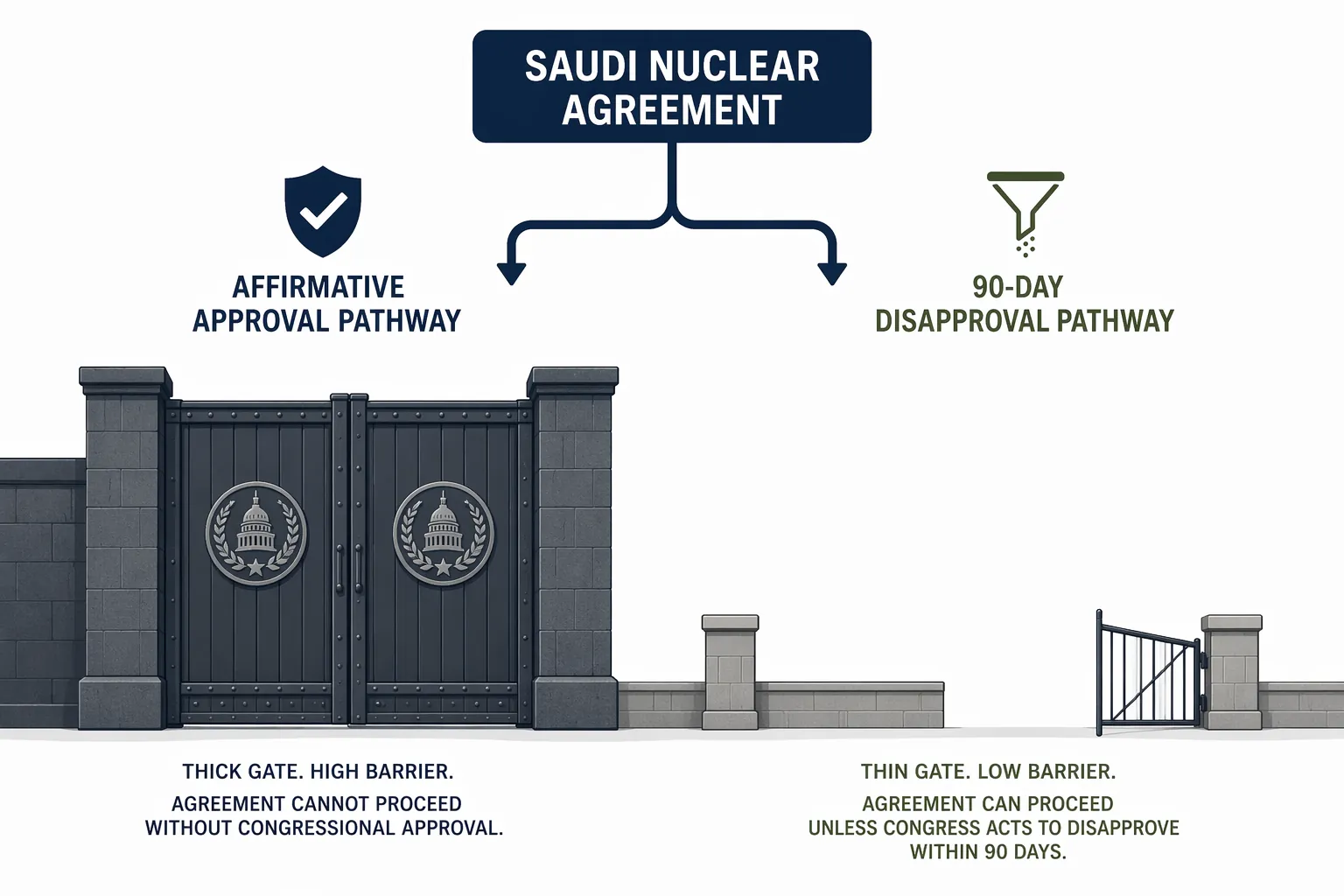
The practical consequence of delinkage is not that Congress has no role. It is that Congress’s role becomes reactive. Under the ordinary Section 123 structure, an agreement can proceed after the review period unless Congress successfully blocks it. That is very different from a rule requiring affirmative approval before the agreement takes effect.
A disapproval pathway puts opponents on the clock. They must draft and move a blocking measure, navigate committee and floor procedure, hold together a coalition, and overcome the political reality that rejecting a presidential national-security agreement is harder than declining to approve one in the first place. If the president supports the agreement, opponents also have to think in veto-proof terms, not simply in press-release terms.
That is why “Congress still gets review” can be a false comfort. Review is not equivalent to control. A member can complain, request briefings, introduce a resolution, or demand safeguards language. None of that recreates the leverage of a statutory affirmative approval requirement or a negotiated condition that Saudi Arabia must satisfy before receiving cooperation.
The old leverage operated before the agreement was submitted. It sat at the bargaining table with Riyadh. The new leverage operates after the administration has signed and defended the deal. That sequencing change is the whole story.
The Card That Was Played Early
Daniel B. Shapiro, the former U.S. ambassador to Israel, described the delinkage as “playing a valuable card that could have been held back,” with a “possible painful opportunity cost.”[4] That is the right frame because it does not pretend the card was a statute. It was leverage. The question is not whether Trump was forbidden to play it. The question is what he bought with it, and what he can no longer demand because it has already been spent.
For Israel, the lost leverage is straightforward. If Saudi Arabia wanted U.S. nuclear cooperation badly enough, Washington could have used that desire to extract a normalization commitment or at least preserve a structured path toward one. Once the nuclear agreement is delinked, Israel’s normalization interest becomes one objective among many rather than the price of admission.
For congressional staff and nonproliferation lawyers, the loss is institutional. A condition that lives in negotiation can sometimes do more work than a weak statutory backstop, precisely because it prevents the deal from reaching Congress as a fait accompli. Once the executive branch transmits the agreement and frames it as central to U.S.-Saudi strategy, the burden shifts to opponents to stop an already-made bargain.
Rubio’s role makes that institutional shift unusually visible. As a senator, he co-sponsored earlier versions of the No Nuclear Weapons for Saudi Arabia Act in 2018 and 2019. As secretary of state, he is now defending a delinked Saudi nuclear agreement as not posing a proliferation risk.[2] That is not automatically hypocrisy. Cabinet officers defend presidential bargains; senators protect congressional prerogatives. But the reversal usefully shows where the fight moved: from requiring Congress to affirmatively approve Saudi cooperation to requiring Congress to muster the votes and time to stop it.
The Proliferation Problem After Delinkage
The normalization condition was never the same thing as a nonproliferation safeguard. Israel recognition does not inspect centrifuges. It does not replace International Atomic Energy Agency safeguards. It does not resolve enrichment, reprocessing, or retransfers. But in regional diplomacy, conditions cluster. A government that wants a nuclear cooperation agreement may accept limits it would otherwise resist if the broader package is valuable enough.
That is why the safeguards question cannot be severed entirely from the normalization question. Arms Control Today reported, based on a November 2025 report to Congress, that the U.S.-Saudi deal was said to loosen prior nonproliferation vows, raising concerns about how Saudi terms could affect the region’s nuclear cooperation baseline.[5] The specific safeguards terms remain dependent on the unreleased agreement text and the reporting available so far, but the legal risk is already visible: once one partner receives more flexible terms, others will notice.
The United Arab Emirates is the obvious comparator because its 2009 nuclear cooperation agreement has long been treated as the regional “gold standard,” particularly because of its renunciation of enrichment and reprocessing. If Saudi Arabia receives less restrictive treatment, Emirati officials would have a ready argument for revisiting their own constraints. Egypt and Turkey would have their own reasons to read the Saudi terms as precedent rather than exception. Those reactions are plausible strategic consequences, not proven outcomes.
The Iran-war context adds urgency but not legal clarity. NBC News reported that the U.S.-Saudi nuclear deal had been accelerated amid the Iran war and Israeli concerns over uranium enrichment.[6] That may strengthen the administration’s national-security argument for speed. It does not answer whether the agreement’s safeguards are strong enough, whether Congress should accept the ordinary review pathway, or whether the United States should have kept normalization attached until Riyadh made concessions on Israel.
For readers focused on safeguards rather than normalization, the companion analysis How the US-Saudi nuclear deal's safeguards differ from IAEA standard addresses the technical baseline. The point here is narrower: delinkage reduced the number of issues Saudi Arabia had to settle in order to obtain nuclear cooperation.
What Congress Still Can Do
Congress is not powerless, but its options are different now. It can try to pass a joint resolution of disapproval. It can demand the agreement text, classified annexes, side letters, and safeguards explanations. It can press for conditions in appropriations or authorization legislation. It can revive Saudi-specific legislation requiring affirmative approval for future cooperation or future transfers. It can also use hearings to force the administration to explain whether any normalization understanding survives outside the nuclear agreement.
Those are oversight tools, not the same tool as a pre-signature condition. They work only if members are willing to spend floor time, absorb pressure from the administration, and accept the diplomatic cost of challenging Riyadh-facing policy. The statutory route remains available prospectively, but Congress cannot pretend that a bill it did not enact already governs the deal before it.
A sharper congressional strategy would stop arguing that delinkage was inherently illegal and focus instead on the approval default. If members believe Saudi nuclear cooperation should depend on normalization, enrichment limits, reprocessing prohibitions, or stronger safeguards, they need to write those requirements into law. Otherwise the executive branch will continue to treat them as negotiable policy preferences.
Legal Permission Is Not Strategic Wisdom
The Trump administration did not need a statute to drop the Abraham Accords condition because no statute imposed that condition in the first place. Section 123 does not require Saudi-Israel normalization. The Abraham Accords do not function as a standing legal trigger for future nuclear cooperation. S.4243 would have changed the terrain by requiring affirmative congressional approval, but it was not enacted.
That legal conclusion should not be mistaken for a strategic endorsement. The dropped condition mattered precisely because it was not automatic. It was leverage the United States had while Saudi Arabia still wanted the nuclear agreement. Once removed, the question shifts from what Riyadh must concede before cooperation begins to whether Congress can stop a deal the president has already chosen to make.
References
- Israel ‘normalisation’ takes back seat as Trump announces Saudi deals, Al Jazeera, May 13, 2025.
- Trump to seek Congress approval for Saudi Arabia nuclear energy pact that lacks restrictions, Reuters, July 22, 2026.
- S.4243 - No Nuclear Weapons for Saudi Arabia Act, Congress.gov.
- Experts react: Reading between the lines of the new US-Saudi nuclear agreement, Atlantic Council.
- U.S.-Saudi Deal Said to Loosen Nonproliferation Vows, Arms Control Association.
- Trump US-Saudi nuclear deal uranium enrichment Iran war Israel, NBC News.
Related records
Tool profile
Browse tool evaluations →Governing regulation
Browse the obligations tracker →Preventive workflow
Browse verification workflows →
Report a correction or tip
Spotted an outdated figure, a misstated fact, or a ruling this case record should reflect? Public comments are disabled for this content given the professional cost of a misreported case outcome, penalty amount, or rule text — use the structured correction channel instead.
Report a correction or tip for this record →