
Trump Tariffs Legal Impact on Consumers Reaches the Courts
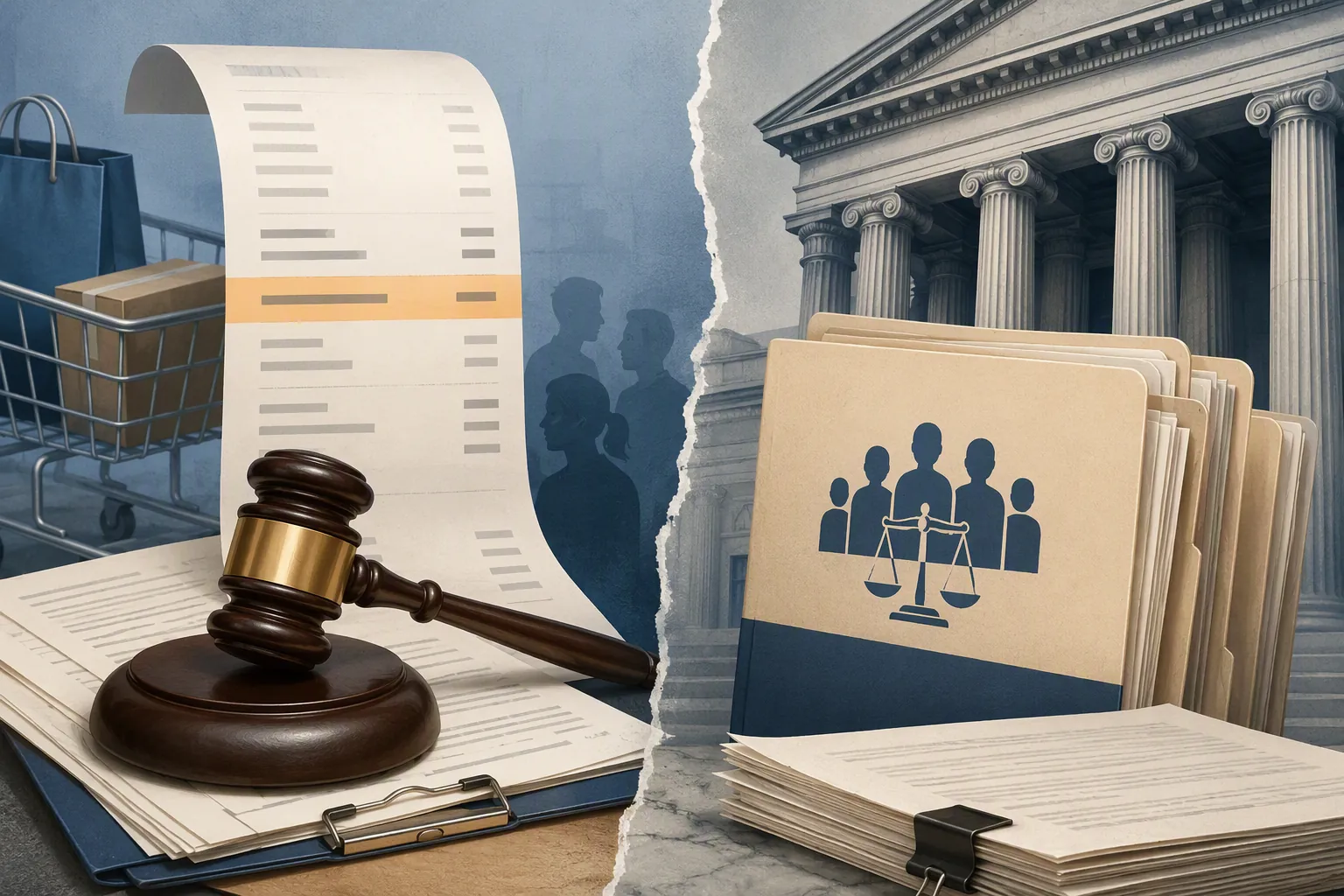
More than 100 consumer class actions have been filed after the Supreme Court invalidated IEEPA tariffs. This Risk Digest entry explains the legal theories, key defendants, and threshold defenses that will determine whether these cases proceed.
- Jurisdiction
- United States
- Court
- U.S. District Court for the Northern District of Illinois
- AI tool named
- None
- Ruling date
- Feb 20, 2026
- Source document
- View primary court order ↗
- Last verified
- Jul 29, 2026
Lex Machina Review is an independent risk-tracking and reference resource. Nothing on this site is legal advice, and using it does not create an attorney-client relationship. Every record is reviewed against primary sources but may not reflect the most current status of a matter — always verify directly against the cited court order, rule text, or a licensed attorney before relying on it.
Companion explanation — secondary to the source document above
Litigation over the legal impact of the 2025 Trump tariffs on consumers has already moved past the warning-label stage. More than 100 putative consumer class actions have been filed across more than 30 federal districts, with Holland & Knight reporting more than 80 cases in June 2026 and Thompson Coburn describing the count as upward of 100 by July 2026.[1][2] That pace matters, but it should not be confused with legal viability. As of July 29, 2026, no court has ruled on the merits of these IEEPA tariff consumer class actions.
The first serious sorting event is expected in Stockov v. Costco Wholesale Corp. in the Northern District of Illinois, where a pending motion tests ripeness and voluntary-payment defenses.[3] If that motion produces a clean dismissal theory, the wave starts to look like a docket-management problem with a template answer. If it does not, defendants may be looking at expensive discovery into pricing, surcharge language, refund accounting, consumer disclosures, arbitration programs, and state-law variations.
The Refund Gap Is the Center of the Case
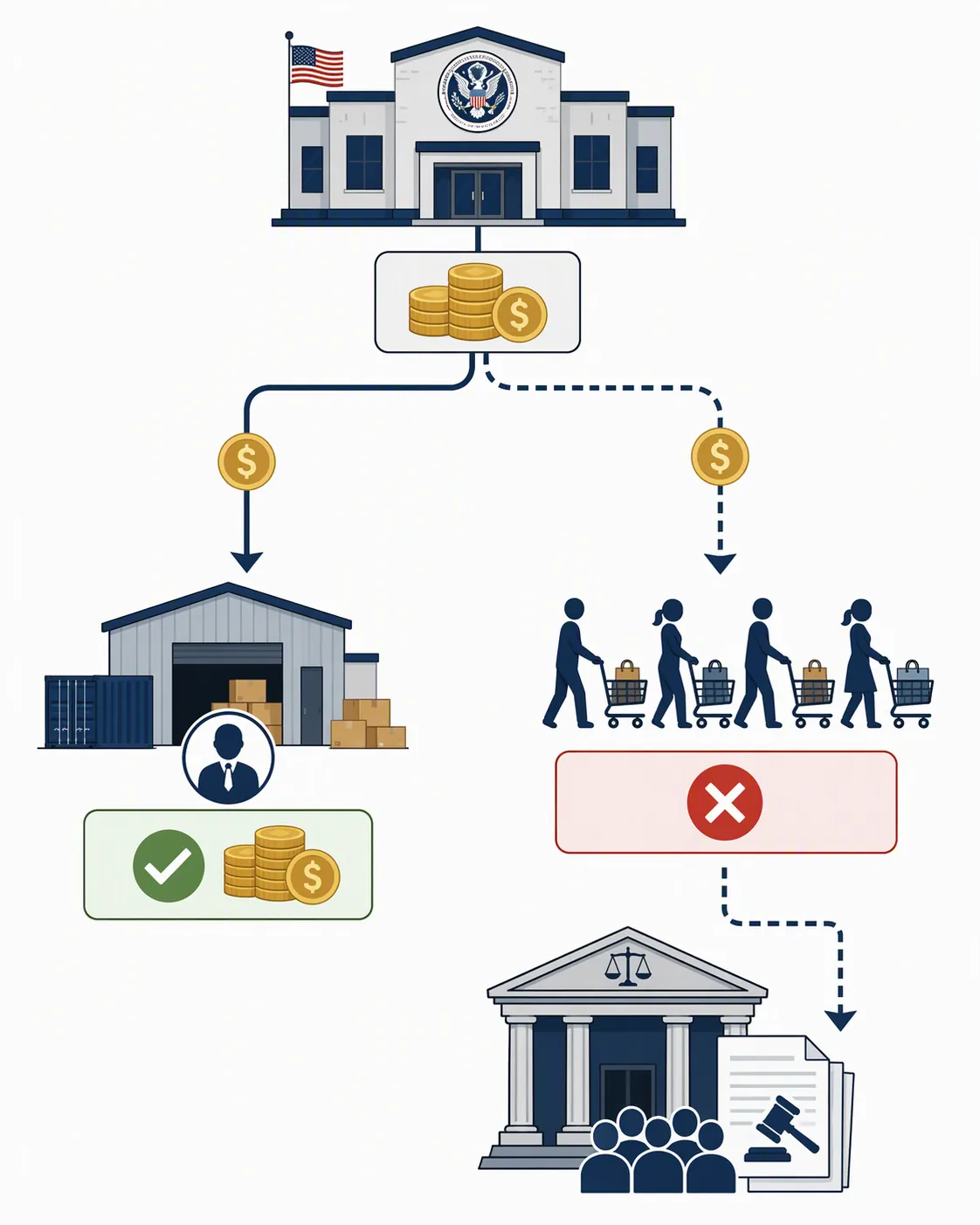
The cases do not arise merely because tariffs raised prices. They arise because the government-refund mechanism and the alleged consumer payment path do not line up.
The Tax Foundation reported that U.S. Customs and Border Protection collected approximately $133.5 billion in IEEPA duties through December 14, 2025, and estimated total illegal collections at $160 billion to $175 billion by the Supreme Court’s February 20, 2026 ruling.[4] Those figures explain why plaintiffs’ lawyers are interested. They do not tell us how much, if anything, consumers can recover from retailers, shippers, or brands.
The practical gap comes from the refund order. The Court of International Trade’s nationwide refund order directs refunds to importers of record under 19 C.F.R. § 24.36, and that order is on appeal before the Federal Circuit.[5] A consumer who paid a tariff surcharge at checkout, or who paid a higher price after a retailer publicly blamed tariffs, is not the party to whom CBP is directed to issue the refund. Plaintiffs are trying to use state-law consumer claims to bridge that missing link.
That is why incidence data, while important, does not end the analysis. New York Fed research found that 86% to 94% of tariff incidence fell on U.S. firms and consumers rather than foreign exporters.[6] Plaintiffs will cite that research to explain why the burden did not stay overseas. But economic incidence is not the same as a legal entitlement to a specific refund, against a specific defendant, under a specific state-law theory.
The Pleadings Follow Two Different Pass-Through Patterns
The complaints are not all equally positioned. The strongest plaintiff narratives are likely to come from visible tariff charges: a consumer sees an itemized surcharge, pays it, and later learns that the importer of record may receive a refund. Arnold & Porter has identified itemized tariff surcharges by companies including FedEx and UPS as one of the main pass-through patterns in the emerging litigation.[7]
The second pattern is less tidy: embedded price increases that were publicly attributed to tariffs. Arnold & Porter identifies companies such as EssilorLuxottica and Costco in that category.[7] These cases may have appealing public statements, but they also invite harder questions. Was the challenged price increase actually caused by tariffs? Was all of it caused by tariffs? Did the same price include freight, exchange-rate movement, supplier changes, inventory timing, or ordinary margin decisions?
That distinction should drive risk assessment. An itemized surcharge can simplify causation and consumer reliance, at least at the pleading stage. Embedded pricing requires plaintiffs to turn public tariff explanations into class-wide proof of overcharge. A press release, earnings-call comment, or website notice may help plaintiffs get past the first narrative hurdle, but it does not automatically isolate damages.
The named defendants show how broadly the filings have spread. Holland & Knight has identified cases against FedEx, UPS, Costco, Amazon, Nike, Lululemon, IKEA, Nintendo, and others.[1] That breadth is not surprising. The tariff story touched logistics, retail, apparel, furniture, electronics, and consumer goods. The more useful question is not whether a sector appears on the defendant list, but whether a particular company created a record that lets plaintiffs connect consumer payment to tariff collection and possible refund receipt.
What Plaintiffs Are Actually Pleading
The causes of action are familiar class-action tools: unjust enrichment, money had and received, breach of contract, state unfair and deceptive acts and practices statutes, and false advertising.[2] None requires a new tariff-specific consumer remedy. That is the point. Plaintiffs are not asking CBP to pay consumers directly; they are asking courts to treat defendants’ alleged retention of tariff-related amounts as recoverable under ordinary state-law theories.
| Theory | What plaintiffs need it to do | Early pressure point |
|---|---|---|
| Unjust enrichment | Treat retained tariff-related amounts as inequitable once refunds are available | Whether the defendant has received, or will receive, a refund |
| Money had and received | Frame the alleged overcharge as money that should belong to consumers | Whether the payment can be traced to the tariff rather than the overall price |
| Breach of contract | Use checkout terms, invoices, or surcharge language as the promise | Whether the contract actually promised refund treatment or only disclosed a charge |
| UDAP statutes | Characterize tariff statements, surcharges, or refund retention as unfair or deceptive | State-law variation, reliance, materiality, and class certification |
| False advertising | Turn public tariff explanations into actionable consumer-facing representations | Whether statements were specific enough and caused the claimed payment |
The table is deliberately prosaic because the cases are prosaic at this stage. The pleadings will rise or fall on timing, documents, and state-law elements before anyone reaches a grand theory of tariff fairness.
Ripeness May Be the First Gate
Ripeness is the cleanest early defense where the alleged unjust enrichment depends on a refund that has not yet been received. The CIT refund order remains on appeal before the Federal Circuit.[5] If an importer has not received a refund, a defendant can argue that plaintiffs are suing over a contingent future event rather than a present enrichment.
That defense is especially important for defendants who are both importers of record and consumer-facing sellers. Plaintiffs want to collapse the chain: consumer pays defendant, defendant paid illegal tariffs, defendant will receive refund, consumer should recover. The unresolved appeal interrupts that chain. It may also affect damages, because the refund amount, timing, and scope remain dependent on what survives appellate review.
Stockov v. Costco is therefore more than one retailer’s motion. Covington has identified it as a pending bellwether testing ripeness and voluntary-payment arguments in this wave.[3] The ruling will not bind every court, but a well-reasoned order could become the first serious template for complaints filed on similar facts.
Standing and Traceability Are Not Economic Incidence
Standing should not be waved through just because tariff incidence fell heavily on U.S. firms and consumers. The NY Fed’s 86% to 94% finding supports the general proposition that the burden was substantially domestic.[6] A consumer class complaint still has to connect a plaintiff’s own payment to the challenged defendant’s conduct and requested relief.
That connection is easier when a receipt says something like a tariff surcharge. It is harder when the complaint alleges that a retailer raised prices during the tariff period and made public comments about tariffs. A court may ask whether the alleged injury is the higher price, the failure to refund, the misleading explanation, or the future retention of money. Each framing carries a different standing problem.
Traceability also becomes a class problem. A named plaintiff may have a clear receipt. Other class members may have bought different products, at different times, under different promotions, after different disclosures. The more plaintiffs rely on embedded pricing, the more defendants can argue that individualized pricing and causation questions swamp common proof.
The Voluntary-Payment Defense Will Not Fit Every Case the Same Way
The voluntary-payment doctrine gives defendants a direct answer to many overcharge theories: the consumer saw the price or surcharge and paid it. The defense is not magic. Its strength depends on state law, disclosure, mistake, coercion, and how the plaintiff frames the payment. But it is exactly the kind of threshold doctrine that can decide whether a tariff complaint reaches discovery.
Itemized surcharges cut both ways. They give plaintiffs a clean number and a clean story. They also give defendants a clean disclosure argument. If the consumer knowingly paid a disclosed tariff charge, the defendant will argue that ordinary state-law refund doctrines do not convert later government refunds into automatic consumer restitution.
Embedded price cases create a different voluntary-payment record. The consumer usually accepted an advertised product price, not a separately labeled tariff line. That may make disclosure less useful to the defense, but it also makes the alleged tariff component harder to isolate. Plaintiffs cannot recover a tariff overcharge simply by pointing to a price increase unless they can plead and later prove that the increase was tariff-driven in a legally cognizable way.
Arbitration May Remove Some of the Most Consumer-Facing Claims
The filings count can overstate practical exposure if a meaningful share of claims is subject to enforceable arbitration clauses. Retailers, online marketplaces, delivery platforms, loyalty programs, and account-based sellers may have class waivers or arbitration provisions that change the economics of the litigation before merits issues are reached.
For defendants, the first document review should be boring and fast: checkout terms, account-creation screens, order confirmations, shipping terms, app terms, amendment histories, opt-out language, and version control. A tariff refund theory may be novel, but a motion to compel arbitration will depend on the same formation and notice questions courts already know how to decide.
The Federal Arbitration Act may also preempt state-law rules that interfere with bilateral arbitration or class waivers. That issue will not matter in every case. It matters where plaintiffs try to keep consumer claims aggregated despite a contract path that points elsewhere.
Preemption and Federal Tariff Law Are Background, Not a Complete Answer
Defendants will have an obvious instinct to say that tariff refunds are a federal customs matter and that state-law consumer claims should not interfere. That argument may be useful, especially where plaintiffs’ theories would effectively redirect CBP refunds away from the importer-of-record framework. But it is not a complete defense just because the original duty was federal.
Plaintiffs are likely to answer that they are not asking state courts to administer customs law. They are suing over consumer-facing representations, charges, contracts, and retention of money. Whether that answer survives will depend on how closely a complaint ties relief to the federal refund order and whether the requested remedy would conflict with the refund mechanism described by the CIT and customs regulations.
What Should Be Monitored Now
The immediate monitoring list is short. First, watch Stockov for the court’s treatment of ripeness and voluntary payment.[3] Second, watch the Federal Circuit appeal of the CIT refund order, because the downstream consumer cases depend on whether, when, and how importers receive refunds.[5] Third, track whether courts distinguish itemized surcharge cases from embedded-price cases at the pleading stage.
Companies assessing exposure should not reserve solely from the headline number of filings. They should separate claims by role and record: importer of record or downstream seller; itemized surcharge or embedded price; refund received or not received; arbitration available or not; tariff statement specific or generic; state-law theory uniform or fractured across jurisdictions.
As of late July 2026, the wave is large enough to matter and too immature to price confidently. The consumer story is intuitive when a visible tariff charge meets a government refund payable only to an importer. The legal exposure, however, will be set by early dispositive rulings and by the still-unresolved refund path, not by the incidence data alone.
References
- Tariff Consumer Class Actions, Holland & Knight, June 2026.
- Consumer Class Actions Targeting Post-Tariff Pricing: An Emerging Risk for Importers and Retailers, Thompson Coburn, July 2026.
- Consumer Class Actions Arising from IEEPA Tariff Refund Efforts, Covington, March 2026.
- Supreme Court Trump Tariffs Ruling, Tax Foundation.
- The Supreme Court Ends IEEPA Tariffs, Skadden, February 2026.
- Who Is Paying for the 2025 U.S. Tariffs?, Liberty Street Economics, Federal Reserve Bank of New York, February 2026.
- The Next Wave of Tariff Litigation, Arnold & Porter, March 2026.
Related records
Tool profile
Browse tool evaluations →Governing regulation
Browse the obligations tracker →Preventive workflow
Browse verification workflows →
Report a correction or tip
Spotted an outdated figure, a misstated fact, or a ruling this case record should reflect? Public comments are disabled for this content given the professional cost of a misreported case outcome, penalty amount, or rule text — use the structured correction channel instead.
Report a correction or tip for this record →