
Trump-Thune DHS Shutdown: A Legal Analysis
This article examines the statutory and constitutional questions raised by the Trump administration's use of OBBA border-security funds during the 76-day DHS shutdown, including the Neguse v. ICE ruling, the Purpose Statute, and the structural limits of Congress's appropriations power.
- Jurisdiction
- US Federal
- Court
- U.S. District Court for the District of Columbia
- Judge
- Jia Cobb
- AI tool named
- None
- Ruling date
- Mar 2, 2026
- Source document
- View primary court order ↗
- Last verified
- Jul 25, 2026
Lex Machina Review is an independent risk-tracking and reference resource. Nothing on this site is legal advice, and using it does not create an attorney-client relationship. Every record is reviewed against primary sources but may not reflect the most current status of a matter — always verify directly against the cited court order, rule text, or a licensed attorney before relying on it.
Companion explanation — secondary to the source document above
What Is Actually Verified
The DHS shutdown at issue ran from February 14 to April 30, 2026, ending after the House passed the Senate bill by voice vote and the measure was signed the same day, according to the synthesized legislative chronology available in the record.[1] On April 3, President Trump issued a memorandum directing the Secretary of Homeland Security to use OBBA Section 90007's "safeguard the borders" funding to pay "each and every employee of DHS" during the lapse.[2] The only judicial boundary marker identified in the available materials is Neguse v. ICE, a March 2, 2026 ruling by Judge Jia Cobb of the U.S. District Court for the District of Columbia, reported by Lawfare from docket materials, holding that certain OBBA hiring and training funds could not lawfully be used to cover salaries in specified DHS offices.[3]
That last qualification matters. No court appears, on the available record, to have ruled on the legality of the April 3 DHS-wide memorandum itself. Neguse is important because it rejects an elastic use of OBBA funds in a shutdown setting, but it is not a holding that invalidates the April 3 directive. This is a legal analysis of the public record, not legal advice for any agency, employee, contractor, or litigant.
The Trump-Thune clash over a DHS shutdown proposal matters legally because it explains why the administration reached for a unilateral funding route. On March 23, Senate Majority Leader John Thune was reported to have floated a proposal that would fund DHS except for ICE through regular appropriations while addressing ICE through reconciliation; President Trump rejected that path and demanded that the SAVE Act be attached.[4] The political fight is not the main legal event. The main legal event is what happened after appropriations failed: the executive branch treated a border-security account as a bridge for a much broader department.
The Account Was the Case
Appropriations disputes often become abstract quickly: separation of powers, executive necessity, congressional leverage, public safety. But the first hard question is usually more prosaic. What account paid the bill?
The April 3 memorandum identified OBBA Section 90007 and its "safeguard the borders" funding as the source for paying all DHS employees.[2] That is broader than saying CBP officers at ports of entry may continue working, or that ICE detention operations remain funded by a still-available appropriation. It is broader even than the earlier March 27 move, reported as a TSA-specific directive to pay transportation security personnel from the same OBBA border-security fund.[3][5] By April 3, the theory was no longer limited to one operationally visible workforce. It covered "each and every employee of DHS."[2]
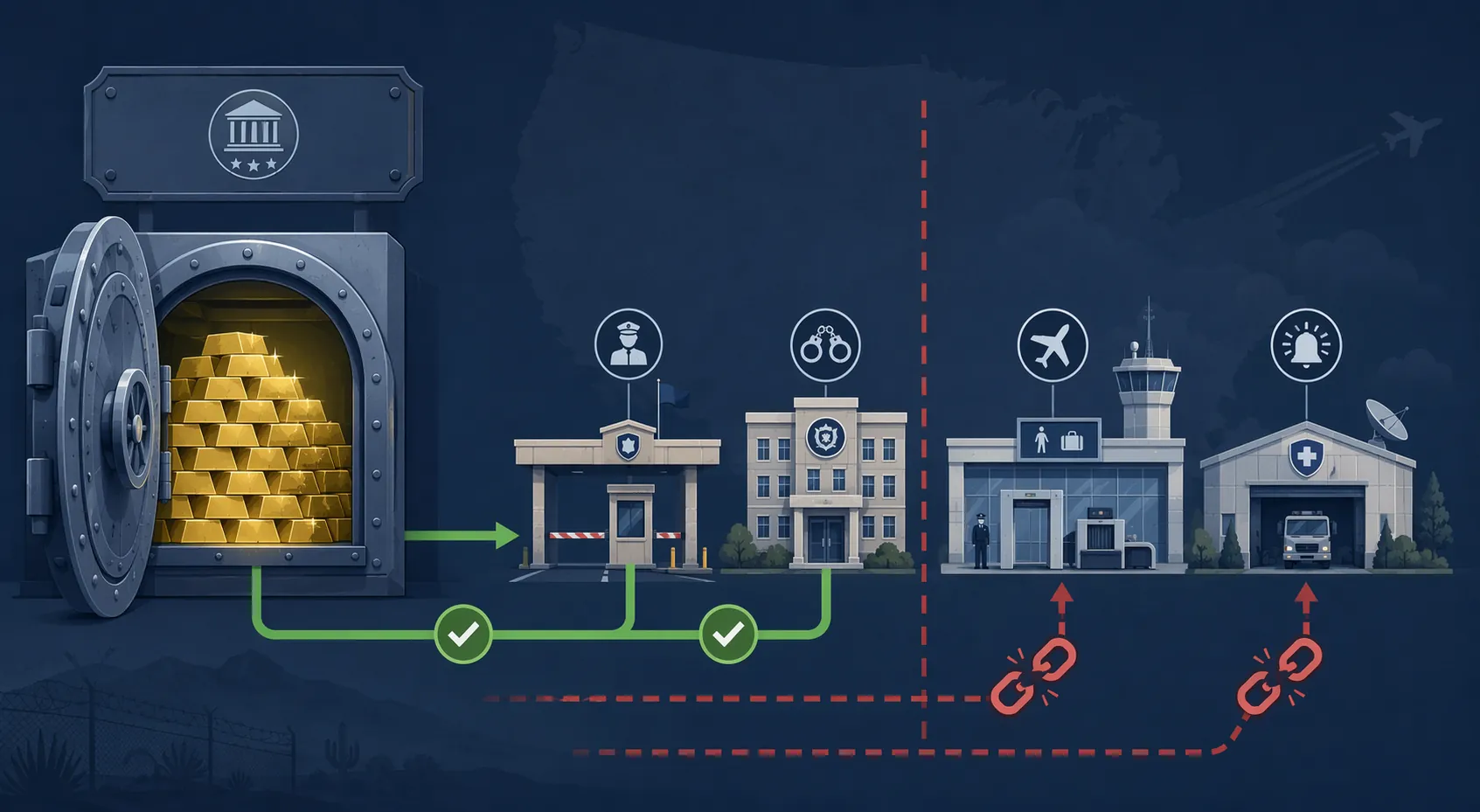
That is where the Purpose Statute analysis becomes unavoidable. The Purpose Statute is not a drafting suggestion. It requires appropriations to be applied only to the objects for which they were made, except as otherwise provided by law. If Congress appropriates money to safeguard the borders, the executive needs a legally defensible connection between that object and the expense charged to the account.
Some uses of a border-security fund may be easy to defend. Personnel and operations directly tied to border inspection, interdiction, detention, or removal could plausibly fit the statutory object, depending on the text and account structure. That is not a concession that every ICE or CBP expenditure is automatically valid; it is just the point at which the legal argument begins to look like ordinary appropriations work.
TSA is harder. Airport screening is essential, and letting screening lanes fail during a shutdown would create immediate public consequences. But operational importance is not the same thing as account purpose. CNBC reported the TSA funding move in the context of worsening airport-delay pressure, which explains the practical incentive behind the March 27 directive.[5] It does not itself supply the statutory nexus between TSA salaries and an OBBA fund described as safeguarding the borders.
FEMA and other non-border DHS components make the April 3 theory still more strained. Emergency response, cybersecurity support, grants administration, headquarters legal offices, procurement offices, and aviation security may all be housed within DHS. They do not become border-security expenses merely because Congress located them in the same department. Departmental identity is not an account purpose.
Why the TSA-Only Move Was Already a Warning
The March 27 TSA directive should not be collapsed into the April 3 DHS-wide memorandum. They present different legal risk profiles. A TSA-only payment theory at least allowed the administration to argue that aviation security has a homeland-security relationship to border protection, international travel, and entry control. That argument may be thin, but it has a shape.
The April 3 memorandum removed the limiting principle. Paying "each and every employee of DHS" from a border-security appropriation asks the account to carry the whole department.[2] Once the theory reaches that breadth, the question is not whether a particular DHS function contributes indirectly to national security. Almost every DHS function can be described that way. The question is whether Congress made this money available for that object.
Budget analysts quoted or summarized in the available record treated that leap as legally serious. Bobby Kogan of the Center for American Progress characterized the funding directive as a clear Antideficiency Act violation, and Devin O'Connor of the Center on Budget and Policy Priorities noted the absence of a public legal justification connecting TSA and FEMA operations to the "safeguard the borders" appropriation.[1] Those are expert assessments, not court holdings. They are still useful because they focus on the right issue: the account-purpose nexus, not the politics of who caused the shutdown.
Neguse Is Narrow, but It Cuts in the Same Direction
Neguse v. ICE is the strongest judicial material in the public record, but it should not be made to do more than it did. As reported by Lawfare, Judge Cobb ruled on March 2 that OBBA hiring and training funds could not be used to pay salaries in certain DHS offices during the shutdown.[3] The reported holding concerns a narrower category of OBBA funds and a narrower set of salary payments than the April 3 memorandum.
Still, the warning is direct. A court had already rejected the idea that OBBA funding could be treated as a general payroll substitute when the expenditure did not match the appropriation's statutory purpose.[3] That matters because the April 3 memorandum took a more aggressive form of the same basic move: use still-available OBBA money to solve a lapsed-appropriations payroll problem.
The evidentiary posture also matters. The Neguse order has been described through Lawfare's reporting from the docket, not through a directly reviewed PACER PDF in the available record.[3] That is a real limitation. It does not erase the case from the analysis, but it counsels against treating snippets of the reported ruling as if they were the full opinion text.
The Antideficiency Act Problem Is Not Just Overspending
The Antideficiency Act is often described as the shutdown statute because it bars agencies from obligating or expending federal funds in advance or in excess of appropriations, and it limits voluntary services absent statutory authorization or an emergency involving the safety of human life or protection of property.[6] In a lapse, agencies sort activities into categories: funded, excepted, or non-excepted. That sorting exercise is not clerical. It decides who reports to work, who waits at home, which invoices can be paid, and which obligations become legal landmines.
The emergency exception in 31 U.S.C. Section 1342 can preserve functions whose interruption would imminently threaten life or property. Airports, border operations, detention facilities, disaster response, cyber response, and law-enforcement operations all present real-world facts that agency lawyers cannot ignore. A shutdown plan that treated every such function as ordinary discretionary work would fail the public as well as the statute.
But the emergency exception is not a payroll appropriation. It permits acceptance of certain services during a lapse; it does not automatically identify a proper account for current payment. That is why the OBBA maneuver is legally distinct from ordering excepted employees to keep working. If the government uses a still-available appropriation for a mismatched purpose, the issue is not merely whether the employee's work was important. The issue is whether the account could lawfully bear that cost.
This distinction matters for TSA screeners and FEMA responders in particular. The strongest practical argument for paying them is that their work cannot simply stop without public consequences. The strongest legal objection is that practical necessity does not rewrite an appropriation. Agencies may need room to keep essential operations from failing in real time. That room is not a license to convert a targeted fund into an all-purpose shutdown bridge.
A Contractor's View of the Same Boundary
Contractors experience the same legal boundary in less constitutional language. During a DHS lapse, they may receive stop-work orders, face delayed access to government facilities, or be told that some work is excepted while related work is not. Ward & Berry's shutdown advisory emphasized the practical distinction between excepted and non-excepted contract performance, including issues of stop-work orders, excusable delay, and funding uncertainty.[8]
For counsel advising a contractor, the question is not simply whether DHS is open for some purposes. It is whether the contract has available funding, whether the contracting officer has authority to direct continued performance, whether the work falls within an excepted activity, and whether any instruction to proceed rests on a funding theory that later may be disavowed. A contractor should not have to litigate the constitutional theory of a shutdown to know whether it can recover for work the government insisted be performed.
This is where the April 3 memorandum's breadth creates downstream risk. If the account theory is later deemed invalid, the burden is unlikely to fall evenly. Employees may eventually be made whole through back-pay legislation or administrative correction. Contractors may face slower claims paths, narrower remedies, or disputes over whether performance was authorized at all. Lower-level contracting officers and program officials are then left to paper over a decision made far above their pay grade.
Why the Enforcement Mechanism Falters
The deeper problem is not that the Antideficiency Act lacks rules. It has rules, and agencies have spent decades building shutdown practices around them. The problem is that the ADA's ordinary enforcement architecture assumes a kind of institutional separation inside the executive branch that becomes fragile when the President is the source of the disputed instruction.
The statutory framework requires agencies to report ADA violations, with reports going to the President and Congress and to the Comptroller General.[6] That model can expose ordinary agency violations. It can also create an administrative record for GAO. But when the alleged violation is directed by the President, the reporting chain points back toward the official whose decision would need to be repudiated.
GovTrack's discussion of GAO's fiscal year 2025 Antideficiency Act compilation noted nine violation reports and underscored the familiar enforcement gap: violations are documented, but criminal prosecutions have not followed.[1] That history does not prove that no remedy could ever exist. It does show why an after-the-fact report is a weak constraint on a live shutdown maneuver, especially where the political branches aligned behind the disputed conduct.
Congress had theoretical tools. It could legislate more specific restrictions, demand documents, hold hearings, threaten confirmations, sue, or alter future appropriations. During a same-party alignment, those tools depend on political appetite. The April 30 resolution ended the immediate lapse, while ICE and CBP continued under OBBA funding and reconciliation moved forward through the budget-resolution process, according to the available legislative chronology.[1] That sequence reduced the incentive for Congress to force a judicial test of the April 3 memorandum.
The Shutdown Asymmetry
Shutdown law does not burden all parts of government equally. Lawfare and related analysis described an asymmetry in which coercive functions such as immigration enforcement and border operations are more likely to continue under emergency or retained-funding theories, while regulatory, benefit, oversight, and service functions are more vulnerable to furlough.[3] Yale Journal on Regulation commentary likewise situated the shutdown dispute within a broader pattern of executive spending and impoundment conflicts that can compound congressional loss of control over appropriated funds.[7]
That asymmetry changes leverage. If the President can preserve favored enforcement functions, pressure disfavored functions, and then use a targeted retained fund to blunt the most visible public pain, Congress's refusal to appropriate loses practical force. The Constitution's appropriations structure still exists. The statutes still exist. But the remedy arrives late, if at all, and the people who must act in the meantime are agency counsel, certifying officials, contracting officers, furloughed employees, and contractors.
The proposed Congressional Power of the Purse Act, discussed in Lawfare, aimed at parts of this problem by limiting retained-fund availability and increasing transparency around contingency planning.[3] Such reforms would not answer every emergency. They would at least recognize that shutdown law is not only about whether agencies may continue essential services. It is also about whether the executive can use account structure to rearrange Congress's priorities during a lapse.
What a Court Would Still Have to Decide
A court reviewing the April 3 memorandum would not need to decide whether DHS functions are important. It would need to decide whether OBBA Section 90007's "safeguard the borders" appropriation was legally available for the particular salary obligations charged to it. That inquiry would likely turn on statutory text, account language, the relationship between the funded activity and border security, prior appropriations practice, agency contemporaneous justification, and the degree of deference owed to executive account interpretation during a shutdown.
The administration's public posture, as reflected in the available record, leaves a conspicuous gap: no public legal memorandum has been identified that explains how all DHS employees fit within the "safeguard the borders" object. Expert criticism is not a substitute for adjudication, but the absence of a public nexus analysis matters. In appropriations law, the account justification is the argument.
The best defense would likely emphasize DHS's integrated mission, border-security spillovers, operational continuity, and emergency conditions. The best challenge would answer that Congress funded a purpose, not a cabinet department; that TSA, FEMA, and many headquarters functions are too remote from that purpose; and that the emergency exception cannot supply spending authority where the chosen account is unavailable. Neguse would not control the entire case, but it would give challengers a recent example of a federal court refusing to let OBBA money become generic shutdown salary money.[3]
The Legal Bottom Line
On the available record, the March 27 TSA directive was legally strained, and the April 3 DHS-wide memorandum was substantially more vulnerable. The core defect is not that the government tried to keep essential personnel working. The defect is the apparent conversion of OBBA Section 90007's border-security appropriation into a general DHS payroll account, without a public legal justification tying every covered salary to the statutory purpose.
That supports a serious Purpose Statute and Antideficiency Act objection. It does not support the stronger statement that a court has already invalidated the April 3 memorandum, because no such ruling appears in the record. The one reported court ruling, Neguse, is narrower, though directionally important.
The larger lesson is institutional. Congress's appropriations power can be weakened without being formally abolished. It is enough for the executive to exploit retained funds, emergency categories, and slow enforcement paths while the officials and private parties below absorb the legal uncertainty. The law still draws account boundaries. The hard part is enforcing them when the disputed spending instruction comes from the top.
References
- DHS Funding During the Shutdown, GovTrack, April 27, 2026.
- Liberating the Department of Homeland Security From the Democrat-Caused Shutdown, The White House, April 3, 2026.
- The Homeland Security Shutdown and the Power of the Purse, Lawfare.
- Trump-Thune DHS, Punchbowl News.
- TSA Trump DHS Shutdown Airports, CNBC, April 1, 2026.
- The Antideficiency Act Explained, Bipartisan Policy Center.
- Impoundments Are Compounding the Federal Shutdown Problem, Yale Journal on Regulation.
- Another Funding Stalemate: How DHS Appropriations Uncertainty Impacts Government Contractors, Ward & Berry.
Related records
Tool profile
Browse tool evaluations →Governing regulation
Browse the obligations tracker →Preventive workflow
Browse verification workflows →
Report a correction or tip
Spotted an outdated figure, a misstated fact, or a ruling this case record should reflect? Public comments are disabled for this content given the professional cost of a misreported case outcome, penalty amount, or rule text — use the structured correction channel instead.
Report a correction or tip for this record →