
Two laws still block Turkey's F-35 reentry
The July 22, 2026 State Department letter to Congress states that Turkey has not met the statutory conditions for F-35 reentry. This briefing maps the two independent legal barriers — CAATSA Section 231 sanctions on SSB and the FY2020 NDAA Section 1245 transfer bar — and what must change before any transfer is lawful.
- Jurisdiction
- US federal
- Court
- Not a court proceeding
- AI tool named
- None named
- Ruling date
- Jul 22, 2026
- Source document
- View primary court order ↗
- Last verified
- Jul 31, 2026
Lex Machina Review is an independent risk-tracking and reference resource. Nothing on this site is legal advice, and using it does not create an attorney-client relationship. Every record is reviewed against primary sources but may not reflect the most current status of a matter — always verify directly against the cited court order, rule text, or a licensed attorney before relying on it.
Companion explanation — secondary to the source document above
Status snapshot, last checked July 31, 2026 UTC: a July 22, 2026 State Department letter to Congress is reported by three consistent outlets; the full letter has not been published; and the reported State Department position is that Turkey has not met the statutory conditions for F-35 reentry. Those reported conditions matter more than the headline phrase “sanctions relief,” because the legal conditions for Turkey to rejoin the F-35 program sit in two separate instruments, not one switch. The first is CAATSA Section 231 sanctions on Turkey’s Presidency of Defense Industries, or SSB. The second is the FY2020 NDAA Section 1245 bar on F-35 transfers unless specified certification conditions are met.[1][2][3]

The July 22 letter is the live trigger, but not yet a public primary source
The letter is reported as a Bureau of Legislative Affairs response, written on behalf of President Trump, to Rep. Wesley Bell of Missouri. The three reports are mutually consistent on the operative points: the administration’s policy is reported to be “fully consistent with” CAATSA and FY2020 NDAA Section 1245; any resolution process must be “transparent, lawful, and consistent with our national security interests”; and, most importantly, “Turkey has not yet met these conditions.” Because the full letter is not public, those phrases should be treated as reported quotations, not independently verified quotations from a published document.[1][2][3]
That distinction is not pedantry. A dated executive-branch letter can be a serious legal anchor, but only to the extent its text is available or reliably reported. For a sanctions, procurement, or congressional-notice brief, the safe formulation is narrower: as reported by The Jerusalem Post, Kathimerini, and Turkish Minute, the State Department told Congress on July 22 that Turkey has not met the statutory conditions for receiving F-35s.
The two-lock map
| Legal instrument | What it blocks | Who must act | Condition that matters now | Why it is not interchangeable with the other lock |
|---|---|---|---|---|
| CAATSA Section 231 sanctions on SSB | Sanctions imposed on Turkey’s defense-procurement agency and related persons after the S-400 transaction; the December 2020 measures included an export-license ban, asset and visa restrictions for named persons, and restrictions on certain U.S. loans or credits to SSB.[4] | The President and executive branch, depending on the termination or waiver route used; Congress may receive a review role under some CAATSA pathways. | For termination, the relevant CAATSA mechanics require cessation or significant verifiable steps plus reliable assurances; waiver routes raise separate national-security and notice questions. | Resolving sanctions on SSB may reopen some defense-procurement channels, but it does not by itself certify that Turkey can receive F-35 aircraft. |
| FY2020 NDAA Section 1245 | A separate statutory prohibition on transferring F-35 aircraft to Turkey unless specified certification conditions are satisfied.[5] | The Secretaries of State and Defense must make the required certification to the relevant congressional committees, as described by CRS.[6] | Turkey must no longer possess the S-400 or associated equipment and personnel, must provide credible assurances against reacquisition, and must satisfy the statutory requirement regarding other Russian defense equipment since July 2019.[5][6] | This is the aircraft-transfer bar. It remains even if CAATSA sanctions are lifted, waived, or otherwise resolved; JINSA and FDD make that two-statute correction in advocacy analyses, and the statutory text supports the separation.[5][7][8] |
The immediate answer to “can Turkey rejoin the F-35 program if CAATSA sanctions are lifted?” is therefore no, not on that fact alone. CAATSA relief and Section 1245 compliance are different legal acts, with different consequences.
CAATSA relief would address SSB, not the aircraft-transfer certification
The CAATSA side began with Turkey’s acquisition of the Russian S-400 system. On December 14, 2020, the State Department announced sanctions under CAATSA Section 231 against SSB and four related persons. The measures included a ban on U.S. export licenses and authorizations to SSB, asset and visa restrictions on named individuals including then-SSB president Ismail Demir, and restrictions on U.S. financial-institution loans or credits above $10 million to SSB.[4]
SSB is not a marginal actor in this analysis. It is Turkey’s defense-procurement authority, so sanctions on SSB can obstruct major U.S. arms transactions with Turkey even when the proposed transaction is not an F-35. That is why CAATSA relief is politically and commercially significant. It is also why compressing the whole F-35 question into “lifting sanctions” produces a legally unreliable sentence.
The standard CAATSA termination route is not simply a presidential preference statement. JINSA, describing the relevant CAATSA mechanics, points to Section 236’s requirement that the President determine and certify that the sanctioned party is no longer engaging in the activity, has taken significant verifiable steps toward stopping it, and has provided reliable assurances against future sanctionable conduct. JINSA is an advocacy organization, but on this point its two-statute warning tracks the legal structure the F-35 discussion keeps blurring.[7]
There is then the congressional-review question. Under CAATSA Section 216, certain proposed actions to terminate or waive sanctions can trigger a congressional review period. The review window is commonly described as 30 days, but extends to 60 days when the notice is submitted between July 10 and September 7, a timing point that matters in a late-July 2026 scenario.[7][8]
One caution belongs here because it changes how confidently anyone should describe the procedure: not every possible CAATSA path is necessarily the same congressional-review path. The available source record includes a disputed nuance involving a modified waiver authority under CAATSA Section 231 as amended by Section 1294 of Public Law 115-232. JINSA and FDD flag that route as potentially not subject to the same joint-resolution-of-disapproval mechanism. The available sources do not establish that the administration will use it, or that its applicability is uncontested. The correct brief is therefore: some CAATSA relief paths may require congressional review under Section 216; a separate modified-waiver argument exists; the administration’s chosen route would matter.[7][8]
For legal teams, that is the same kind of source-status problem that appears in sanctions-compliance work generally: the obligation is not checked by reading the political headline, but by matching the government act, the statutory hook, and the current record. The same discipline is useful in adjacent sanctions files, including the site’s discussion of sanctions compliance risk.
Section 1245 is the harder stop for the F-35 aircraft
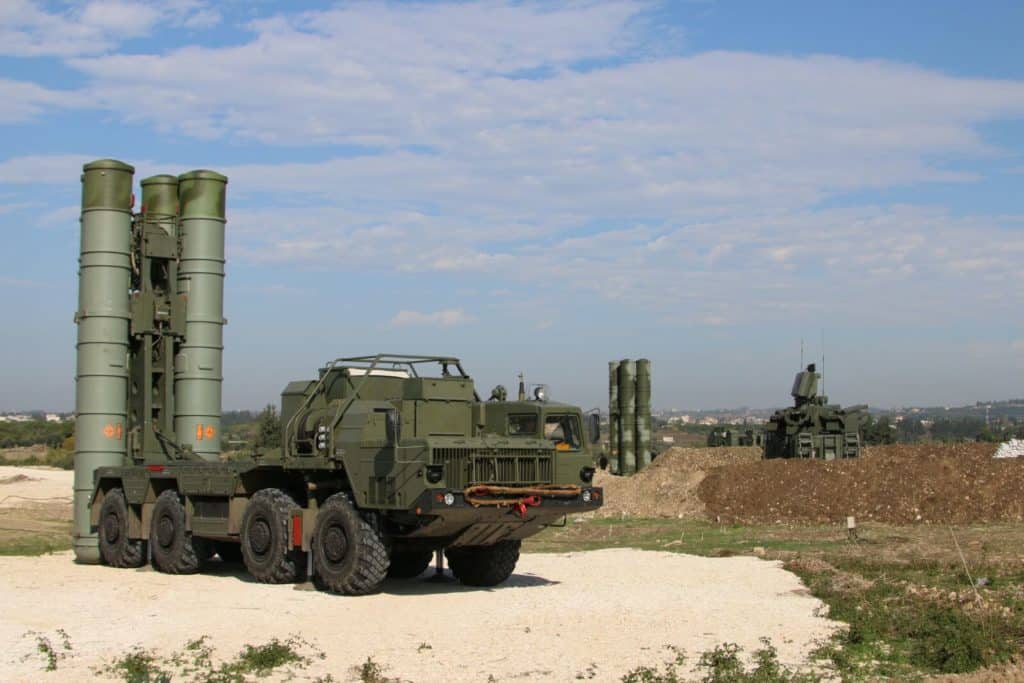
FY2020 NDAA Section 1245 is not a sanction on SSB. It is a transfer restriction directed at the F-35 itself. The statute bars the transfer of F-35 aircraft to Turkey unless the required certification is made. CRS summarizes the required certification as having three elements: Turkey no longer possesses the S-400 system or associated equipment and personnel; Turkey has provided credible assurances that it will not reacquire the S-400; and Turkey has not purchased or accepted other Russian defense equipment since July 2019 that could compromise F-35 capabilities.[5][6]
Those are not atmospherics. They are the statutory conditions that connect the S-400 fact pattern to the F-35 transfer. If Turkey still possesses the S-400 or associated equipment and personnel, the aircraft-transfer lock remains closed. If the S-400 is removed but the credible-assurances record is not made, the lock remains closed. If the record leaves unresolved other Russian defense equipment within the statutory category, the lock remains closed.
The reported July 22 letter sits exactly on this point. It reportedly recites the three conditions and then states that Turkey has not yet met them. That is a narrower and stronger legal point than saying the administration is skeptical, Congress is opposed, or the sale is politically difficult. It is the executive branch reportedly telling Congress that the statutory predicates have not been satisfied.[1][2][3]
The 90-day mechanism should be stated with care
The sources do not phrase the Section 1245 timing mechanism identically. CRS describes the provision as allowing a waiver 90 days after the Secretaries of State and Defense certify that the statutory conditions are met.[6] FDD, in an advocacy alert, describes the certification as required 90 days before transfer.[8] That discrepancy does not change the current bottom line, because the reported State Department position is that the conditions have not been met at all. It does matter for anyone drafting a procedural timeline; do not state the 90-day step more precisely than the source you are relying on supports.
The stakes explain the pressure, not the legal answer
The urgency did not come from nowhere. Turkey was removed from the F-35 program in July 2019 after S-400 deliveries began.[6] Al-Monitor reported in July 2026 that Turkey had paid roughly $1.4 billion for six F-35s it never received.[9] CRS reports that Turkey has sought 40 F-35s and also notes reporting from a Turkish official that defense-procurement sanctions were obstructing about $20 billion in F-16 spare parts.[6]
Those figures explain why a sanctions-relief comment can immediately become an F-35 headline. They do not alter the legal sequence. Money already paid, aircraft previously intended for Turkey, and the commercial burden of the SSB sanctions may be relevant to negotiations. They are not substitutes for the CAATSA termination or waiver record, and they are not substitutes for the Section 1245 certification.
What would have to change before a lawful F-35 transfer
A lawful path would require movement on both tracks. The administration would need to resolve the CAATSA sanctions on SSB through a legally available termination or waiver mechanism, with whatever notice, certification, national-security finding, or congressional-review consequence attaches to the chosen route. That would address the defense-procurement sanctions problem.
Separately, the State and Defense Departments would need to satisfy the FY2020 NDAA Section 1245 certification conditions for the aircraft transfer. Based on the statutory language and CRS summary, that means a record that Turkey no longer possesses the S-400 or associated equipment and personnel, that Turkey has provided credible assurances against reacquiring it, and that the statutory condition concerning other Russian defense equipment since July 2019 is satisfied.[5][6]
- If CAATSA sanctions are waived but Section 1245 is not certified, the F-35 transfer remains blocked.
- If Section 1245 conditions are satisfied but SSB remains subject to unresolved CAATSA restrictions, the procurement channel remains legally encumbered.
- If the administration relies on a contested or less commonly discussed CAATSA waiver route, the procedural description must identify that route rather than assuming the ordinary congressional-review path.
- If the July 22 letter is later published in full, any quotation-based brief should be checked against the published text, not against media paraphrase.
As of the record last verified on July 31, 2026 UTC, the reported executive-branch position is that Turkey has not met the statutory conditions. The answer changes only if the underlying statutory conditions change, the CAATSA route is lawfully executed, the Section 1245 certification record is made, or the July 22 letter record is superseded by published text or a later official communication.
References
- Turkey does not meet legal requirements to receive F-35, State Department says — The Jerusalem Post, July 24, 2026.
- Turkey doesn’t meet legal conditions to rejoin F-35 program, State Department tells Congress — eKathimerini, July 22, 2026.
- US says Turkey cannot receive F-35s while it keeps S-400s — Turkish Minute, July 23, 2026.
- The United States Sanctions Turkey Under CAATSA 231 — U.S. Department of State, December 2020.
- National Defense Authorization Act for Fiscal Year 2020, Public Law 116-92 — Congress.gov.
- Turkey (Turkiye): Possible F-35 Sale and Sanctions Relief — Congressional Research Service, July 14, 2026.
- After Ankara: Lifting CAATSA Doesn't Unlock the F-35 for Turkey — JINSA, July 9, 2026.
- Policy Alert: Why Congress Must Block Any F-35 Transfer to Turkey — FDD Action, September 25, 2025.
- Trump says US will lift CAATSA sanctions on Turkey, consider F-35 sale — Al-Monitor, July 7, 2026.
Related records
Tool profile
Browse tool evaluations →Governing regulation
Browse the obligations tracker →Preventive workflow
Browse verification workflows →
Report a correction or tip
Spotted an outdated figure, a misstated fact, or a ruling this case record should reflect? Public comments are disabled for this content given the professional cost of a misreported case outcome, penalty amount, or rule text — use the structured correction channel instead.
Report a correction or tip for this record →