
Tylenol Naproxen Combo: FDA Approval and Side Effect Risks
The FDA-approved Tylenol with Naproxen combination delivers 650 mg acetaminophen and 220 mg naproxen sodium in a single dose every 12 hours. This article explains the three distinct organ-system warnings—liver toxicity, gastrointestinal bleeding, and cardiovascular risk—plus the pregnancy restriction, and why the fixed-dose format creates unique safety considerations compared to taking the drugs separately.
- Jurisdiction
- US Federal
- Court
- U.S. Food and Drug Administration
- AI tool named
- Tylenol with Naproxen
- Ruling date
- Jul 24, 2026
- Source document
- View primary court order ↗
- Last verified
- Jul 25, 2026
Lex Machina Review is an independent risk-tracking and reference resource. Nothing on this site is legal advice, and using it does not create an attorney-client relationship. Every record is reviewed against primary sources but may not reflect the most current status of a matter — always verify directly against the cited court order, rule text, or a licensed attorney before relying on it.
Companion explanation — secondary to the source document above
The FDA approved Kenvue’s Tylenol with Naproxen on July 24, 2026, making it the first nonprescription fixed-dose combination of acetaminophen and naproxen sodium for 12-hour pain relief in the United States.[1] The side effect question starts with the dose, not the brand name: one approved dose is two tablets containing a total of 650 mg acetaminophen and 220 mg naproxen sodium, taken every 12 hours, with a maximum of four tablets in 24 hours.[1]
That fixed dose is the useful part and the safety problem. Acetaminophen and naproxen are familiar OTC pain medicines, but this product does not let a user take one without the other. Every dose brings acetaminophen liver warnings, NSAID stomach bleeding warnings, NSAID cardiovascular warnings, and naproxen pregnancy restrictions into the same decision.
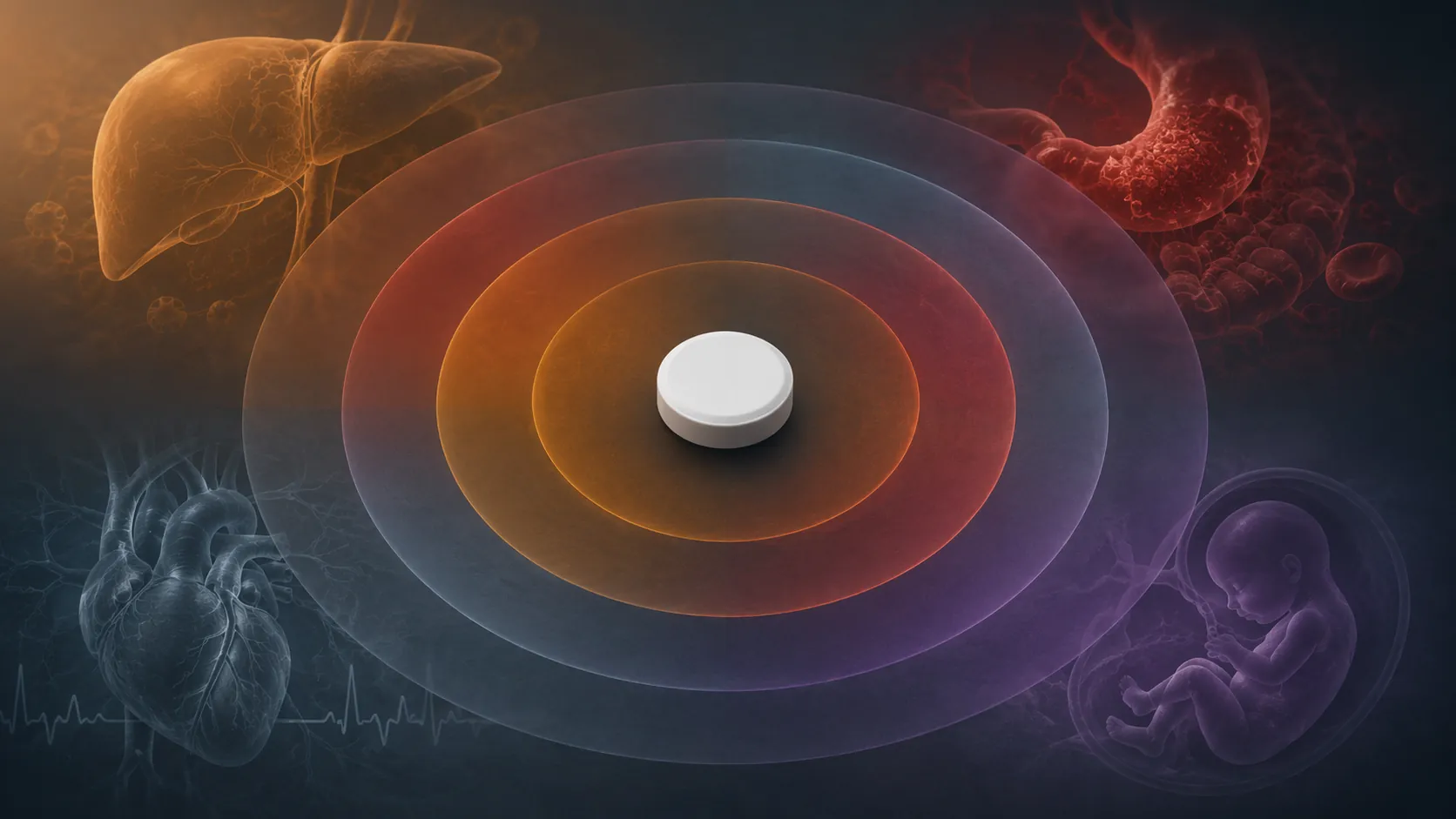
The Dose Is Simple; The Screening Is Not
A 12-hour OTC pain reliever has obvious appeal. Someone with back pain, arthritis pain, menstrual cramps, or a headache may not want to keep track of two bottles and two dosing schedules. The submitted clinical program, as described by the FDA and manufacturer, found the fixed-dose combination superior to either acetaminophen 650 mg alone or naproxen sodium 220 mg alone, with onset in less than 30 minutes and duration up to 12 hours.[1][2]
But “superior to either ingredient alone” is a narrower finding than “better than using the two medicines separately in a well-managed schedule.” Pharmacy Times noted that the program did not include a published head-to-head comparison against optimally staggered separate dosing of acetaminophen and naproxen.[3] That distinction matters for people who already alternate products carefully, because separate bottles preserve a choice the combination removes: delaying, withholding, or adjusting one drug without automatically taking the other.
| What the label-level dose means | Why it matters |
|---|---|
| Two tablets per dose | The approved dose delivers both active ingredients together, not as optional add-ons. |
| 650 mg acetaminophen per dose | Duplicate acetaminophen from cold, flu, sleep, or other pain products must be counted. |
| 220 mg naproxen sodium per dose | NSAID stomach, cardiovascular, and pregnancy warnings apply each time the dose is taken. |
| Every 12 hours; maximum four tablets per 24 hours | The regimen is simpler, but the safety check repeats with every fixed-dose use. |
The Liver Warning Comes From Acetaminophen
Acetaminophen’s central safety issue is severe liver damage. The relevant Drug Facts warning is familiar but easy to underestimate: risk rises if a person takes more than 4,000 mg of acetaminophen in 24 hours, uses more than one acetaminophen-containing product, or has three or more alcoholic drinks every day.[3]
The duplicate-product problem is the one that tends to hide in plain sight. A person may think of this new product as “Tylenol plus longer relief,” then add a nighttime cold medicine, flu product, sleep aid, migraine product, or another pain reliever that also contains acetaminophen. The liver does not care whether the extra acetaminophen came from a product marketed for congestion, sleep, fever, or pain.
The fixed-dose format does not create a new acetaminophen molecule. It changes the counting problem. With separate products, a user can choose naproxen and skip acetaminophen if the day’s acetaminophen total is already high. With this combination, taking the naproxen component always means taking more acetaminophen too.
The Stomach Bleeding Warning Comes From Naproxen
Naproxen is a nonsteroidal anti-inflammatory drug, and the NSAID stomach bleeding warning travels with it. The risk is higher for people age 60 or older, those with a history of stomach ulcers or bleeding problems, people taking blood thinners or other NSAIDs including aspirin, and people who have three or more alcoholic drinks every day.[2][3]
This is where the brand-name shorthand can mislead. A product carrying the Tylenol name may feel, to some consumers, like it belongs mainly in the acetaminophen risk world. This one does not. Because naproxen is fixed into every dose, the usual NSAID questions still have to be asked: ulcer history, aspirin use, anticoagulant use, other NSAID use, alcohol pattern, and age-related bleeding risk.
Bleeding risk is not the same for every user. The point is that a user cannot separate “I want the acetaminophen part” from “I accept the naproxen stomach warning” once the product is chosen.
The Heart And Stroke Warnings Still Apply At OTC Doses
NSAID labels also warn about cardiovascular events, including heart attack, heart failure, and stroke, with risk increasing at higher doses and with longer use.[3] That warning is not erased by the fact that this is an OTC product or by the presence of acetaminophen in the same dose.
For many occasional users, the practical consequence is simply that the product should be treated as an NSAID-containing medicine, not as a general-purpose acetaminophen product with a second ingredient. For people with cardiovascular disease, hypertension, heart failure concerns, kidney disease, or clinician-directed restrictions on NSAID use, the naproxen half of the combination is not a detail. It is part of the decision before the first dose.
Pregnancy Changes The Usual Acetaminophen Assumption
Pregnancy deserves its own pause because acetaminophen and naproxen do not carry the same pregnancy profile. Naproxen is contraindicated at 20 weeks or later in pregnancy because of risks including fetal renal dysfunction, oligohydramnios, and premature closure of the ductus arteriosus.[4]
That makes this combination materially different from reaching for acetaminophen alone during pregnancy. A pregnant person, or someone who might be pregnant, is not just deciding whether Tylenol is acceptable. They are deciding whether naproxen is acceptable, and after 20 weeks the answer on the label is no.

Fixed-Dose Use Removes Some Useful Flexibility
Separate acetaminophen and naproxen products create more work, but they also preserve more control. A person can take acetaminophen and avoid naproxen before a procedure if told to avoid NSAIDs. They can skip acetaminophen if they already took a cold medicine. They can hold naproxen because of stomach symptoms while still discussing other pain options with a clinician. They can ask a pharmacist whether aspirin, an anticoagulant, or an SSRI changes the NSAID risk calculus before adding naproxen.
The fixed-dose product compresses those decisions. Every dose is an all-in dose for acetaminophen exposure and naproxen exposure. That does not make it inappropriate for everyone. It means the screening threshold should be higher than “Have I taken Tylenol before?” or “Have I taken Aleve before?”
- If another product contains acetaminophen, the daily acetaminophen total has to be counted before adding this combination.
- If aspirin, another NSAID, an anticoagulant, or a history of ulcer bleeding is in the picture, the naproxen stomach bleeding warning becomes central.
- If cardiovascular disease, hypertension, heart failure, or kidney disease is part of the medical history, the product should be treated as an NSAID-containing medicine.
- If pregnancy has reached 20 weeks or more, naproxen’s pregnancy restriction makes the combination unsuitable under the label warning.
What The Approval Shows, And What It Does Not Yet Show
FDA approval means the agency found the product met the applicable standard for OTC use based on the submitted evidence and labeling. It does not mean every user has low risk, and it does not replace the Drug Facts label with a blanket reassurance. The evidence described so far supports superiority over either ingredient alone in the studied doses, faster-than-30-minute onset, and 12-hour duration.[1][2]
It does not yet answer some of the questions pharmacists will hear quickly: whether people who already stagger acetaminophen and naproxen get meaningfully better relief from the fixed-dose product, how often consumers accidentally duplicate acetaminophen after purchase, how often NSAID warnings are missed because the front of the package says Tylenol, or what real-world adverse-event patterns will look like. The approval was one day ago, so post-market surveillance data are not available yet.
The FDA also granted three years of OTC exclusivity, running through July 2029, for this specific fixed-dose combination.[4] That mainly affects expectations: generic versions of the same OTC fixed-dose acetaminophen-naproxen product should not be expected immediately. It does not change the safety analysis.
The Practical Safety Judgment
Tylenol with Naproxen may simplify pain relief for appropriately screened users who want a 12-hour option and are not already bumping against acetaminophen, NSAID, cardiovascular, bleeding, alcohol, kidney-related, or pregnancy cautions. The simplicity is real. So is the compression of risk.
The safest way to read this approval is not “two familiar medicines, therefore routine.” It is “two familiar medicines, therefore two familiar warning systems at the same time.” Every dose requires the same four checks: duplicate acetaminophen, NSAID stomach bleeding risk, NSAID cardiovascular risk, and naproxen pregnancy restriction.
References
- FDA Approves First Nonprescription Fixed-Dose Combination of Acetaminophen and Naproxen Sodium for 12-Hour Pain Relief — FDA, July 24, 2026
- FDA approves Tylenol® with Naproxen, the first and only over-the-counter fixed-dose combination of acetaminophen (650 mg) and naproxen sodium (220 mg) — Kenvue, July 24, 2026
- FDA Approves First OTC Acetaminophen–Naproxen Combination for 12-Hour Pain Relief — Pharmacy Times
- Tylenol with Naproxen (acetaminophen and naproxen sodium) FDA Approval History — Drugs.com
Related records
Tool profile
Browse tool evaluations →Governing regulation
Browse the obligations tracker →Preventive workflow
Browse verification workflows →
Report a correction or tip
Spotted an outdated figure, a misstated fact, or a ruling this case record should reflect? Public comments are disabled for this content given the professional cost of a misreported case outcome, penalty amount, or rule text — use the structured correction channel instead.
Report a correction or tip for this record →