
What the Ukraine Court Hack Means for Cross-Border Litigation
The October 2024 pro-Ukraine hack on Russia's Pravosudiye court system destroyed approximately 89 million electronic case files—one-third of the consolidated national archive—and permanently erased backups stored in a single data center. This article explains why the loss creates a structural evidentiary risk for any cross-border litigation that relies on Russian court records, and what verification steps practitioners should take given surviving local court websites.
- Jurisdiction
- jurisdiction-us-federal
- Court
- Russian Judicial System
- AI tool named
- Pravosudiye
- Ruling date
- Oct 1, 2024
- Source document
- View primary court order ↗
- Last verified
- Jul 24, 2026
Lex Machina Review is an independent risk-tracking and reference resource. Nothing on this site is legal advice, and using it does not create an attorney-client relationship. Every record is reviewed against primary sources but may not reflect the most current status of a matter — always verify directly against the cited court order, rule text, or a licensed attorney before relying on it.
Companion explanation — secondary to the source document above
The hard question for a cross-border file is not whether Russia’s court system was hacked. It is whether a pre-October 2024 Russian court record can still be verified well enough to carry weight in another forum. For lawyers comparing this issue with Wildberries-related Ukraine-Russia infrastructure incidents, the important distinction is scope: this article concerns the Pravosudiye court information system, not Wildberries-related infrastructure incidents. The legal consequence here is evidentiary, and it starts with a missing archive.
Recorded Future News reported that Russia’s Audit Chamber said a pro-Ukraine hack of Pravosudiye erased about 89 million electronic case files, roughly one-third of the consolidated court archive. The same reporting chain says the backups were stored in the same single data center and were lost with the primary data.[1] If that is the record path a party expected to use for a judgment, appeal history, enforcement packet, sanctions review, or litigation-history search, the practical answer is no longer “pull it from the national archive and move on.”
That does not mean every Russian court document is now worthless. It means the consolidated national archive can no longer be treated as a safe single point of reliance for affected historical material. The difference matters. A missing national record, a surviving local court page, a party-held certified copy, and an authenticated paper file do not all prove the same thing, and they do not fail for the same reason.
What Was Reported Lost
Pravosudiye was the consolidated Russian court case management and archive system. In October 2024, BO Team, described by Recorded Future News as a pro-Ukraine hacking group linked to Ukrainian military intelligence, claimed an attack on the system. The attribution is relevant background, but it does not by itself tell a foreign court, arbitral tribunal, bank, sanctions team, or enforcement counsel what can be proved after the breach.[1]
The evidentiary problem comes from the reported scale and architecture of the loss. Recorded Future News, citing the Russian Audit Chamber’s Telegram statement, reported three linked facts: approximately 89 million files were deleted; that represented about one-third of the consolidated archive; and the system’s backups were kept in the same data center as the primary data.[1] Read those figures with that sourcing chain in mind. They are not an independent count performed here; they are the Audit Chamber’s figures as relayed by Recorded Future News.
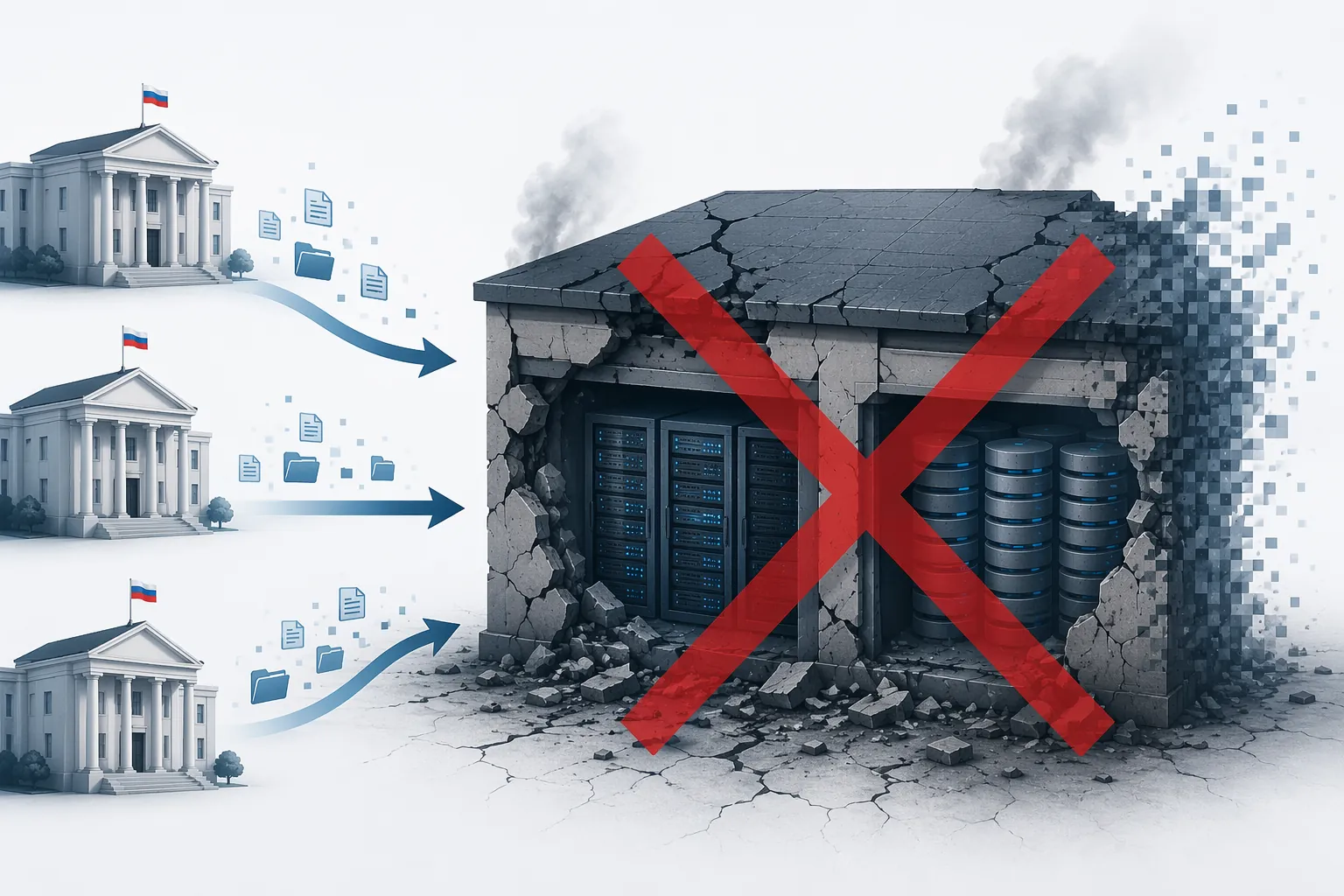
For litigation work, the backup point is more important than the attacker’s branding. A corrupted front-end system can often be rebuilt around preserved data. A deleted database can sometimes be restored from clean backup. But when the primary archive and backup copies are reportedly in the same unrecoverable location, the failure is not just an outage. It is a break in the evidentiary chain.
Recorded Future News also reported that 65.2 billion rubles, about $810 million, had been allocated to the system since 2003, and that there had been no external security audit since its inception.[1] Those procurement and governance details do not prove that any particular judgment is false, altered, or missing. They do, however, make the loss look less like a momentary technical accident and more like a structural risk that should change how records are collected and described.
Permanent Archive Loss Is Different From a One-Month Court Outage
The reported operational disruption was severe but easier to misunderstand. Court websites were down for about a month after the breach; new lawsuits could not be filed electronically, and hearing schedules were inaccessible during that period, according to Recorded Future News.[1] That kind of interruption creates missed deadlines, adjournment questions, docket-monitoring failures, and urgent local-counsel workarounds. It is disruptive, but it is time-bounded.
The archive loss has a longer tail. A month-long inability to see a hearing date is not the same problem as a destroyed historical record. The first asks what counsel could reasonably do during an outage. The second asks whether a later user can reconstruct the record with enough source transparency to persuade someone outside the Russian system.
That difference will surface in ordinary-looking tasks. An associate checking whether a Russian defendant has prior adverse judgments may find a gap in the national system and have to decide whether the gap means no record, no accessible record, or a destroyed record. Enforcement counsel preparing a recognition application may need a judgment, proof of finality, service history, and appeal status; a national-archive absence after October 2024 does not answer any of those questions cleanly. A sanctions or counterparty-diligence team may need to explain why its search did not capture litigation that once sat in the consolidated archive.
The Source Hierarchy After Pravosudiye
Recorded Future News reported that individual district and municipal court websites retained separate records, even though consolidation into a single authoritative archive was difficult.[1] That is the fact that prevents overstatement. The breach did not establish that every local Russian court record disappeared. It established, on the reported facts, that a large portion of the consolidated archive was erased and that backups were not available from a separate protected location.
A surviving local site can be highly useful. It may show docket entries, party names, hearing dates, decision text, or procedural movements that no longer appear in the consolidated archive. It may also be closer to the court that generated the record. But it is not a complete substitute for a national archive if the task requires a systemwide litigation search, a consolidated appeal trail, or confirmation that nothing else exists elsewhere.
| Record Source | What It Can Help Show | What It Cannot Safely Prove Alone |
|---|---|---|
| Consolidated Pravosudiye archive | Historically, a national record path for court materials and legal research | Completeness for affected pre-October 2024 materials after the reported deletion |
| District or municipal court website | Local survival of docket or decision information where the site still holds it | That the national archive is complete, or that other related proceedings do not exist |
| Certified paper or party-held copies | The contents of a particular document and, depending on authentication, its official character | The full procedural history unless matched against other sources |
| Counsel correspondence, hearing notices, filing receipts, or service records | Procedural chronology and contemporaneous conduct | The authoritative court record without corroboration |
The operational move is therefore parallel-source verification, not resignation. A practitioner should look for the local court site, preserved copies, filing confirmations, appeal notices, enforcement documents, and any available certification route. The key is to record the path: where the document was found, when it was accessed, whether the national archive was searched, whether the local court page survived, and what could not be checked because of the reported archive loss.
Where the Risk Bites in Cross-Border Work
In recognition and enforcement proceedings, the opposing party may not need to prove that a record was manipulated. It may be enough to press on authentication, finality, notice, or procedural regularity. If the proponent’s answer is only that the record should exist somewhere in Pravosudiye, the reported deletion makes that answer weak. A better packet separates the judgment text from the proof of its procedural status and supports each with the best surviving source.
Appeal-record assembly faces a related problem. A national database can create a reassuring illusion of sequence: complaint, acceptance, hearings, interim orders, decision, appeal, cassation, enforcement. When one-third of the consolidated archive is reportedly gone, absence from that sequence cannot be treated casually. The record assembler needs to identify whether a missing item is unavailable from the national archive only, unavailable from the local court as well, or contradicted by another source.
Sanctions-adjacent diligence has a different tolerance problem. Diligence reports often use court searches to identify ownership disputes, insolvency pressure, asset seizures, fraud allegations, or politically exposed litigation. The reported Pravosudiye loss does not make every negative search invalid. It does mean that a clean national-archive result for affected historical material should be described with a caveat if the search did not include local court checks or alternative records.
Legal research workflows are exposed in a quieter way. Precedent research, litigation analytics, and matter-history summaries depend on databases being not only searchable but meaningfully complete. If the underlying corpus lost a large historical segment, a trend line or frequency claim may measure database survival rather than court activity. That is especially dangerous when the result is later exported into an expert declaration, client risk memo, or foreign pleading.

How to Describe a Russian Court Record Without Overclaiming
The safest language is specific. “No record found in the consolidated archive” is not the same as “no case exists.” “Record located on a district court website” is not the same as “the national archive is complete.” “Certified copy supplied by local counsel” is not the same as “all related procedural events have been verified.” Those distinctions are not defensive writing. They are how a later reader can evaluate weight.
For an affected Russian matter, a useful file note should usually include the following:
- The exact court, case number, party names, and date range searched.
- Whether the consolidated Pravosudiye archive was searched and what result it returned.
- Whether the relevant district, municipal, or other local court site was searched separately.
- Which documents came from official web sources, certified copies, local counsel, party files, or other repositories.
- Any known gap that may relate to the reported October 2024 archive loss rather than to the nonexistence of a proceeding.
That file note matters most when the record will travel: to a foreign court, arbitral tribunal, regulator, bank, insurer, investor committee, or sanctions reviewer. The receiving forum may not know the architecture of Pravosudiye, and it should not have to infer the source path from a screenshot or translated extract.
What the Later Raids Add—and What They Do Not
Recorded Future News reported that Russia’s FSB raided IT companies involved in developing Moscow’s court information system in March 2025, with the raids framed around the legality of budget spending.[1] For evidentiary purposes, that is not a separate proof point that any specific case file was destroyed, restored, or altered. It is better read as a sign that accountability, recovery, and attribution remained politically charged after the breach.
The same restraint applies to BO Team’s claimed role. Attribution may matter for intelligence, sanctions, or geopolitical analysis. On the current materials, it does not supply a reliable rule for which civil, commercial, administrative, or criminal records survived. A practitioner still has to verify the record, not the slogan attached to the attack.
The Mid-2026 Evidence Gap
As of July 2026, the research materials used here do not establish the current full operational state of Pravosudiye or the completeness of any reconstruction. They support a narrower conclusion: the October 2024 breach reportedly destroyed about one-third of the consolidated archive, including backups stored in the same data center, while some local court records survived separately.[1] That is enough to change evidentiary behavior, but not enough to declare every Russian court record unusable.
The disciplined position is procedural caution. Do not represent a pre-October 2024 Russian court search as complete merely because the national archive returns no result. Do not ignore a surviving local court record merely because the consolidated database is compromised. For each Russian court document that enters a cross-border file, document the source path, distinguish national-archive absence from local-record survival, and avoid claiming completeness where the underlying archive may no longer exist.
References
Related records
Tool profile
Browse tool evaluations →Governing regulation
Browse the obligations tracker →Preventive workflow
Browse verification workflows →
Report a correction or tip
Spotted an outdated figure, a misstated fact, or a ruling this case record should reflect? Public comments are disabled for this content given the professional cost of a misreported case outcome, penalty amount, or rule text — use the structured correction channel instead.
Report a correction or tip for this record →