
When Ukraine's AI Interceptor Drones Err, Who Is Accountable?
IHL does not prohibit autonomous interceptors, but Ukraine's reported fielding of AI-targeting drones strains the accountability rules built for human decision-makers. This assessment maps where the legal implications and attribution risks actually sit for counsel vetting or advising on these systems.
- Jurisdiction
- Ukraine
- Court
- Non-judicial
- AI tool named
- LITAVR, Zerov-8, Sting
- Ruling date
- Jul 10, 2026
- Source document
- View primary court order ↗
- Last verified
- Aug 4, 2026
Lex Machina Review is an independent risk-tracking and reference resource. Nothing on this site is legal advice, and using it does not create an attorney-client relationship. Every record is reviewed against primary sources but may not reflect the most current status of a matter — always verify directly against the cited court order, rule text, or a licensed attorney before relying on it.
Companion explanation — secondary to the source document above
Reported Ukrainian interceptors make the question immediate
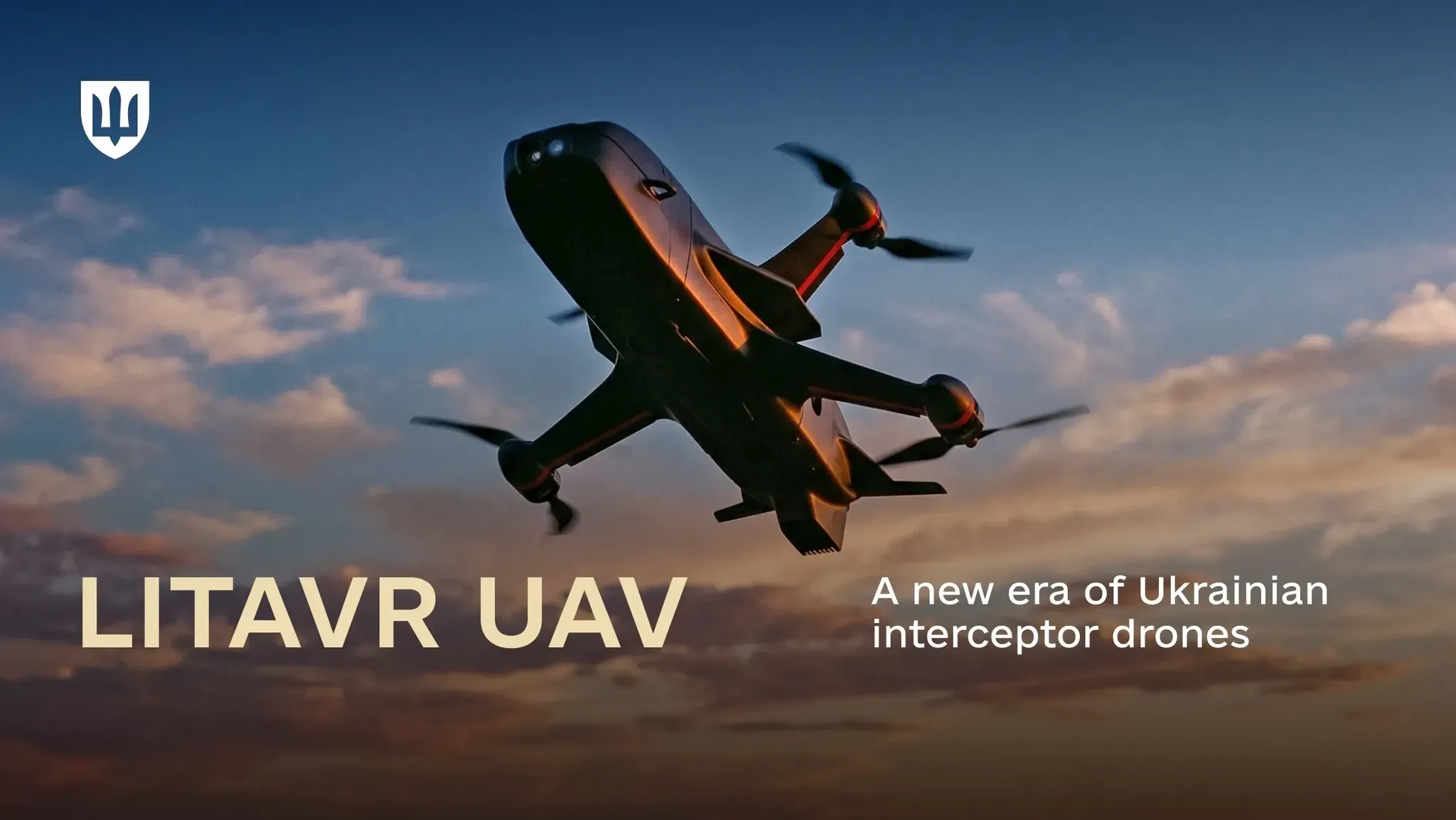
Ukraine’s counter-drone procurement is no longer only about faster pilots, better sensors, or cheaper interceptors. On July 10, 2026, The Defense Post reported that F-Drones’ LITAVR had been unveiled for Ukraine as a fully autonomous interceptor, billed as the first of its kind in that role.[1] Forbes had earlier described Ukraine turning to autonomous drone interceptors as Shahed-style attacks surged, including systems in the same capability line as The Fourth Law’s Zerov-8.[2] Public technical summaries of Sting describe a different but related step: long-range remote piloting with AI terminal lock-on, along with manufacturer-reported claims about unit cost and production capacity.[3]
Those descriptions matter for legal analysis of Ukraine’s interceptor drone use, but they should not be laundered into verified legal facts. As last checked on 2026-08-04, the LITAVR, Zerov-8, and Sting capability descriptions come from public reporting, manufacturer-adjacent materials, and technical summaries, not from an independently tested weapons-review record. The prudent legal reading is narrower: Ukraine is reportedly moving along a capability spectrum from AI-assisted terminal targeting toward interceptors that may select and engage an incoming drone without a fresh human lock-on command.
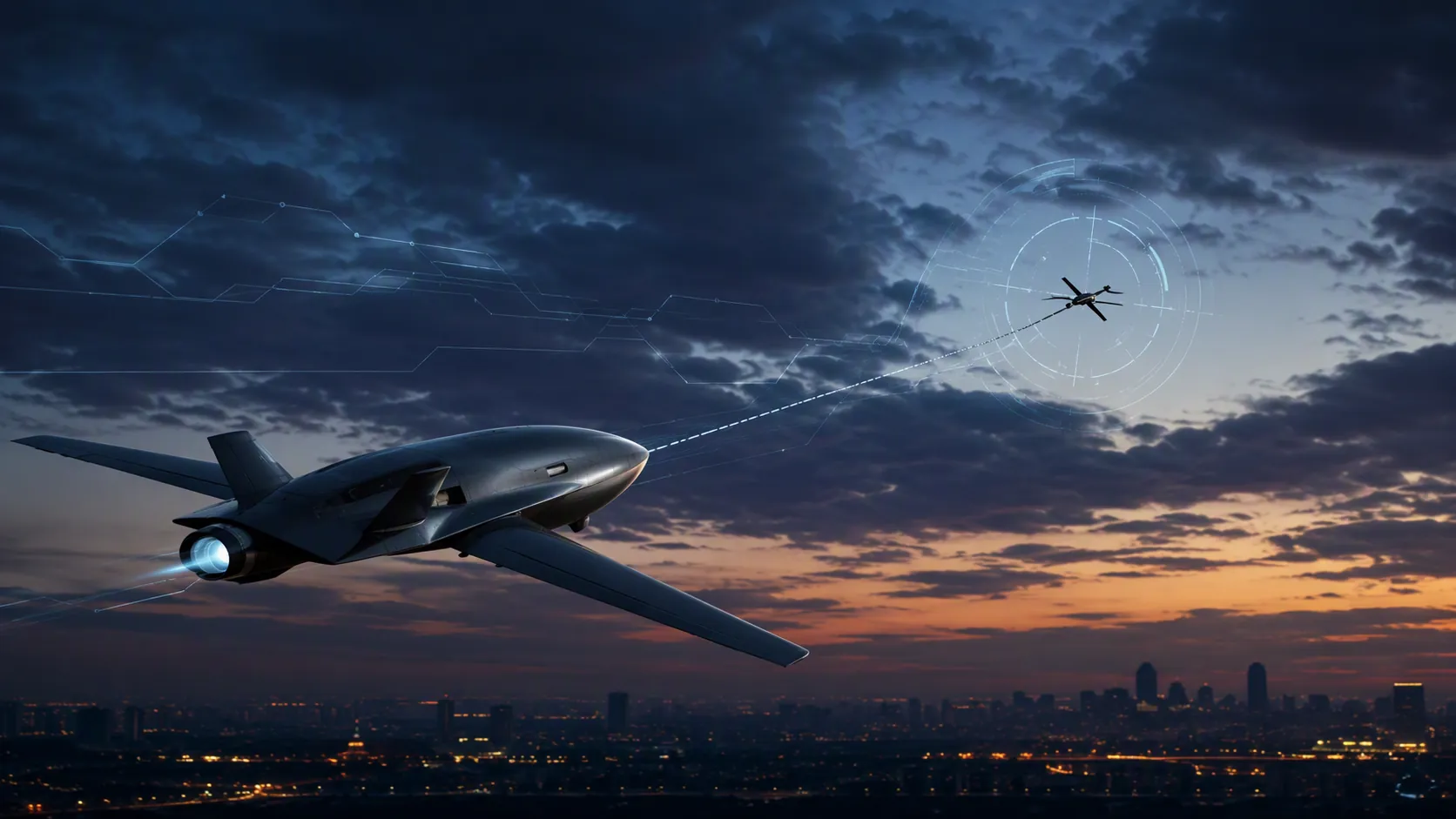
That shift sits inside a Ukrainian drone ecosystem that has scaled rapidly under battlefield pressure, with domestic design, battlefield iteration, and procurement channels compressing the distance between prototype and operational use.[4] None of that makes autonomous interceptors unlawful by itself. It does mean the hard legal question has moved from seminar-room speculation to a file counsel may actually have to review: if an interceptor misidentifies a protected object, mistimes an engagement over civilians, or locks onto the wrong aircraft, who owns the decision?
The legal object is activation, not the marketing label
The ICRC’s definition is the cleanest place to start because it turns the debate away from branding. Autonomous weapon systems are weapons that, once activated, select and engage targets without further human intervention.[5] Under that framing, “AI,” “autonomous,” “terminal lock-on,” and “human-in-the-loop” are not interchangeable legal conclusions. The legally important moment is activation: who set the target profile, where and when the system was permitted to operate, what sensor inputs the system would treat as sufficient, and whether a human still had to approve the final engagement.
A remotely piloted interceptor with AI help at the final lock-on stage is not the same legal object as a system released into a defined box to select and strike any object matching its onboard criteria. Both may raise targeting-law questions. The second raises sharper attribution questions because the concrete target-selection decision happens after the commander has already delegated part of the engagement function to the machine.
For counter-Shahed operations, the practical appeal is obvious. A state facing repeated one-way attack drones has every military reason to shorten detection-to-intercept time, conserve trained operators, and use cheaper interceptors against incoming systems. International humanitarian law does not require a defender to use the slowest lawful tool. But it does require the human belligerent, not the software, to fulfill the legal duties attached to attack decisions.
IHL permits autonomy in principle, but the duties still point back to humans
There is no general IHL rule that says a weapon becomes unlawful merely because it has autonomous functions. The ICRC’s 2026 position treats the legality question through the ordinary rules governing means and methods of warfare: distinction, proportionality, precautions in attack, prohibitions on indiscriminate weapons, and the Martens Clause.[5] Its drone FAQ makes the same larger point for drones in armed conflict: drones are not prohibited as such, but their use must comply with IHL in each operation.[6]
For an interceptor aimed at incoming military drones, distinction may look administratively easier than it does in a crowded ground-targeting scenario. The target class is narrower. The engagement window may be short. The operating area can sometimes be defined in advance. Those facts can make a lawful use case plausible. They do not eliminate the legal work. A system that classifies objects through sensors and software still has to be constrained so that it is not, in its normal or foreseeable operation, incapable of being directed at a lawful target set.
Proportionality and precautions are where the counter-drone context becomes less tidy. Intercepting an incoming drone over open terrain is different from intercepting it over an apartment block, hospital perimeter, evacuation route, or dense airspace. The human decision may not be “which aircraft is this?” alone. It may also be “where will the wreckage fall, what if the interceptor misses, and is this the moment to engage?” If the system makes the timing and lock-on decision after activation, the legal review has to ask whether the human commander’s earlier parameters were specific enough to discharge those duties.
That is why the phrase “meaningful human control” keeps reappearing even when it is not itself a universally codified treaty test. It is shorthand for a more concrete proposition: IHL obligations attach to persons and states. The machine may process the engagement; it does not become the legal subject that distinguished, weighed, or took precautions.
After an error, the attribution channels narrow quickly
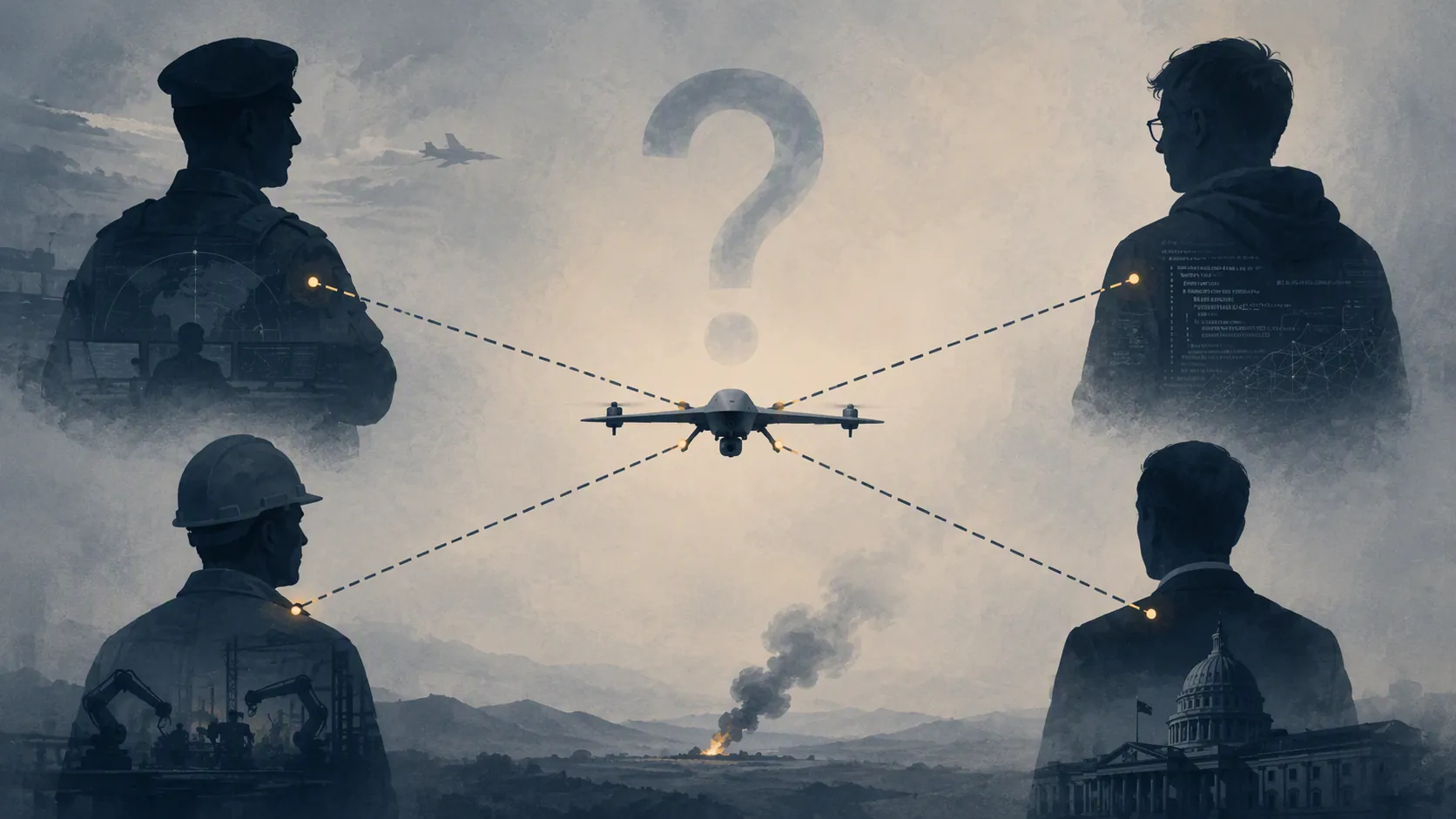
Gerald Mako’s 2026 accountability analysis is useful because it names the actors who would actually appear in the post-incident file: the programmer, the manufacturer, the commander, and the state. His central concern is not that autonomous weapons float outside law altogether. It is that familiar accountability doctrines strain when the harmful selection or engagement is produced by an autonomous system rather than by a human who consciously chose the target at the final moment.[7]
The commander or operator
The strongest case for individual responsibility remains the human who deployed the system under known, legally defective conditions. If a commander authorizes an interceptor to operate in an area where its sensors cannot reliably distinguish the intended target class, or ignores known failure modes in a populated airspace, the autonomy label does not dissolve responsibility. The relevant conduct is not the algorithm’s internal computation; it is the human decision to use that tool under those conditions.
The harder case is the one procurement counsel should assume will eventually occur: the system was lawfully procured on paper, deployed against a legitimate threat class, and then made an unexpected classification or timing error. Criminal responsibility normally turns on mental elements such as intent, knowledge, or recklessness. Mako’s analysis emphasizes that mens rea becomes difficult when no human specifically intended the wrongful target selection and the machine’s pathway to error is not easily reducible to one person’s conscious choice.[7]
Command responsibility is not a complete escape route. It is built around effective control: the superior’s material ability to prevent or punish unlawful conduct by subordinates. That doctrine works tolerably when the subordinate is a human unit whose conduct can be ordered, supervised, corrected, or disciplined. It becomes less clean when the immediate harmful act is a system’s autonomous engagement after activation. A commander can control whether to field the system, where to place it, what parameters to authorize, and whether to keep using it after incidents. The commander cannot cross-examine, discipline, or deter the algorithm as a subordinate.
That distinction should not be overstated. “The system did it” is not a legal defense if the commander retained practical control over the conditions that made the error foreseeable. But it does identify the wobble in the doctrine. The more the final selection decision is separated from human review, the more the inquiry shifts backward into deployment parameters, testing, known limitations, incident history, and whether the operator had a realistic abort function.
The programmer or manufacturer
The programmer and manufacturer are tempting targets after a machine-made error because they designed the classification logic, trained or selected models, wrote the control software, integrated sensors, and marketed performance. In a procurement dispute, that may be exactly where attention belongs. Representations about target recognition, safe operating envelopes, update procedures, override functions, and known limitations are not decorative. They are part of the factual basis on which a commander or ministry decides whether the system can be lawfully used.
War-crimes attribution is less accommodating. Mako’s account treats manufacturer and programmer liability as difficult because the causal chain from code design to a particular unlawful engagement is technically and legally complex, and because criminal law still asks whether the accused person possessed the required mental state for the wrongful act.[7] Bad engineering, overconfident marketing, or inadequate testing may be highly relevant to procurement remedies, contract liability, export controls, or domestic criminal law. They do not automatically prove that a developer intended or knowingly participated in an unlawful attack.
That is where vendor language becomes dangerous. A brochure claim that an interceptor is “fully autonomous” may be a selling point. In a legal file, it is a question generator. Fully autonomous within what geographic boundary? Against what target library? With what confidence thresholds? Under what weather, lighting, jamming, spoofing, and clutter conditions? With what logging? With what human abort option? If the vendor cannot answer those questions in usable form, counsel should not allow the marketing claim to carry the legal conclusion.
The state
State responsibility may be the most stable channel, but it answers a different question. If a weapon system is used by a state’s armed forces, the state cannot avoid international responsibility by saying that an algorithm produced the immediate engagement decision. Mako’s analysis treats state responsibility as part of the accountability map, but not as a cure for the individual-liability gap.[7] Attribution to the state does not identify which commander, engineer, procuring official, or manufacturer employee committed a crime or breached a specific duty.
For civilian harm, that distinction matters. A victim, opposing state, investigator, insurer, or ministry may be able to say the engagement was an act of the armed forces. The next questions are harder: was the engagement unlawful under IHL, was the risk foreseeable, did the state take feasible precautions, did the review process miss a defect, and did any individual have the necessary mental state? State attribution keeps the incident within law. It does not by itself supply a satisfying account of personal blame.
That is the narrower, more useful version of the accountability gap. It is not a claim that autonomous weapons are ungoverned. It is a claim that existing doctrines were built around human acts and human mental states, while autonomous interceptors may distribute the legally relevant choices across design, procurement, activation, operating parameters, and machine classification.
For the broader doctrinal version of the same problem, see Who Is Liable When an AI Drone Strikes a Civilian? This Ukraine-focused analysis is narrower because an interceptor aimed at incoming drones presents a more defensible target class, but the same attribution problem reappears once the final lock-on or target-selection decision is delegated.
Weapons review becomes the pressure point
If post-harm attribution is uncertain, the pre-fielding record becomes more important. Article 36-style legal review is where a state asks whether a new weapon, means, or method of warfare would be prohibited in some or all circumstances. The counter-UAS literature flags a specific issue for software-driven systems: targeting code and system behavior may themselves be part of the means or method that requires legal assessment before use.[8]
For an autonomous interceptor, a meaningful review cannot stop at airframe range, warhead size, or nominal target type. It has to examine how the system classifies targets, what data it uses, how it behaves when sensors conflict, whether it can be spoofed, what conditions degrade performance, and how its operating box is constrained. The most legally useful documents may be the least dramatic ones: test logs, failure reports, update histories, human-machine interface descriptions, abort procedures, and written limits on where and when the system may be activated.
Counsel reviewing a procurement file should separate at least four kinds of statements. First, what the vendor says the system can do. Second, what testing actually showed. Third, what the commander is authorized to do with it in a particular theater. Fourth, what the system records after activation. The first category may sell the program. The other three decide whether the file is defensible after an error.
| Procurement question | Why it matters after harm |
|---|---|
| Who sets the operating area, time window, and target profile? | Those choices may become the human decision closest to the later autonomous engagement. |
| What human action remains after activation? | A required final approval, realistic abort option, or merely passive monitoring changes the accountability analysis. |
| What failures were known before fielding? | Foreseeable misclassification or unsafe engagement behavior can pull responsibility back toward commanders, reviewers, or vendors. |
| What does the system log? | Without usable logs, reconstructing distinction, proportionality, precautions, and causation becomes substantially harder. |
| How are software updates reviewed? | A lawful configuration can become a different legal risk if targeting behavior changes without renewed assessment. |
This is also where counter-drone law should not be flattened into one category. Domestic C-UAS authority, such as the kind discussed in FBI Drone Takedown Authority at the World Cup, turns on statutory authorization, airspace rules, public safety, and domestic rights constraints. Ukraine’s battlefield interceptor problem is an armed-conflict IHL question. Both are C-UAS problems; they are not the same legal regime.
Treaty talks do not remove the current risk
The Convention on Certain Conventional Weapons process remains relevant but not operationally sufficient. Mako notes that more than 120 countries have endorsed treaty talks on autonomous weapons, while major powers have resisted binding rules, and he treats a Group of Governmental Experts protocol by the 2026 CCW deadline as unlikely.[7] As of Q3 2026, that is regulatory context, not a rule counsel can apply in place of IHL.
That matters because Ukrainian systems are reportedly being developed and fielded now. A future treaty might impose clearer prohibitions, control requirements, or review obligations. It might also leave many counter-drone uses untouched. The immediate legal file still has to be built under existing IHL, weapons-review practice, state responsibility, command responsibility, procurement law, and the actual technical record.
Ukraine’s reported autonomous interceptors do not become unlawful merely by being autonomous. A well-constrained interceptor used against incoming attack drones may be easier to defend than many other battlefield AI applications. The unresolved risk is narrower and more stubborn: when the system’s own target-selection or terminal lock-on decision causes civilian harm, existing accountability doctrines can identify relevant humans and the responsible state, but they may not cleanly match the machine-made error to a culpable human decision. That gap is already a procurement and operational risk, not a hypothetical for later.
References
- Ukraine Unveils First Fully Autonomous Interceptor Drone, The Defense Post, July 10, 2026
- Ukraine Turns To Autonomous Drone Interceptors As Shahed Attacks Surge, Forbes, March 8, 2026
- Sting (drone), Wikipedia
- How Ukraine Became a Drone Superpower, Just Security
- Autonomous Weapon Systems and International Humanitarian Law: Selected Issues, International Committee of the Red Cross, March 3, 2026
- FAQ: International Humanitarian Law and Drones in Armed Conflict, International Committee of the Red Cross, December 10, 2025
- Legal Accountability for AI-Driven Autonomous Weapons, Lieber Institute, March 9, 2026
- The Juridical Landscape of Countering Unmanned Aircraft Systems, JAPCC/TNO
Related records
Tool profile
Browse tool evaluations →Governing regulation
Browse the obligations tracker →Preventive workflow
Browse verification workflows →
Report a correction or tip
Spotted an outdated figure, a misstated fact, or a ruling this case record should reflect? Public comments are disabled for this content given the professional cost of a misreported case outcome, penalty amount, or rule text — use the structured correction channel instead.
Report a correction or tip for this record →