
How UN Accountability Hearings Shape AI Governance in Law Firms
This article distills the oversight architecture proposed in the 2026 UN accountability reform hearings — budget conditionality, independent audit functions, mandate review, and consequence mechanisms — and maps each reform tool to a specific AI governance practice with court-sanction precedent. Law firms can use this verified framework to structure AI tool verification policies, replacing generic best-practice lists with a model tested on institutional accountability failures.
- Jurisdiction
- United States
- Ruling date
- Apr 29, 2026
- Source document
- View primary court order ↗
Lex Machina Review is an independent risk-tracking and reference resource. Nothing on this site is legal advice, and using it does not create an attorney-client relationship. Every record is reviewed against primary sources but may not reflect the most current status of a matter — always verify directly against the cited court order, rule text, or a licensed attorney before relying on it.
Companion explanation — secondary to the source document above
The useful legal implications of the UN accountability reform hearings do not start with diplomacy. They start with a familiar control failure: a document, payment, mandate, or AI-generated filing moves through a large system where many people can say they were involved, but no one had the independent authority, budget leverage, review deadline, or consequence mechanism to stop it.
That is why the 2026 UN accountability hearings matter to law-firm AI governance. They are not binding authority for lawyers. They do not create a professional-responsibility rule. Their value is structural. The hearings put four accountability tools on the table: conditional funding tied to verified benchmarks, an inspector-general function that can audit without waiting for permission, periodic review of stale mandates, and consequences when staff ignore controls. Those are the same four tools missing from many AI policies that read well in a client alert but fail at 11:40 p.m., when an associate is trying to decide whether a generated citation can go into a brief.

Law firms already know the diffuse-responsibility problem. A partner approves use of a tool in principle. IT manages licenses. Knowledge management drafts guidance. Associates use the system. Professional-responsibility lawyers warn about confidentiality and competence. When something false survives into a filing, the policy trail often proves only that everyone had a role, not that anyone owned verification. That is the governance gap described in The AI Governance Gap Is an Active Legal Risk in 2026, and it is why personal experimentation with AI can outrun firm controls unless approval and review authority are assigned before a tool becomes routine.
The Hearing Architecture Is About Leverage, Not Aspiration
The April 29, 2026 House Foreign Affairs Committee hearing identified a practical accountability split through four witnesses: Brett Schaefer of AEI, Richard Goulart of AAF, Stefano Gennarini of C-Fam, and Peter Yeo of the Better World Campaign. The committee framing was UN accountability and reform, but the witness mix is useful because it showed different theories of control rather than one generic demand for better behavior.[1]
Schaefer’s account emphasized financial leverage. Goulart’s testimony, as framed in the hearing materials, fit a burden-sharing and institutional-efficiency model. Gennarini’s position focused attention on mandate and policy accountability. Yeo’s presence supplied the counterweight: reform should not be confused with disengagement. For law firms, the important point is not which UN policy preference should prevail. It is that each theory answers a governance question firms also face: should AI compliance rely on voluntary professional judgment, central approval, independent testing, or funding leverage?
The financial-leverage record is the sharpest because it is attached to operational numbers. AEI reported that U.S. assessment withholding helped move the UN regular budget from $3.72 billion to $3.45 billion, described the reduction as $270 million, and tied the process to more than 2,900 staff-post abolitions and a 15% peacekeeping reduction.[2] The same account describes $125 million in savings tied to verified reform benchmarks.[2] Those figures should be checked against live Fifth Committee records before anyone treats them as settled primary-record numbers; the AEI piece is useful evidence of the leverage claim, not a substitute for the budget document itself.
Even with that caution, the control lesson is straightforward. Conditionality changes the meeting. A reform request that leadership can admire and ignore is one kind of document. A reform benchmark attached to money, staffing, renewal, or continued authority is another.
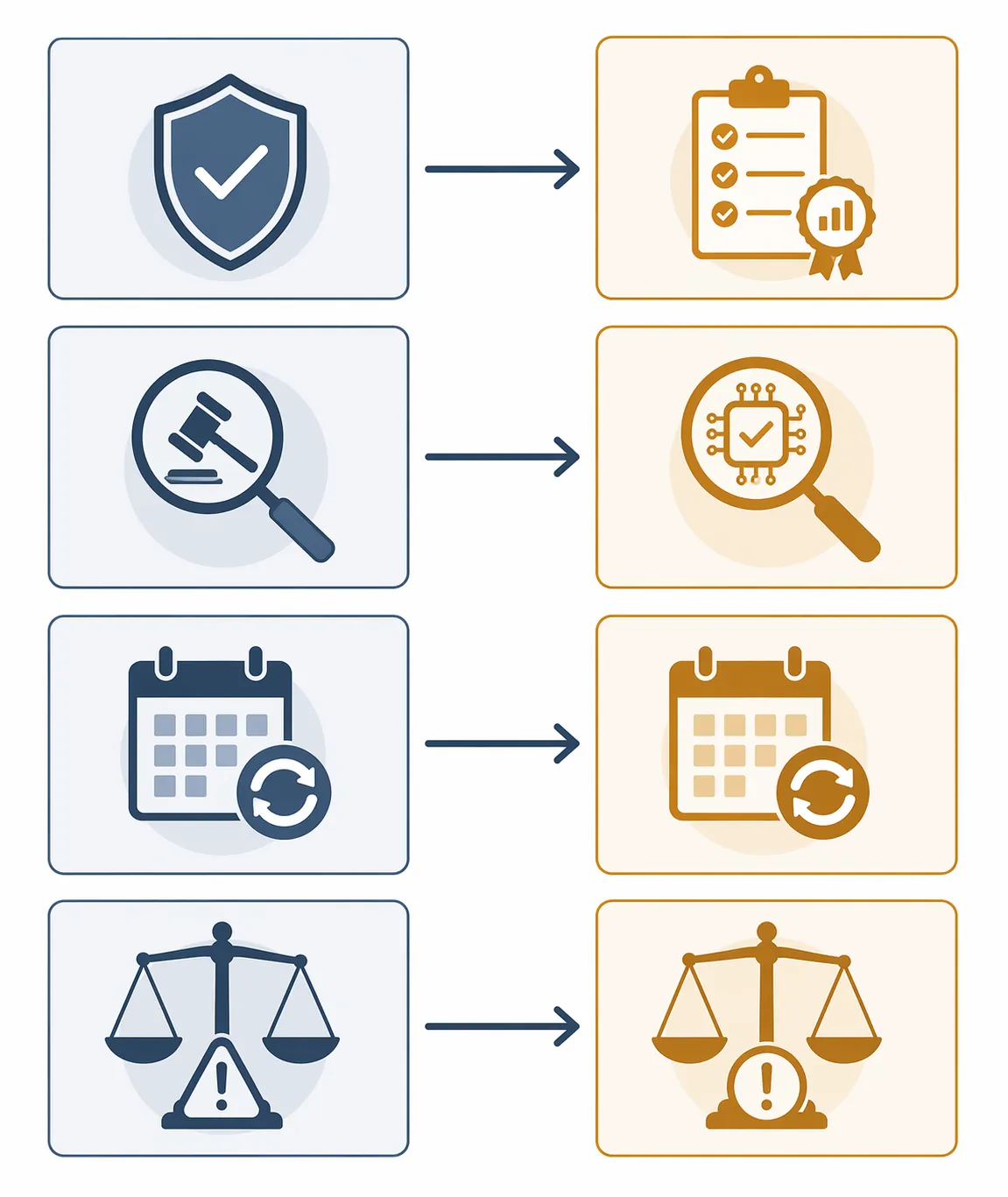
| UN accountability tool | Law-firm AI governance control | Control question |
|---|---|---|
| Budget conditionality tied to verified benchmarks | Procurement and renewal approval tied to benchmarked tool performance | Who can block purchase or renewal if the tool fails verification? |
| Inspector-general-style audit discretion | Independent AI audit function outside the tool owner’s reporting line | Who can test workflows without practice-group permission? |
| Mandatory mandate review | Expiration and renewal review for approved AI use cases | When does permission to use the tool end unless reapproved? |
| Staff consequence mechanisms | Documented sanctions or matter-level restrictions for ignored verification duties | What happens when someone bypasses the check? |
Conditionality Belongs at Procurement, Renewal, and Matter Approval
In a law firm, budget conditionality should not mean a vague instruction to buy responsible AI. It should mean that no legal-research, drafting, summarization, or due-diligence tool is approved for defined legal work until someone with risk authority has verified performance against the use case. The tool can be excellent for internal brainstorming and still unacceptable for citation generation. It can be tolerable for first-pass document triage and still inappropriate for privilege calls. Conditionality forces the distinction before the license is normalized.
The firm version is simple enough to write into an intake form. Procurement approval should require the vendor to identify intended legal tasks, known limitations, data-handling terms, retention rules, jurisdictional coverage, update cadence, and any benchmark evidence it offers. The firm should then test the tool against its own workflow. Renewal should require a fresh check, not a celebratory usage chart. A tool that became embedded during a pilot should not glide into permanent status because lawyers like it.
This is where many firms soften the control until it no longer controls anything. A committee “reviews” AI tools, but the practice group controls the budget. A risk lawyer “comments,” but cannot pause rollout. IT “approves security,” but not legal reliability. Conditionality works only if the person responsible for verification can stop purchase, renewal, or matter-level use. Otherwise the benchmark is a memo attachment.
The same logic should apply at the matter level. A firm may approve an AI research tool generally but restrict it for emergency injunctive filings, criminal matters, sanctions-sensitive submissions, or jurisdictions where the tool’s source coverage is weak. The operational question is not whether the firm “permits AI.” It is whether approval is conditional on the task, the output, and the verification burden.
Independent Audit Cannot Report Only to the People Who Want the Tool
The OIOS point in the UN materials is the closest institutional analog to a credible AI audit function. The reform theory is that oversight needs discretion to initiate investigations without political clearance. Translated into firm governance, the AI audit function cannot depend on permission from the practice group, vendor sponsor, or innovation team whose project is being tested.
That does not require a large new department. In many firms, the function can sit with risk, general counsel, professional responsibility, or a designated legal-ops control group. What matters is authority. The audit owner should be able to select matters for review, inspect prompts and outputs where confidentiality rules allow, test claimed workflow compliance, review exception logs, and compare vendor assertions against actual work product. If the audit team must ask the tool champion whether it is convenient to look, it is not auditing.
Independent audit also needs evidence sources outside the vendor’s sales file. Firms can maintain internal incident logs, sample outputs across approved use cases, track correction rates, and consult public hallucination resources where they are relevant to tool-risk assessment. The point of comparing legal AI hallucination databases is not to outsource judgment to a database. It is to widen the evidence base so the firm is not evaluating reliability only through vendor disclosures and lawyer anecdotes.
The international-law accountability literature has long treated mechanism design as more than a naming exercise: accountability turns on forum, information, standards, and consequences.[3] For a law firm, the same elements are concrete. The forum is the audit owner. The information is prompts, outputs, source checks, exception logs, and user attestations. The standard is the approved workflow. The consequence is what happens when the workflow is bypassed.
Mandates Should Expire Before They Become Folklore
Mandatory mandate review may sound remote from legal AI until one has read enough firm policies that still describe tools as pilots two years after everyone began using them. Permission decays. A model changes. A vendor alters retrieval architecture. A court issues a standing order. A practice group quietly expands from summarization into research. If the original approval does not expire, the firm has no scheduled moment to ask whether the use case still deserves permission.
A useful AI mandate is narrower than “approved tool.” It identifies the users, tasks, jurisdictions if relevant, data categories, output types, required verification steps, prohibited uses, reviewer role, and renewal date. That format gives knowledge-management lawyers and risk counsel something they can actually maintain. It also gives associates a defensible path: if the approved mandate says generated citations must be verified in the underlying primary source before filing, the associate is not left to infer the firm’s risk tolerance from hallway folklore.
A renewal review does not need to be theatrical. It should ask whether the tool changed, whether the vendor’s data practices changed, whether users stayed inside the approved workflow, whether incidents or near misses were logged, whether client terms restricted use, and whether courts or regulators changed the risk environment. Some mandates will renew quickly. Some should shrink. Some should die.
This is the point where a firm can move from policy language into an operating workflow. The implementation path in Closing the Governance Gap for AI Legal Research is useful because it treats research governance as a sequence of approvals, checks, and evidence records rather than an ethics preamble.
Consequences Are Part of the Verification System
Training-only reform has a place, but it is a weak control when the failure mode is predictable and the deadline pressure is real. Lawyers do not need another slide saying AI can hallucinate. They need to know which outputs require source-level verification, who performs it, who signs off, where the record is kept, and what happens if the required check is skipped.
The sanction risk in AI-assisted legal work does not arise because a lawyer touched a new tool. It arises when a lawyer submits or relies on unverified output in a context where professional duties require competence, candor, supervision, and reasonable inquiry. The control layer should therefore be built around the act courts care about: the filing, advice, representation, or certification that carries legal consequence. A hallucinated citation that dies in a research memo is a training event. A hallucinated citation that reaches a court after required verification was skipped is a governance failure.
The firm’s consequence mechanism does not have to start with discipline. It can include mandatory retraining, loss of tool access, elevated partner review, matter-level restrictions, reporting to the risk committee, or escalation under existing professional-responsibility procedures. But the consequence must be written before the incident. If every response is improvised after embarrassment, the firm has not created deterrence; it has created discretion.
The practical verification layer can be quite plain. For filings, require a source check against the cited authority, confirmation that quotations and pincites match, validation that cases remain good law, and a record of who performed the check. For research memos, require a reviewer to distinguish generated leads from verified authorities. For contract analysis, require sampling and escalation rules for uncertain classifications. A structured checklist such as A Six-Phase AI Hallucination Audit Checklist for Legal Professionals is useful because it turns a known risk into reviewable acts.
The Witness Split Mirrors the Choice Law Firms Have to Make
The April 29 hearing is most useful when read as a set of competing accountability designs. One design relies on financial leverage: withhold, condition, or reduce support until verified benchmarks are met. Another emphasizes managerial reform and burden sharing. Another presses mandate scrutiny. Another warns against weakening the institution while trying to improve it. Law firms face the same design choice in less diplomatic language.[1]
- Centralized oversight asks whether a firm risk body, not each practice group alone, controls AI approval and review.
- Distributed responsibility asks whether trained lawyers can manage AI use through professional judgment without a strong central gate.
- Conditional funding asks whether procurement, renewal, and matter use stop when benchmarks are not met.
- Audit independence asks whether the people testing the workflow can act against the preferences of the people promoting it.
A mature firm will usually need all four, but not with equal weight in every setting. A small firm may use a compact approval group and a short checklist. A global firm may need formal tool registers, audit sampling, client-specific restrictions, and practice-group dashboards. What should not vary is the existence of a stop mechanism. Personal AI use is already outpacing many institutional controls, and the harder problem is not curiosity; it is unsupported reliance in work product that clients and courts treat as lawyer-certified.
The broader UN record supplies useful caution but should not dominate the analogy. AEI reported that the UN budget had quadrupled over 25 years without commensurate peace-and-security outcomes, noted $2.4 billion in unpaid assessments, and identified seven vetoed Security Council resolutions in 2024, described as the highest number since 1986.[2] Those data points may support arguments about institutional performance, but law firms do not need to resolve foreign-policy causation to extract the governance lesson. The transferable piece is the accountability architecture: leverage, audit, review, consequence.
A Short Caveat on the 2026 Record
The March 20, 2026 House materials identify a separate hearing on U.S. accountability at the United Nations, framed around challenges and opportunities for reform.[4] Secondary coverage also described congressional demands for oversight of U.S. contributions and scrutiny of UN reform and accountability.[5][6] Those materials reinforce the accountability theme, but the publicly available event listings and secondary reports should be treated carefully when they are standing in for full transcripts.
The same caution applies even more strongly to the July 22 burden-sharing material. As of July 23, 2026, testimony and transcripts may not yet be available in a form that can bear much weight. If the later record confirms a sharper burden-sharing framework, it may help firms think about shared responsibility between vendors and law firms. Until then, vendor responsibility should not be used to dilute the firm’s own verification duties.
The Firm Policy Test
The UN hearings do not prove that one international reform model governs legal AI. They do something narrower and more useful: they expose the control failures that appear whenever institutions announce responsibility without assigning verification power. Law firms should keep the analogy structural, not legal. A congressional hearing about UN reform is not authority for a brief, an ethics opinion, or a sanctions response. It is a working model for asking whether an accountability system has teeth.
The test is blunt. If a firm’s AI policy cannot say who conditions tool approval on verified benchmarks, who audits independently, when approved use cases expire, and what consequences follow when verification duties are ignored, the policy has not solved the accountability problem. It has named the problem and left the next bad document to find the gap.
References
- United Nations Accountability and Reform: Advancing an America First Foreign Policy through Strategic Diplomacy and Burden Sharing, House Foreign Affairs Committee, April 29, 2026
- US Financial Leverage Works at the United Nations, AEI, January 2026
- The Rise of Accountability Mechanisms, Case Western Reserve Journal of International Law
- U.S. Accountability at the United Nations: Challenges and Opportunities for Reform, House Foreign Affairs Committee, March 20, 2026
- UN Accountability: Congress Demands Oversight of U.S. Contributions, Legis1
- House Committee Scrutinizes UN Reform and Accountability, Legis1
Related records
Tool profile
Browse tool evaluations →Governing regulation
Browse the obligations tracker →Preventive workflow
Browse verification workflows →
Report a correction or tip
Spotted an outdated figure, a misstated fact, or a ruling this case record should reflect? Public comments are disabled for this content given the professional cost of a misreported case outcome, penalty amount, or rule text — use the structured correction channel instead.
Report a correction or tip for this record →