
What US Cartel Probes Mean for Mexican Politicians
The US has deployed a multi-statute enforcement framework—including FTO designations, material-support prosecutions, and civil ATA liability—to investigate and prosecute Mexican officials linked to drug cartels. This digest catalogs the active statutes, key indictments, and the cascading compliance risks for legal professionals advising clients with Mexico-facing operations.
- Jurisdiction
- United States (Federal)
- Court
- U.S. District Court for the Southern District of New York
- AI tool named
- None
- Ruling date
- Apr 1, 2026
- Source document
- View primary court order ↗
- Last verified
- Jul 26, 2026
Lex Machina Review is an independent risk-tracking and reference resource. Nothing on this site is legal advice, and using it does not create an attorney-client relationship. Every record is reviewed against primary sources but may not reflect the most current status of a matter — always verify directly against the cited court order, rule text, or a licensed attorney before relying on it.
Companion explanation — secondary to the source document above
The Rocha Moya indictment is the filing that changes the compliance conversation. In April 2026, federal prosecutors in the Southern District of New York charged Sinaloa Governor Rubén Rocha Moya and nine other current and former Mexican officials, alleging that bribes were exchanged for electoral support and that cartel-linked actors were able to name corrupt law-enforcement officials. Two defendants had already surrendered to U.S. marshals, and one was cooperating, according to the Justice Department announcement.[1]
That is a different risk record from the familiar one. U.S. prosecutors have charged cartel leaders, former governors, former security officials, and former cabinet-level law-enforcement figures before. Charging a sitting Mexican governor pulls the alleged political infrastructure itself into the caption. For companies, banks, logistics providers, outside counsel, and compliance teams with Mexico exposure, the question is no longer only whether a counterparty is sanctioned. It is whether payments, transport, security arrangements, local intermediaries, campaign-facing relationships, or government-facing facilitation can be recast as support for a designated cartel or as participation in a corruption scheme with a U.S. jurisdictional hook.
This is a risk digest, verified against the cited materials as of July 26, 2026. It distinguishes confirmed indictments and court outcomes from reported investigations, legal commentary, and untested exposure theories. It is not legal advice. The source hierarchy matters: primary Justice Department releases and court-linked outcomes carry more weight than client alerts; named legal analysis carries more weight than anonymous-source reporting; reported investigations are not charges.
Why the Rocha Moya case matters before any conviction
An indictment is an allegation, not a finding. But it is also a charging instrument that tells risk professionals what the government believes it can plead. The Rocha Moya case matters because it describes a chain in which political power, cartel support, and law-enforcement appointments allegedly reinforce each other. That chain is much closer to the work of ordinary diligence than to the mythology of cartel enforcement.
A Mexico-facing company does not need to be in the narcotics business to care about that fact pattern. The relevant records may sit in vendor onboarding files, route-security contracts, campaign-adjacent donations, customs brokerage arrangements, local government correspondence, cash-handling exceptions, or invoices approved under pressure. If the alleged political sponsor is still in office, the internal question becomes harder: who approved continued dealings after the public filing, who escalated the issue, and who decided that a local relationship remained commercially necessary?
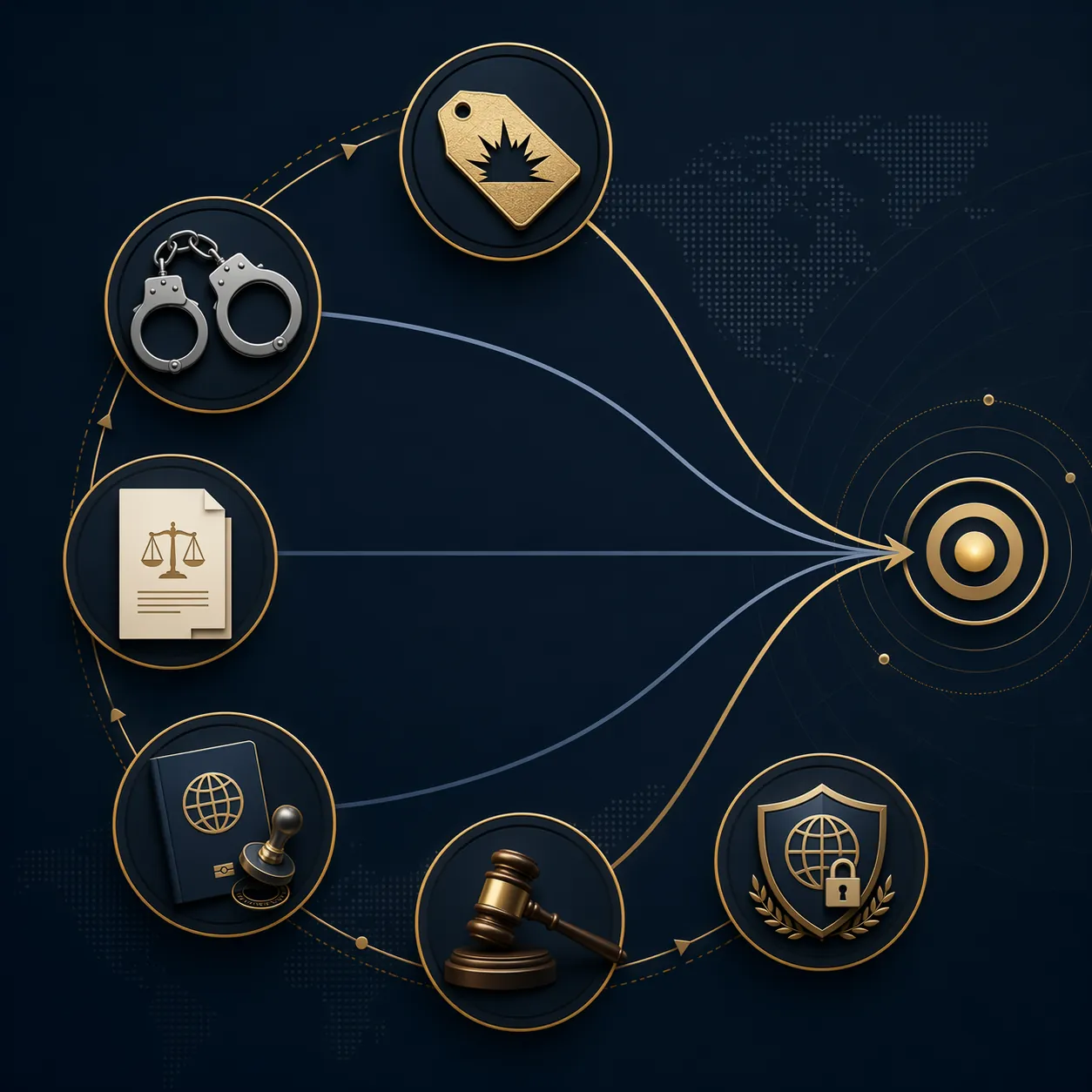
The filing also lands in a year when U.S. tools have multiplied. The indictment does not stand alone; it sits beside Foreign Terrorist Organization designations, sanctions designations, immigration pressure, extradition alternatives, civil terrorism theories, and prior corruption convictions. The practical effect is cumulative. One agency’s label can change another agency’s charging theory, and a civil plaintiff can borrow from both.
| Mechanism | What it changes for legal risk |
|---|---|
| Criminal indictment | Creates a public fact pattern that can trigger internal reviews, subpoenas, preservation duties, and counterparty reassessment. |
| FTO designation | Moves some cartel-related support analysis from blocking and sanctions screening into potential material-support exposure. |
| ATA/JASTA civil liability | Opens a possible private-litigation theory for U.S. nationals injured by cartel violence, though cartel-specific theories remain untested at trial. |
| Kingpin Act sanctions | Blocks property interests and requires sanctions controls for designated narcotics traffickers and related parties. |
| Visa revocation | Applies pressure without requiring a public criminal filing or an extradition request. |
| Extradition or custody transfer | Determines whether a U.S. case can move from indictment to appearance, discovery, plea, or trial. |
The FTO designations widened the aperture
The February 2025 designation of eight cartel entities under the Trump administration’s terrorism framework is the legal move that makes the Rocha Moya-style fact pattern more dangerous for private actors. WilmerHale’s analysis of EO 14157 and the related FTO and Specially Designated Global Terrorist designations emphasizes that the shift is not merely reputational. Once an entity is designated as a Foreign Terrorist Organization, 18 U.S.C. § 2339B makes it a crime to knowingly provide material support or resources to that organization, and the statute does not operate like an ordinary sanctions penalty schedule with a capped civil fine.[2]
That is why the compliance question changes from “Is this party on a list?” to “What exactly are we providing, to whom, through whom, and after what notice?” Material support can include money, services, lodging, training, expert advice or assistance, transportation, and other resources. A payment routed through a local intermediary, a security arrangement imposed as a condition of operating, or a logistics contract touching territory controlled by a designated group may not fit the mental model of terrorist financing. The statute does not care about the mental model.
RAND described the designations as putting new tools in play, rather than simply renaming cartel violence as terrorism.[3] That distinction is useful. FTO designation does not prove that any particular Mexican official, trucking vendor, warehouse operator, municipal contact, or U.S. parent company committed an offense. It gives prosecutors a different legal frame for support relationships that previously might have been treated mainly as narcotics, sanctions, corruption, or money-laundering problems.
Voluntariness is not the comfort some operators want it to be
Mexico-facing businesses often describe cartel contact in the grammar of coercion: tolls, protection demands, route access, forced use of a local service provider, or a payment that local employees believed was unavoidable. Those facts matter, especially to intent, duress, disclosure strategy, and prosecutorial discretion. They do not make the issue disappear at intake. The first legal task is classification, not moral reassurance.
The file a lawyer wants is not a dramatic narrative. It is a chronology: when the counterparty was onboarded, when the relevant cartel designation became effective, who knew what, which payments continued, whether the recipient was blocked or associated with a designated group, whether services were actually rendered, whether employees escalated threats, and whether anyone documented a legal review. In the FTO context, the absence of a sanctions-list hit is not the end of the analysis.
Civil ATA theories are serious, but not settled
The Anti-Terrorism Act and JASTA belong in the same risk map because they create private civil exposure, including treble damages, for certain terrorism-related injuries. Princeton Legal Journal’s analysis argues that civil ATA suits may pose a greater corporate threat than criminal prosecution in the cartel-designation setting because any U.S. citizen injured by cartel violence could attempt to sue alleged supporters of a designated cartel.[4]
The caveat is not cosmetic. The research record does not identify trial-level decisions applying ATA/JASTA liability to newly FTO-designated Mexican cartels. WilmerHale treats the issue as a meaningful risk, not as a settled cartel-specific rule.[2] The most responsible way to describe the theory is this: plaintiffs will have a statute, a damages incentive, and terrorism-designation language to work with; defendants will have unresolved questions about causation, knowledge, substantial assistance, extraterritoriality, and the fit between cartel violence and terrorism precedents.
That unsettled posture still has operational force. Civil plaintiffs do not need to wait for prosecutors to indict a company before sending preservation letters, testing discovery theories, or using public indictments as a roadmap. A Rocha Moya-type allegation about political protection and law-enforcement appointments could become useful background in a civil complaint even when the defendant is a private actor accused of supplying money, services, routing, facilities, or other assistance.
Prior cases show U.S. courts already operating as a corruption forum
The Rocha Moya indictment did not appear in a vacuum. The Baker Institute’s comparison of Tomás Yarrington, Genaro García Luna, and Salvador Cienfuegos frames U.S. courts as a parallel system of justice for high-level Mexican corruption cases when Mexican institutions do not or cannot resolve them domestically.[5] That is a useful frame, provided it is not overstated. Parallel does not mean supreme.
García Luna is the conviction marker. The former Mexican secretary of public security was sentenced in the Eastern District of New York to more than 38 years in prison, and the case remains the most visible example of a former senior Mexican law-enforcement official being convicted in U.S. court on cartel-corruption allegations. The civil side also produced a reported $2.448 billion judgment, underscoring that corruption-linked cartel cases can generate financial consequences well beyond imprisonment.[6]
Yarrington supplies a different precedent marker: a former governor whose U.S. case reinforced the idea that state-level political power can be examined through U.S. criminal process when the alleged conduct intersects with narcotics trafficking, money movement, or U.S. jurisdiction.[5] Rocha Moya is more sensitive because he is a sitting governor. That difference is precisely why the indictment should be treated as an escalation, not as a guaranteed template.
Cienfuegos is the brake pedal. The former Mexican defense secretary was arrested in the United States in 2020 and then released after diplomatic intervention, with the U.S. case dropped and the matter returned to Mexico.[5] Anyone treating U.S. reach as automatic should keep that file open. Jurisdiction, proof, custody, and diplomacy do not move in a straight line.
Visa revocations and custody transfers are pressure tools, not convictions
Immigration tools matter because they can operate before, beside, or instead of public criminal charges. Reuters reported that the United States revoked visas of more than 50 Mexican politicians in a move tied to cartel-related concerns.[7] The reported figure should be treated as single-source reporting unless matched to public government records, but the legal point is sound: INA § 212(a)(3)(C) gives the United States a way to restrict access when it views a foreign official’s presence as creating adverse foreign-policy consequences.
A visa revocation does not establish criminal liability. It can, however, change behavior. Banks revisit politically exposed person files. Law firms reassess representation conflicts and payment sources. Companies ask whether a public official can still attend meetings, sign documents, or influence permits without increasing corruption and sanctions risk. The pressure is administrative, but the downstream diligence is private.
Custody is the other practical hinge. The 1978 U.S.-Mexico Extradition Treaty remains the formal route, but recent events have also raised questions about alternative transfers. Verfassungsblog criticized Mexico’s February 2025 delivery of 29 nationals to the United States without formal extradition, describing the episode as legally contested rather than routine treaty practice.[8] For a defense lawyer or compliance officer, that distinction matters because a defendant’s physical presence in the United States can convert a dormant indictment into active litigation.
Reported investigations are not charges, but they still move counterparties
The Los Angeles Times reported in June 2026 that U.S. authorities were investigating two additional Mexican governors, Alfonso Durazo of Sonora and Américo Villarreal of Tamaulipas, and reported Significant Public Benefit Parole details through anonymous sources.[9] That reporting is important and limited at the same time. It identifies potential investigative expansion, but it does not establish charges, findings, or the terms of any cooperation arrangement.
The compliance consequence is not to treat every named official as guilty. It is to stop treating reported U.S. investigative attention as mere political weather. If a client depends on permits, state security coordination, port access, fuel transport, public works, or procurement in a state tied to a reported investigation, counsel should know which contracts, intermediaries, donations, meetings, and payments connect to that office. The review can be targeted. It should not wait for a conviction that may never come.
Where the private-sector exposure actually sits
The highest-risk files are not always the ones with the most lurid facts. They are the ones where a U.S.-linked person or entity supplied something useful after notice became harder to deny. In a cartel-designation environment, useful support can be financial, logistical, operational, professional, or reputational. In a corruption-indictment environment, the same file may also raise bribery, money-laundering, sanctions, procurement, false-books, and disclosure issues.
- Payments: recurring fees, “security” charges, access payments, charitable or campaign-adjacent transfers, and invoices from intermediaries with unclear services.
- Logistics: route selection, warehousing, fuel, transport vendors, customs brokers, and local actors who control movement through contested territory.
- Government touchpoints: permits, procurement, law-enforcement coordination, public works, state-owned counterparties, and meetings arranged through political fixers.
- Professional services: legal, accounting, consulting, risk, lobbying, security, and advisory work that may benefit a designated entity or an alleged political enabler.
- Knowledge records: emails, hotline reports, audit exceptions, adverse media reviews, sanctions-screening hits, board minutes, and advice-of-counsel memoranda.
The uncomfortable file is the one where everyone knew enough to be uneasy but no one classified the issue. A local manager describes coercion; procurement keeps the vendor; finance processes the payment; the counterparty passes basic screening; headquarters treats the matter as local political risk. After an FTO designation or a public indictment, that division of labor can look less like fragmentation and more like notice.
A practical classification matrix
| Question | Why it matters |
|---|---|
| Is the relevant cartel an FTO, an SDGT, a Kingpin Act designee, or some combination? | The answer determines whether the issue is only sanctions-screening, potential material support, civil terrorism exposure, or overlapping exposure. |
| Was value provided after designation or after public notice of alleged cartel links? | Timing affects knowledge, willfulness, remediation, disclosure, and civil pleading risk. |
| Was the recipient the cartel, an intermediary, a public official, or a private vendor? | The legal theory changes depending on whether the support is direct, indirect, corrupt, coerced, or commercially disguised. |
| Is there a U.S. person, U.S. dollar transaction, U.S. victim, U.S. communication, or U.S. proceeding? | Jurisdictional hooks determine whether U.S. criminal, civil, sanctions, or discovery tools become realistic. |
| Was coercion documented contemporaneously? | A duress narrative is more useful when the record shows threats, escalation, legal review, and attempted mitigation before the subpoena arrives. |
What not to overread
The U.S. toolkit is broader and more aggressive than prior cartel-corruption enforcement. It now reaches elected officials, alleged political enablers, and potentially private support networks. That does not mean every investigation becomes an indictment, every indictment becomes an extradition, or every civil ATA theory survives a motion to dismiss.
Mexico’s response remains a real constraint. President Claudia Sheinbaum’s refusal to extradite Rocha Moya and her accusation of U.S. meddling create uncertainty around cooperation, discovery, asset tracing, witness access, and custody. Cienfuegos already showed that diplomatic pressure can interrupt an otherwise serious U.S. case.[5] The 29-person delivery episode shows that custody may also move through contested channels rather than clean treaty procedure.[8]
For legal professionals, the measured conclusion is enough. U.S. cartel probes now require a multi-statute review: indictment facts, FTO status, material-support exposure, ATA/JASTA theories, Kingpin Act sanctions, visa restrictions, extradition posture, and the quality of proof behind each allegation. The practical force of that framework will still depend on documents, witnesses, cooperation, diplomacy, and courts that have not yet resolved the cartel-specific civil terrorism theories.
References
- Governor of Sinaloa and Nine Other Current and Former Mexican Officials Charged, U.S. Attorney’s Office for the Southern District of New York, justice.gov/usao-sdny
- Implications of EO 14157 and Recent FTO/SDGT Designations, WilmerHale, April 22, 2025, wilmerhale.com/en/insights/client-alerts/20250422
- Targeting Cartels as Terrorists Puts New Tools in Play, RAND Corporation, April 2025, rand.org/pubs/commentary/2025/04
- FTO Fallout: The Corporate Risks of Labeling Mexican Cartels as Terrorists, Princeton Legal Journal, legaljournal.princeton.edu/fto-fallout
- Yarrington, García Luna, and Cienfuegos: Three Cases that Explain the New Judicial Relationship Between Mexico and the US, Baker Institute, bakerinstitute.org/research
- Ex-Mexican Secretary García Luna Sentenced to Over 38 Years, U.S. Attorney’s Office for the Eastern District of New York, justice.gov/usao-edny
- US Revokes Visas of Over 50 Mexican Politicians, Reuters, reuters.com/legal/government
- From Hugs to Handcuffs, Verfassungsblog, verfassungsblog.de/mexico-us-deliver-drug-lords
- US Investigating Two More Mexican Governors, Los Angeles Times, June 3, 2026, latimes.com/world-nation/story/2026-06-03
Related records
Tool profile
Browse tool evaluations →Governing regulation
Browse the obligations tracker →Preventive workflow
Browse verification workflows →
Report a correction or tip
Spotted an outdated figure, a misstated fact, or a ruling this case record should reflect? Public comments are disabled for this content given the professional cost of a misreported case outcome, penalty amount, or rule text — use the structured correction channel instead.
Report a correction or tip for this record →