
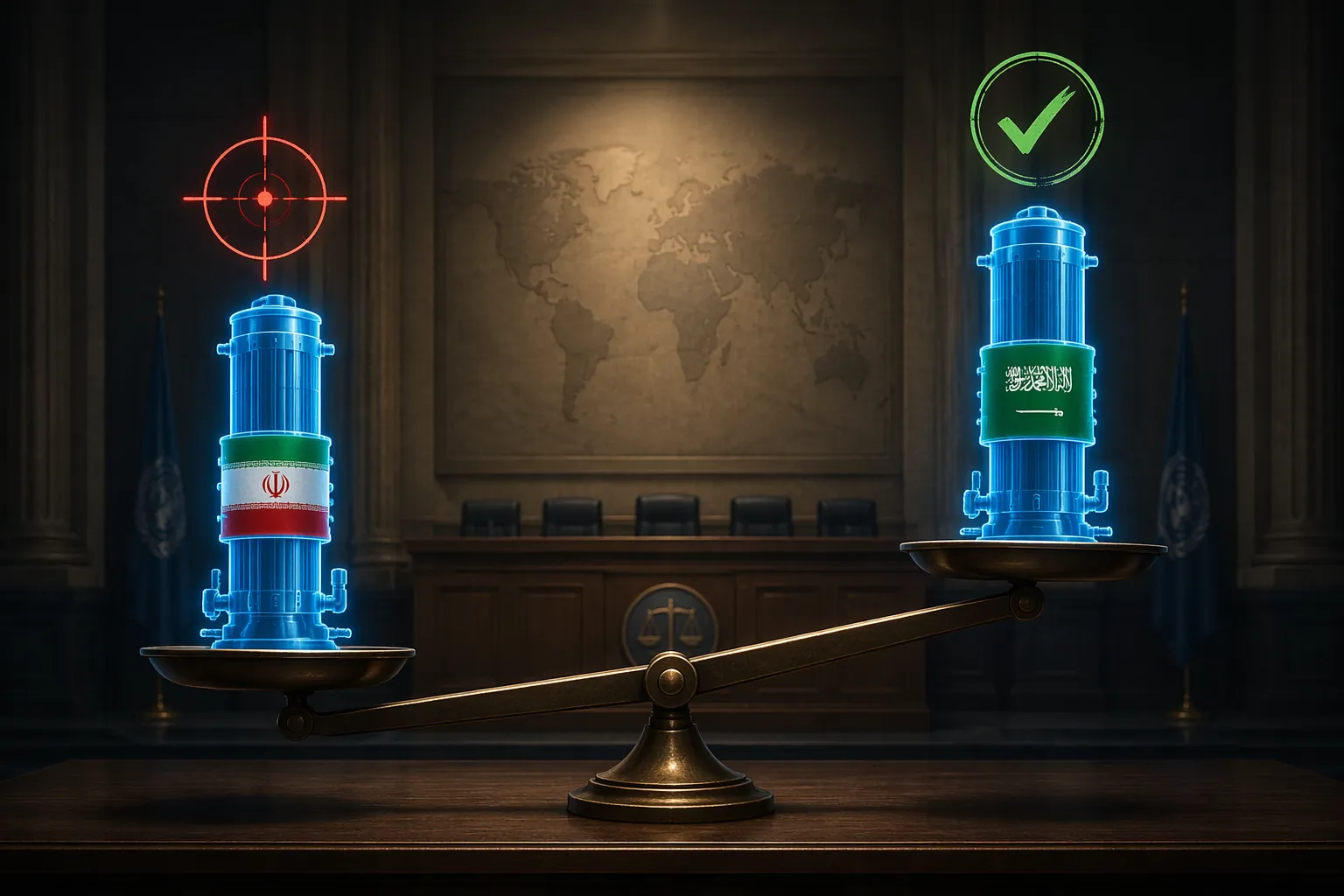
The legal paradox of bombing Iran while permitting Saudi enrichment
The US-Saudi 123 agreement permits Saudi enrichment while the US military strikes Iran for similar enrichment activity, raising questions of legal consistency under the NPT and customary international law. This article examines the policy contradiction and its implications for nonproliferation enforcement.
- Jurisdiction
- International
- Ruling date
- Jul 22, 2026
- Source document
- View primary court order ↗
Lex Machina Review is an independent risk-tracking and reference resource. Nothing on this site is legal advice, and using it does not create an attorney-client relationship. Every record is reviewed against primary sources but may not reflect the most current status of a matter — always verify directly against the cited court order, rule text, or a licensed attorney before relying on it.
Companion explanation — secondary to the source document above
The contradiction arrived in a form lawyers could not easily file under mere hypocrisy. On July 22, 2026, reports described a new U.S.-Saudi nuclear cooperation agreement that would not include the “gold standard” ban on enrichment and reprocessing, even as the same administration had justified military action against Iran by treating enrichment as an intolerable security threat. At a House Foreign Affairs Committee hearing, Rep. Brad Sherman put the problem in its sharpest form: the United States was “bombing Iran because they insist upon enriching and reprocessing” while giving Saudi Arabia a “green light to reprocess and to enrich”; “the only difference I see here is that Westinghouse stands to make an awful lot of money.”[1]
That statement is powerful because it compresses two different legal questions into one political sentence. The first question is whether enrichment by a non-nuclear-weapon state is, by itself, prohibited. It is not. The Nuclear Non-Proliferation Treaty preserves the “inalienable right” of parties to develop nuclear energy for peaceful purposes, subject to the treaty’s nonproliferation obligations. Iran and Saudi Arabia therefore begin from the same legal baseline: neither is barred by the NPT merely because it wants a fuel-cycle capability.
The second question is harder: what happens when a government treats one state’s exercise of that right as a military trigger while helping another state preserve a route to the same capability? That is not a clean treaty-violation argument. It is an enforcement-legitimacy argument, and it may be the more damaging one.
The right and the guardrail are not the same thing
A 123 agreement is not a permission slip from the NPT. It is the domestic U.S. statutory framework for significant nuclear cooperation with another country. Section 123 of the Atomic Energy Act requires an agreement to meet nine mandatory nonproliferation criteria before U.S. nuclear materials, equipment, or technology can be transferred, including safeguards, peaceful-use assurances, physical security protections, and restrictions on retransfers and enrichment or reprocessing of transferred U.S.-origin material without U.S. consent.[2]
Those criteria matter because they define what Congress has required as a floor. They do not automatically require the “gold standard” used in the 2009 U.S.-UAE nuclear cooperation agreement, under which the UAE renounced domestic enrichment and reprocessing. Nor do they automatically require a state to have an Additional Protocol in force with the International Atomic Energy Agency. Those are stricter policy choices, not universal treaty text.
That distinction is where much of the public debate becomes sloppy. If the U.S.-Saudi agreement satisfies Section 123’s mandatory criteria, it is not made unlawful merely because it omits a gold-standard renunciation. Reuters reported in May 2026 that a State Department letter to Senator Ed Markey said the agreement lacked such strict guardrails, including a binding Saudi commitment to forgo enrichment and reprocessing, and that Saudi Arabia had not yet brought an Additional Protocol into force.[3] Those facts may make the agreement less restrictive than some prior models. They do not, on their own, prove that the agreement violates Section 123.
The legal baseline therefore cuts in two directions. It prevents a simple accusation that Saudi enrichment is per se unlawful. It also prevents a simple defense of bombing Iran on the theory that enrichment, standing alone, is outside the rights of an NPT non-nuclear-weapon state.
Why the Iran comparison does not disappear
The administration’s problem is not that Saudi Arabia and Iran are identical. They are not. Their safeguards histories, regional alignments, missile programs, threat perceptions, and relationships with Washington differ in legally relevant ways. A state assessing proliferation risk may weigh those differences. Treaty law does not require foreign policy blindness.
But difference is not the same as a rule. If the rule being announced is that enrichment by a non-nuclear-weapon state creates an unacceptable threat, then Saudi Arabia is an awkward beneficiary. If the rule is instead that enrichment is lawful when safeguards, political trust, and U.S. consent are present, then the Iran strikes need a narrower legal justification than “they enrich.”
Sherman’s formulation matters for that reason. It forces the administration to say what exactly made Iran’s enrichment a military target. Was it enrichment itself? Was it safeguards noncompliance? Was it the scale of the program, the level of enrichment, weaponization evidence, regional conduct, or an imminent armed threat? Each answer has a different legal consequence. Only some of them can be reconciled with allowing Saudi Arabia to preserve a domestic enrichment option.
This is also why Sen. Chris Murphy’s warning, while less legally precise, should not be dismissed as ordinary partisan alarm. He argued that the Saudi deal “will set off a nuclear race in the region” and further discourage Iran from limiting its own program.[1] That is a regional-security prediction, not a treaty conclusion. Still, nonproliferation law lives on confidence that restraints will be applied with some intelligible consistency. A state asked to accept limits will notice when a rival is offered a more permissive path.
Saudi intent is relevant, but not conclusive
Saudi Arabia’s own public language makes the permissive approach harder to defend. Crown Prince Mohammed bin Salman has said that if Iran obtains a nuclear weapon, “we have to get one.”[4] That sentence is not evidence that Saudi Arabia has a weapons program. It is not proof of a diversion plan. It does, however, put intent and conditionality into the legal risk assessment.
A 123 agreement can be legally valid while still being difficult to square with the stated objective of preventing a regional nuclear race. The point is not that any state making a threatening statement forfeits its Article IV rights. It is that a state publicly linking its future weapons posture to Iran’s conduct is a peculiar candidate for a more permissive U.S. enrichment policy at the same moment Washington is using force to suppress Iranian enrichment.
That distinction matters for lawyers who will have to defend the arrangement. They need not argue that Saudi Arabia has no peaceful-use right. They have to argue that enabling a latent capability in Saudi Arabia does not undermine the claimed necessity of military enforcement against Iran. That is a much narrower and more fragile position.
The “black box” does not yet solve the legal problem
Some reporting has described a possible “black box” arrangement: a U.S.-operated enrichment facility on Saudi soil, with Saudi Arabia receiving fuel while being denied access to enrichment technology. That architecture, if it exists and if it is enforceable, would be materially different from an unrestricted transfer of enrichment know-how. But the arrangement has not been confirmed in publicly released agreement text, and the precise safeguards terms were not public as of July 23, 2026.
This uncertainty should restrain the analysis in both directions. It would be premature to declare that the agreement authorizes Saudi Arabia to master the full enrichment fuel cycle. It would also be premature to accept an unnamed-source technical workaround as if it were binding law. In nuclear cooperation, the difference between political architecture and enforceable text is not decorative; it is the place where obligations are created.
The available reports still leave the central contradiction intact. A prohibition on Saudi access to technology might reduce proliferation risk, but it would not erase the administration’s broader message: enrichment capability can be accommodated for a partner, even while enrichment is described as a reason to use force against an adversary.
Normalization with Israel is politically important, legally secondary
The reported absence of Saudi-Israel normalization changes the political bargain more than the treaty analysis. Earlier versions of a U.S.-Saudi nuclear package were often discussed as part of a larger regional arrangement that might include normalization with Israel. The July 2026 reporting, by contrast, described a deal that made no mention of normalization.[1][5]
That absence matters because it weakens one of the political arguments for accepting proliferation-sensitive concessions: that the nuclear terms were the price of a major regional diplomatic realignment. But even if normalization had been included, it would not have changed the NPT baseline. A diplomatic prize cannot convert a nonproliferation policy preference into a treaty rule.
For legal analysis of the reported Saudi nuclear deal and its normalization context, normalization is therefore a contextual fact, not the center of gravity. The harder legal issue is what U.S. enforcement of nonproliferation rules looks like when the same fuel-cycle activity is condemned in one file and negotiated in another.
The UAE clause turns inconsistency into leverage
The most practical consequence may come not from Iran, but from a U.S. partner that already accepted stricter terms. The 2009 U.S.-UAE 123 agreement is widely treated as the gold-standard model because the UAE renounced enrichment and reprocessing. FDD has described a consultation mechanism under which the UAE may seek consultations if another Middle Eastern state receives more favorable nuclear cooperation terms from the United States.[4]
That point should be verified against the original agreement text before anyone treats it as an automatic renegotiation right. But if the clause operates as described, the Saudi deal does more than weaken a talking point. It may give the UAE a contractual basis to ask why it remains bound by stricter fuel-cycle commitments than those offered to Riyadh.
This is the part of the paradox that tends to survive changes in administration rhetoric. A state that accepted restraint can compare text. It can ask whether its bargain has been devalued. It can use the United States’ own regional precedent to reopen what Washington once presented as the preferred nonproliferation model.
What the contradiction does, and does not, prove
The reported U.S.-Saudi agreement does not, on the present public record, prove that the Saudi deal is unlawful. Section 123 permits nuclear cooperation agreements that do not include a blanket enrichment ban, provided the statutory criteria are met. The NPT does not prohibit peaceful enrichment by non-nuclear-weapon states. And a public Saudi statement about matching Iran if Iran obtains a weapon is not the same thing as evidence that Saudi Arabia is building one.
Nor does the contradiction, by itself, make the Iran strikes automatically void under international law. The legality of force would turn on the administration’s actual justification, the facts it claimed about threat and necessity, and the applicable rules on self-defense or Security Council authorization. If officials had evidence beyond enrichment itself, that evidence would matter.
But the contradiction does narrow the government’s defensible vocabulary. It cannot credibly say that enrichment by an NPT non-nuclear-weapon state is categorically incompatible with international peace while preserving a pathway for Saudi enrichment. It cannot easily claim that the gold standard is essential while declining to require it where the strategic relationship is more convenient. And it cannot ask other states to treat Article IV as both an enforceable right for partners and a revocable privilege for adversaries.
The damage is therefore institutional. Nonproliferation enforcement depends on more than having correct treaty nouns. It depends on whether the reasons attached to those nouns can be applied without changing shape from one capital to the next.
The precedent other states will see
Other NPT non-nuclear-weapon states do not need to prove discrimination in a courtroom to use the precedent. They can raise it in safeguards negotiations, export-control diplomacy, regional security talks, and future 123 consultations. They can say that Washington treated enrichment as manageable when embedded in a friendly bilateral arrangement and intolerable when asserted by an adversary.
That is not an answer to every proliferation concern. A state’s record still matters. Safeguards still matter. Secret weaponization work, if proven, would matter enormously. But when the legal right is formally equal and the policy treatment is radically different, the state imposing the distinction has to explain the limiting principle.
As of July 23, 2026, the actual U.S.-Saudi agreement text and the full safeguards terms were not public. That uncertainty should prevent categorical judgments about the agreement’s legality. It does not eliminate the contradiction already visible in reported policy and official justification. If enrichment is a protected peaceful right for partners and a military trigger for adversaries, the regime’s legal vocabulary remains intact, but its enforcement logic becomes visibly selective.
References
- No normalization, no gold standard: US signs Saudi nuclear deal — Ynetnews
- The U.S. Atomic Energy Act Section 123 At a Glance — Arms Control Association
- US nuclear power pact with Saudi Arabia lacks strict guardrails, letter says — Reuters
- FAQ: Understanding Saudi Arabia's Uranium Enrichment Request — FDD
- US-Saudi nuclear deal makes no mention of normalization with Israel — Jerusalem Post
Related records
Tool profile
Browse tool evaluations →Governing regulation
Browse the obligations tracker →Preventive workflow
Browse verification workflows →
Report a correction or tip
Spotted an outdated figure, a misstated fact, or a ruling this case record should reflect? Public comments are disabled for this content given the professional cost of a misreported case outcome, penalty amount, or rule text — use the structured correction channel instead.
Report a correction or tip for this record →