
Legal Recourse for USCIS Glitch False Green Card Approvals
If USCIS issued a false green card approval due to a system glitch, you have six legal remedies ranked by urgency and fit — from a simple I-90 card replacement to a federal mandamus lawsuit. This guide explains the critical 30-day NOIR deadline and what your sworn answer must include to avoid automatic default.
- Jurisdiction
- United States
- Ruling date
- Jul 24, 2026
- Source document
- View primary court order ↗
Lex Machina Review is an independent risk-tracking and reference resource. Nothing on this site is legal advice, and using it does not create an attorney-client relationship. Every record is reviewed against primary sources but may not reflect the most current status of a matter — always verify directly against the cited court order, rule text, or a licensed attorney before relying on it.
Companion explanation — secondary to the source document above
Start With The Fork That Can Cost You The Case
A false green card approval from a USCIS glitch is not one legal problem. It is several possible problems wearing the same label. The first question is not whether USCIS made a mistake. The first question is whether you have received a Notice of Intent to Rescind, usually called a NOIR.
If there is a NOIR, the case has moved out of customer-service territory. USCIS is alleging that permanent residence was granted in error, and the response window is 30 days. Under 8 CFR § 246.2, the answer must be sworn, must respond to each allegation, and should expressly demand a hearing before an Immigration Judge if rescission is contested; USCIS policy describes rescission as the process used when a person was not eligible for adjustment at the time permanent residence was granted.[1]

If there is no NOIR, the remedy depends on what actually went wrong: a defective card, an inaccurate online update, a formal adverse decision, an exhausted administrative channel, or an unreasonable delay. Those routes can overlap, but they do not do the same work. Filing the wrong one first can waste the only deadline that matters.
| Tier | Best fit | Deadline or timing | What it can do | What it does not do |
|---|---|---|---|---|
| 1. e-Request or Form I-90 | Card typo or production error after a real approval | No special rescission deadline; I-90 fee rules depend on the defect | Correct the physical card or request replacement | Does not cure an approval that was never legally valid |
| 2. CIS Ombudsman request | Unresolved USCIS channel, system error, stuck correction | After trying USCIS channels first | Push USCIS to review and resolve a documented problem | Does not replace a required appeal, motion, or NOIR answer |
| 3. Form I-290B motion | Formal denial or adverse decision based on USCIS error | Generally 30 days from the decision | Ask USCIS to reopen or reconsider | Does not preserve a rescission hearing unless the NOIR rules are satisfied |
| 4. NOIR sworn answer and IJ hearing demand | USCIS says the green card was approved in error and intends rescission | 30 days | Preserve defenses and the required hearing posture | A narrative letter alone can default the case |
| 5. Congressional assistance | Unresponsive agency after documented efforts | No formal filing deadline | Create pressure and obtain status attention | Does not bind USCIS or create damages |
| 6. Mandamus lawsuit | Unreasonable delay where agency action is being withheld | No fixed USCIS form deadline, but delay must be supportable | Compel agency action | Does not guarantee approval or compensation |
The NOIR Response Is The Remedy You Cannot Recreate Later
A NOIR is the highest-risk version of the USCIS glitch false green card approval problem because it turns the agency’s error into an allegation against the status holder. The practical harm may have started with USCIS: a card arrived, the online account showed approval, an employer changed plans, travel plans shifted, or another status was allowed to lapse. But once the NOIR arrives, the question becomes procedural: did the person preserve the right to contest rescission?
The answer should not be a polite cover letter saying USCIS made a mistake. It should be a sworn answer. It should admit, deny, or explain each allegation. It should attach evidence showing eligibility at the time adjustment was granted. It should explicitly demand a hearing before an Immigration Judge if the allegations are contested. Practitioner discussions of rescission repeatedly warn that failing to answer in the required form can lead to default rather than a merits hearing.[2][3]
The five-year issue belongs in that first answer if it is available. INA § 246(a), codified at 8 USC § 1256, limits rescission authority in important ways, and practitioner analysis treats the limitation defense as something to raise immediately, not as a fallback to remember after USCIS has already entered the rescission track.[4]
This is where otherwise sensible people make the dangerous move. They try to be helpful. They write a timeline. They attach the card. They explain that they relied on the approval. Those facts may matter, but they do not substitute for the required sworn answer, documentary eligibility evidence, and hearing demand. The agency can be wrong and the respondent can still lose the procedural protection by answering in the wrong form.
What The NOIR Packet Should Force You To Check
- The date of service and the exact response deadline.
- Every factual allegation USCIS makes about why adjustment was supposedly improper.
- Eligibility at the time adjustment was granted, not only eligibility today.
- Whether the five-year INA § 246(a) limitation defense is available.
- Whether the filing expressly demands an Immigration Judge hearing.
The point is not to make the response look aggressive. The point is to keep the case in the posture where the person can contest rescission at all.
Erroneous Cards Are Real, But The Old Audit Number Has A Date Stamp
USCIS card mistakes are not imaginary. A DHS Office of Inspector General audit found that at least 19,000 green cards with incorrect information or duplicates were issued between July 2013 and May 2016, including cards sent to wrong addresses and cards containing wrong names, dates, or category codes.[5]
That figure should be used carefully. It is not a current 2026 count, and it does not prove that every false approval today comes from the same kind of failure. It does establish the more modest and more useful point: erroneous card issuance has been documented by a government audit, and physical possession of a card does not automatically settle the legal status question.
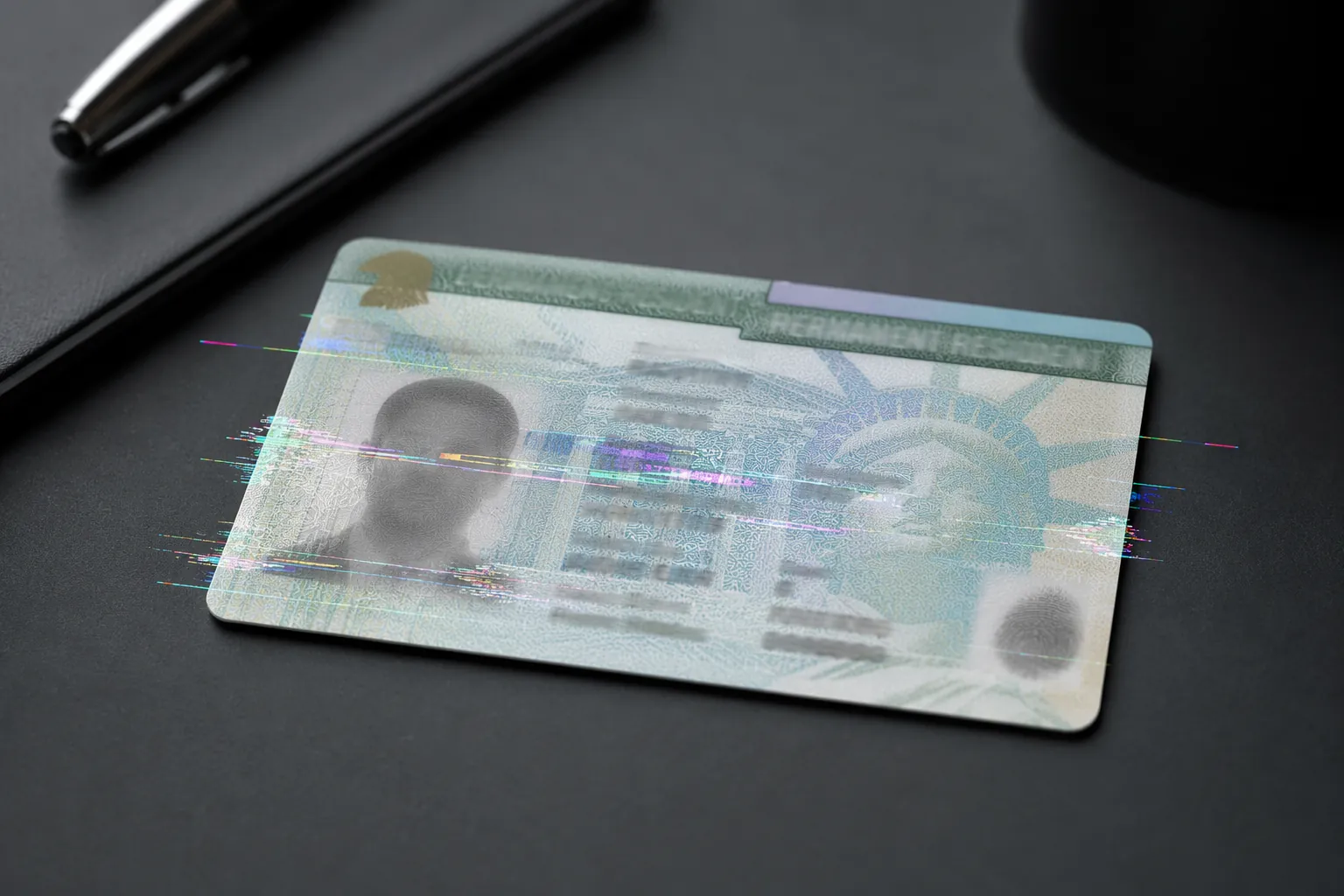
A 2019 public Avvo scenario shows why this matters in real life without proving a broader trend. In that account, an EB-1A applicant reportedly received a green card without an interview, the employer withdrew H-1B sponsorship based on the apparent approval, and USCIS later issued a NOIR.[6] The harm there is not abstract. The apparent approval changed the applicant’s and employer’s choices before USCIS tried to unwind the approval.
But reliance harm and legal remedy are not the same thing. No specific class action for USCIS glitch-based false green card approvals was identified in the research materials, and the ordinary remedy stack does not include compensatory damages for collateral losses such as an employer’s withdrawn sponsorship, closed work authorization strategy, or missed planning window. Those losses may explain urgency. They do not themselves create a simple damages claim.
If The Card Is Wrong But The Approval Was Real
A clean card defect is the lowest-risk version of the problem. The name is misspelled, the date is wrong, the category code is incorrect, or the card was produced with information that does not match the actual approval. In that scenario, the task is correction, not litigation.
Murthy Law Firm describes using USCIS correction channels or Form I-90 when a green card contains an error, while distinguishing those card-production problems from situations where the person may not have been eligible for the card in the first place.[7]
- Use an e-Request or USCIS service channel when the issue is plainly a typographic or production error.
- Use Form I-90 when a replacement permanent resident card is the correct mechanism.
- Do not use I-90 to pretend an invalid approval was valid.
- Keep copies of the approval notice, the defective card, delivery records, and all USCIS communications.
The distinction is narrow but important. If the agency approved a case it had authority to approve and printed the card incorrectly, replacement-card logic fits. If the agency approved a case before eligibility existed, skipped a required step, or later says the grant itself was improper, a card replacement form is not the remedy that protects status.
If The Online Status Is Wrong Or USCIS Will Not Clean Up Its Own Error
An online case-status error is irritating, but it is not always legally operative. A practitioner page from JQK Law calls USCIS online case status “highly inaccurate” and gives the firm’s view that errors are common; that should be treated as practitioner opinion, not a measured government statistic.[8]
A Westlaw practitioner note also reported mistaken adjustment case-status emails attributed to an apparent USCIS technical glitch. Because the note is practitioner reporting and not a public government audit, it supports caution rather than a numerical claim about frequency.[9]
When the status error persists after ordinary USCIS channels are tried, the CIS Ombudsman can be the next pressure point. Landerholm Immigration describes the Ombudsman as an escalation option after USCIS channels have been exhausted and states that the office has an approximately 80% resolution rate; DHS provides Form 7001 for submitting case assistance requests.[10][11]
The Ombudsman is not a substitute for a filing deadline. It is useful when USCIS is stuck, inconsistent, or not responding to a documented system problem. It is dangerous if used as a way to avoid a 30-day NOIR answer or a 30-day motion deadline.
If USCIS Has Issued A Formal Adverse Decision
A formal denial, revocation-type action, or adverse decision based on an agency error may point toward Form I-290B, depending on the decision type and whether that form is allowed. Lozano Law describes the I-290B as a way to challenge USCIS error and gives a 30-day filing deadline from the decision, with adjudication often taking 90 days to six months.[12]
The motion has to do more than complain that the outcome is unfair. It should identify the agency error, show why the record supports reopening or reconsideration, and distinguish USCIS mistake from applicant omission. Thomas V. Allen’s discussion of motions to reopen and reconsider emphasizes that these motions depend on the governing standard and the evidence or legal error being presented.[13]
Do not assume that an I-290B preserves a rescission hearing. If the document in hand is a NOIR, the rescission regulation controls the immediate move. If the document is a denial or other appealable USCIS decision, the motion route may be the correct one. The caption on the notice matters.
Congressional Help Is Pressure, Not A Cure
A congressional inquiry can sometimes get a stalled or mishandled USCIS matter looked at by the right unit. It is most sensible after the record is organized: receipt notices, card copies, screenshots, service requests, USCIS replies, and a short chronology that separates verified facts from assumptions.
It should not be sold as a legal remedy with predictable force. A congressional office can ask for information and press for attention. It cannot rewrite a missed NOIR deadline, compel USCIS to approve an ineligible case, or award compensation for reliance losses.
Mandamus Is For Delay, Not For A Guaranteed Green Card
Federal mandamus is sometimes the last usable tool when USCIS will not act. De Wit Immigration Law describes mandamus lawsuits against USCIS for case delays as typically involving $5,000 to $15,000 in legal fees and a three-to-six-month timeline from filing.[14]
That makes mandamus a poor first move for a simple card typo and a poor answer to a live NOIR. Its function is to compel agency action unlawfully withheld or unreasonably delayed. It does not guarantee approval, and it is not a damages vehicle for the disruption caused by a false approval.
Mandamus becomes more plausible when USCIS has acknowledged a problem but will not resolve it, when normal requests have gone nowhere, and when no administrative filing is available to force the case forward. Even then, the expected result is movement, not a promised status outcome.
A Practical Sorting Rule
Use the document in front of you, not the emotional shape of the problem, to choose the first remedy.
- If there is a NOIR, preserve the 30-day sworn answer, eligibility evidence, hearing demand, and any INA § 246(a) defense first.
- If the approval was valid but the card is wrong, use USCIS correction channels or I-90.
- If the online status or email notice is wrong and USCIS channels are exhausted, consider the CIS Ombudsman.
- If there is a formal adverse USCIS decision, evaluate I-290B before the 30-day window closes.
- If the agency is simply not acting after documented attempts, congressional assistance or mandamus may fit, with mandamus aimed at action rather than approval.
This is a verification-first risk guide, not legal advice. Before relying on any deadline or citation, recheck INA § 246, 8 CFR § 246.2, 8 USC § 1256, the current USCIS Policy Manual, and the notice actually issued in the case.
References
- Chapter 3 - Rescission of Adjustment of Status, USCIS Policy Manual,
- Defeating INA 204(c) Green Card Rescission NOIR, Loblack Law,
- Losing Your Green Card Through Rescission, SGG Immigration,
- Green Card Rescission After 5 Years, Hacking Immigration Law,
- Better Safeguards Are Needed in USCIS Green Card Issuance, DHS Office of Inspector General, November 2016,
- USCIS rescind my green card because of their error, Avvo, 2019,
- Addressing Green Cards Issued in Error by USCIS, Murthy Law Firm, June 1, 2023,
- USCIS Case Status Errors, JQK Law,
- Apparent USCIS Technical Glitch Causes Mistaken Adjustment Case Status Emails, Westlaw,
- What Is a USCIS Ombudsman Request?, Landerholm Immigration, November 2022,
- DHS Form 7001, DHS CIS Ombudsman,
- USCIS Makes Error? I-290B to the Rescue, Lozano Law Firm,
- Motions to Reopen and Reconsider (MTR): When and How to Challenge a USCIS Denial, Thomas V. Allen,
- How Do I File a Mandamus Lawsuit Against USCIS for Case Delays?, De Wit Immigration Law,
Related records
Tool profile
Browse tool evaluations →Governing regulation
Browse the obligations tracker →Preventive workflow
Browse verification workflows →
Report a correction or tip
Spotted an outdated figure, a misstated fact, or a ruling this case record should reflect? Public comments are disabled for this content given the professional cost of a misreported case outcome, penalty amount, or rule text — use the structured correction channel instead.
Report a correction or tip for this record →