
How Administrative and Criminal Paths Diverge in the Vance Leak Case
This record explains the legal posture of the JD Vance Secret Service leak investigation: the applicable statutes (18 USC §§ 793, 798), the parallel administrative and criminal tracks, the lower burden of proof on the administrative side, and the specific-intent hurdle that limits the criminal path.
- Jurisdiction
- us-federal
- Court
- None
- AI tool named
- none
- Ruling date
- Jul 23, 2026
- Source document
- View primary court order ↗
- Last verified
- Jul 24, 2026
Lex Machina Review is an independent risk-tracking and reference resource. Nothing on this site is legal advice, and using it does not create an attorney-client relationship. Every record is reviewed against primary sources but may not reflect the most current status of a matter — always verify directly against the cited court order, rule text, or a licensed attorney before relying on it.
Companion explanation — secondary to the source document above
As of July 24, 2026, the legal posture of the JD Vance Secret Service leak investigation is narrower than much of the surrounding commentary suggests. The Secret Service has confirmed an administrative investigation and has referred to a potential criminal inquiry, but no charging document, court order, or confirmed grand jury proceeding has been reported for this specific matter. The suspected employee’s name has not been officially released; public reports describe the person only as a member of the Vice Presidential Protective Division who has been placed on administrative leave and whose security clearance has been suspended.[1][2]
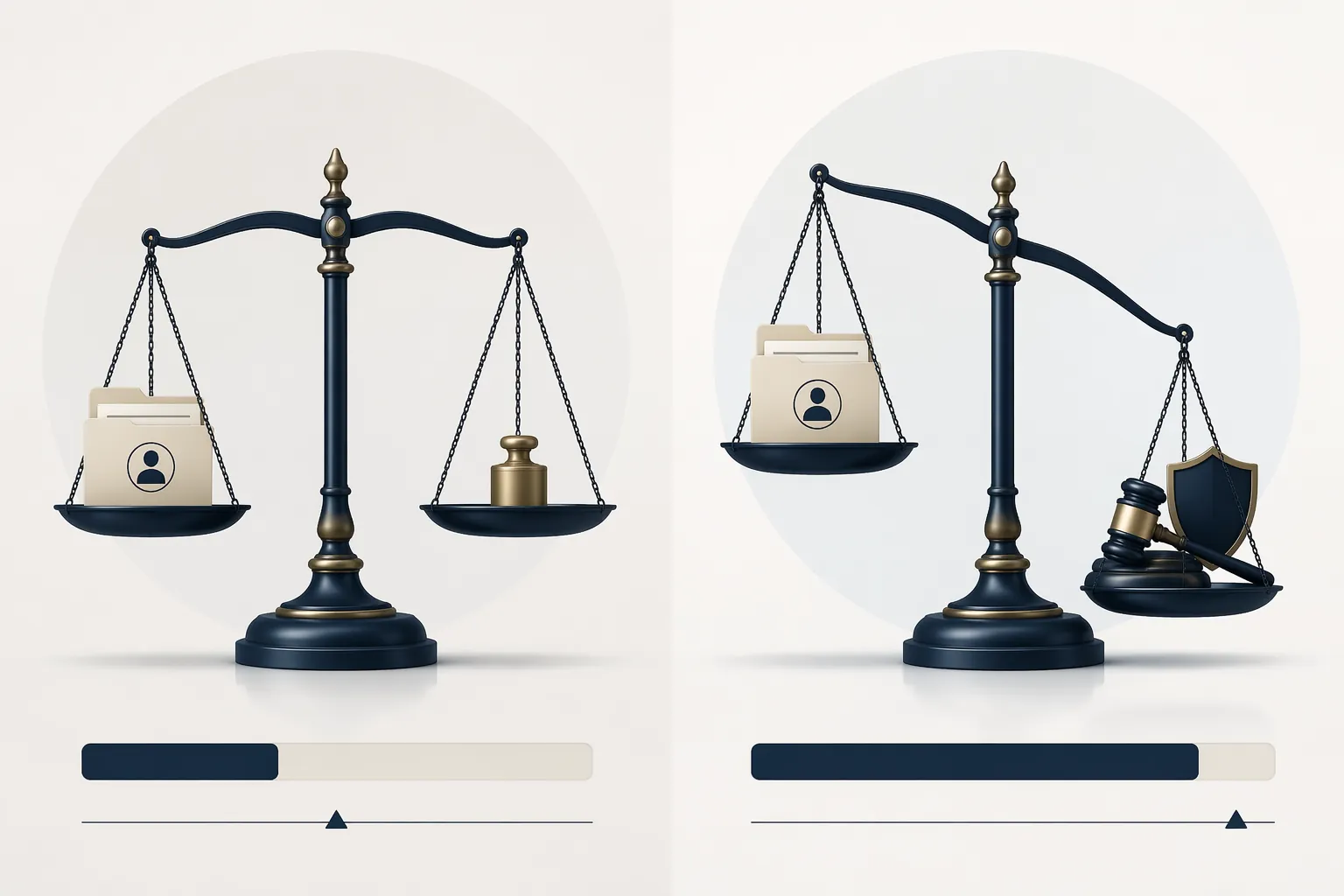
That distinction matters. Administrative leave and clearance suspension are not previews of an Espionage Act indictment. They are personnel and security measures available to an agency while facts are still being developed. A criminal case, if one ever follows, would have to satisfy a different decision-maker, a different burden, and a different intent standard.

The Confirmed Record Is a Two-Track Record
The most useful starting point is the Secret Service’s own wording. On July 23, 2026, Chief of Communications Anthony Guglielmi described both an “administrative investigation” and a “potential criminal inquiry,” language reported by multiple outlets covering the agency response.[1][2][3] That phrasing does not collapse the two tracks. It separates them.
| Track | Who Can Act | What Is Reported So Far | What It Can Decide |
|---|---|---|---|
| Administrative | Secret Service Office of Professional Responsibility and agency leadership | Administrative leave and security-clearance suspension for an unnamed Vice Presidential Protective Division member | Whether the employee should remain in duty status, retain access, or face personnel action |
| Criminal | FBI and DOJ, if the matter is pursued as a criminal case | A potential inquiry has been referenced, but no charge, court filing, or confirmed grand jury has been reported for this matter | Whether prosecutors can prove a statutory offense beyond a reasonable doubt |
The reported trigger was an MS NOW story about frustration inside Vice President Vance’s detail over off-the-record travel demands, including accounts of a planned Marine Two helicopter trip connected to his son’s golf lesson. The original MS NOW article was not available in the materials reviewed here; its contents are therefore treated only as reconstructed from descriptions in CNN, The Hill, Fox News, the BBC, and the New York Post.[1][3][4][5]
The name point deserves its own caution because leak stories tend to contaminate one another quickly. This matter should not be merged with the separately reported January 2026 Tomas Escotto incident, which involved a different alleged leak vector, an undercover video by James O’Keefe, and a different evidentiary posture.[6] The current Vance-detail matter remains officially unnamed in the public record described by the reporting.
What the Administrative Track Can Do Before Prosecutors Decide Anything
The administrative side is where the government can move first and usually fastest. An agency responsible for protecting the vice president does not need to wait for prosecutors to prove a crime before it limits access to sensitive spaces, suspends a clearance, or removes an employee from an assignment. Those decisions are risk-management decisions tied to trust, access, and mission integrity.
For an agency lawyer or risk officer, the key point is that administrative action is not punishment in the criminal-law sense. It can be justified by a lower evidentiary threshold and by the agency’s obligation to decide whether continued access is consistent with national-security and personnel standards. Federal adverse-action rules under 5 U.S.C. § 7503 use a preponderance framework for covered suspensions of 14 days or less, and Executive Order 10450 supplies the older government-wide security principle that employment must be “clearly consistent with the interests of the national security.”[7][8]
That does not mean the agency may do anything it wants without process. It means the agency’s question is different from DOJ’s. OPR can ask whether the employee violated internal rules, mishandled protected information, breached trust, or created a security risk serious enough to justify clearance action or personnel discipline. None of those findings requires a prosecutor to establish every element of 18 U.S.C. § 793 or § 798 beyond a reasonable doubt.
- Administrative leave can remove the employee from operational duties while fact-gathering continues.
- Clearance suspension can cut off access before the agency reaches a final discipline decision.
- OPR interviews, device reviews, access-log analysis, and internal reporting channels can proceed even if prosecutors have not charged anyone.
- Termination or other discipline may remain possible even if DOJ later declines prosecution.
That last point is often where public commentary goes wrong. A declination would not necessarily clear the employee for agency purposes. Conversely, administrative leave does not establish that a crime occurred. The two tracks may use overlapping facts, but they do not ask the same legal question.
The Criminal Path Is Not a Generic “Leak” Charge
There is no single federal statute that criminalizes every unauthorized disclosure of classified information. The federal framework is a patchwork: different provisions cover different categories of information, different recipients, and different mental states. CRS and Federation of American Scientists materials describe that architecture as fragmented rather than comprehensive.[9][10]
For a national-security disclosure case, two obvious statutory candidates are 18 U.S.C. § 793 and 18 U.S.C. § 798. Section 793 covers certain conduct involving national defense information, including willful communication, delivery, transmission, or retention under specified circumstances. Section 798 covers knowing and willful disclosure of classified information concerning communications intelligence, cryptographic systems, or related communications-security matters. Each carries a maximum penalty of up to 10 years’ imprisonment for covered violations.[11][12]
Those statutes still do not answer the Vance matter by themselves. The reported story involved vice-presidential travel and protective-detail frustration. The public record, as of July 24, does not establish what information was allegedly disclosed, whether it was classified, whether it was national defense information, whether it involved communications intelligence, or whether the suspected employee was the source. Without those facts, statute-spotting is not charging analysis.
The intent problem is the harder part. Under the AIPAC line of analysis discussed by FAS, prosecutions involving national defense information can require proof of specific intent or bad-faith purpose: the government must show more than an unauthorized disclosure and more than embarrassment to officials. The relevant criminal question becomes whether the defendant acted with reason to believe the information could be used to injure the United States or advantage a foreign nation, or otherwise with the required bad-faith purpose under the applicable theory.[9]
That is why a reporter receiving sensitive information and an agency suspending a clearance are not enough to complete a criminal case. Prosecutors would need admissible proof tying a person to the disclosure, identifying the protected character of the information, satisfying the statutory mental state, and overcoming any factual problems created by prior access, multiple possible sources, or ambiguity about what was actually transmitted.
The Broader Leak Crackdown Is Context, Not Evidence
The Trump administration’s broader enforcement posture is relevant, but only in a limited way. In July 2026, CNN reported that the administration had issued grand jury subpoenas to four New York Times journalists in connection with an Air Force One security story. Reports also described June 2026 subpoenas involving Wall Street Journal and Washington Post journalists that were later withdrawn, with FBI Director Kash Patel personally involved in the broader media-subpoena disputes.[13][14]
Those episodes show a willingness to use criminal-process tools in leak-related matters. They do not prove anything about the unnamed Vice Presidential Protective Division member. They do not establish that a grand jury has been impaneled in this case, that the same prosecutors are involved, or that the Vance-detail facts fit any particular statute.
What Outcomes Remain Realistically Open
Several outcomes remain open without contradicting the current record. The agency could sustain administrative findings and impose discipline even if prosecutors decline a criminal case. It could restore access or duty status if OPR cannot support its suspicions. DOJ could open or continue a criminal inquiry and still never charge. Or, if investigators develop stronger evidence about the source, the information disclosed, and the required intent, prosecutors could test an Espionage Act theory.
The legally clean posture is therefore modest. The administrative investigation is live and gives the Secret Service practical tools now: leave, clearance suspension, internal fact-finding, and possible personnel action. The criminal path is possible, but materially harder. It would require more than proof that sensitive or classified information reached a reporter; it would require proof that the particular statutory elements, including the required intent, can be met in court.
References
- Secret Service agent placed on leave amid Vance detail leak investigation, CNN, July 22–23, 2026.
- Secret Service confirms administrative investigation and potential criminal inquiry, NBC News, July 2026.
- Secret Service investigating alleged leak involving Vance detail, The Hill, July 23, 2026.
- Secret Service agent on leave after alleged Vance travel leak, BBC, July 23, 2026.
- Secret Service probes leak over JD Vance travel demands, New York Post, July 23, 2026.
- Secret Service agent Tomas Escotto incident coverage, New York Post, January 14, 2026.
- 5 U.S. Code § 7503 - Cause and procedure, Cornell Legal Information Institute.
- Executive Order 10450—Security Requirements for Government Employment, The American Presidency Project, April 27, 1953.
- Leaks and the Law: The Story of Thomas Drake, Federation of American Scientists.
- Criminal Prohibitions on the Publication of Classified Defense Information, Congressional Research Service.
- 18 U.S. Code § 793 - Gathering, transmitting or losing defense information, Cornell Legal Information Institute.
- 18 U.S. Code § 798 - Disclosure of classified information, Cornell Legal Information Institute.
- Trump administration subpoenas New York Times journalists over Air Force One security story, CNN, July 11, 2026.
- Media subpoena disputes involving Wall Street Journal and Washington Post journalists, NBC News, June–July 2026.
Related records
Tool profile
Browse tool evaluations →Governing regulation
Browse the obligations tracker →Preventive workflow
Browse verification workflows →
Report a correction or tip
Spotted an outdated figure, a misstated fact, or a ruling this case record should reflect? Public comments are disabled for this content given the professional cost of a misreported case outcome, penalty amount, or rule text — use the structured correction channel instead.
Report a correction or tip for this record →