
How to Verify the Moreno–Miller Abuse Allegations
A fixed evidence-weighting sequence—court orders, sworn filings, police reports, agency determinations, self-published recordings, press reports—lets counsel separate what is documented, admitted, and unresolved in the Moreno–Miller abuse allegations. The piece also translates status phrases such as "unsubstantiated" and "no charges" so readers can brief partners or clients without adopting either party's narrative.
- Jurisdiction
- Ohio, US
- Court
- Cuyahoga County Court of Common Pleas
- Judge
- Boros
- AI tool named
- None
- Ruling date
- Jun 1, 2026
- Source document
- View primary court order ↗
- Last verified
- Aug 4, 2026
Lex Machina Review is an independent risk-tracking and reference resource. Nothing on this site is legal advice, and using it does not create an attorney-client relationship. Every record is reviewed against primary sources but may not reflect the most current status of a matter — always verify directly against the cited court order, rule text, or a licensed attorney before relying on it.
Companion explanation — secondary to the source document above
Start by translating the status words
For anyone asked to brief the Bernie Moreno–Max Miller “unfit for Congress” abuse allegations, the first task is not to decide which headline sounds more plausible. It is to rank the source behind each sentence and translate the procedural label before treating it as a factual conclusion. “Unsubstantiated,” “no charges,” “denied,” and “dismissed” do not mean the same thing. They also do not carry the same evidentiary weight.
The safest working rule is simple: court orders and sworn filings outrank police reports and agency sufficiency decisions; those outrank self-published recordings; those outrank press summaries and political statements. That order does not make the top source automatically true or the bottom source useless. It tells the person drafting the memo what kind of sentence may be written without importing someone else’s advocacy.
One phrase needs correction at the door: “no charges” is not a finding of innocence. The House Ethics Committee made that point in a May 11, 2026 statement in another matter, explaining that a decision not to bring charges “is not a finding of innocence or ‘no wrongdoing.’” The statement concerned Representative Cory Mills, not Miller, but the status rule is the useful part: prosecutorial inaction is not an adjudicated merits finding. [1]
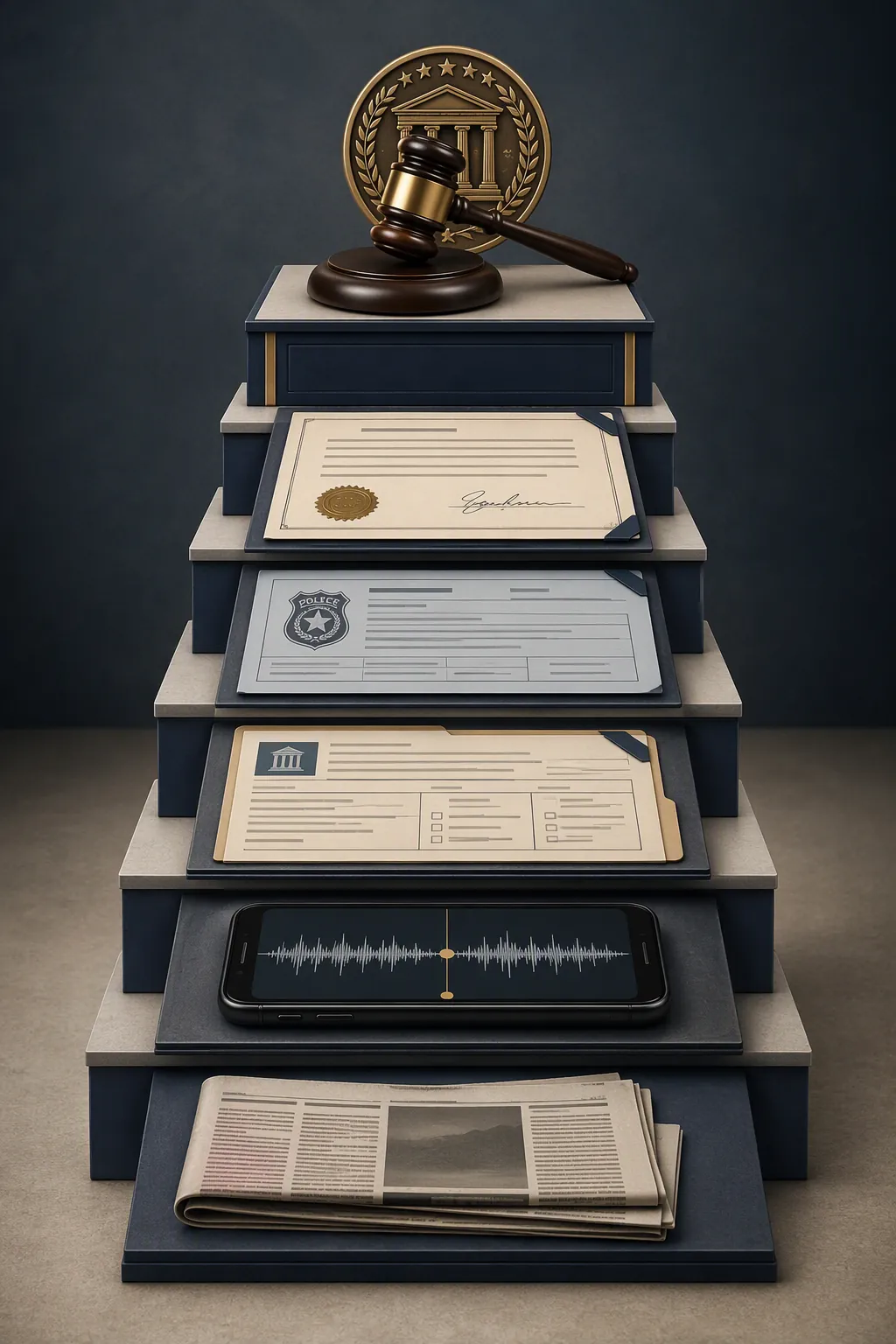
A usable evidence sequence for this packet
The following sequence is a verification tool, not a law-of-evidence chart. It is built for the person who has to decide whether a sentence is safe in a client alert, diligence note, internal risk memo, or newsroom backgrounder.
| Source type | What it can usually support | Common mistake |
|---|---|---|
| Court orders and docket entries | That the court entered, denied, granted, continued, or scheduled something | Treating a temporary or procedural order as a factual finding on the underlying allegation |
| Sworn pleadings, affidavits, and discovery responses | That a party alleged, admitted, denied, or objected under procedural rules | Treating an objection as a denial, or treating an allegation as adjudicated fact |
| Police reports and protection-order materials | That a report was made and what the report records | Treating the existence of a report as proof that the reported event occurred |
| Agency determinations | That an agency reached a sufficiency or screening decision within its own mandate | Extending a narrow agency finding to allegations or people outside the agency’s finding |
| Self-published recordings and clips | That a speaker appears to say something, subject to authentication and context | Treating a short clip and the poster’s caption as the same evidentiary object |
| Press reports and political statements | That a publication or official reported, quoted, or characterized something | Treating narrative synthesis as if it were the underlying record |
That sequence matters in the Miller record because the public packet contains all six types. It also contains a predictable failure pattern: a procedural status gets promoted into a merits conclusion, or a party-framed excerpt gets repeated as if the court had adopted it.
The trigger is political; the verification problem is documentary
The current public surge followed Senator Bernie Moreno’s Aug. 2, 2026 statement about Representative Max Miller, his former son-in-law. NBC News reported that Moreno said Miller “should not serve in the House of Representatives” and “needs to seek professional help.” That is a relevant trigger for why the matter is being briefed now. It is not, by itself, proof of any underlying abuse allegation. [2]
The status facts are narrower. AP reported that Miller had not been criminally charged, that joint custody continued, and that Miller’s own domestic-violence case against Moreno was dismissed with a finding that Miller was not in fear. Each of those facts can be repeated as a procedural status. None should be rewritten as “the abuse allegations were false.” [3]
The civil litigation posture is also part of the record. Roll Call reported on May 14, 2026 that Miller filed a defamation lawsuit against his ex-wife. That fact supports the existence and posture of the lawsuit. It does not resolve whether the challenged allegations are true, false, privileged, actionable, or substantially true. [4]
Three labels that should not be merged
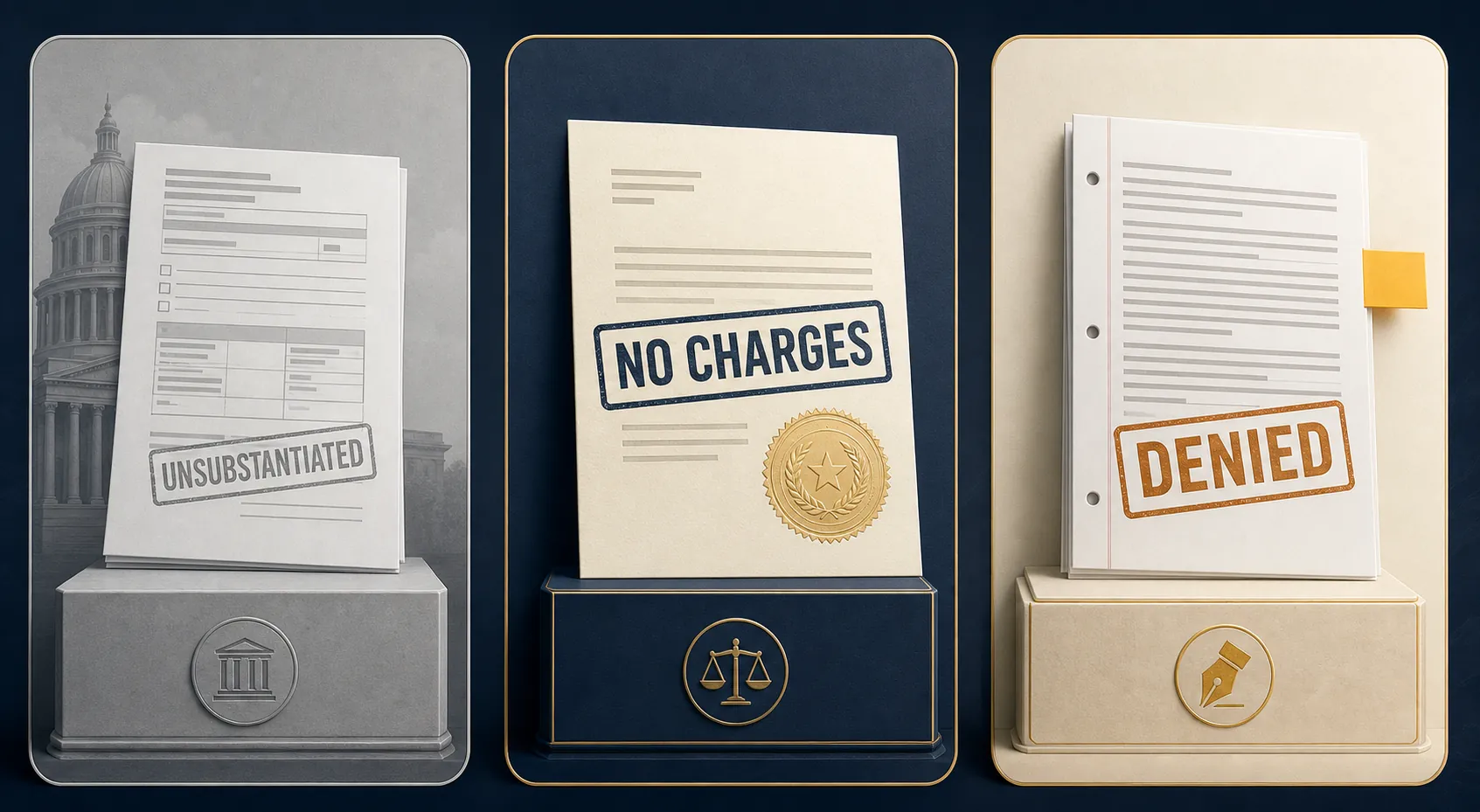
“Unsubstantiated” is a sufficiency finding, not an acquittal
Mother Jones reported records-based allegations including a June 2024 hot-water incident involving a pan of eggs, a Feb. 1, 2026 custody-exchange allegation that Moreno was thrown against a wall and had an “obvious grab mark on her upper arm,” an allegation that a gun was held to her head, and a Feb. 2026 clavicle fracture involving the couple’s 2-year-old, with bruising a child-protection specialist described as appearing to be a handprint and appearing to have been inflicted. Mother Jones also reported that Cuyahoga County DCFS found the child-abuse allegation unsubstantiated. [5]
That last sentence is easy to misuse. An unsubstantiated child-abuse screen means the agency did not substantiate that child-abuse allegation under its process and evidentiary threshold. It does not adjudicate the adult domestic-abuse allegations. It also does not mean every factual statement in the surrounding family-court record was found false. A responsible brief keeps the noun attached to the finding: the child-abuse allegation was reported as unsubstantiated.
“No charges” does not close the factual record
AP’s “no charges” status can be cited for what it says: no criminal charges had been brought. It should not be converted into a finding that no abuse occurred, that no civil claim has merit, or that every allegation is untrue. The Ethics Committee’s Mills statement is useful precisely because it states the general rule in institutional language: a decision not to bring charges is not the same as a finding of innocence or no wrongdoing. [1][3]
A discovery objection is not the same thing as “deny”
The discovery record needs the same grammar. Mother Jones reported that Miller’s interrogatory responses showed both objection-only patterns and explicit “DENY” patterns. That distinction matters. If a response objects without answering, the defensible sentence is that the party objected. If the response says “DENY,” the defensible sentence is that the party denied the allegation. Collapsing both into “he denied everything” is not verification; it is cleanup for one side’s narrative. [5]
The inverse error is just as bad. A discovery objection is not an admission merely because it avoids a direct denial. It may preserve a procedural position, challenge wording, invoke scope, or object on another ground. Unless the response admits, denies, or supplies facts, it should not be made to do more work than it does.
Custody status and dismissed petitions have limited reach
Continued joint custody is a court-status fact. It is meaningful because it shows the court had not, as reported, displaced the custody arrangement in the way a lay reader might expect after reading the allegations. But custody continuation is not a comprehensive truth finding on each abuse allegation. Family-court interim posture can reflect many considerations that are not identical to a final factual adjudication.
The same caution applies to the dismissal of Miller’s domestic-violence case against Moreno. AP reported that the case was dismissed with a finding that Miller was not in fear. That is a useful and repeatable procedural outcome. It should not be expanded into a global finding about all allegations between all parties. [3]
When briefing under deadline, the practical wording is often enough: “No criminal charges have been reported; joint custody continued; Miller’s domestic-violence case against Moreno was dismissed with a finding that he was not in fear; those statuses do not adjudicate the separate abuse allegations.” That sentence is less dramatic than either side’s preferred version, and more likely to survive contact with the docket.
The apparent admission sits in self-published audio
The most significant admitted-looking material in the public packet is not a court finding. It is audio. Moreno’s counsel, in party advocacy, characterized a June 3, 2026 New York Post clip posted by Miller as an admission to the “gist and sting” of the hot-water allegation, pointing to statements including “I never thought that that hurt you” and “I didn’t mean to hurt you. It wasn’t done with intent.” [6]
That material can support a careful sentence: Miller appears, in a self-published audio clip highlighted by Moreno’s counsel, to acknowledge that something he did hurt her while denying intent. It cannot support a careless sentence: a court found Miller scalded Moreno. The latter moves the sentence from apparent admission and advocacy framing into adjudication, which is not what the cited material establishes.
The counsel-source problem is not a reason to ignore the clip. Party filings and advocacy posts can point to real record material. They just do not get upgraded into neutral findings because they are well packaged. If the memo relies on that audio, the clip should be described as self-published audio and the “admission” characterization should be attributed to Moreno’s counsel unless and until a court adopts it.
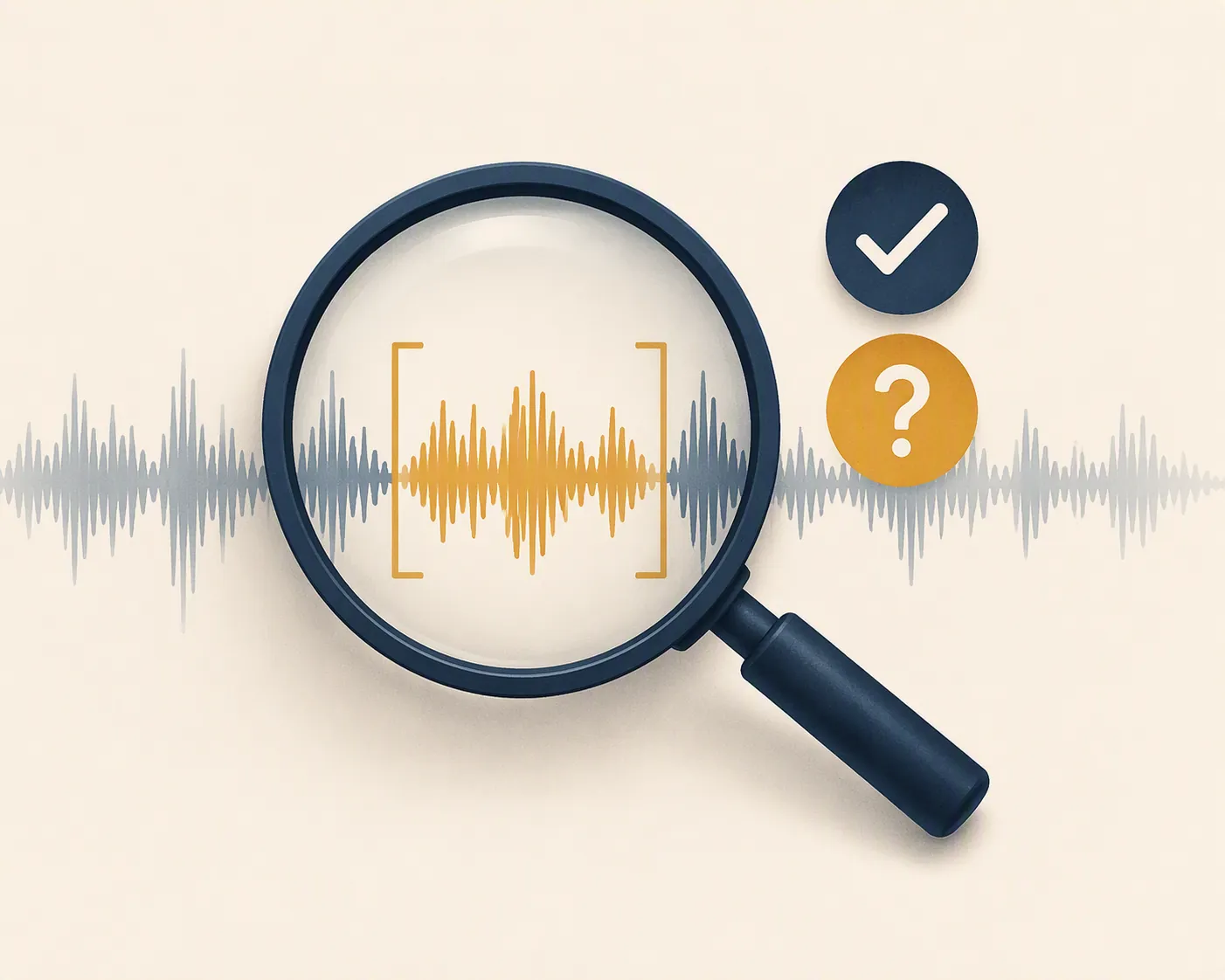
Audio verification does not stop at “is this really his voice?”
Authentication is the first audio question, not the last. A clip can be authentic and still be incomplete. It can contain the speaker’s real words and still be framed beyond what the words support. It can be useful on one allegation and irrelevant to another. That is why self-published recordings sit below sworn record materials in the working sequence.
A defensible audio check should separate at least five issues: identity of the speaker, completeness of the recording, chain of custody or source path, transcript accuracy, and the relationship between the clip and the proposition being asserted. The last issue is where many public-figure packets fail. The caption says “this proves fabrication” or “this proves abuse,” while the recording proves, at most, a narrower statement.
- Do not cite the poster’s caption as the content of the recording.
- Quote the exact words if the words matter, and say whether the quote comes from the recording, a transcript, or a party filing.
- State whether the available clip is complete or excerpted. If unknown, say unknown.
- Tie the clip to the narrow allegation it actually addresses. Do not use it to clear or prove unrelated allegations.
- Check for court orders limiting dissemination before embedding, quoting extensively, or linking to third-party social posts.
Moreno’s counsel also described a June 1, 2026 order by Judge Boros restricting third-party and social-media use, but that point should be treated as a party-source pointer unless the order is pulled from the court docket directly. The operational rule is not subtle: if the order changes what may be quoted, posted, or republished, cite the order itself, not a law-firm blog summarizing it. [6]
What the current record supports
Last verified: Aug. 4, 2026, UTC. On the materials identified here, a careful brief can say the following without taking over either side’s theory of the case.
- Documented: Moreno publicly said Miller should not serve in Congress and should seek professional help, as reported by NBC News. [2]
- Documented: Miller had not been criminally charged, joint custody continued, and Miller’s domestic-violence case against Moreno was dismissed with a finding that he was not in fear, as reported by AP. [3]
- Documented: Miller filed a defamation lawsuit against his ex-wife, as reported by Roll Call. [4]
- Reported from records: Mother Jones described multiple abuse allegations and reported that the child-abuse allegation was found unsubstantiated by Cuyahoga County DCFS. [5]
- Procedurally distinct: Mother Jones reported both objection-only and explicit “DENY” patterns in Miller’s interrogatory responses; those should not be collapsed into a single “denied everything” sentence. [5]
- Apparently admitted, but not adjudicated: Moreno’s counsel points to Miller’s self-published audio as an admission concerning the hot-water allegation; that characterization remains party advocacy unless adopted by a court. [6]
That leaves several unresolved points. As of this verification, the materials reviewed here did not identify any House Ethics announcement of an investigation of Miller; the temporary-restraining-order posture required direct docket checking before being treated as closed; and the Aug. 5, 2026 Ohio ballot-withdrawal deadline had not yet passed. Those are live-status items, not evidentiary findings.
The cleanest memo does not end with “therefore Miller is guilty” or “therefore the allegations are false.” It separates the packet into documented statuses, reported allegations, party denials and objections, an apparent audio admission, and unresolved authentication or docket questions. That is the point where the present public record stops.
References
- Statement of the Chairman and Ranking Member of the Committee on Ethics Regarding Representative Cory Mills, House Committee on Ethics, May 11, 2026
- Bernie Moreno says former son-in-law Max Miller shouldn't serve in Congress after abuse allegations, NBC News
- Abuse claims could make Ohio Rep. Max Miller vulnerable in midterms, AP News
- Rep. Max Miller files defamation lawsuit against ex-wife, Roll Call, May 14, 2026
- Assault, Misogyny, Verbal Threats: Records Detail New Allegations Against Rep. Max Miller, Mother Jones
- Reputational Self-Immolation, Chandra Law Firm
Related records
Tool profile
Browse tool evaluations →Governing regulation
Browse the obligations tracker →Preventive workflow
Browse verification workflows →
Report a correction or tip
Spotted an outdated figure, a misstated fact, or a ruling this case record should reflect? Public comments are disabled for this content given the professional cost of a misreported case outcome, penalty amount, or rule text — use the structured correction channel instead.
Report a correction or tip for this record →